
Ayodhya to Neelkanth Mahadev Temple: Distance, Train Route & Nearest Railway Station 2026
Planning an Ayodhya to Neelkanth Mahadev Temple journey in 2026 becomes much easier when you understand the distance, train route, nearest railway station, Rishikesh connection, and final hill-road journey in advance. Neelkanth Mahadev Temple is located in the Pauri Garhwal region of Uttarakhand, near Rishikesh, and is one of the well-known Lord Shiva temples visited by travellers throughout the year. This guide explains how to reach the temple from Ayodhya by train and road, which railway station is most practical, where you may need to change transport, and how to plan the final journey from Rishikesh without unnecessary confusion.
A trip from the plains of Uttar Pradesh to the hills around Rishikesh is quite different from an ordinary city-to-city journey. You cannot simply look at the total kilometres and estimate the travel time. The final section includes hill roads, and traffic conditions can change considerably during busy periods.
For that reason, this guide focuses on the complete journey rather than giving you only one distance figure. It covers railway options, Rishikesh and Haridwar connections, road routes, travel time, temple access, suitable seasons, common planning mistakes, and useful tips for families.
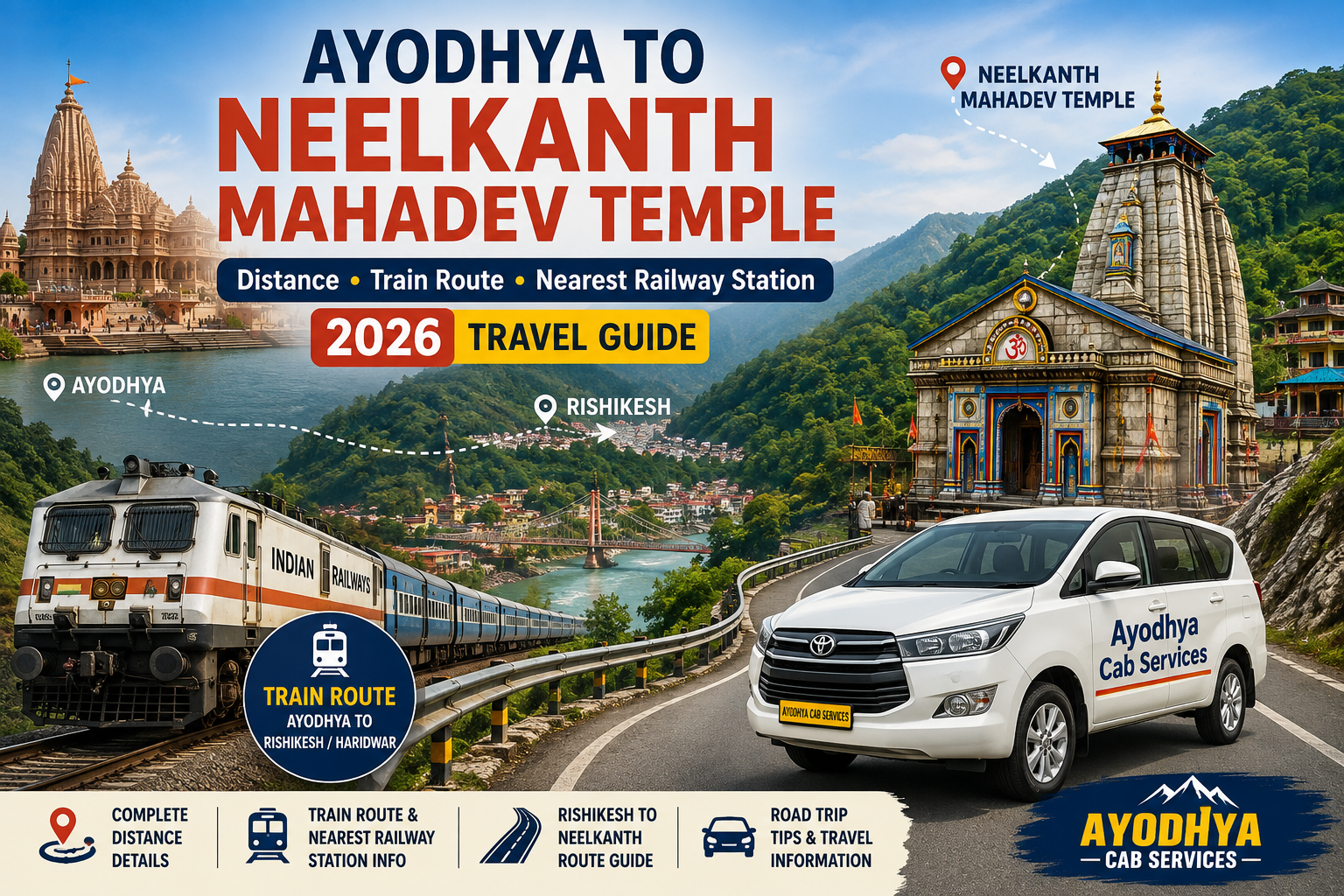
Plan your Ayodhya to Neelkanth Mahadev Temple journey with distance, train route, nearest railway station and Rishikesh travel information for 2026.
Ayodhya to Neelkanth Mahadev Temple Distance
The Ayodhya to Neelkanth Mahadev Temple distance can vary according to the road selected, traffic conditions, and whether you travel through Lucknow, Delhi-side highways, Haridwar, or another practical connection. For trip planning, it is better to consider the journey as roughly an 800–900 km road trip, rather than relying on one fixed kilometre figure.
Your navigation application may show a different distance when you actually travel. That is normal. Road diversions, starting location within Ayodhya, the selected highway, and your entry into Rishikesh can all change the final number.
More importantly, distance alone does not explain the difficulty of the trip. A large part of the journey runs through plains and highways. However, the final approach after Rishikesh is different. Roads become more winding as you move towards the temple area.
The Pauri Garhwal district administration describes Neelkanth Mahadev as about 32 km from Rishikesh via the Barrage route and around 22 km via the Ram Jhula side. Therefore, you may see different Rishikesh-to-temple distance figures while researching the journey.
This variation is one reason travellers should avoid planning the trip minute by minute. Keep additional time for local traffic, road conditions, food breaks, and the hill section.
Ayodhya to Neelkanth Mahadev Temple by Train
Travelling Ayodhya to Neelkanth Mahadev Temple by train requires understanding one important point: the train cannot take you directly to the temple.
The practical rail journey ends in the Rishikesh-Haridwar region. From there, you continue by road towards Neelkanth Mahadev.
While searching for trains, check both your departure station and the final railhead carefully. Ayodhya has more than one railway station, so selecting the wrong station name can change the available options.
Similarly, don’t search only for one direct train and stop planning if you cannot find a convenient service. A connecting rail journey may sometimes provide better timings.
Haridwar is particularly important while researching the route because it is a major railway point. Rishikesh is closer to the temple, but train availability may differ depending on your date.
Therefore, compare complete journey time rather than only train duration.
For example, a train that reaches Haridwar at a convenient morning hour can sometimes be more useful than another option that reaches closer to Rishikesh very late at night. After all, you still have to arrange the final road journey.
For a 2026 trip, check the current railway schedule for your exact date before booking. Timings, operating days, temporary services, and routes can change.
Neelkanth Mahadev Temple Nearest Railway Station
The Neelkanth Mahadev Temple nearest railway station question can be confusing because travellers often see both Rishikesh and Haridwar mentioned online.
Rishikesh is geographically the closer railhead for the temple area. Therefore, if you find a suitable train connection reaching Rishikesh, it provides a convenient starting point for the final road section.
However, Haridwar Junction is also extremely useful for long-distance travellers.
Why?
Haridwar is a major railway station with broader connectivity. Depending on your travel date, you may find a more convenient train reaching Haridwar than Rishikesh. From Haridwar, you can continue towards Rishikesh and then proceed to the temple.
So, the smartest answer is not simply “choose the nearest station.”
Instead, compare Rishikesh for proximity and Haridwar for wider train connectivity.
This can save several hours in real travel.
A traveller who reaches Rishikesh after multiple inconvenient changes may spend more time than someone who takes a convenient long-distance train to Haridwar and completes the remaining section by road.
Always compare arrival time as well. Reaching the region early in the day makes the hill journey easier to manage, especially for families and first-time visitors.
Rishikesh Railway Station to Neelkanth Mahadev Temple Distance
The Rishikesh Railway Station to Neelkanth Mahadev Temple distance depends on the route used after entering the Rishikesh area.
Official district information gives two commonly referenced figures from Rishikesh: about 32 km through the Barrage side and around 22 km through the Ram Jhula side.
Therefore, do not worry if different maps show different numbers.
Your exact starting point matters too. “Rishikesh” covers a larger area than a single landmark. Someone starting near the railway station may receive a different route than a traveller leaving from Swarg Ashram.
The final road section deserves additional time.
Hill driving is naturally slower than highway driving. Traffic can also build up during weekends, festival periods, and the monsoon pilgrimage season.
As a result, a 25–30 km hill journey should never be calculated using the same average speed as an expressway.
If you are travelling with children or elderly family members, keeping extra time is even more useful. A relaxed journey is better than trying to complete darshan and return according to an overly tight schedule.
Before leaving Rishikesh, check the current road condition and local traffic situation. This becomes particularly important during heavy rain.
Haridwar to Neelkanth Mahadev Temple Route
The Haridwar to Neelkanth Mahadev Temple route is important for travellers arriving by long-distance train.
After reaching Haridwar, the journey generally continues towards Rishikesh. From there, you proceed towards the temple through the appropriate local hill route.
Haridwar to Rishikesh is a busy travel corridor. Therefore, actual travel time can change considerably according to traffic.
This becomes especially noticeable during weekends and major pilgrimage periods. A route that looks short on a map can take much longer when thousands of additional visitors are travelling in the same direction.
If your train reaches Haridwar early in the morning, you gain a useful advantage. You can move towards Rishikesh before the busiest part of the day and then continue towards Neelkanth.
However, don’t automatically plan same-day darshan after every train arrival.
If you reach Haridwar late after a long overnight journey, staying in Haridwar or Rishikesh and starting fresh the following morning can be more comfortable.
Rishikesh is particularly convenient if Neelkanth is the main purpose of your visit because it shortens the next day’s road journey.
Ayodhya to Rishikesh Distance
Understanding the Ayodhya to Rishikesh distance helps divide the journey into two simple sections.
The first section takes you from Ayodhya to Rishikesh or Haridwar. This is the major intercity portion of the trip. The second section runs from Rishikesh towards Neelkanth Mahadev Temple.
This division makes planning easier.
Instead of thinking about an 800-plus-kilometre journey as one continuous route, consider Rishikesh your main gateway. Once you reach Rishikesh, the remaining journey becomes a local hill trip.
Road distance can vary according to the route suggested on the day of travel. Therefore, avoid building your itinerary around a single exact kilometre number months before departure.
Traffic around major cities can also change the total travel time.
If travelling entirely by road, an overnight halt can make the journey more comfortable. This is particularly relevant when only one person will be driving.
Long highway driving followed immediately by winding hill roads can be tiring.
A train-plus-road combination removes much of that driving burden. That is why rail travel to the Haridwar-Rishikesh region can be attractive for families.
Ayodhya to Rishikesh Train
Travellers searching for an Ayodhya to Rishikesh train should compare more than direct services.
Railway schedules can vary by date, and the most convenient option may involve Haridwar rather than terminating at Rishikesh itself.
Start by searching from the correct Ayodhya station. Then compare trains reaching Rishikesh, Yog Nagari Rishikesh, and Haridwar according to the current railway booking system.
Pay attention to arrival time.
Suppose one train reaches the region at 5:00 am while another reaches at 10:00 pm. Even if the second service appears slightly more convenient on paper, the early-morning arrival may work much better for your temple plan.
Operating days matter as well.
Some trains run daily, while others operate only on selected days. Temporary timetable changes can also occur.
Therefore, avoid copying train numbers from an old travel article and booking the rest of the trip around them. Search the railway schedule again when your travel date is finalized.
Also consider your return journey before booking the onward ticket.
A convenient train going towards Uttarakhand may have an inconvenient return schedule. Planning both directions together prevents you from getting stuck with an unnecessarily long waiting period.
Ayodhya to Haridwar by Train
Ayodhya to Haridwar by train can be a practical alternative when the Rishikesh connection does not match your preferred date.
Haridwar is one of Uttarakhand’s important railway gateways. Consequently, travellers from many parts of Uttar Pradesh often find it useful while planning journeys towards Rishikesh.
Once you reach Haridwar, Rishikesh becomes the next major stop by road or suitable local transport.
This route has another advantage. If your itinerary includes Haridwar sightseeing or Ganga Aarti, you can combine that visit naturally with the Neelkanth journey.
However, adding too much into one day can make the trip exhausting.
A traveller arriving after a long train journey may be tempted to cover Haridwar, Rishikesh, and Neelkanth immediately. On paper, this looks efficient. In practice, traffic and waiting time can make the day rushed.
A two- or three-day plan usually provides a more comfortable experience.
When comparing trains, look at departure time, arrival time, total duration, class availability, and your onward transport from Haridwar. These factors matter more than simply choosing the train with the shortest listed duration.
How to Reach Neelkanth Mahadev Temple from Ayodhya
Travellers researching how to reach Neelkanth Mahadev Temple from Ayodhya have three broad possibilities: rail plus road, a complete road journey, or a combination involving a flight and road travel.
For many travellers, rail plus road offers a practical balance.
You can take a suitable train towards Haridwar or Rishikesh. After reaching the region, continue by road towards the temple.
A full road trip offers more flexibility. You can choose your own departure time, stop when required, and combine several destinations. However, it also involves a long drive before the hill section begins.
Flying can reduce part of the travel time, but it is rarely as simple as flying directly to the temple. You still need to complete a substantial road section after landing.
Therefore, the “best” route depends on your priorities.
Families may prefer a comfortable train. A group with several sightseeing stops might prefer a road trip. Travellers with limited time may compare flights.
Budget also matters.
Instead of choosing a transport mode first, decide how many days you have and who is travelling. Then select the route that fits the group.
Ayodhya to Neelkanth Mahadev Temple Road Route
The Ayodhya to Neelkanth Mahadev Temple road route is suitable for travellers who enjoy long-distance driving or want a flexible itinerary.
A practical road journey moves northwest from Ayodhya through major Uttar Pradesh highway corridors before entering Uttarakhand and approaching Haridwar-Rishikesh.
The exact route shown by navigation may change.
That is not necessarily a problem. Modern navigation systems can adjust the journey according to road closures, traffic, construction, and congestion.
However, don’t follow every shortcut blindly.
A route that saves a few kilometres may take you through narrow local roads. This can be inconvenient at night or when travelling with family.
For a long journey, major highways are generally easier to manage.
The final Rishikesh-to-Neelkanth section requires more attention. Roads are narrower and more winding than the plains.
Therefore, plan fuel, food, and rest stops before beginning the hill section.
If possible, avoid arriving at the hills after an exhausting day of continuous driving. A night halt in Rishikesh can make the final journey much easier.
Ayodhya to Neelkanth Mahadev Temple Travel Time
The Ayodhya to Neelkanth Mahadev Temple travel time cannot be predicted accurately from distance alone.
By road, you need to consider highway traffic, city congestion, meal breaks, fuel stops, weather, and the final hill section. Therefore, a realistic itinerary should include a buffer.
Rail travel has different variables.
Your train duration may be predictable, but the complete journey also includes reaching the departure station, waiting time, arrival at Haridwar or Rishikesh, and onward road transport.
Festival traffic can create another major difference.
During busy Shiva pilgrimage periods, the approach towards Neelkanth can become much more crowded than on an ordinary weekday.
Monsoon weather can also influence the journey.
For this reason, don’t schedule an important return train with a very narrow gap after leaving the temple.
Allow enough time to return to the railway station without stress. An additional buffer may seem unnecessary when planning from home, but it becomes valuable when local traffic changes unexpectedly.
Rishikesh to Neelkanth Mahadev Temple Road Route
The Rishikesh to Neelkanth Mahadev Temple road route is the most important local section of the journey.
The temple is located in the hills above the Rishikesh region. Official district information notes a route of about 32 km via Barrage and another reference of about 22 km via the Ram Jhula side.
These figures explain why different travel websites may give different distances.
The road passes through a scenic hilly environment. However, drivers need to remain attentive because the route includes curves and narrower stretches.
Traffic can become heavier during popular pilgrimage periods.
If you are travelling during the rainy season, check local road conditions before departure. Hill roads can be affected by rainfall, debris, temporary restrictions, or slow-moving traffic.
Early morning travel is often easier than beginning during the busiest part of the day.
It also gives you more flexibility if the journey takes longer than expected.
For first-time visitors, treating Rishikesh as the base is simple. Stay there, start early, visit the temple, and return with enough daylight available.
Rishikesh to Neelkanth Mahadev Temple by Road
Travelling Rishikesh to Neelkanth Mahadev Temple by road is the most straightforward choice for many visitors.
Road transport allows you to reach close to the temple area without undertaking the longer traditional walking route.
The journey is relatively short in kilometres, but it should not be rushed.
Hill roads require slower driving. In addition, traffic near popular attractions can affect travel time.
Visitors travelling with parents or young children may find road travel more convenient than trekking.
However, people who experience motion sickness should prepare for winding roads. Sitting near the front, avoiding a heavy meal immediately before departure, and taking short breaks can make the journey more comfortable.
Weather should also influence your decision.
A clear morning can provide an easier drive. Heavy rainfall requires greater caution.
When returning to Rishikesh, leave enough time before dark if you are unfamiliar with the road.
The road journey is part of the overall experience, so a relaxed schedule works better than trying to complete everything as quickly as possible.
Rishikesh to Neelkanth Mahadev Temple Trek
The Rishikesh to Neelkanth Mahadev Temple trek attracts travellers who prefer reaching the temple on foot.
Official district information mentions a roughly 12 km trekkable route through forested surroundings from the Swarg Ashram side.
However, trekking should not be treated casually.
Distance on a hill trail feels very different from walking the same distance on a flat city road. Fitness, weather, footwear, daylight, and hydration all matter.
First-time visitors should understand the current route before starting.
Do not rely entirely on an old blog or video because local conditions can change. Ask locally about the active path and its condition.
Carrying water is sensible, but avoid making your bag unnecessarily heavy.
Comfortable footwear is far more important than fashionable footwear. During rain, surfaces may become slippery.
Also calculate the return.
Walking uphill to the temple is only one part of the journey. You still need to decide whether you will trek back or use available road transport for the return.
For families with elderly members, the road route is generally easier to plan.
Neelkanth Mahadev Temple Route from Ram Jhula
The Neelkanth Mahadev Temple route from Ram Jhula appears frequently in travel searches because Ram Jhula and the Swarg Ashram side are familiar reference points in Rishikesh.
Official local information places the temple around 22 km from this side, although exact road navigation can vary according to your starting point and active route.
Before beginning, check current local access.
Rishikesh traffic patterns have changed over time, and vehicle restrictions around bridge and pedestrian areas can affect where your road journey actually begins.
Therefore, treat “Ram Jhula route” as a regional reference rather than assuming your vehicle can drive from the exact bridge location in every situation.
If you are staying nearby, ask your hotel about the easiest current pickup point.
This small step can save time.
Travellers should also distinguish between the road approach and trekking references. Online articles sometimes combine the two, which makes distance information confusing.
When using navigation, enter the temple itself as the destination and compare the route with current local advice.
Neelkanth Mahadev Temple Location
The Neelkanth Mahadev Temple location is in Pauri Garhwal district of Uttarakhand, within convenient travel reach of Rishikesh.
The temple stands at an elevation of roughly 926 metres according to district information. It is surrounded by a mountainous landscape, which explains why the final approach differs considerably from the long plains journey from Uttar Pradesh.
Understanding the district is useful because many travellers casually refer to the site as “Neelkanth Temple Rishikesh.”
That description is convenient for travel planning because Rishikesh is the main gateway. However, the temple itself falls within Pauri Garhwal district.
The location also explains the route options.
Visitors generally first reach the Rishikesh region and then climb towards the temple by road or trekking route.
For navigation, save the temple location before leaving a strong network area. Mobile connectivity can vary in hilly regions.
It is also sensible to keep your hotel location saved offline if you plan to return to Rishikesh after darshan.
Simple preparation can make the local journey smoother.
Neelkanth Mahadev Temple History
The Neelkanth Mahadev Temple history is closely connected with the well-known Samudra Manthan story associated with Lord Shiva.
According to Hindu tradition, poison emerged during the churning of the ocean. Lord Shiva consumed the poison to protect creation. His throat became blue, leading to the name Neelkanth, meaning “blue-throated.”
The temple is associated with this story and attracts large numbers of devotees.
Its mountain setting adds another dimension to the visit. The journey from Rishikesh gradually moves away from the busy city environment and into forested hills.
For many visitors, understanding the story before reaching the temple makes the journey more meaningful.
However, a travel guide should also remain practical.
History may inspire the visit, but travellers still need reliable information about transport, weather, road conditions, railway connections, and accommodation.
Combining both sides creates a more useful guide.
That is why planning the route before departure is particularly important for first-time visitors travelling from distant cities such as Ayodhya.
Why Is Neelkanth Mahadev Temple Famous?
Travellers often search why is Neelkanth Mahadev Temple famous before deciding whether to include it in a Rishikesh itinerary.
The temple is widely known for its association with Lord Shiva and the Samudra Manthan story. Its location among the hills also makes the journey visually different from temples located in major city centres.
Another reason for its popularity is proximity to Rishikesh.
Visitors already staying in Rishikesh can add Neelkanth as a day excursion. This makes it accessible to travellers who may be visiting the region for several reasons.
The temple receives particularly strong interest around Mahashivratri and the Shravan period.
However, increased popularity also means increased crowds.
If you prefer a calmer journey, ordinary weekdays outside the busiest festival periods may provide a more manageable experience.
Those who specifically want the festival atmosphere should plan accommodation and transport well in advance.
The best experience depends on what you want from the trip.
Best Time to Visit Neelkanth Mahadev Temple
The best time to visit Neelkanth Mahadev Temple depends on whether you prioritize weather, crowd levels, or major religious occasions.
Spring and the cooler post-monsoon months can be comfortable for many travellers. The hill environment is pleasant, and road journeys can be easier when weather conditions remain stable.
Summer can also be suitable, although daytime temperatures in the lower areas may feel warmer.
The monsoon requires more caution.
Uttarakhand’s hills receive substantial rain, and road conditions can change. Shravan also attracts many devotees, so rainfall and crowd levels may occur together.
Winter travel can be enjoyable during clear weather, but mornings and evenings are cooler.
Before finalizing the trip, check the forecast for Rishikesh and the surrounding hill area rather than relying only on Ayodhya’s weather.
Conditions can be very different at the destination.
If you have flexibility, a weekday trip often provides an easier experience than a busy weekend.
Neelkanth Mahadev Temple During Sawan
Visiting Neelkanth Mahadev Temple during Sawan offers a very different experience from an ordinary-season trip.
The period has strong significance for Lord Shiva devotees. As a result, the number of visitors can increase dramatically.
This affects almost every part of the journey.
Roads may be busier. Travel times can increase. Accommodation around Rishikesh can fill faster. Local traffic arrangements may also change to manage pilgrim movement.
Therefore, travellers coming from Ayodhya should build a larger time buffer.
Avoid booking a return train that leaves only a short time after your expected arrival back in Rishikesh or Haridwar.
If travelling by road, check local traffic arrangements before entering the region.
The atmosphere can be energetic and memorable, but it requires patience.
Families travelling with elderly people should consider whether they are comfortable with heavy crowds. If the main goal is relaxed darshan, another period may be easier.
Neelkanth Mahadev Temple During Mahashivratri
Neelkanth Mahadev Temple during Mahashivratri attracts strong visitor interest because the temple is dedicated to Lord Shiva.
Travellers planning specifically for this occasion should think about the entire trip differently.
Accommodation should be arranged earlier. Transport should have more flexibility. Darshan can take longer, and traffic near the temple may be heavier.
Starting early can help, although it does not guarantee a crowd-free visit.
Keep food and water planning practical. At the same time, avoid carrying unnecessary luggage into crowded areas.
If you arrive in Uttarakhand the same day after a long train journey, consider whether your family will have enough energy to continue immediately.
Sometimes an overnight stay in Rishikesh creates a much better experience.
Festival travel is not only about reaching the destination. Crowd management, waiting time, and return transport matter equally.
Neelkanth Mahadev Temple Weather
Checking Neelkanth Mahadev Temple weather is important because conditions in Ayodhya cannot be used to predict conditions in the Uttarakhand hills.
The Rishikesh area can be warm during parts of the year, while the higher approach may feel different.
Rain deserves particular attention.
A light shower in the plains may be a minor inconvenience. On a hill road, sustained rainfall can affect visibility, traffic speed, and road conditions.
Therefore, check the forecast close to your departure date.
Clothing should match the season. During cooler months, carry a light or warm layer depending on the forecast. In monsoon conditions, rain protection and footwear with a reliable grip become useful.
Do not overpack.
A day visit from Rishikesh requires only the essentials. Keeping luggage light makes movement easier, particularly if you intend to walk around the temple area.
Weather planning takes only a few minutes but can improve the entire trip.
Neelkanth Mahadev Temple Road Conditions
Searching Neelkanth Mahadev Temple road conditions shortly before departure is especially useful during monsoon or periods of heavy traffic.
Hill roads can change faster than major highways.
Rainfall, maintenance, landslide debris, local restrictions, or temporary congestion can influence travel time.
This is why a travel article written months earlier should never replace a same-day local road check.
Your hotel in Rishikesh can often provide useful current information. Local transport operators may also know which approach is moving smoothly.
If authorities introduce temporary traffic arrangements, follow them even when your navigation application suggests another route.
Do not attempt unknown shortcuts simply to save a few minutes.
The safest route may not always be the shortest one.
Drivers unfamiliar with hill roads should avoid unnecessary speed. Use appropriate gears on slopes and maintain distance from the vehicle ahead.
Good planning matters, but careful driving matters more.
Is Neelkanth Mahadev Temple Road Safe for Family?
The question is Neelkanth Mahadev Temple road safe for family is common among first-time visitors.
The temple is regularly visited by families, and there is a motorable approach. However, it remains a hill road, so travellers should prepare accordingly.
A driver comfortable with hill conditions is preferable.
People prone to motion sickness may find winding sections uncomfortable. Carrying their usual travel essentials can help.
Children should remain seated properly during the hill journey. Elderly travellers may appreciate a short break before beginning the climb from Rishikesh.
Weather can change the situation.
A route that feels straightforward on a clear day may require additional caution during heavy rain.
Therefore, safety should be assessed according to current conditions rather than a simple yes-or-no answer.
Start with enough daylight, avoid rushing, and check the local situation before leaving.
These basic decisions can make a family trip far more comfortable.
Neelkanth Mahadev Temple Trip with Parents
A Neelkanth Mahadev Temple trip with parents should be planned around comfort rather than covering the maximum number of attractions.
The long journey from Ayodhya itself can be tiring.
If travelling by train, reaching Haridwar or Rishikesh and resting before the temple visit may be sensible. This avoids combining an overnight railway journey with immediate hill travel.
Choose accommodation with easy vehicle access.
Some parts of Rishikesh have narrow roads or pedestrian-heavy areas. A beautiful hotel is not always the most convenient choice for elderly travellers if vehicles cannot reach it easily.
During the temple visit, keep walking requirements in mind.
Crowd levels can also affect comfort, so ordinary weekdays may work better than peak festival periods.
Carry regular personal essentials and sufficient water. However, keep luggage minimal.
Most importantly, avoid an itinerary that treats Haridwar, Rishikesh, Neelkanth, rafting points, and several other attractions as one-day targets.
A slower trip is often much more enjoyable.
Neelkanth Mahadev Temple One Day Trip from Rishikesh
A Neelkanth Mahadev Temple one day trip from Rishikesh is practical for many travellers because the temple is close enough for a dedicated excursion.
Start early.
Morning departure gives you more flexibility for traffic, darshan, breaks, and the return journey.
After visiting the temple, you can return to Rishikesh and spend the evening around the city if energy and time permit.
However, avoid packing too many distant activities into the same day.
The kilometre count may look small, but hill-road travel and temple crowds can consume more time than expected.
If you are visiting during Sawan or Mahashivratri, consider keeping the entire day for Neelkanth.
During quieter periods, the schedule can be more flexible.
Staying in Rishikesh for at least two nights can work well. The first day can cover arrival and local sightseeing. The second can focus on Neelkanth. You can then continue or return the following day.
This reduces unnecessary rushing.
Ayodhya to Neelkanth Mahadev Temple 2 Day Trip
An Ayodhya to Neelkanth Mahadev Temple 2 day trip is possible in some travel combinations, but it can feel rushed because Ayodhya is far from Uttarakhand.
Train timings become critical.
If you can travel overnight and arrive early in the Haridwar-Rishikesh region, you may use the first day for the temple and return according to a suitable overnight schedule.
However, this leaves little room for delays.
A two-day plan is better suited to travellers who are comfortable with long journeys and have a very specific itinerary.
Families may prefer three days.
The extra day provides space for Rishikesh, rest, traffic delays, and a more relaxed temple visit.
If you still choose two days, avoid adding too many sightseeing stops.
Make Neelkanth the primary destination. Anything else should be optional.
Short itineraries succeed when priorities are clear.
Ayodhya to Neelkanth Mahadev Temple 3 Day Itinerary
An Ayodhya to Neelkanth Mahadev Temple 3 day itinerary provides a better balance for many travellers.
Use the first phase for the journey from Ayodhya towards Haridwar or Rishikesh. Depending on train timing, you can spend the remaining evening resting or exploring a nearby area.
Keep the next morning for Neelkanth.
Leave early from Rishikesh, complete darshan without rushing, and return later in the day.
The final day can include a limited amount of local sightseeing before beginning the return journey.
This schedule has one major advantage: buffer time.
If the train is delayed or road traffic becomes heavier than expected, your entire trip does not immediately collapse.
Families benefit particularly from this flexibility.
You can also choose accommodation in Rishikesh for two nights instead of changing hotels repeatedly.
A good itinerary is not the one containing the most places. It is the one that lets you enjoy the places you actually came to see.
Places to Visit Near Neelkanth Mahadev Temple
Travellers searching places to visit near Neelkanth Mahadev Temple often plan to combine the journey with Rishikesh.
Rishikesh itself offers enough attractions for an additional day.
The Ram Jhula and Swarg Ashram area, Triveni Ghat, riverfront surroundings, and other local spots can fit naturally into the itinerary.
However, distance and traffic should guide your choices.
Do not assume every attraction around Rishikesh can be covered immediately after returning from Neelkanth.
If you arrive back late, a relaxed evening may be better.
Haridwar can also be combined with the journey because many long-distance trains use Haridwar Junction.
This creates a practical travel loop: arrive through Haridwar, stay around Rishikesh, visit Neelkanth, and cover selected Haridwar attractions according to your return schedule.
The route works best when sightseeing follows the transport plan rather than fighting against it.
Rishikesh and Neelkanth Mahadev Temple Itinerary
A Rishikesh and Neelkanth Mahadev Temple itinerary is ideal for travellers who want more than a quick temple visit.
Keep Rishikesh as the base.
On arrival day, explore only nearby places and rest after the long journey. The following morning, leave for Neelkanth.
After returning, spend the evening around the riverfront.
If another full day is available, use it for the Rishikesh experiences that match your interests.
Adventure activities should be planned separately from the temple visit when possible.
Rafting, for example, requires time and energy. Combining it with a long hill-road journey and darshan may make the day unnecessarily hectic.
A balanced itinerary gives each experience enough space.
This is particularly useful for travellers arriving from Ayodhya because the intercity journey itself is substantial.
Haridwar Rishikesh Neelkanth Mahadev Temple Trip
A Haridwar Rishikesh Neelkanth Mahadev Temple trip is one of the most logical combinations for travellers coming from Uttar Pradesh.
Haridwar can serve as the railway gateway. Rishikesh can serve as the accommodation and local travel base. Neelkanth becomes the hill excursion.
This sequence reduces unnecessary backtracking.
For example, arrive at Haridwar, continue to Rishikesh, and check into your hotel. Visit Neelkanth the following morning. Then explore selected parts of Rishikesh.
Haridwar can be covered either at the beginning or before your return train, depending on timings.
Avoid shifting hotels every night unless necessary.
Staying in one base reduces packing, check-in delays, and transport coordination.
The combination works particularly well for a three-day trip.
During busy pilgrimage periods, add more flexibility because traffic between Haridwar and Rishikesh can increase considerably.
Where to Stay for Neelkanth Mahadev Temple Trip
Travellers wondering where to stay for Neelkanth Mahadev Temple trip will usually find Rishikesh the most practical base.
Rishikesh offers a much wider choice of accommodation than the immediate temple area.
You can choose according to budget, parking, family requirements, river proximity, or road access.
For a temple-focused trip, vehicle accessibility should be high on the priority list.
A hotel deep inside a pedestrian area may be attractive, but early-morning pickup can become inconvenient.
If travelling with your own car, confirm parking before booking.
Do not assume every Rishikesh hotel has dedicated parking.
Families may prefer quieter accommodation slightly away from the busiest tourist lanes.
Solo travellers may prioritize location and walking access.
The best hotel therefore depends on your itinerary rather than only online ratings.
Budget for Ayodhya to Neelkanth Mahadev Temple Trip
The budget for Ayodhya to Neelkanth Mahadev Temple trip depends mainly on transport, accommodation, food, and local travel.
Train travel can keep the intercity cost relatively controlled. However, fare changes according to class and booking availability.
Accommodation in Rishikesh varies widely.
Budget rooms can be affordable during ordinary periods, while prices may increase during weekends, festivals, and high-demand travel dates.
Local road transport is another expense.
The amount depends on whether you use shared transport, hire a vehicle privately, or travel in your own car.
Food can remain flexible because Rishikesh has options across different budgets.
Instead of calculating an unrealistically low total, keep a contingency amount.
Unexpected transport changes, train waiting time, parking, or an extra night can increase expenses.
A slightly larger budget with unused money is better than a trip planned with no financial buffer.
Cheapest Way to Reach Neelkanth Mahadev Temple from Ayodhya
The cheapest way to reach Neelkanth Mahadev Temple from Ayodhya will usually involve economical rail travel combined with affordable onward transport.
However, the absolute cheapest option is not always the most practical.
A route involving several changes may save a small amount but consume many extra hours.
Therefore, compare total cost against total journey time.
Sleeper-class rail travel can reduce intercity expenses. After reaching Haridwar or Rishikesh, shared local transport may further lower the cost.
Budget accommodation can keep the overall trip affordable.
Travelling with a group changes the calculation.
When several people share road-transport costs, a private vehicle for the local section may become reasonably priced per person.
Food and accommodation can also be managed according to budget.
The best low-cost plan is one that saves money without creating unnecessary travel complications.
Neelkanth Mahadev Temple Travel Tips 2026
These Neelkanth Mahadev Temple travel tips 2026 are most useful when applied before leaving home.
Confirm train timings close to the journey date. Check weather before entering Uttarakhand. Review local road conditions if rain is expected.
Keep your itinerary flexible.
An extra hour in the schedule can prevent a lot of stress.
If travelling by road, avoid beginning the hill section when the driver is already exhausted. For railway travellers, note the exact station where you will arrive and arrange the next stage accordingly.
Mobile connectivity can vary, so save important information in advance.
During busy periods, carry patience along with your luggage. Crowds and traffic are part of the experience.
Most importantly, do not attempt to cover every nearby destination simply because it appears on a map.
A comfortable journey usually creates better memories than a rushed checklist.
Common Mistakes While Planning Neelkanth Mahadev Temple Trip
Several common mistakes while planning Neelkanth Mahadev Temple trip can make an otherwise simple journey difficult.
One mistake is treating Rishikesh-to-temple distance like ordinary city driving. Hill roads take longer.
Another is booking a return train with almost no buffer.
Heavy traffic can quickly make such a schedule risky.
Travellers also sometimes book accommodation without checking parking or vehicle access. This becomes inconvenient when carrying luggage or travelling with elderly family members.
Ignoring weather is another problem, especially during monsoon.
Some visitors also rely on old train timetables. Railway schedules can change, so always verify your specific date.
Finally, avoid planning too many places in one day.
Haridwar, Rishikesh, Neelkanth, rafting, and distant sightseeing may look close when listed together. In reality, each requires time.
Good planning removes unnecessary pressure from the journey.
Is Neelkanth Mahadev Temple Worth Visiting from Ayodhya?
For travellers wondering is Neelkanth Mahadev Temple worth visiting from Ayodhya, the answer depends on the kind of trip you want.
If you are interested in Lord Shiva temples, mountain scenery, and a Rishikesh-based Uttarakhand journey, Neelkanth can fit very naturally into the itinerary.
The distance from Ayodhya means it is not a casual one-day outing.
Therefore, the trip becomes more worthwhile when combined with a comfortable stay in Rishikesh or Haridwar.
The hill approach also gives the journey a character different from many temple visits in the plains.
However, don’t travel simply because a destination is trending online.
Consider the season, your available days, the people travelling with you, and the total budget.
When those factors fit, the journey can become an enjoyable Uttarakhand travel experience.
Final Travel Plan for Ayodhya to Neelkanth Mahadev Temple
An Ayodhya to Neelkanth Mahadev Temple trip is easiest when you treat Rishikesh as the gateway rather than trying to plan the entire journey as one continuous route. Compare trains for Rishikesh and Haridwar, choose the option with the most convenient arrival time, and keep enough space for the final hill-road journey. If travelling by car, consider rest before beginning the winding section beyond Rishikesh.
A three-day plan works comfortably for many visitors because it provides time for the journey, temple visit, Rishikesh, and unexpected delays. Two days can work with favourable transport timings, but the schedule becomes much tighter.
Before departure, verify your train, weather, and local road conditions. During Sawan, Mahashivratri, weekends, or heavy rain, keep an even larger time buffer.
Most importantly, don’t judge the trip only by kilometres. The journey combines a long intercity route with a relatively short but slower hill section. Once that difference is understood, planning becomes much simpler.
Neelkanth Mahadev Temple Darshan Timings 2026
Knowing the Neelkanth Mahadev Temple darshan timings 2026 can help you organize the Rishikesh portion of your journey more comfortably. Temple schedules can vary with season, festivals, crowd management, and local arrangements. Therefore, travellers should confirm the current opening and closing time shortly before their visit rather than depending entirely on an old timetable.
For most visitors coming from outside Uttarakhand, an early start from Rishikesh is practical. Morning travel gives you more daylight for the hill road. Moreover, it provides additional time if traffic near the temple becomes slow.
During busy periods, reaching the area early can be especially useful. Sawan, Mahashivratri, long weekends, and holidays can attract larger crowds. Consequently, waiting time may increase even when the actual road distance from Rishikesh appears short.
Do not plan your return train based only on an estimated darshan duration. You also need time to descend from the hills and travel towards Rishikesh or Haridwar.
Families should keep the schedule flexible. If elderly people or young children are travelling, a relaxed morning departure is usually better than trying to complete the visit according to a strict hourly plan.
Most importantly, verify the current temple schedule locally before starting. A little flexibility can prevent an otherwise enjoyable journey from becoming unnecessarily rushed.
Neelkanth Mahadev Temple Opening Time and Closing Time
Travellers frequently search for Neelkanth Mahadev Temple opening time and closing time because they want to complete the trip from Rishikesh within one day.
Instead of treating one online timing as permanent, plan around daylight and verify the current schedule when you arrive in Rishikesh. Temple arrangements can be adjusted during special occasions and periods of unusually heavy visitor movement.
Morning visits have several practical advantages.
The temperature can feel more comfortable during suitable seasons. Road traffic may also be easier than later in the day. In addition, starting early leaves enough time for unexpected delays.
Late departures require more care.
Suppose you leave Rishikesh after lunch and encounter slow-moving traffic. Your arrival may become much later than expected. You will then have less flexibility for darshan and the return journey.
Therefore, first-time visitors should generally keep Neelkanth as the main activity for that part of the day.
If you also want to explore Rishikesh, do it after returning or keep a separate day.
The distance may appear short, but the hill-road environment means that a simple kilometre calculation cannot predict your complete schedule.
Neelkanth Mahadev Temple Darshan Time During Sawan
Neelkanth Mahadev Temple darshan time during Sawan becomes particularly important because this is one of the busiest periods for Lord Shiva devotees.
During this season, normal journey estimates may not apply.
A road section that usually feels manageable can take considerably longer because of increased visitor movement. Local traffic management may also influence vehicle access and route choices.
Therefore, avoid planning Sawan travel with a narrow schedule.
If possible, stay in Rishikesh the previous night and begin early the following morning. This removes the pressure of arriving from a long-distance train and immediately continuing towards the hills.
Crowds can also increase waiting time around the temple.
Carry only what you genuinely need. Heavy luggage makes movement more difficult in crowded areas.
Weather creates another consideration. Sawan falls during the monsoon period, so rainfall may affect hill-road conditions.
Check the forecast and local route status before leaving Rishikesh.
The combination of religious importance, crowds, and monsoon weather makes this a memorable period to visit, but it also requires much more flexibility than an ordinary weekday journey.
Best Route to Neelkanth Mahadev Temple from Ayodhya
Finding the best route to Neelkanth Mahadev Temple from Ayodhya depends on whether you prioritize comfort, travel time, flexibility, or budget.
For many travellers, reaching the Haridwar-Rishikesh region by train and completing the final journey by road is a sensible combination. It reduces the amount of long-distance driving while still providing convenient access to the temple.
A complete road journey gives greater freedom.
You can stop according to your own schedule and combine several destinations. However, the driver needs to handle a long plains journey before entering the hill section.
Therefore, road travel works particularly well when two experienced drivers can share the journey.
Train passengers should compare both Haridwar and Rishikesh connections. Do not automatically reject Haridwar simply because it is farther from the temple.
A convenient train arriving in Haridwar at the right time may create a smoother overall journey than an inconvenient connection reaching closer to Rishikesh.
The best route is therefore the one that minimizes unnecessary waiting and difficult transfers.
Think in terms of complete door-to-door travel time rather than only kilometres.
Ayodhya to Neelkanth Mahadev Temple via Lucknow
The Ayodhya to Neelkanth Mahadev Temple via Lucknow route can be relevant for travellers considering a complete road journey or searching for broader transport connections.
Lucknow is a major transport centre. Therefore, it can provide additional rail, road, and air options when a convenient connection is not available directly from Ayodhya.
However, going through Lucknow is not automatically necessary for every traveller.
If a suitable train from Ayodhya or Ayodhya Cantt fits your schedule, adding an unnecessary connection can increase travel time.
The same logic applies to road travel.
Navigation should be checked close to departure because highway conditions and recommended routes can change. A route through major highway corridors may be more comfortable even if another option appears slightly shorter.
If you are travelling with family, prioritize road quality and sensible rest stops.
Long-distance journeys become much easier when breaks are planned before the driver becomes tired.
Once you approach Haridwar and Rishikesh, traffic patterns can change significantly. Therefore, avoid assuming that the final 50 or 100 kilometres will take the same time as an equivalent distance on an expressway.
Ayodhya to Neelkanth Mahadev Temple via Haridwar
Travelling Ayodhya to Neelkanth Mahadev Temple via Haridwar is one of the most practical approaches for people using the railway network.
Haridwar acts as a major transport gateway for the region. After arriving there, travellers can move towards Rishikesh and then continue to Neelkanth.
This approach becomes particularly useful when a suitable long-distance train to Haridwar matches your date better than options reaching Rishikesh.
Arrival time should guide the next step.
If you reach Haridwar in the morning, continuing towards Rishikesh on the same day is straightforward. Depending on your energy and traffic, you can decide whether to visit Neelkanth immediately or stay overnight.
A late-evening arrival is different.
After a long railway journey, continuing onto hill roads simply to save one hotel night may not be worthwhile. Staying in Haridwar or Rishikesh and starting fresh the next morning can make the journey far more comfortable.
This route also allows travellers to include Haridwar in their itinerary without making a major detour.
Ayodhya to Neelkanth Mahadev Temple via Rishikesh
The Ayodhya to Neelkanth Mahadev Temple via Rishikesh approach is the easiest way to understand the complete journey.
Think of Rishikesh as the main base.
First, travel from Ayodhya towards the Haridwar-Rishikesh region. Once you reach Rishikesh, stay overnight if your schedule allows. Then start the temple journey early the following day.
This structure removes a lot of confusion.
You no longer need to think of the entire distance as one continuous trip. Instead, the long intercity journey and short hill journey become two separate stages.
Rishikesh also provides accommodation across different budgets.
Moreover, staying there gives you flexibility if weather or traffic changes your temple plan.
After darshan, return to the same hotel rather than immediately rushing towards a distant railway station.
If you have another day available, Rishikesh can then be explored at a relaxed pace.
For families, this is often more comfortable than changing accommodation repeatedly.
Ayodhya Cantt to Rishikesh Train Route
Travellers researching the Ayodhya Cantt to Rishikesh train route should pay close attention to station names.
Ayodhya Cantt and Ayodhya Dham Junction are separate railway stations. A train available from one may not necessarily stop at the other.
This is a simple detail, but it can create major booking confusion.
When searching for your journey, enter the exact station from which you are prepared to depart. Then compare connections towards Haridwar, Rishikesh, and Yog Nagari Rishikesh.
Do not select a train only because its destination appears closest to the temple.
Arrival time, waiting time, number of changes, and onward road availability matter just as much.
For example, a comfortable train reaching Haridwar early may be more practical than a complicated route involving several connections before reaching Rishikesh.
Also check the return journey before paying for the onward ticket.
Train availability can be very different in the opposite direction. Planning both sides together helps create a more balanced itinerary.
For travel in 2026, always verify the current timetable for your actual date.
Ayodhya Dham to Rishikesh Train
People searching for an Ayodhya Dham to Rishikesh train should first confirm whether they specifically want to depart from Ayodhya Dham Junction or are also comfortable using Ayodhya Cantt.
Being flexible with the departure station can sometimes provide more options.
The same principle applies at the Uttarakhand end.
Search Rishikesh-related stations as well as Haridwar Junction. Then compare the complete journey.
Rail planning becomes easier when you stop focusing only on a direct train.
A connecting journey can be perfectly reasonable if the waiting time is short and the transfer station is convenient.
However, too many changes create unnecessary difficulty for families carrying luggage.
Therefore, prioritize simplicity.
An overnight train can be particularly useful because it saves daytime travel hours and may reduce accommodation requirements.
Still, comfort matters. Choose a travel class appropriate for the length of the journey and your group.
Before departure, confirm the station printed on the ticket. Ayodhya’s station names can easily confuse first-time travellers.
Haridwar Railway Station to Neelkanth Mahadev Temple Distance
The Haridwar Railway Station to Neelkanth Mahadev Temple distance is longer than the journey from Rishikesh because Haridwar lies farther away from the hill destination.
The usual travel pattern is simple: Haridwar to Rishikesh, followed by Rishikesh to Neelkanth.
Actual distance depends on the local route.
Traffic is the bigger issue.
Haridwar and Rishikesh can both experience heavy vehicle movement during weekends, summer holidays, religious events, and major pilgrimage periods.
Therefore, don’t calculate the journey using only the map distance.
If you have a return train from Haridwar, keep a substantial buffer while descending from Neelkanth.
A delay in the hills can be followed by another delay between Rishikesh and Haridwar.
This double uncertainty is important.
Travellers sometimes underestimate it because the cities appear close on a map.
If your return train leaves early in the morning, staying in Haridwar on the final night may reduce stress. Conversely, if Neelkanth is your main activity, Rishikesh is generally the more convenient base before the temple visit.
Yog Nagari Rishikesh to Neelkanth Mahadev Temple
Yog Nagari Rishikesh to Neelkanth Mahadev Temple is another useful search because modern train results may show Yog Nagari Rishikesh rather than the older Rishikesh station.
This station can serve as a practical railway gateway for visitors whose trains terminate or stop there.
After arrival, the journey continues by road.
Your exact road distance will depend on the route used to cross or move through the Rishikesh area before climbing towards Neelkanth.
Therefore, don’t confuse the railway station with the temple destination.
You still need local transport after leaving the train.
If arriving with family, decide in advance whether you want to go directly towards your hotel or continue to the temple.
A hotel stop is usually sensible when carrying substantial luggage.
Travelling into the hills with suitcases that you do not need for darshan only creates inconvenience.
Check the train’s arrival time as well.
An early arrival can support same-day temple travel. A late arrival may make an overnight stay the better choice.
Neelkanth Mahadev Temple Nearest Airport
The Neelkanth Mahadev Temple nearest airport is useful for travellers comparing rail and air travel.
The main airport serving the Rishikesh-Dehradun region is Jolly Grant Airport near Dehradun. From the airport, the journey continues by road.
Flying does not eliminate the hill journey.
You still need to travel towards Rishikesh and then continue to the temple.
Therefore, calculate the complete door-to-door time before assuming a flight is much faster than a train.
Airport reporting time, baggage collection, road transfer, and flight connections all add to the journey.
From Ayodhya, flight options may also involve connections depending on the schedule available on your travel date.
Air travel becomes more attractive when the timings are convenient and your trip is short.
For families, a comfortable overnight train may sometimes be easier than changing flights and vehicles.
Compare both options based on your actual date rather than choosing purely by distance.
Ayodhya to Neelkanth Mahadev Temple by Flight
Travelling Ayodhya to Neelkanth Mahadev Temple by flight involves multiple stages because there is no airport at the temple.
The practical air journey would take you towards the Dehradun-Rishikesh region, followed by road travel.
Before booking, compare the complete cost.
Flight fares can vary significantly. You also need to add transport to the departure airport, transfer from the destination airport, and the final journey towards Neelkanth.
Timing is equally important.
A flight with a long connection may provide little advantage over an overnight train.
However, a convenient air itinerary can save time for travellers with only a few days available.
After landing, consider whether you want to travel directly to Rishikesh or stay elsewhere.
Rishikesh remains the most convenient base for a temple-focused trip.
Once again, the final hill section must be completed by road, regardless of how you travel from Ayodhya to Uttarakhand.
Train vs Road for Ayodhya to Neelkanth Mahadev Temple
Comparing train vs road for Ayodhya to Neelkanth Mahadev Temple depends mainly on group size, comfort, flexibility, and available time.
Train travel reduces long-distance driving fatigue.
You can rest during the overnight journey and begin the Uttarakhand section with more energy. This can be particularly useful for families.
Road travel offers freedom.
You can leave at your preferred time, carry more luggage, stop wherever needed, and combine destinations without depending on railway schedules.
However, someone still needs to drive.
After several hundred kilometres on highways, the driver must then handle the winding route beyond Rishikesh. That can become tiring.
For a group with two experienced drivers, the road option becomes more attractive.
Solo travellers and couples may find train travel simpler.
Cost can also change the decision. Railway tickets may be economical for a small group, while shared fuel and vehicle expenses can become competitive when several people travel together.
There is no single winner. Choose according to the people travelling, not just the route.
Train vs Flight for Neelkanth Mahadev Temple Trip
The train vs flight for Neelkanth Mahadev Temple trip comparison is more complicated than simply comparing journey hours.
An overnight train can use sleeping hours effectively. You board in the evening, rest during the journey, and arrive closer to your destination the following day.
Flights appear faster, but airport procedures add time.
You need to reach the airport early, complete security, wait for departure, collect baggage, and then arrange road transport after landing.
Connecting flights can further reduce the time advantage.
Cost is another major difference.
Train fares are generally easier to manage for budget travellers, while flights can become expensive for an entire family.
However, travellers with limited leave may value every saved hour.
In that case, a well-timed flight can be worthwhile.
The smartest approach is to compare actual available options for your dates. Don’t assume one mode is always better.
Your hotel check-in time and temple plan should also be considered before booking.
Neelkanth Mahadev Temple Parking
Neelkanth Mahadev Temple parking is an important consideration for travellers using their own car or a private vehicle.
Parking arrangements and traffic controls can vary according to visitor volume.
During ordinary periods, vehicle management may be relatively straightforward. However, busy weekends and major pilgrimage occasions can create much more pressure near the temple area.
Therefore, follow current local parking directions.
Do not stop on a narrow hill road simply because a space appears available.
Poorly parked vehicles can block traffic and create safety problems.
During extremely busy periods, authorities may regulate how close private vehicles can approach.
For that reason, travellers should be prepared for some walking even when arriving by road.
Keep valuables with you and avoid leaving important documents visible inside the vehicle.
If you are travelling from Rishikesh with a local driver, discuss the pickup point before separating.
Mobile signals may not always behave exactly as expected, so having a clearly agreed meeting location can prevent confusion after darshan.
Food Options Near Neelkanth Mahadev Temple
Understanding food options near Neelkanth Mahadev Temple can help families plan a more comfortable day trip.
The temple route and surrounding visitor areas generally have basic food and refreshment options, especially during periods of regular tourist movement.
However, don’t depend on finding a specific restaurant at a specific time.
Eat a sensible meal before beginning the hill journey.
A very heavy meal may be uncomfortable for people prone to motion sickness, so keep breakfast balanced.
Carry drinking water for the journey.
Small snacks can also be useful for children or elderly travellers.
At the same time, avoid carrying excessive food that becomes additional luggage.
Rishikesh provides a much broader range of dining choices. Therefore, many travellers prefer having their main meal there before or after the temple excursion.
During festival periods, food outlets may be busier.
Keep some flexibility rather than planning the day around one restaurant.
What to Carry for Neelkanth Mahadev Temple
Knowing what to carry for Neelkanth Mahadev Temple can make the trip easier, particularly for first-time visitors.
Keep your luggage light.
Carry water, essential identification, payment options, necessary personal items, and clothing suitable for the season.
Comfortable footwear is important.
Even when travelling by vehicle, you may need to walk around parking areas and the temple surroundings.
During monsoon, rain protection becomes useful. In cooler months, carry an appropriate layer based on the weather forecast.
If travelling with elderly family members, bring their usual travel necessities.
However, avoid carrying unnecessary valuables.
Save important booking information on your phone and keep an offline copy where practical.
A power bank can also be useful during a long day.
Preparation should make the journey simpler, not turn your day bag into heavy luggage.
Neelkanth Mahadev Temple with Kids
Planning Neelkanth Mahadev Temple with kids requires a little extra time but can be manageable for families.
Children may become uncomfortable during a long road journey, especially on winding sections.
Therefore, keep breaks available and avoid rushing.
If a child is prone to motion sickness, prepare before starting from Rishikesh.
Carry water and simple snacks.
However, avoid giving children a very heavy meal immediately before the hill drive.
Crowds require additional attention.
During busy periods, keep younger children close and decide on a meeting point for older family members in case the group becomes separated.
A weekday visit outside major festivals can provide an easier experience.
The complete journey from Ayodhya is long, so a rest night in Rishikesh is especially useful for families with small children.
Trying to move directly from a long overnight journey into several hours of sightseeing can make everyone tired.
Neelkanth Mahadev Temple for Senior Citizens
A Neelkanth Mahadev Temple for senior citizens itinerary should prioritize road access, rest, and manageable crowd levels.
The availability of a motorable approach makes the destination more practical than a temple requiring a long mandatory trek.
However, individual mobility still matters.
Check how much walking will be required from the active parking or drop-off arrangement on your travel date.
Festival crowds can make movement slower.
Therefore, senior travellers may find an ordinary weekday more comfortable than peak Sawan or Mahashivratri periods.
Rishikesh works well as a base because it allows travellers to rest before and after the hill journey.
Avoid booking a hotel that requires difficult walking access if mobility is limited.
Similarly, don’t combine too many attractions on the same day.
One comfortable temple visit is better than five rushed stops.
Neelkanth Mahadev Temple Solo Trip
A Neelkanth Mahadev Temple solo trip can be straightforward when the traveller plans transport and return timing in advance.
Rishikesh is a convenient base for solo visitors because it has extensive tourist infrastructure.
The main planning question is how you will reach the temple and return.
Check available local transport before leaving. If using shared transport, understand where the return pickup normally happens.
Do not depend on finding a vehicle at the last minute late in the day.
Starting early provides more options.
Solo travellers should also keep family or friends informed about their basic itinerary, especially if choosing the trekking route.
Carry a charged phone and avoid taking unknown shortcuts through forested hill areas.
The destination is popular, but ordinary travel precautions still matter.
A simple plan with clear transport arrangements makes the solo journey much easier.
Neelkanth Mahadev Temple Weekend Trip
A Neelkanth Mahadev Temple weekend trip may sound ideal for people working Monday to Friday, but weekends can also bring heavier traffic to Rishikesh.
This means a Saturday or Sunday itinerary needs additional buffer time.
If possible, reach Rishikesh on Friday evening or early Saturday rather than beginning the entire journey after sunrise on Saturday.
Visit the temple early.
Then keep the rest of the day flexible.
Sunday evening traffic leaving popular Uttarakhand destinations can also be heavier, so consider this when booking your return train.
A long weekend can provide a much more comfortable schedule.
Adding one extra day allows you to avoid squeezing the temple, Rishikesh sightseeing, and return journey into a narrow window.
Weekend travel works well, but only when the itinerary acknowledges that many other travellers have the same idea.
Neelkanth Mahadev Temple Trip in Monsoon
A Neelkanth Mahadev Temple trip in monsoon needs more careful planning than a clear-weather journey.
Rain can change hill-road conditions.
Visibility may reduce, traffic can slow, and temporary road restrictions can occur.
Therefore, checking the current route condition becomes essential.
Do not rely solely on a weather forecast from several days earlier.
Conditions in mountain regions can change.
If heavy rain is predicted, keep your schedule flexible enough to postpone the hill journey.
Drivers should use extra caution and avoid unnecessary overtaking.
Travellers planning the trek need even greater care because wet paths can become slippery.
At the same time, the monsoon landscape can look beautiful and green.
The objective is not to avoid the season completely. It is to respect the conditions and make decisions based on current local information.
Neelkanth Mahadev Temple Trip in Winter
A Neelkanth Mahadev Temple trip in winter can offer a different experience from the crowded monsoon pilgrimage season.
Days may feel pleasant when the sun is out, while mornings and evenings can be colder.
Layered clothing works well because temperatures can change throughout the day.
Daylight hours are also shorter than summer.
Therefore, starting the temple journey in the morning gives you more flexibility for the return.
Check the weather before travelling.
Winter conditions in Uttarakhand can vary from one area to another, so don’t make assumptions based on the plains.
Crowds may be easier outside holiday periods.
This can appeal to families looking for a more relaxed trip.
However, always confirm current temple access and road conditions before travelling, regardless of season.
Neelkanth Mahadev Temple Trip in Summer
A Neelkanth Mahadev Temple trip in summer is popular because families often travel during school holidays.
Rishikesh can become busy during this period.
Therefore, hotel prices and traffic may increase on popular dates.
The hill journey can still feel more comfortable than the hotter plains, but daytime sun should not be underestimated.
Carry water and use appropriate sun protection.
Early departure remains useful.
It allows you to complete much of the road journey before the busiest part of the day.
Summer weekends can attract large numbers of tourists visiting Rishikesh for several activities.
Consequently, traffic around the city may affect your schedule even before you begin climbing towards Neelkanth.
Booking accommodation in advance can help during peak holiday weeks.
Best Month to Visit Neelkanth Mahadev Temple
The best month to visit Neelkanth Mahadev Temple depends on your preferred experience.
If you want manageable weather and comparatively comfortable road travel, choose a period with stable conditions.
If your priority is participating during an important Lord Shiva festival or Sawan, then the experience will be very different and much busier.
Families often prefer periods outside extreme crowd levels.
Photographers may enjoy greener landscapes after rain, while road travellers may prefer clearer conditions.
Therefore, there is no single month that is perfect for everyone.
Look at three factors together: weather, crowd level, and your available leave.
Then choose the period that balances all three.
Travellers coming from Ayodhya should also check railway availability before finalizing dates because convenient trains can sell out during popular holiday periods.
Neelkanth Mahadev Temple Travel Guide for First-Time Visitors
A Neelkanth Mahadev Temple travel guide for first-time visitors should make one thing clear: Rishikesh is the key to simplifying the journey.
Reach the Rishikesh-Haridwar region first.
Then treat the temple as a separate hill excursion.
This approach makes transport, accommodation, and timing much easier to understand.
First-time visitors should avoid arriving without knowing how they will return from the temple.
Check local transport beforehand.
Keep enough daylight for the road journey and verify weather during rainy periods.
Choose accommodation with convenient vehicle access.
If travelling by train, confirm whether your ticket is for Ayodhya Dham, Ayodhya Cantt, Haridwar, Rishikesh, or Yog Nagari Rishikesh.
Station confusion is completely avoidable.
Finally, don’t overload your first trip with too many attractions.
Neelkanth and Rishikesh together already provide enough for a comfortable short itinerary.
How Many Days Are Enough for Neelkanth Mahadev Temple?
Travellers often ask how many days are enough for Neelkanth Mahadev Temple when planning from a distant city.
The temple itself does not require several days.
The challenge is the long journey to Uttarakhand.
For travellers already staying in Rishikesh, one day is usually enough for the temple excursion.
From Ayodhya, however, the complete trip deserves more time.
Two days can be possible with excellent transport timings, but the schedule may feel rushed.
Three days provides a better balance for many travellers.
If you also want to explore Haridwar and Rishikesh properly, consider adding another day.
The number of days should also depend on who is travelling.
Young travellers may be comfortable with overnight journeys and tight schedules. Families with children or senior citizens often benefit from additional rest.
Therefore, calculate days based on the complete trip rather than the time required for darshan alone.
Is One Day Enough for Neelkanth Mahadev Temple from Rishikesh?
Is one day enough for Neelkanth Mahadev Temple from Rishikesh? For most ordinary travel days, keeping a dedicated day for the temple is a practical plan.
You can start in the morning, travel through the hills, complete darshan, and return to Rishikesh.
However, festival periods can change this calculation.
Heavy crowds may increase both road and waiting time.
Monsoon conditions can also slow the journey.
Therefore, don’t schedule another major activity immediately after your expected return.
If you come back early, you can always explore a nearby part of Rishikesh.
This approach is better than booking several activities in advance and then rushing through the temple visit.
One day provides enough flexibility when Neelkanth remains the main priority.
Neelkanth Mahadev Temple and Rishikesh Trip Cost
The Neelkanth Mahadev Temple and Rishikesh trip cost can be adjusted according to almost any reasonable travel budget.
Railway class creates one of the biggest differences for travellers coming from Ayodhya.
Accommodation is another variable.
Rishikesh has everything from basic rooms to premium hotels and resorts. Weekend and festival rates can be much higher than ordinary weekday prices.
Local transport also affects the total.
Shared options can reduce the cost for solo travellers. A private vehicle may become more economical per person for a family or group.
Food expenses remain flexible.
Keep a separate amount for unexpected changes.
A delayed train may require an extra meal or hotel night. A route change may increase transport costs.
Budget planning should therefore include a buffer rather than calculating only the minimum possible amount.
Family Trip to Neelkanth Mahadev Temple from Uttar Pradesh
A family trip to Neelkanth Mahadev Temple from Uttar Pradesh becomes easier when the itinerary includes enough rest.
The biggest mistake families make is trying to maximize every hour.
A long train or road journey already consumes energy.
Therefore, reaching Rishikesh and resting before the hill excursion can improve the experience considerably.
Book accommodation based on family needs.
Parking, lift availability, vehicle access, room size, and distance from busy areas may matter more than a scenic photograph.
During the temple journey, carry only essential items.
Keep children and elderly members comfortable.
If anyone experiences motion sickness, prepare for the winding road.
Avoid peak crowd periods when possible if your family prefers a calmer environment.
A flexible schedule makes the journey enjoyable for everyone rather than turning it into a race between attractions.
Neelkanth Mahadev Temple Route for Bike Riders
The Neelkanth Mahadev Temple route for bike riders can appeal to travellers who enjoy hill riding, but experience and caution are important.
A winding mountain road requires different riding habits from a straight highway.
Control speed on curves.
Maintain a safe distance and avoid aggressive overtaking.
Weather matters even more on a motorcycle.
Rain reduces visibility and road grip. Therefore, check the forecast before beginning the climb.
Protective riding gear should be considered essential rather than optional.
If riding all the way from Ayodhya, fatigue becomes another major concern.
Do not complete a very long highway ride and immediately push through the hill section when exhausted.
A night halt in Rishikesh provides rest before the final ride.
The route can be enjoyable when approached responsibly.
Neelkanth Mahadev Temple Route for Car Travellers
The Neelkanth Mahadev Temple route for car travellers is convenient because families can travel directly towards the temple area without depending on multiple local transfers.
However, drivers should be comfortable with hill roads.
Use controlled speed and appropriate gears.
Avoid riding the brakes continuously on descents.
Give larger vehicles enough room on narrow sections.
Before leaving Rishikesh, check fuel and basic vehicle condition.
You do not want to discover a tyre or fuel issue after entering the hill route.
Parking instructions should be followed near the destination.
During busy periods, traffic arrangements may change.
If driving from Ayodhya in the same vehicle, consider how tired the driver will be by the time you reach Rishikesh.
Rest is a safety decision, not wasted time.
Complete Neelkanth Mahadev Temple Travel Plan 2026
A complete Neelkanth Mahadev Temple travel plan 2026 should begin with transport to the Haridwar-Rishikesh region.
Choose rail, road, or air according to your available days and budget.
Next, select Rishikesh as the main base if the temple is your priority.
Stay overnight when possible and begin the hill journey early.
Keep the temple visit as the main activity for that day.
After returning, explore nearby Rishikesh areas only if you still have enough time and energy.
Before leaving Uttarakhand, allow sufficient buffer to reach your railway station or airport.
This is particularly important if departing from Haridwar after staying in Rishikesh.
Check weather and road conditions close to the travel date.
Finally, remember that the most efficient itinerary is not necessarily the fastest one. A little extra time can make a long-distance journey significantly more comfortable.
Important Questions Before Planning Your 2026 Trip
Before booking anything, travellers should know which Ayodhya station they will use, whether Haridwar or Rishikesh provides the better train connection, and how they will complete the final road section.
You should also know where you plan to stay.
Confirm parking if travelling by car. Check vehicle access if travelling with senior citizens. During monsoon, review current hill-road conditions.
If travelling during Sawan or Mahashivratri, expect higher crowds.
Return transport deserves equal attention.
Do not book the onward journey carefully and leave the return plan undecided until the last minute.
A complete itinerary includes both directions, accommodation, local travel, and sufficient buffer time.
Once these basics are settled, the journey becomes much easier to manage.
Best Railway Route for Neelkanth Mahadev Temple from Ayodhya
For travellers who prefer a train journey, the best railway route for Neelkanth Mahadev Temple from Ayodhya usually means reaching Haridwar or the Rishikesh region first and then continuing by road.
The railway part should be chosen according to convenience, not only distance. A train that reaches Haridwar at a suitable morning time can be more useful than a complicated route that arrives closer to Rishikesh very late.
This is especially true for families.
After a long rail journey, passengers still need to collect luggage, arrange onward transport, and complete the final hill-road section. Therefore, train arrival time becomes almost as important as total journey duration.
Travellers should also compare different Ayodhya departure stations before booking. Ayodhya Dham Junction and Ayodhya Cantt are separate stations. Their train options may differ on the same date.
The return journey deserves the same attention.
Do not book the onward train first and assume the return will be easy. Check both directions before finalizing accommodation and sightseeing.
The most practical rail plan is the one that keeps transfers simple and avoids long waiting periods.
Neelkanth Mahadev Temple Nearest Major Railway Junction
The Neelkanth Mahadev Temple nearest major railway junction is commonly considered from the Haridwar-Rishikesh side.
Rishikesh is closer to the temple, while Haridwar offers stronger long-distance rail connectivity.
This difference is important.
If a traveller sees that Rishikesh is closer, they may assume it is automatically the best station. In reality, train availability can make Haridwar more convenient.
For example, a direct or simpler train to Haridwar may save more time than a route involving several changes before reaching Rishikesh.
Therefore, always compare the complete journey.
Check the railway arrival point, arrival time, local road distance, and your hotel location.
If you plan to stay in Rishikesh, reaching Haridwar is still manageable because the two cities are connected by road.
A major station can also be more practical for return bookings.
The nearest station and the best station are not always the same thing.
Haridwar or Rishikesh: Which Station Is Better for Neelkanth?
The question Haridwar or Rishikesh: which station is better for Neelkanth? depends on your train schedule and travel plan.
Rishikesh wins on proximity.
Once you reach the city, the temple becomes a local hill journey. This is ideal if a convenient train takes you there directly.
Haridwar wins on railway connectivity.
It receives a larger variety of long-distance trains. Therefore, travellers from Uttar Pradesh may sometimes find better timings or easier connections.
The right choice is simple.
If you find a comfortable train to Rishikesh with a good arrival time, choose it. If Haridwar offers a much better train, reaching Haridwar and continuing by road is perfectly practical.
Do not spend several extra hours changing trains only to save a smaller road distance later.
Families should also consider luggage.
Every railway change adds effort. A simpler rail journey followed by one road transfer may be easier.
So, compare total convenience instead of focusing only on the name of the nearest station.
Yog Nagari Rishikesh Railway Station Guide for Neelkanth Visitors
A Yog Nagari Rishikesh railway station guide for Neelkanth visitors is useful because many travellers now see this station while searching for trains.
Yog Nagari Rishikesh serves the Rishikesh region and can be a practical arrival point for the temple journey.
However, passengers should not assume that stepping out of the station means they are immediately close to Neelkanth.
There is still a road journey ahead.
Depending on your hotel and transport plan, you may first travel into the main Rishikesh area, check in, and then begin the temple trip later or the next morning.
This is often more comfortable.
Carrying all your luggage towards the hill destination makes little sense when you plan to return to Rishikesh.
If your train arrives early, you have more flexibility.
A late-night arrival is different. In that case, checking into your hotel and starting fresh the following morning is usually better.
The station can be very useful, but its convenience depends on the train available on your actual travel date.
Neelkanth Mahadev Temple Distance from Yog Nagari Rishikesh
The Neelkanth Mahadev Temple distance from Yog Nagari Rishikesh varies depending on the road selected and the exact starting point after leaving the station.
Instead of focusing on one fixed number, consider the journey as part of the wider Rishikesh-to-Neelkanth hill route.
The city itself takes time to cross.
Traffic near tourist areas can also influence how quickly you begin the actual hill section.
This means two travellers leaving from different parts of Rishikesh may receive noticeably different navigation results.
Therefore, use live navigation close to your trip.
If you are staying overnight, check the distance from your hotel rather than from the railway station.
That figure will be much more useful for the next day’s schedule.
Also remember that hill-road time cannot be estimated using normal city speed.
A route may look short, but curves, traffic, and weather can slow progress.
Keep enough time in your plan.
Neelkanth Mahadev Temple Distance from Haridwar
The Neelkanth Mahadev Temple distance from Haridwar is useful for travellers who plan to stay in Haridwar instead of Rishikesh.
The journey generally involves moving towards Rishikesh and then taking the hill approach to Neelkanth.
Therefore, Haridwar adds an additional road section before the climb begins.
This is not necessarily a problem.
If your train arrives at Haridwar and your hotel is located there, you can still make a day trip. However, the overall day becomes longer than it would be from Rishikesh.
Early departure becomes more important.
Traffic between Haridwar and Rishikesh can increase later in the day.
On weekends and during busy pilgrimage seasons, this corridor may move slowly.
If Neelkanth is the main purpose of your trip, staying in Rishikesh generally reduces unnecessary travel.
If Haridwar sightseeing is equally important, then Haridwar can still work as a practical base.
The right choice depends on the balance of your itinerary.
Neelkanth Mahadev Temple Distance from Dehradun
The Neelkanth Mahadev Temple distance from Dehradun is relevant for travellers arriving by air or including Dehradun in their Uttarakhand trip.
From Dehradun, the journey moves towards the Rishikesh side and then continues into the hills.
Traffic around the Dehradun-Rishikesh corridor can influence travel time.
Therefore, the map distance does not always tell the complete story.
If your flight lands early, travelling towards Rishikesh and staying there can make the next day’s temple trip easier.
A late landing may require a more relaxed plan.
Do not book a temple visit immediately after a delayed evening flight unless you have checked local conditions.
Rishikesh remains a better base for the temple itself.
Dehradun is more useful when your itinerary includes the city, Mussoorie, or air travel.
When planning a multi-destination Uttarakhand trip, choose accommodation according to the next day’s primary destination rather than changing hotels too often.
Jolly Grant Airport to Neelkanth Mahadev Temple
The Jolly Grant Airport to Neelkanth Mahadev Temple route is relevant for travellers who choose to fly to Uttarakhand.
After leaving the airport, road transport is required.
The journey usually moves towards Rishikesh before continuing into the hill area.
Flight passengers should remember that airport travel includes hidden time.
You need to wait for baggage, exit the terminal, arrange transport, and then drive towards the destination.
Therefore, don’t compare only flight duration against train duration.
A one-hour flight can still become several hours of door-to-door travel.
If travelling with family, consider whether you want to stop at a Rishikesh hotel first.
This is particularly sensible when carrying heavy luggage.
The final hill journey is more comfortable when you travel with only what you need for the temple visit.
Best Road Route from Rishikesh to Neelkanth Mahadev Temple
The best road route from Rishikesh to Neelkanth Mahadev Temple can vary according to traffic and current local arrangements.
Official local references mention more than one approach from the Rishikesh side.
Therefore, travellers should use live navigation and local advice rather than insisting on a fixed route mentioned in an old article.
The shortest distance is not always the fastest.
A slightly longer road may move more smoothly when another section is congested.
During festivals, traffic authorities may also create temporary diversions.
Follow those arrangements.
Trying to bypass them through narrow local roads can create more delay.
If you are staying at a hotel, ask reception which route is moving better that morning.
Local information can be more useful than a route selected the previous night.
The hill journey is short enough to be manageable, but dynamic traffic conditions make real-time planning important.
Neelkanth Mahadev Temple Route via Barrage
The Neelkanth Mahadev Temple route via Barrage is one of the commonly mentioned approaches from Rishikesh.
Official district information references the temple at around 32 km from Rishikesh through this side.
However, the exact figure depends on where you begin.
A traveller starting from the railway station will receive a different total than someone already staying near the Barrage area.
The Barrage route may also be selected by navigation depending on traffic and local vehicle movement.
Therefore, do not assume it will always be the recommended option.
Road conditions should be checked during heavy rain.
This is particularly important because the route eventually moves into the hills.
If travelling with an experienced local driver, they can often choose the practical approach based on the day’s conditions.
The main goal should be a comfortable journey, not saving two or three kilometres.
Neelkanth Mahadev Temple Route via Ram Jhula
The Neelkanth Mahadev Temple route via Ram Jhula is another popular search among visitors staying in the central Rishikesh area.
The name can be slightly misleading because vehicle access around Ram Jhula and nearby zones may be regulated.
Therefore, consider it a route reference rather than assuming your car can always begin from the bridge itself.
Travellers staying around Swarg Ashram may find this side useful.
Official local information has referenced the temple at roughly 22 km from the Ram Jhula side.
However, real travel distance can change according to the active road and pickup location.
Ask locally before leaving.
If you are using a private driver, agree on the pickup point in advance.
This becomes especially useful in areas where pedestrian movement or traffic restrictions make vehicle access complicated.
Clear communication can save unnecessary walking and waiting.
Which Route Is Better: Barrage or Ram Jhula to Neelkanth?
Travellers often ask which route is better: Barrage or Ram Jhula to Neelkanth?
There is no fixed answer for every day.
The better route depends on where you are staying, current traffic, road conditions, and temporary traffic management.
If your hotel is closer to one side of Rishikesh, that route may naturally make more sense.
During busy periods, another approach may move faster.
Therefore, live navigation should be combined with local advice.
This is especially important during Sawan, Mahashivratri, and long weekends.
A route that worked perfectly on an ordinary Tuesday may become crowded on a festival Sunday.
Weather also plays a role.
After heavy rainfall, local authorities may guide vehicles differently.
The best route is simply the one that is open, safe, and moving efficiently on the day of your visit.
Neelkanth Mahadev Temple Road Trip from Rishikesh
A Neelkanth Mahadev Temple road trip from Rishikesh can be one of the easiest ways to include the temple in your Uttarakhand itinerary.
Start early from your hotel.
Carry only the essentials.
Then use current traffic guidance for the hill route.
The drive provides a noticeable change in scenery as you move away from the busier parts of Rishikesh.
However, road conditions require attention.
Curves, narrow sections, and slower vehicles mean drivers should remain patient.
Avoid overtaking simply because another car appears slow.
If you are not comfortable driving in the hills, using a local driver can reduce stress.
After darshan, return towards Rishikesh with enough daylight.
This gives you flexibility if traffic builds up.
The trip works well as a half-day or full-day excursion depending on crowd levels.
Neelkanth Mahadev Temple Road Trip with Family
A Neelkanth Mahadev Temple road trip with family is easiest when comfort comes before speed.
Children may need breaks.
Senior citizens may prefer a slower drive.
People prone to motion sickness may require careful seating and meal planning.
Therefore, avoid an itinerary built around the fastest possible journey.
Leave early and keep the afternoon flexible.
If the group wants to stop for tea or rest, there should be enough time.
During busy periods, keep everyone together near parking and temple areas.
Large crowds can make coordination difficult.
Agree on a meeting point before entering a crowded area.
This is a simple step, but it can prevent confusion if mobile connectivity becomes weak.
Family travel becomes much more enjoyable when the schedule allows people to move at different speeds.
Neelkanth Mahadev Temple Road Trip with Senior Citizens
A Neelkanth Mahadev Temple road trip with senior citizens should minimize unnecessary transfers.
If possible, use transport that can take the group close to the active drop-off area.
Avoid changing shared vehicles several times.
Rishikesh is a sensible overnight base because it reduces the distance on the temple day.
Ask your hotel about road access and pickup convenience.
A room with beautiful views may not help if reaching the vehicle requires climbing many stairs.
Crowd timing also matters.
Senior travellers may find Sawan or Mahashivratri conditions tiring.
If the date is flexible, choose an ordinary weekday.
Carry essential medicines and water.
Do not skip meals for the sake of reaching the temple earlier.
A comfortable journey is more important than completing the visit at a specific minute.
Neelkanth Mahadev Temple Road Trip with Children
A Neelkanth Mahadev Temple road trip with children can be smooth if parents prepare for the winding road.
Some children may feel motion sickness.
A light meal before departure can help compared with a very heavy breakfast.
Carry water, tissues, and simple snacks.
However, avoid giving children too many sugary or greasy foods during the hill drive.
Keep them seated properly.
Frequent movement inside a moving vehicle is not safe on a curved road.
During crowded periods, children should remain close to adults.
Parents can also save the hotel location and transport details on their phones in case the group becomes separated.
The journey itself can be enjoyable for children when the schedule is relaxed.
Neelkanth Mahadev Temple Bike Trip from Rishikesh
A Neelkanth Mahadev Temple bike trip from Rishikesh can attract riders who want to experience the hill road directly.
The route can be enjoyable, but riding discipline matters.
Wear proper protective gear.
Do not treat the curves as a place to test speed.
Hill roads require visibility and patience.
During rain, braking distance and grip can change considerably.
Therefore, avoid riding aggressively on wet surfaces.
If you are renting a motorcycle in Rishikesh, check the vehicle before leaving.
Brakes, tyres, lights, and fuel level all matter.
Carry basic documents.
Also decide where you will park before entering the temple area.
A bike can make local movement flexible, but responsibility is essential.
Neelkanth Mahadev Temple Scooty Trip
A Neelkanth Mahadev Temple scooty trip may appear easy because the local distance is not very large.
However, scooters have different performance characteristics from motorcycles, especially on inclines.
Rider experience matters.
Two people plus luggage can also affect performance on hill roads.
If you are unfamiliar with the route, don’t choose a scooter simply because rental prices are low.
Check brakes and tyres carefully.
During rain, small wheels can feel less stable on uneven or slippery surfaces.
The rider should also be confident with downhill braking.
For first-time hill riders, road transport with an experienced driver may be more comfortable.
A cheap transport option is only useful when it is appropriate for the route.
Neelkanth Mahadev Temple Taxi from Rishikesh
A Neelkanth Mahadev Temple taxi from Rishikesh can be convenient for families and travellers who do not want to drive in the hills.
Before starting, confirm whether the vehicle is booked for one-way travel or a return trip.
Return arrangements matter.
If the driver is waiting, agree on how long the stop includes.
If you plan to spend additional time around the temple, communicate that in advance.
During high-demand periods, local fares and waiting conditions may differ.
Therefore, confirm the total cost before departure.
Also note the driver’s contact number.
Mobile connectivity may be inconsistent, so choose a clear meeting point if the vehicle parks away from the temple entrance.
A pre-planned return journey is far more comfortable than looking for transport after darshan.
Shared Transport from Rishikesh to Neelkanth Mahadev Temple
Shared transport from Rishikesh to Neelkanth Mahadev Temple can help budget travellers reduce local costs.
Availability can depend on season, time of day, and passenger demand.
Therefore, check locally before building your entire itinerary around a shared option.
Early daytime hours are generally more practical than late-evening travel.
Understand the departure point.
Different local vehicles may leave from specific stands rather than offering pickup from every hotel.
Return timing is equally important.
Do not reach the temple late and assume shared transport will remain available indefinitely.
Ask about the last practical return options before leaving Rishikesh.
Budget travel works best when the schedule is clear.
Saving money is useful, but getting stranded creates a much larger inconvenience.
Neelkanth Mahadev Temple Local Transport Guide
A Neelkanth Mahadev Temple local transport guide should focus on three things: departure point, return plan, and timing.
Visitors can encounter different options in the Rishikesh region depending on season.
Private taxis provide convenience.
Shared vehicles can lower costs.
Self-drive cars and bikes provide flexibility.
However, every option has a trade-off.
Private transport costs more but offers easier scheduling. Shared transport may be cheaper but operates according to availability. Self-driving gives freedom but requires confidence on hill roads.
Choose according to your group.
A solo backpacker and a family of six should not automatically make the same decision.
Before departure, confirm where the vehicle will leave you and where you can find it for the return.
Small logistical details matter more once you are actually on the road.
Cheapest Transport from Rishikesh to Neelkanth Mahadev Temple
Travellers searching for the cheapest transport from Rishikesh to Neelkanth Mahadev Temple will usually compare shared local vehicles with other budget options.
Shared transport can reduce the per-person cost.
However, it may involve waiting for passengers and following a fixed pickup point.
For solo travellers, that trade-off can be worthwhile.
For a group, a private vehicle divided among several people may become surprisingly competitive.
Therefore, calculate the price per person.
Do not compare only the total vehicle fare.
Convenience has value too.
A family with elderly members may save a small amount using multiple shared transfers but spend much more energy.
Budget travel should reduce unnecessary cost without making the journey difficult.
The cheapest option on paper is not always the best-value option.
Best Time to Leave Rishikesh for Neelkanth Mahadev Temple
The best time to leave Rishikesh for Neelkanth Mahadev Temple is usually earlier in the day.
Morning departure provides several advantages.
Traffic may be easier.
Temperatures can be more comfortable.
You also gain enough daylight for the return.
During festivals, even an early start can encounter crowds. However, leaving late usually creates an even tighter schedule.
If you are travelling during monsoon, morning travel also gives you more time to respond if weather changes.
Late-afternoon departures are less flexible.
A road delay can push the return into darkness.
For first-time visitors, this is unnecessary.
A relaxed morning journey allows you to complete the temple visit without constantly checking the clock.
Best Day to Visit Neelkanth Mahadev Temple
The best day to visit Neelkanth Mahadev Temple depends on whether you prefer atmosphere or lower crowds.
Mondays may attract additional Lord Shiva devotees.
Weekends can also become busy because tourists from nearby cities travel to Rishikesh.
If your priority is a calmer journey, a midweek day outside major festivals may be easier.
However, crowd levels vary by season.
An ordinary Monday in a quiet month may still be easier than a Saturday during summer holidays.
Therefore, consider the date more broadly.
Weather, school holidays, long weekends, Sawan, and major festivals can all affect visitor numbers.
A flexible traveller can often improve the experience simply by avoiding the busiest days.
Neelkanth Mahadev Temple Crowd on Monday
The Neelkanth Mahadev Temple crowd on Monday can be higher because Monday has special importance for Lord Shiva devotees.
The difference becomes more noticeable during Sawan.
Therefore, travellers choosing a Monday should leave early.
Parking and road movement may take longer.
Darshan waiting time can also increase.
If you are travelling with elderly family members or young children, decide whether the extra crowd matches the experience you want.
Some devotees specifically prefer Monday because of its religious significance.
Others may value a quieter visit more.
There is no wrong choice.
The important thing is adjusting your schedule according to expected visitor volume.
Neelkanth Mahadev Temple Crowd on Weekend
The Neelkanth Mahadev Temple crowd on weekend is influenced not only by temple visitors but also by the overall popularity of Rishikesh.
Saturday and Sunday attract tourists from Delhi NCR, Uttar Pradesh, and nearby regions.
This can increase city traffic before you even reach the hill road.
Therefore, weekend visitors should build more buffer time.
Hotels may also cost more.
Popular areas of Rishikesh can become congested in the evening.
If possible, travel towards the temple early on Saturday or Sunday morning.
Do not plan your return according to the fastest weekday travel estimate.
Weekend traffic can change the entire schedule.
Neelkanth Mahadev Temple Crowd During Sawan
The Neelkanth Mahadev Temple crowd during Sawan can be significantly heavier than ordinary months.
The period is closely associated with Lord Shiva worship.
As a result, large numbers of devotees may travel through the Rishikesh region.
Traffic management can be different.
Vehicles may be regulated or diverted.
Waiting time can increase.
Accommodation can also fill quickly.
Therefore, Sawan visitors should book essential arrangements earlier.
At the same time, monsoon weather may affect road movement.
The combination requires patience.
Do not create a strict schedule based on an ordinary-season trip report.
Allow the day to move according to actual conditions.
Neelkanth Mahadev Temple Crowd During Mahashivratri
The Neelkanth Mahadev Temple crowd during Mahashivratri is another important consideration.
Many devotees intentionally visit during this period.
Therefore, the temple experience can feel very different from a normal weekday.
Road congestion and waiting time should be expected.
If you plan to visit, stay close enough to Rishikesh that you can begin early.
Avoid arriving after a long overnight journey and expecting everything to move quickly.
Carry only essentials.
Heavy bags become inconvenient in crowded spaces.
Return timing also deserves attention.
If you have a train later that day, keep a very large buffer.
Festival travel rewards patience more than precision.
Neelkanth Mahadev Temple Trip During Long Weekend
A Neelkanth Mahadev Temple trip during long weekend can become busy because Rishikesh itself attracts large numbers of visitors.
Hotel demand rises.
Traffic can increase around entry points.
Popular restaurants and attractions may also become crowded.
Therefore, book accommodation in advance if your dates are fixed.
Start the temple journey early.
Keep other sightseeing optional.
If traffic consumes more time than expected, skip an additional attraction rather than rushing through the main destination.
Long weekends can still be enjoyable.
The key is accepting that many other travellers will be following similar plans.
Neelkanth Mahadev Temple Trip During School Holidays
A Neelkanth Mahadev Temple trip during school holidays is popular with families.
This can increase accommodation demand and local traffic, particularly during summer.
Family travellers should reserve suitable rooms early.
Look for parking, easy access, and family-friendly room arrangements.
Avoid assuming every hotel listed as “Rishikesh” is equally convenient for the temple road.
Some properties may be located in areas with restricted vehicle access.
Check the map carefully.
School holidays also mean more children at popular attractions.
Keeping the schedule flexible becomes useful.
A family trip works better when breaks are part of the plan.
Best Hotel Area in Rishikesh for Neelkanth Mahadev Temple
The best hotel area in Rishikesh for Neelkanth Mahadev Temple depends on your transport.
If you have a private vehicle, easy road access and parking may be more important than being directly beside a famous tourist landmark.
If using local transport, staying near a convenient pickup area can reduce morning hassle.
Families should also consider noise.
Busy tourist lanes can remain active late into the evening.
A slightly quieter area may provide better rest before an early temple trip.
Do not choose accommodation only because a listing says “near Ram Jhula.”
Check actual walking and driving access.
Rishikesh geography can make a short straight-line distance feel very different in practice.
Budget Hotels in Rishikesh for Neelkanth Trip
Travellers searching for budget hotels in Rishikesh for Neelkanth trip should compare location and facilities alongside room price.
A very cheap room far from practical transport can increase local travel costs.
Similarly, a hotel without parking may be inconvenient for car travellers.
Check reviews for cleanliness, road access, and hot water according to the season.
During busy periods, prices may rise.
Booking earlier can improve your options.
However, avoid non-refundable bookings months in advance if your train or travel dates are still uncertain.
The best budget hotel is not always the lowest-priced room.
It is the property that provides reasonable comfort without creating additional travel problems.
Family Hotels in Rishikesh for Neelkanth Mahadev Temple
Family hotels in Rishikesh for Neelkanth Mahadev Temple should be selected according to practical needs.
Room size matters for larger families.
A lift can be useful for senior citizens.
On-site parking can save time for road travellers.
Restaurant availability may also help after returning from a tiring day.
Check whether the hotel can be reached directly by car.
Some attractive properties are located in pedestrian or narrow-lane areas.
That may be fine for young travellers but less convenient with children and luggage.
A comfortable base improves the entire temple journey.
Therefore, accommodation deserves more attention than simply choosing the cheapest available option.
Where to Stay in Haridwar for Neelkanth Trip
Travellers who prefer Haridwar may search where to stay in Haridwar for Neelkanth trip.
Haridwar is particularly convenient when your train arrives late or departs early.
Staying near the railway station can reduce transfer stress.
However, the next day’s temple journey will be longer than starting from Rishikesh.
Therefore, decide what matters more.
If the temple is the main goal, moving to Rishikesh may be better.
If Haridwar sightseeing and railway convenience are equally important, staying there can make sense.
A split stay is another option, but changing hotels adds effort.
For a short trip, one well-chosen base is often simpler.
Stay in Rishikesh or Haridwar for Neelkanth Temple?
The question stay in Rishikesh or Haridwar for Neelkanth Temple? has a simple practical answer.
Rishikesh is better for temple proximity.
Haridwar is better for some railway connections.
If Neelkanth and Rishikesh are your primary destinations, stay in Rishikesh.
If your train schedule strongly favours Haridwar and you also want to explore that city, staying there can work.
Families should consider the number of hotel changes.
Moving luggage repeatedly can consume time.
Therefore, the most efficient itinerary often uses Rishikesh as the main base and Haridwar mainly as an arrival or departure point.
How Much Time Is Needed for Neelkanth Darshan from Rishikesh?
Travellers often ask how much time is needed for Neelkanth darshan from Rishikesh?
There is no fixed answer because road traffic and crowd levels change.
On an ordinary day, the complete excursion can fit comfortably within part of a day.
During Sawan, Mahashivratri, or a busy weekend, much more time may be required.
Therefore, keep at least a generous half-day available and preferably more if conditions are expected to be busy.
Do not schedule a tightly timed rafting slot immediately after the temple visit.
Likewise, avoid a return train that requires you to leave the temple at an exact minute.
Flexible planning works much better.
If you return early, use the extra time for Rishikesh.
If delays occur, your main plan remains protected.
How Long Is the Hill Road to Neelkanth Mahadev Temple?
The question how long is the hill road to Neelkanth Mahadev Temple? is better answered by thinking about travel time rather than kilometres alone.
From Rishikesh, the final section is not a long interstate journey.
However, it is a winding hill route.
Traffic moves more slowly.
Curves limit speed.
During busy periods, vehicle queues can increase travel time.
Therefore, do not compare the route with a similar 20–30 km city drive.
The road itself is manageable for regular visitors, but patience is essential.
Weather can make a major difference.
A clear weekday and a rainy festival day will produce very different experiences.
Motion Sickness on Rishikesh to Neelkanth Road
Motion sickness on Rishikesh to Neelkanth road can affect travellers who are sensitive to winding routes.
Sitting toward the front of the vehicle may help some people.
Avoid reading continuously on a phone during the drive.
Looking outside can feel more comfortable.
A very heavy meal before departure may worsen symptoms.
Keep water available.
If someone regularly uses medication for motion sickness, they should follow their usual professional advice.
Drivers should also avoid sudden acceleration and harsh braking.
A smoother drive can make the journey easier for everyone.
Plan a short break if needed rather than forcing an uncomfortable passenger to continue.
Is the Neelkanth Road Difficult for New Drivers?
The question is the Neelkanth road difficult for new drivers? deserves a practical answer.
The road is regularly used by visitors, but it remains a hill route.
A driver with little experience on curves and gradients may feel less confident.
If you are uncomfortable, there is no reason to prove anything.
Using an experienced local driver can make the trip more relaxing.
New hill drivers should keep speed controlled.
Avoid unnecessary overtaking.
Use appropriate gears on climbs and descents.
Do not follow other vehicles too closely.
Rain requires extra caution.
Driving skill matters more than reaching the temple quickly.
Is Neelkanth Mahadev Temple Accessible by Car?
Is Neelkanth Mahadev Temple accessible by car? Yes, the destination has a motorable approach used by many visitors.
However, the exact parking and drop-off arrangement can change according to traffic management.
During busy periods, vehicles may not always reach the same point as they do on quieter days.
Therefore, be prepared for some walking.
Families and senior travellers should ask about the current drop-off arrangement before leaving Rishikesh.
Driving all the way to the area is still far more convenient than a mandatory long trek.
Follow official parking instructions.
Do not attempt to stop wherever you find space on a narrow road.
Is Neelkanth Mahadev Temple Accessible Without Trekking?
Travellers often ask is Neelkanth Mahadev Temple accessible without trekking?
Yes, the temple can be approached by road.
The longer trekking route is an option rather than the only way to reach the destination.
This makes the temple more practical for families.
However, some walking around the parking, market, or temple area may still be necessary.
The amount can vary with crowd management.
Therefore, senior visitors should prepare for normal walking even when using a vehicle.
Those who enjoy trekking can choose the traditional walking route separately.
The road and trek provide different experiences.
Neelkanth Mahadev Temple Trek Difficulty
The Neelkanth Mahadev Temple trek difficulty depends on fitness, weather, and experience.
A hill trek should never be judged only by its kilometre count.
Elevation changes make walking more demanding.
Rain can make surfaces slippery.
Heat can increase fatigue.
Therefore, wear appropriate footwear and start with enough daylight.
People with limited trekking experience should ask about current trail conditions.
Do not begin simply because someone online described the route as easy.
Individual fitness levels differ.
If the group includes people who are uncomfortable trekking, use the road route instead.
The goal is to enjoy the visit, not turn it into an unnecessary physical challenge.
Neelkanth Mahadev Temple Trek Distance
The Neelkanth Mahadev Temple trek distance is commonly referenced at around 12 km from the Swarg Ashram side in official district information.
However, trekkers should confirm the active route locally.
The starting point can influence the actual walking distance.
Do not rely on a general figure to estimate time.
A 12 km hill trek can take much longer than a flat 12 km city walk.
Rest stops, weather, and group pace all matter.
Start early enough to avoid finishing in darkness.
Carry water and useful essentials.
Avoid loading your backpack with items you will not use.
Good preparation makes the route more enjoyable.
Can Senior Citizens Visit Neelkanth Mahadev Temple?
Can senior citizens visit Neelkanth Mahadev Temple? Many senior travellers do visit because the temple has road access.
However, suitability depends on individual mobility and health.
The winding drive can feel tiring.
Crowds may also make movement difficult during festival periods.
Therefore, choose a comfortable date.
Stay in Rishikesh before the visit.
Use suitable road transport.
Avoid rushing.
Ask about the current walking distance from the drop-off area.
These simple choices can make the journey much easier for elderly family members.
Can Children Visit Neelkanth Mahadev Temple?
Can children visit Neelkanth Mahadev Temple? Yes, families regularly travel with children.
Parents should mainly prepare for the long intercity journey and winding local road.
Keep the temple day simple.
Do not combine too many activities.
Carry food and water appropriate for the child.
Avoid peak crowds if the child is very young.
During the hill drive, make sure children remain safely seated.
A well-paced itinerary makes the destination family friendly.
The same journey becomes much harder when parents try to cover every nearby attraction in one day
Neelkanth Mahadev Temple Trip for Solo Travellers
A Neelkanth Mahadev Temple trip for solo travellers can be economical when using train travel and shared local transport.
Rishikesh offers a wide range of budget accommodation.
However, solo visitors should confirm return transport before leaving for the hills.
Avoid reaching the temple too late.
A morning start provides more options.
Keep your phone charged.
Share your basic itinerary with someone you trust.
If trekking, use the known route and avoid isolated shortcuts.
Solo travel offers flexibility, but simple precautions still matter.
Neelkanth Mahadev Temple Trip for Group Travellers
A Neelkanth Mahadev Temple trip for group travellers can reduce per-person transport expenses.
A private vehicle may become economical when costs are divided among several people.
Group planning also makes luggage easier to manage.
However, larger groups move slowly.
Someone may need more rest.
Others may spend longer at the temple.
Therefore, build enough time into the schedule.
Choose one person to coordinate transport and hotel details.
Share the itinerary with everyone before departure.
This prevents confusion when multiple people have different expectations.
A group trip becomes smoother when decisions are made before reaching the destination.
Neelkanth Mahadev Temple Trip for Backpackers
A Neelkanth Mahadev Temple trip for backpackers can fit easily into a wider Uttarakhand itinerary.
Rishikesh is a natural base because it offers budget stays, cafes, transport options, and connections to other destinations.
Backpackers can choose shared transport or trekking depending on their schedule.
However, do not carry the full backpack to the temple if you are returning to the same accommodation.
Leave unnecessary luggage securely at the hotel.
Carry only water, basic essentials, and weather protection.
This makes the hill journey much more comfortable.
A flexible itinerary also allows travellers to wait for better weather if needed.
Neelkanth Mahadev Temple Photography Tips
Neelkanth Mahadev Temple photography tips should begin with respecting local restrictions.
Do not assume photography is permitted everywhere.
Temple interiors may have specific rules.
Follow signage and local instructions.
The surrounding hill landscape can provide better photography opportunities than forcing pictures in restricted areas.
Morning light can be pleasant.
Rainy-season greenery can look attractive, but protect your equipment from moisture.
Avoid blocking pathways for photos.
During crowded periods, keep equipment compact.
A simple phone may be more practical than carrying a large camera bag through dense crowds.
Neelkanth Mahadev Temple Mobile Network
The Neelkanth Mahadev Temple mobile network can vary according to exact location and provider.
Therefore, do not depend entirely on live connectivity.
Save your hotel address.
Screenshot important bookings.
Keep your driver’s number available.
If travelling in a group, decide on a meeting point before entering crowded areas.
Offline map access can also be useful.
Modern travel often depends heavily on phones, but basic preparation prevents problems when signal quality changes.
A charged power bank can be useful during a long day trip.
ATM Near Neelkanth Mahadev Temple
Travellers may search for an ATM near Neelkanth Mahadev Temple, but it is better not to depend on finding cash facilities exactly when needed.
Withdraw sufficient cash in Rishikesh.
At the same time, avoid carrying an unnecessarily large amount.
Digital payments may be available at many places, but connectivity can affect transactions.
A mix of payment options is practical.
Keep smaller notes for minor expenses.
This is particularly useful for parking, refreshments, and local purchases.
Basic financial preparation reduces unnecessary searching during the trip.
Washroom Facilities Near Neelkanth Mahadev Temple
Families often want to know about washroom facilities near Neelkanth Mahadev Temple before travelling with children or elderly people.
Visitor areas generally have basic facilities, but cleanliness and availability can vary.
Therefore, use reliable facilities in Rishikesh before leaving.
During long traffic delays, this simple step becomes valuable.
Carry tissues and basic hygiene essentials.
Avoid drinking too little water simply because you are worried about washrooms.
Hydration remains important.
Families should plan these practical details, especially during busy festival days.
Food to Eat Before Neelkanth Mahadev Temple Road Journey
Choosing the right food to eat before Neelkanth Mahadev Temple road journey can help people who feel uneasy on winding roads.
Keep the meal moderate.
Avoid overeating.
Very oily or heavy food can increase discomfort for some travellers.
Simple breakfast options may be easier.
Carry water.
A small snack can be useful later.
People who already know they experience motion sickness should follow the routine that normally works for them.
The goal is not to travel hungry.
It is to avoid beginning a curved hill journey immediately after an excessive meal.
What Not to Carry to Neelkanth Mahadev Temple
Knowing what not to carry to Neelkanth Mahadev Temple can make the visit easier.
Avoid unnecessary valuables.
Do not bring large luggage from your hotel.
Heavy bags create inconvenience in crowds.
Expensive items that serve no purpose should stay safely at your accommodation.
Carry only useful travel essentials.
If photography equipment is permitted and important to you, keep it compact.
Families should avoid bringing more bags than they can comfortably manage.
A light day bag is usually enough.
Travelling light makes movement easier around parking and temple areas.
Neelkanth Mahadev Temple Safety Tips
These Neelkanth Mahadev Temple safety tips are simple but important.
Use controlled speed on hill roads.
Check weather before travelling in monsoon.
Follow official traffic directions.
Avoid unknown shortcuts.
Keep children close in crowded areas.
Senior travellers should take breaks when needed.
If trekking, start with enough daylight.
Carry a charged phone but do not depend completely on mobile signal.
Most travel problems can be reduced through basic preparation.
There is no need to make the trip complicated.
Neelkanth Mahadev Temple Monsoon Safety Tips
Neelkanth Mahadev Temple monsoon safety tips become particularly important because rainfall can affect hill travel.
Check the current road condition before leaving Rishikesh.
Do not travel simply because the rain has stopped at your hotel.
Conditions higher up may be different.
Avoid parking close to unstable slopes or drainage areas.
Drivers should reduce speed.
Trekkers should wear footwear with reliable grip.
If local authorities advise delaying the journey, follow that advice.
A destination can be visited another time.
Safety should always take priority over completing a fixed itinerary.
Neelkanth Mahadev Temple Winter Travel Tips
Useful Neelkanth Mahadev Temple winter travel tips include starting earlier, carrying layers, and checking daylight hours.
The road may feel comfortable in clear weather.
However, mornings and evenings can be cooler.
Keep a jacket easily accessible rather than buried inside luggage.
Check the local forecast before departure.
Do not assume that winter conditions in Rishikesh are identical to those in the hill section.
Returning before it becomes too late provides a simpler drive for first-time visitors.
Winter trips can feel peaceful outside holiday periods.
Neelkanth Mahadev Temple Summer Travel Tips
These Neelkanth Mahadev Temple summer travel tips focus on hydration, crowds, and early departure.
School holidays can bring additional tourists to Rishikesh.
Therefore, city traffic may already be busy before the hill road begins.
Carry enough water.
Protect yourself from strong daytime sun.
Avoid leaving the temple visit until the hottest part of the afternoon if you have flexibility.
Book accommodation early for popular weekends.
Summer travel is manageable, but planning becomes more important when visitor numbers rise.
Neelkanth Mahadev Temple Sawan Travel Tips
Practical Neelkanth Mahadev Temple Sawan travel tips begin with accepting that normal travel times may not apply.
Crowds can be large.
Traffic arrangements may change.
Rain may affect the road.
Therefore, keep the day flexible.
Stay in Rishikesh beforehand if possible.
Leave early.
Carry light luggage.
Do not book a return train with a narrow margin.
Families should decide whether everyone is comfortable with the crowd level.
Sawan offers a distinctive experience, but it requires patience.
Neelkanth Mahadev Temple Mahashivratri Travel Tips
Useful Neelkanth Mahadev Temple Mahashivratri travel tips include booking accommodation early and avoiding a tightly packed itinerary.
Large numbers of devotees may visit.
Darshan can take longer.
Road congestion may increase.
Therefore, treat the entire day as dedicated to the temple.
Do not schedule rafting or distant sightseeing immediately afterward.
Carry essential food and water.
Agree on a meeting point if travelling in a group.
Festival trips work best when the schedule can adapt to actual conditions.
Neelkanth Mahadev Temple Travel Problems and Solutions
Understanding Neelkanth Mahadev Temple travel problems and solutions can help first-time visitors plan better.
The first common problem is traffic. The solution is an early start and extra buffer time.
The second problem is motion sickness. A smooth drive, suitable seating, and moderate food can help.
Another problem is train confusion. Verify the exact Ayodhya and Uttarakhand stations before booking.
Rain creates another challenge. Check current road information instead of relying only on a general forecast.
Accommodation can also cause problems if vehicle access is poor.
Check parking and road connectivity before payment.
Most difficulties are not complicated. They are simply easier to solve before the trip begins.
Neelkanth Mahadev Temple Road Closed: What to Do?
Travellers searching Neelkanth Mahadev Temple road closed: what to do? should never attempt to bypass an official closure.
Road restrictions in the hills can occur due to weather, maintenance, debris, or traffic management.
Wait for verified local information.
Ask your hotel or local authorities about alternatives.
Do not follow an unknown shortcut suggested casually by another traveller.
A route closure may delay the trip, but forcing an unsafe route creates a much larger problem.
Keep one flexible day in a longer itinerary when travelling during monsoon.
That allows you to postpone the temple visit without cancelling the entire journey.
Neelkanth Mahadev Temple Rain Problem
A Neelkanth Mahadev Temple rain problem can affect visibility, travel speed, and road conditions.
Light rain does not automatically mean the journey must be cancelled.
However, persistent heavy rainfall requires caution.
Check the actual road situation.
If local advice indicates problems, delay the visit.
Carry rain protection.
Avoid slippery footwear.
Trekkers should be particularly careful because trail conditions may become difficult.
Travel plans should always remain secondary to current hill conditions.
Neelkanth Mahadev Temple Traffic Jam
A Neelkanth Mahadev Temple traffic jam is more likely during busy weekends, festivals, and Sawan.
If you encounter heavy traffic, remain patient.
Aggressive overtaking on narrow roads can make the situation worse.
Keep water in the vehicle.
Families with children should plan for unexpected waiting.
The best way to reduce the risk is leaving early.
However, no departure time can completely eliminate traffic during peak periods.
Therefore, keep the return schedule flexible.
Missing one minor sightseeing stop is better than rushing to catch a train.
Neelkanth Mahadev Temple Parking Problem
A Neelkanth Mahadev Temple parking problem can occur during periods of heavy visitor movement.
Follow local parking instructions rather than stopping wherever space appears available.
During busy days, you may need to park farther away.
Wear comfortable footwear because additional walking may be required.
If travelling with senior citizens, ask whether a suitable drop-off point is available before parking.
Drivers should save the parking location on their phones.
In large temporary parking areas, finding the vehicle later can become surprisingly difficult.
A photo of the nearby landmark can also help.
Neelkanth Mahadev Temple Hotel Booking Problem
A Neelkanth Mahadev Temple hotel booking problem usually arises when travellers wait until a busy weekend or festival period.
Rishikesh has many hotels, but demand can rise quickly.
Book earlier when your dates are fixed.
However, read cancellation terms carefully.
Do not choose a property only from photographs.
Check location, parking, road access, and family facilities.
Some listings may appear close to major attractions yet be difficult to access by vehicle.
The right hotel can save several hours of unnecessary movement during a short trip.
Neelkanth Mahadev Temple Train Booking Tips
Useful Neelkanth Mahadev Temple train booking tips begin with checking several station combinations.
Search from Ayodhya Cantt as well as Ayodhya Dham when practical.
At the destination end, compare Haridwar, Rishikesh, and Yog Nagari Rishikesh.
Look beyond total travel duration.
Arrival time matters.
Number of transfers matters.
Return availability matters too.
Book both directions with the complete itinerary in mind.
If your dates fall during a holiday period, waiting too long may reduce good options.
Always verify the current railway schedule before final payment.
What If There Is No Direct Ayodhya to Rishikesh Train?
Travellers often wonder what if there is no direct Ayodhya to Rishikesh train?
This does not make the trip difficult.
Search for Haridwar.
Also compare sensible connecting routes.
A simple connection can work perfectly well.
The important thing is avoiding several unnecessary transfers.
For families, one comfortable train to Haridwar followed by road transport may be easier than changing trains multiple times to reach closer to Rishikesh.
Think about the total journey.
A direct train is convenient, but it is not essential.
Good travel planning always includes alternatives.
What If the Train Reaches Haridwar at Night?
The question what if the train reaches Haridwar at night? has a simple answer: do not feel pressured to continue immediately.
After a long railway journey, staying overnight can be the smarter choice.
You can either stay in Haridwar or continue only as far as Rishikesh if the timing and transport are comfortable.
Avoid starting the hill section late at night simply to save a few hours.
A fresh morning start gives you daylight and more transport options.
This is especially useful for families.
Night arrival should change the schedule, not ruin the trip.
What If the Train Reaches Rishikesh Early Morning?
If the train reaches Rishikesh early morning, you have several options.
You can check into the hotel first if early check-in is available.
Alternatively, leave luggage at the property and begin the temple journey after breakfast.
Going directly to the temple with all your travel bags is rarely necessary.
An early arrival gives you flexibility.
Use it to freshen up and prepare properly.
If everyone is tired after the train, rest for a while.
Reaching early does not mean you must start sightseeing immediately.
A comfortable group will enjoy the day more.
What If You Miss the Return Train from Haridwar?
Travellers should think about what if you miss the return train from Haridwar before creating a narrow itinerary.
The best solution is prevention.
Keep a large buffer while returning from the hills.
Do not schedule a train only a short time after your estimated Rishikesh arrival.
Traffic can occur in two different sections: Neelkanth to Rishikesh and Rishikesh to Haridwar.
Therefore, calculate conservatively.
If you still miss the train, check the next available railway options and accommodation.
However, good planning can usually prevent this stressful situation.
Neelkanth Mahadev Temple Return Journey Planning
Neelkanth Mahadev Temple return journey planning is just as important as reaching the temple.
Decide whether you will return to Rishikesh, Haridwar, or travel onward.
If you have an evening train, leave enough time.
If the train is early the following morning, consider staying closer to the departure station on the final night.
Road traffic is unpredictable.
Therefore, do not create a return schedule with no margin.
Families may also need time for food and luggage collection.
A complete itinerary includes these small transitions.
Without them, even a good route can become stressful.
Rishikesh to Haridwar After Neelkanth Darshan
Travelling Rishikesh to Haridwar after Neelkanth darshan can work well if your return train leaves later.
However, do not underestimate the journey.
First, you need to descend from the temple to Rishikesh.
Then you travel from Rishikesh to Haridwar.
Both sections can experience traffic.
Therefore, keep a substantial buffer.
If your train is very important and cannot be missed, return earlier than the minimum estimate.
You can always spend extra time in Haridwar.
Waiting near the station is far better than watching your train leave because of a road jam.
Best Return Route from Neelkanth Mahadev Temple to Ayodhya
The best return route from Neelkanth Mahadev Temple to Ayodhya generally mirrors the onward plan.
Return first to Rishikesh.
Then travel towards your chosen railway station or continue by road.
If your train leaves from Haridwar, allow enough time for the extra transfer.
If travelling by car, consider whether the driver needs rest before beginning the long highway journey.
Driving several hundred kilometres immediately after a full day in the hills can be exhausting.
An overnight halt may be worthwhile.
The fastest possible return is not always the safest or most comfortable one.
Neelkanth Mahadev Temple Trip with Haridwar Ganga Aarti
A Neelkanth Mahadev Temple trip with Haridwar Ganga Aarti can be included in a multi-day plan.
Trying to do both on the same tightly scheduled day may create pressure.
A better approach is to visit Neelkanth from Rishikesh and keep Haridwar for another evening or the day of arrival.
If your return train leaves from Haridwar, the city can also fit naturally at the end of the trip.
However, luggage storage and station timing should be planned.
Crowds around popular evening areas can increase during festivals.
Therefore, do not leave for the railway station at the last possible minute.
Combining destinations works best when transport logistics come first.
Neelkanth Mahadev Temple with Triveni Ghat
A Neelkanth Mahadev Temple with Triveni Ghat itinerary is easy to arrange because both can fit within a Rishikesh stay.
Visit the temple during the day.
Return to Rishikesh.
Then keep the evening for Triveni Ghat if you have enough time and energy.
This is more practical than trying to visit distant attractions after the hill journey.
Traffic should still be considered.
Reach the ghat with enough time.
During busy periods, parking and walking may take longer.
A simple temple-plus-evening plan creates a comfortable full day.
Neelkanth Mahadev Temple with Ram Jhula
A Neelkanth Mahadev Temple with Ram Jhula plan can work because Ram Jhula lies within the broader Rishikesh sightseeing area.
However, vehicle restrictions may affect how close you can drive.
Therefore, keep some walking time.
Visit the temple early.
Return to Rishikesh.
Then explore the Ram Jhula-Swarg Ashram area at a relaxed pace.
Do not leave the temple very late and expect to cover everything comfortably.
Rishikesh is better enjoyed without rushing.
A second evening can be useful if your itinerary allows it.
Neelkanth Mahadev Temple with Laxman Jhula Area
A Neelkanth Mahadev Temple with Laxman Jhula area itinerary is another popular combination.
The Laxman Jhula side has cafes, river views, and tourist activity.
Current bridge access and local traffic arrangements should be checked because conditions can change.
Keep the temple as the main daytime activity.
Use the evening for nearby Rishikesh exploration.
This keeps the travel sequence logical.
Avoid moving back and forth across the city repeatedly.
Good route planning reduces traffic exposure and unnecessary local transport costs.
Neelkanth Mahadev Temple with Rishikesh Ganga Aarti
Combining Neelkanth Mahadev Temple with Rishikesh Ganga Aarti can create a balanced day if the temple visit finishes comfortably.
Start early.
Return to Rishikesh with enough time to freshen up.
Then attend the evening riverfront experience.
However, do not guarantee the evening plan if you are travelling during a very busy festival day.
Heavy temple traffic can delay your return.
Treat the evening activity as flexible.
This removes pressure from the hill journey.
A relaxed visit usually feels better than constantly checking the clock.
Neelkanth Mahadev Temple with River Rafting
A Neelkanth Mahadev Temple with river rafting itinerary should ideally be spread across separate time blocks or days.
Rafting requires energy.
The temple also involves road travel and potential waiting.
Trying to complete both under strict timing can make the day tiring.
If you have two days in Rishikesh, separate them.
Use one morning for the temple.
Keep rafting for another suitable period according to weather and official activity conditions.
This also provides flexibility if one activity gets delayed.
Adventure and temple travel can fit well together when the itinerary is not overloaded.
Neelkanth Mahadev Temple with Beatles Ashram
A Neelkanth Mahadev Temple with Beatles Ashram visit can work within a Rishikesh-based trip.
The ashram area is better treated as a separate sightseeing activity rather than a quick stop during the temple road journey.
Visit Neelkanth in the morning.
Return and rest.
Then decide whether you have enough time for additional sightseeing.
Check the current opening schedule before planning.
Do not arrive near closing time simply because the map shows the attractions are relatively close.
Opening hours and local traffic matter more than straight-line distance.
Neelkanth Mahadev Temple with Haridwar and Rishikesh in 3 Days
A Neelkanth Mahadev Temple with Haridwar and Rishikesh in 3 days itinerary can work well.
Use the first day for arrival and selected Haridwar or Rishikesh sightseeing.
Keep the second morning for Neelkanth.
Use the remaining part of that day for nearby Rishikesh areas.
The third day can cover anything left before the return journey.
The exact sequence should depend on your train.
If you arrive through Haridwar, it may make sense to explore the city first.
If your train reaches Rishikesh, begin there.
Avoid changing hotels more than necessary.
Three days is enough when the itinerary remains focused.
Neelkanth Mahadev Temple with Haridwar and Rishikesh in 4 Days
A Neelkanth Mahadev Temple with Haridwar and Rishikesh in 4 days itinerary gives much more breathing room.
You can dedicate one full day to the temple.
Another day can cover Rishikesh.
Haridwar can receive its own half or full day.
The fourth day provides travel buffer or additional activities.
This plan is especially suitable for families.
No one needs to wake up extremely early every day.
You also have flexibility if rain or traffic affects the temple visit.
One additional day can make a surprisingly large difference to a long-distance trip.
Best 3 Day Uttarakhand Trip from Ayodhya for Neelkanth
A best 3 day Uttarakhand trip from Ayodhya for Neelkanth should keep the itinerary focused on the Haridwar-Rishikesh corridor.
Trying to add Mussoorie, Dehradun, and distant hill stations will make the schedule unnecessarily tight.
Reach the region on the first day.
Stay in Rishikesh.
Use the second day for Neelkanth and local Rishikesh.
Return according to your train on the third day.
If Haridwar is important, include it around arrival or departure.
This structure minimizes long local transfers.
Short trips become better when destinations are geographically connected.
Best 4 Day Uttarakhand Trip from Ayodhya for Neelkanth
A best 4 day Uttarakhand trip from Ayodhya for Neelkanth gives enough time for both the temple and wider Rishikesh-Haridwar sightseeing.
The first day can cover arrival.
The second can focus on Neelkanth.
The third can be used for Rishikesh.
The final day can include Haridwar before departure.
You can also adjust the sequence according to weather.
If rain affects the planned temple morning, swap activities.
This flexibility is valuable in the hills.
A four-day itinerary works particularly well for families and first-time visitors.
Budget 3 Day Neelkanth Mahadev Temple Trip
A budget 3 day Neelkanth Mahadev Temple trip can be managed with economical train tickets, reasonably priced accommodation, and shared or group local transport.
Travel overnight when practical.
This can reduce one hotel night.
Stay in a simple property with good access rather than paying extra only for a river view.
Eat at regular local restaurants.
Use shared transport if travelling alone.
Groups can divide private vehicle costs.
Keep one emergency buffer.
Trying to spend every rupee according to the minimum estimate leaves no room for changes.
A budget trip should remain comfortable enough to enjoy.
Luxury Neelkanth Mahadev Temple Trip
A luxury Neelkanth Mahadev Temple trip may include premium accommodation in Rishikesh, private transport, flexible timings, and additional wellness experiences.
The main advantage is comfort.
A private vehicle allows you to leave according to your schedule.
A premium hotel can provide better rest after the long journey.
However, luxury does not remove traffic.
Festival congestion affects everyone.
Weather also remains outside your control.
Therefore, even a premium itinerary needs realistic buffer time.
Spend on comfort, but keep the same practical planning principles.
Neelkanth Mahadev Temple Honeymoon Side Trip from Rishikesh
A Neelkanth Mahadev Temple honeymoon side trip from Rishikesh can fit into a couple’s broader Uttarakhand itinerary.
Keep the temple visit in the morning.
Then return to your hotel for a relaxed evening.
Avoid placing too many sightseeing stops into the same day.
Couples may prefer accommodation with good views and quieter surroundings.
However, check vehicle access before booking.
A remote-looking property may require extra travel.
Balance atmosphere with convenience.
The temple can become a meaningful addition to a Rishikesh trip without dominating the entire itinerary.
Neelkanth Mahadev Temple Travel Guide for 2026
A complete Neelkanth Mahadev Temple travel guide for 2026 should help travellers make decisions rather than simply provide one route.
Start by choosing the transport mode from Ayodhya.
For rail travel, compare Haridwar and Rishikesh.
For road travel, build adequate rest into the long journey.
Use Rishikesh as the primary base for the temple.
Start early.
Check weather and traffic.
Keep return plans flexible.
Avoid overloading the itinerary.
These principles remain useful regardless of budget.
The destination is easy to include when the trip is divided into logical stages.
Planning becomes difficult only when travellers try to make every stage happen at once.
Final Conclusion
Planning an Ayodhya to Neelkanth Mahadev Temple journey in 2026 becomes much simpler when Rishikesh is treated as the main gateway. Compare Haridwar and Rishikesh railway options, choose the most practical arrival time, and keep enough space for the final hill-road section.
Do not judge the journey only by total kilometres.
Train timings, traffic, weather, road conditions, crowd levels, and your group’s comfort can change the actual travel experience.
For most first-time visitors, a relaxed three-day plan works better than an extremely tight itinerary. Families and senior travellers may benefit from even more flexibility.
Before departure, verify your railway schedule, local road condition, weather, and temple timings. During Sawan, Mahashivratri, long weekends, or heavy rain, keep additional buffer time.
A well-planned journey is not about covering the maximum number of places. It is about reaching the destination comfortably, enjoying the visit, and returning without unnecessary stress.
Why Choose Ayodhya Cab Services for Your Journey?
When travellers plan a journey from Ayodhya, choosing a reliable local cab company can make the first stage of travel much easier. Ayodhya Cab Services focuses on convenient cab booking in Ayodhya, with travel support also available from Lucknow and Varanasi. For travellers beginning longer journeys, the service can also be considered for suitable outstation travel starting from these service locations.
Rather than presenting the company as a local taxi provider in every Indian city, the focus is simple: travellers can begin their journey from the areas served by the company and travel onward to destinations across India. This distinction is important for anyone searching for a dependable cab for a long-distance trip.
Best Cab Service in Ayodhya for Local and Outstation Travel
Travellers searching for the best cab service in Ayodhya usually want more than a vehicle. They look for convenient booking, suitable cars, clear trip planning, and dependable support.
Ayodhya Cab Services aims to provide that experience for local journeys and outstation trips originating from Ayodhya. Whether a traveller needs to reach a railway station, hotel, tourist location, or begin a longer interstate road journey, the trip can be planned according to the route and travel requirement.
This makes the service particularly relevant for tourists visiting Ayodhya as well as residents planning journeys outside the city. Instead of positioning the brand as a taxi operator in every destination across India, it is more accurate to describe it as an Ayodhya-based travel option for journeys that start from Ayodhya and continue to destinations across India.
Top Cab Service in Ayodhya for Comfortable Travel
For people searching for a top cab service in Ayodhya, reliability and convenience are important factors. A long road journey becomes much easier when the vehicle and route are planned before departure.
Ayodhya Cab Services can be positioned as a strong local choice for travellers starting their trip from Ayodhya. This includes short city requirements as well as longer outstation journeys based on availability and route planning.
For a journey towards Uttarakhand, for example, travellers can plan their road itinerary from Ayodhya without suggesting that the company operates local taxi services after they reach Rishikesh, Haridwar, or other Uttarakhand cities.
This wording keeps the information clear while still building strong brand visibility for searches connected with Ayodhya cab bookings.
Ayodhya Cab Services for Outstation Trips from Ayodhya
Ayodhya Cab Services for outstation trips from Ayodhya is an important branded keyword because many travellers search according to their starting city.
An outstation journey may be for tourism, a family visit, business travel, railway connectivity, airport travel, or a longer road trip. Starting with a pre-planned vehicle gives travellers greater flexibility regarding departure time, luggage, food stops, and breaks.
For long journeys, route planning matters as much as distance. Travellers should consider road conditions, weather, rest stops, and overnight halts when necessary.
The key message is that the journey originates from Ayodhya. This prevents someone in another state from assuming that the company provides local cab bookings in their city.
Ayodhya to Anywhere in India Cab Travel
People searching for Ayodhya to anywhere in India cab travel are usually looking for long-distance road-trip possibilities from Ayodhya.
Ayodhya can be the starting point for journeys towards Uttarakhand, Delhi NCR, Rajasthan, Madhya Pradesh, Bihar, Jharkhand, West Bengal, and many other parts of India, depending on the individual route and booking requirement.
For very long journeys, travellers should compare road travel with rail and air options before deciding. A cab is particularly useful when flexibility, luggage convenience, family travel, multiple stops, or door-to-door movement matters more than simply reaching the destination as quickly as possible.
This does not mean local cab service is provided in every Indian state. The phrase refers to long-distance journeys that begin from Ayodhya and proceed towards destinations elsewhere in India.
Best Outstation Cab Service from Ayodhya
The keyword best outstation cab service from Ayodhya targets travellers who already know they want to begin their road journey from the city.
Outstation travel is different from a short local ride. Vehicle comfort becomes more important because passengers may spend several hours on the road. Route selection, planned breaks, luggage requirements, and the number of passengers should also be considered before departure.
Ayodhya Cab Services can be presented as a convenient option for travellers looking to begin such journeys from Ayodhya. This positioning is particularly useful for travel blogs covering destinations outside Uttar Pradesh because it connects the brand to the traveller’s starting location, rather than incorrectly advertising local taxi operations at the destination.
Cab Service from Ayodhya to Tourist Destinations in India
A cab service from Ayodhya to tourist destinations in India can be useful for travellers who enjoy road trips and want greater control over their itinerary.
Unlike fixed public transport schedules, road journeys allow travellers to choose suitable breaks and adjust the route where practical. This flexibility can be particularly helpful for families and groups carrying more luggage.
However, longer journeys need realistic planning. A destination several hundred kilometres away may require rest breaks or an overnight halt. Hill destinations need additional care because the final road section can be slower.
For journeys such as Neelkanth Mahadev Temple, travellers should assess the full road distance and driver-rest requirements before deciding between a complete road trip and a train-plus-road combination.
Ayodhya to Uttarakhand Outstation Cab Journey
An Ayodhya to Uttarakhand outstation cab journey can appeal to travellers who prefer travelling by road instead of changing between trains and local vehicles.
Destinations around Haridwar and Rishikesh require a long intercity journey from Ayodhya. Therefore, families should plan enough breaks and avoid treating the complete drive as a short city transfer.
Ayodhya Cab Services may be considered for suitable journeys originating from Ayodhya. Once travellers reach Uttarakhand, however, this should not be interpreted as advertising local cab operations within Rishikesh, Haridwar, Dehradun, or other Uttarakhand locations.
For the Neelkanth trip specifically, road travellers should also remember that the final section beyond Rishikesh includes hill driving. Driver rest and current road conditions therefore become important.
Ayodhya to Neelkanth Mahadev Temple Road Trip Planning
For travellers considering an Ayodhya to Neelkanth Mahadev Temple road trip, the journey should be divided mentally into two stages. The first is the long drive from Ayodhya towards the Haridwar-Rishikesh region. The second is the shorter but slower hill-road section towards Neelkanth.
A private road journey provides flexibility, but it should not be rushed. Families can schedule food breaks and rest according to their needs. Moreover, luggage remains with the vehicle instead of being moved repeatedly between different transport modes.
Travellers who do not want such a long drive can instead use a train for the major portion and arrange the final journey separately after reaching Uttarakhand.
Either way, the choice should depend on comfort, budget, available days, and the people travelling.
Cab Booking in Ayodhya for Long-Distance Road Trips
Searching cab booking in Ayodhya for long-distance road trips is more precise than simply searching for a taxi at the destination.
The journey starts in Ayodhya, so travellers can plan their departure according to their preferred time. This can be useful when public transport timings do not match the itinerary.
Long-distance road trips also provide more freedom for families. Food breaks, washroom stops, and rest periods can be adjusted according to the passengers.
However, very long routes require sensible scheduling. Driver fatigue should never be ignored simply to complete the trip faster.
For hill journeys, an overnight rest before the mountain section can sometimes make the overall trip safer and more comfortable.
Cab Service in Lucknow for Outstation Travel
Along with Ayodhya, travellers may also search for a cab service in Lucknow for outstation travel when beginning a long-distance journey from the Uttar Pradesh capital.
Lucknow provides strong road, rail, and air connectivity. Therefore, it can be an important starting point for tourists, residents, families, and business travellers.
Ayodhya Cab Services’ branding can mention Lucknow as a supported starting location without suggesting that the company operates local services throughout every destination state.
For example, someone beginning a long road journey from Lucknow can plan travel towards another state, while a traveller already located in that distant state should not assume the company offers local pickup there.
This distinction keeps the brand message accurate and reduces irrelevant enquiries.
Best Cab Service in Lucknow and Ayodhya for Outstation Trips
Travellers looking for the best cab service in Lucknow and Ayodhya for outstation trips usually value convenience, suitable vehicle selection, route planning, and a straightforward booking experience.
Ayodhya Cab Services can position itself around these requirements while keeping its actual service areas clear. The company can support journeys beginning from its service locations, while destination-specific local transportation should be arranged separately when required.
This approach is especially useful for SEO travel blogs. A blog may cover hundreds of destinations across India, yet the company does not need to claim a local presence in every city discussed.
The article provides travel information nationally. The business branding remains connected to the places from which the company actually serves customers.
Ayodhya Cab Services for Ayodhya, Lucknow and Varanasi Travel
Ayodhya Cab Services for Ayodhya, Lucknow and Varanasi travel clearly communicates the brand’s core service geography.
These three cities are important tourism and transport centres in Uttar Pradesh. Travellers may need local transfers, station or airport connections, sightseeing transportation, or suitable outstation journeys beginning from these locations.
Keeping these cities visible in branding can also reduce confusion created by nationwide travel content.
A reader researching Uttarakhand, Gujarat, Rajasthan, or another state can still benefit from the travel guide. However, the business message remains tied to Ayodhya, Lucknow, and Varanasi rather than suggesting local operations in the destination.
That creates a cleaner relationship between informational SEO content and actual business services.
Why Travellers Can Choose Ayodhya Cab Services
Ayodhya Cab Services can position itself as a strong choice for travellers seeking cab booking in Ayodhya, outstation cab from Ayodhya, Lucknow outstation cab travel, and travel originating from its supported service locations.
The strongest branding does not need to claim that the company has taxis everywhere in India. Instead, it can focus on what matters: helping travellers start their journey from Ayodhya, Lucknow, or Varanasi and, where suitable, continue on longer outstation routes.
This is also a better approach for nationwide travel content. Someone reading about Neelkanth Mahadev Temple gets useful destination information, while someone who genuinely needs a cab from Ayodhya can identify the relevant service.

