
Delhi Railway Station to Akshardham Temple Distance: Route, Metro & Travel Guide
The Delhi Station to Akshardham distance depends on which railway station your train uses. Akshardham’s official visitor information lists approximately 10 km from Old Delhi Railway Station, 11 km from New Delhi Railway Station and 6 km from Hazrat Nizamuddin Railway Station. These are published reference distances, rather than live navigation measurements. Swaminarayan Akshardham New Delhi
Check the station name on your ticket before choosing directions. Old Delhi and New Delhi are different stations, and using the wrong starting point can lead to an incorrect pickup or Metro plan.
For visitors arriving at Old Delhi or New Delhi, the official directions use the Yellow Line to Rajiv Chowk, followed by the Blue Line towards Akshardham. Road transport is another option, particularly when the group’s luggage or mobility needs make an interchange inconvenient. Swaminarayan Akshardham New Delhi
The right choice comes from considering the whole journey: leaving the railway platform, reaching transport, travelling to Akshardham and completing the entrance process.
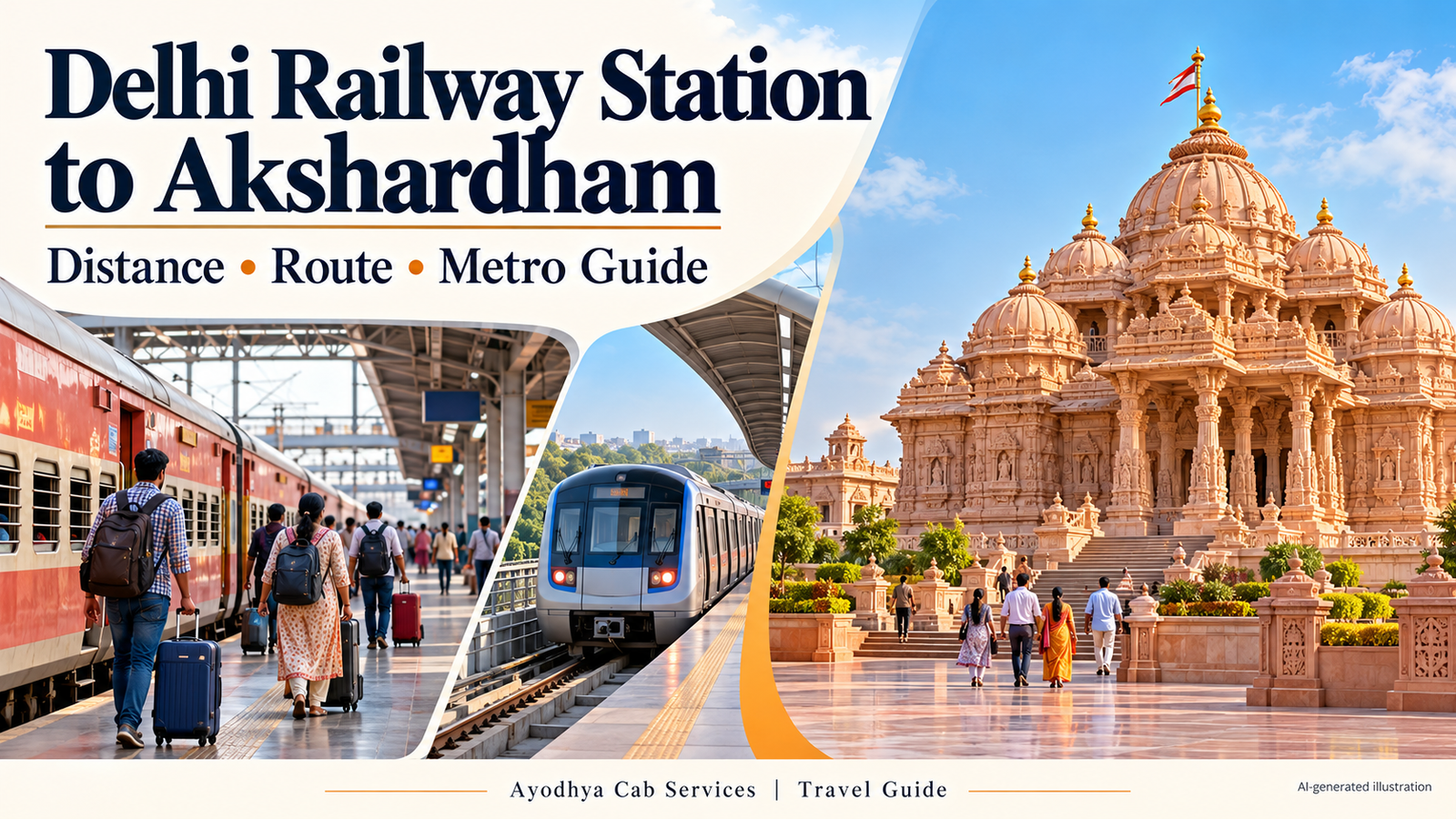
An AI-generated travel illustration introducing the railway-to-Akshardham journey. Confirm whether your train arrives at Old Delhi or New Delhi before choosing directions.
Delhi Station to Akshardham Distance: Which Station Do You Mean?
“Delhi railway station” is an incomplete starting point for a travel plan.
Your ticket may identify Old Delhi, New Delhi, Hazrat Nizamuddin or another station serving the city. Do not assume that a distance given for one applies to all of them.
Use the following figures for initial planning:
| Railway station | Station code | Officially listed distance to Delhi Akshardham |
|---|---|---|
| Old Delhi Railway Station | DLI | Approximately 10 km |
| New Delhi Railway Station | NDLS | Approximately 11 km |
| Hazrat Nizamuddin Railway Station | NZM | Approximately 6 km |
The figures above come from Akshardham’s visitor information. Check a current map for the journey from your actual exit or pickup location. Swaminarayan Akshardham New Delhi
If Your Ticket Says DLI
Use directions starting from Old Delhi Railway Station.
For the Metro option described in this guide, your first task is reaching Chandni Chowk Metro station. Do not travel to New Delhi Railway Station merely because an online article uses that as its starting point.
When arranging a vehicle, share the station name and agreed exit. A station name alone may still leave the driver uncertain about where you will meet.
If Your Ticket Says NDLS
Use the New Delhi Railway Station route.
The official Akshardham directions guide Metro passengers towards the Ajmeri Gate side and New Delhi Metro station. Swaminarayan Akshardham New Delhi
After getting off the train, follow the relevant station signs. If you are unsure, ask station staff before walking out with luggage.
For a road pickup, agree on the meeting point separately. The location most convenient for Metro access may not be the meeting point selected for your vehicle.
If Your Ticket Says NZM
Your starting station is Hazrat Nizamuddin.
Do not use an Old Delhi or New Delhi distance as the basis of your ride. Check directions from the actual station exit and confirm the pickup arrangement.
This article’s detailed Metro instructions below cover DLI and NDLS. A journey from NZM should be planned separately using current Metro or road directions.
Do Not Infer the Station from the Train’s Name
Read the arrival station printed on the ticket.
A train name, city name or message from another traveller can be less precise than the booking information. Check the arrival date as well, particularly if the journey reaches Delhi after midnight.
Before leaving home, save a clear note containing:
- Arrival station.
- Arrival date.
- Expected arrival time.
- Accommodation address, if applicable.
- Planned first destination.
This small preparation prevents several avoidable decisions after a tiring train journey.
Make Sure You Are Visiting Delhi Akshardham
There is more than one Akshardham destination. The official Akshardham organisation lists separate campuses, including Delhi and Gandhinagar in Gujarat. akshardham.org
For this article, select Swaminarayan Akshardham in Delhi.
Check the destination’s city and location when opening a map result. A search for “Akshardham Temple” without a city can return information intended for another campus.
The same applies to photographs, ticket information and opening hours found in travel articles. Confirm that the page describes Delhi before using it to plan the visit.
For a vehicle booking, share the precise map destination rather than an image or an abbreviated name. Ask the driver to confirm that they understand the location.
New Delhi Railway Station to Akshardham by Metro
The basic journey is:
New Delhi Metro station → Rajiv Chowk → Akshardham Metro station
The official visitor directions recommend this interchange route. Swaminarayan Akshardham New Delhi
It involves reaching the Metro from the railway station, travelling on the Yellow Line and changing to the Blue Line.
Step 1: Reach New Delhi Metro Station
Follow signs towards the Ajmeri Gate side and Metro access.
Allow time to leave your railway platform. Your train’s arrival time is not the moment you reach the Metro entrance.
Consider the group’s luggage before starting the walk. If someone cannot comfortably manage the transfer, pause and assess whether a road journey is more suitable.
Ask staff about the relevant accessible route when needed. Do not assume that the first staircase you see is the only available approach.
Step 2: Take the Yellow Line to Rajiv Chowk
Choose the Yellow Line direction that takes you to Rajiv Chowk.
Older directions may refer to HUDA City Centre. DMRC currently identifies that terminal as Millennium City Centre Gurugram, formerly HUDA City Centre. Official Website
Use the station display and confirm that Rajiv Chowk appears in the correct direction. You only need to travel to the interchange, not to the line’s terminal.
Step 3: Change to the Blue Line
At Rajiv Chowk, follow signs for the Blue Line and confirm that the selected train serves Akshardham.
The Blue Line has different eastern branches. The DMRC network information distinguishes the route through Akshardham from the branch towards Vaishali. delhimetrorail.com
Before boarding, check the destination display or ask Metro staff:
“Akshardham ke liye kaunsi train leni hai?”
Do not board merely because the train is on the Blue Line. The branch matters.
Step 4: Get Off at Akshardham Metro Station
The station is the end of the Metro portion of the journey.
Check the exit signs for the temple approach and keep the group together before leaving. Someone who steps out while another person is still handling a bag can easily create unnecessary confusion.
If you need assistance, ask before exiting rather than trying to resolve the route while the group is already moving in different directions.
Step 5: Complete the Onward Walk
Follow the temple direction signs from the Metro station.
The approach is a separate part of the journey. Getting off the train does not mean you have completed security or reached the mandir.
Allow for the group’s walking pace and any required belongings arrangements.
Old Delhi Railway Station to Akshardham by Metro
The basic journey is:
Chandni Chowk Metro station → Rajiv Chowk → Akshardham Metro station
Akshardham’s official directions use this route for visitors arriving at Old Delhi Railway Station. Swaminarayan Akshardham New Delhi
Step 1: Reach Chandni Chowk Metro Station
After leaving the train, follow the appropriate signs towards Metro access.
Your route begins at Old Delhi Railway Station, not New Delhi. Keep that distinction clear when asking for help or opening a route planner.
Do not agree to an unnecessary station-to-station transfer simply because a driver or booking form recognises the phrase “New Delhi” more readily.
Step 2: Travel to Rajiv Chowk
Use the Yellow Line direction that serves Rajiv Chowk.
Check the platform display before boarding. The relevant destination is the interchange station, so focus on whether Rajiv Chowk is on the displayed route.
If you are travelling with several people, confirm the boarding decision before anyone enters the train.
Step 3: Change to the Akshardham Route
At Rajiv Chowk, take the Blue Line service that includes Akshardham.
Check the branch, just as you would when travelling from New Delhi. Do not treat every Blue Line train as interchangeable.
Follow the current displays and staff instructions if there is any service change.
Step 4: Exit and Follow the Temple Approach
Complete the station exit and onward walk as a separate stage.
Before moving on, check that the whole group has exited together and that nobody has left a bag behind.
Avoid stopping in a doorway or passage while deciding what to do next. Move to a suitable place where the group can pause without obstructing others.
How Long Does the Journey Take?
Akshardham’s official visitor page labels its Metro directions as approximately 40 minutes from New Delhi Railway Station and 45 minutes from Old Delhi Railway Station. Treat these as indicative journey guidance, not a live departure-to-entry guarantee. Swaminarayan Akshardham New Delhi
For a road journey, check the current traffic estimate immediately before departure. There is no verified live driving time in this article.
The useful planning calculation is:
Platform exit + transport access + waiting + travel + onward approach + entrance arrangements
A map or route planner may cover only some of those stages.
Railway Arrival Is Only the Starting Point
A train arriving at 9:00 AM does not place you at the temple at 9:00 AM plus the Metro estimate.
You still need to leave the platform, reach the correct transport entrance and complete the transfer.
For a family arriving after an overnight journey, food, freshening up or luggage storage may come before sightseeing.
Decide which of those tasks is necessary rather than treating every stop as a delay.
Metro Interchanges Need Their Own Allowance
A line change is more than the time spent inside a train.
You must follow the interchange route, reach the platform and wait for the appropriate service.
Do not use a journey estimate as a reason to rush someone with limited mobility or separate the group.
If your onward train imposes a fixed deadline, preserve a margin rather than scheduling the visit to the last possible minute.
Entrance Arrangements Are Separate
Reaching Akshardham is not the same as beginning darshan.
Leave room for the entrance process and follow the current official visitor instructions. Part 2 will cover belongings, access and visit planning in more detail.
Do not assume that a transport booking includes assistance with every stage of entry.
Going by Taxi, Auto or Another Road Option
Road transport may be convenient when your group has luggage or finds a Metro interchange difficult.
The choice should be based on the complete arrangement, including pickup and the return journey.
This article provides independent travel guidance. It does not advertise or promise a Delhi cab service.
Confirm the Starting Point
Use your actual station and agreed pickup location.
If a booking form offers several similarly named options, check the address before confirming. “Delhi” alone is insufficient.
Once the driver and vehicle details are available, use the agreed meeting instructions. Do not follow an unrelated person merely because they say they know your destination.
Ask for the Total Journey Price
Confirm what the quotation includes.
Ask whether waiting, parking or other applicable charges are additional. If you are booking a return journey, clarify how that is priced.
Avoid comparing an outward-only fare with another quotation that includes waiting and return travel.
No fixed road fare is supplied here because a current quotation has not been verified.
Match the Vehicle to the Group
Check seating and luggage capacity.
A vehicle that seats the passengers may not comfortably accommodate their bags. Explain the luggage requirement before booking.
For older visitors, consider boarding height and comfort. For children, discuss any specific seating needs rather than assuming that every vehicle provides the same arrangement.
Plan the Return Before Relying on Waiting
If the driver is waiting, agree on:
- Where you will meet.
- How waiting is charged.
- How you will communicate after the visit.
- What happens if the visit takes longer.
- Whether the return destination is the original station or elsewhere.
A return to your hotel is different from a return to the railway station. Confirm the final destination explicitly.
Metro or Road Transport: Which Should You Choose?
Compare the number of transitions and the needs of the group.
| Your situation | What to assess |
|---|---|
| Light luggage and comfortable walking | Metro access and the Rajiv Chowk interchange |
| Several bags | Storage options and the effort of moving them |
| An older traveller | Walking tolerance, boarding comfort and assistance |
| Children after an overnight journey | Rest, food and the number of transfers |
| Fixed return-train departure | Both outward and return arrangements |
| A larger group | Seating, luggage and keeping everyone together |
When Metro May Suit the Visit
Consider Metro when the group can comfortably manage the railway-to-Metro approach, interchange and onward walk.
Check current operation and fare information through the official DMRC website or station facilities.
A simple route can still require planning when several people are travelling together. Agree on what to do if someone fails to board with the others.
When a Road Journey May Be Easier
Consider road transport when reducing luggage handling or interchanges would help the group.
That does not automatically make it faster. Check traffic and the full quotation before deciding.
A direct vehicle journey can simplify one part of the outing while leaving entrance procedures and walking inside the destination unchanged.
When a Hotel Stop Is More Practical
A stop at your accommodation may be worthwhile after a long train journey.
It gives you a place to leave unnecessary belongings and prepare for the visit, subject to the property’s confirmed check-in or storage arrangements.
Check those arrangements in advance. An early arrival does not guarantee that the room will be ready.
Check the Visit Date Before Leaving the Station
Before starting the transfer, confirm that Akshardham is open on your intended day.
The official visitor information states that the Delhi campus is closed on Mondays. Swaminarayan Akshardham New Delhi
This check matters more than finding a slightly shorter route.
If your train arrives on a Monday, plan the visit for another suitable day. Do not assume that a tour listing or transport booking changes the campus’s opening arrangements.
For other dates, review the current entry schedule before deciding when to leave.
A Practical Arrival Decision
Once you know your station, make the following decisions in order:
- Confirm the visit date.
- Decide where luggage will remain.
- Choose the transport mode.
- Check the current route or pickup arrangement.
- Confirm what must happen before your return departure.
For example, a hypothetical family arriving at NDLS with several bags may choose to visit its hotel first. A solo traveller with light belongings may prefer the Metro route.
Akshardham Entry Timings: Arrival Time and Darshan Time Are Different
Knowing the Delhi Station to Akshardham distance helps with the transfer, but the visit schedule determines when that transfer is useful.
The official visitor page currently lists:
| Visitor activity | Published timing |
|---|---|
| Opening days | Tuesday–Sunday |
| First entry | 10:00 AM |
| Last entry | 6:30 PM |
| Mandir darshan | 10:00 AM–8:00 PM |
| Arti | 10:30 AM and 6:00 PM |
The campus is closed on Mondays. Recheck the official visitor information before travelling. Swaminarayan Akshardham New Delhi
Last entry and the end of darshan are different deadlines. Do not assume that an 8:00 PM darshan closing time means you can arrive at the entrance shortly before 8:00 PM.
For a railway arrival, calculate when you can realistically reach the campus after leaving the train, managing luggage and completing the journey.
If Your Train Arrives Early in the Morning
An early arrival gives you options, but it does not mean the campus is ready for entry.
Consider whether you need breakfast, a place to freshen up or luggage storage before sightseeing. Confirm any hotel arrangements rather than relying on an assumed early check-in.
For example, a hypothetical family arriving at New Delhi Railway Station at 6:30 AM could use the morning to reach its accommodation and prepare for the visit.
That is an itinerary suggestion, not a verified schedule for a particular train or hotel.
If Your Train Arrives in the Afternoon
Prioritise what you want to see.
A mandir-focused visit and a visit including exhibitions require different amounts of time. Check the ticket counter closing time before deciding that all activities can fit into the remaining afternoon.
If the train is delayed, revise the plan. Removing an optional attraction is more sensible than trying to preserve an itinerary that no longer matches the available time.
If You Arrive Near Last Entry
Check the current journey estimate before leaving the railway station.
Do not use the published distance as proof that you will reach the campus in time. Road conditions, transport access and the entrance process can affect the actual arrival.
If the margin is too narrow, choose another suitable day. A transport booking cannot extend the entry deadline.
Plan Your Luggage Before Leaving the Railway Station
For train passengers, luggage can be the most important practical issue.
The official rules list luggage, phones, cameras and electronic items among prohibited belongings. A free visitor cloakroom is listed, but deposits must meet size restrictions; money and valuables should not be deposited. Swaminarayan Akshardham New Delhi
Do not assume that every suitcase, large backpack or valuable item can be stored there.
Decide Where Larger Bags Will Stay
Consider these arrangements before departure:
- Confirmed storage at your accommodation.
- A suitable railway luggage-storage facility, if available and appropriate.
- Another legitimate storage arrangement you have checked directly.
The article does not confirm the availability or conditions of a particular railway storage service.
Ask about operating hours, collection requirements and whether the facility accepts your bags. If you need documents or a valid ticket for storage, establish that before relying on the arrangement.
Compare Storage by the Whole Day’s Route
The nearest storage location is not always the most convenient.
Suppose your train arrives at Old Delhi but your accommodation is elsewhere. Leaving bags at the arrival station may require a return trip that does not fit the rest of the day.
Alternatively, storing bags at the hotel can be practical if you will return there anyway.
Compare:
- Where you arrive.
- Where the bags will stay.
- Where you go after Akshardham.
- Where your next train departs.
Choose the arrangement that makes those journeys manageable.
Separate Essential Items from Unnecessary Belongings
Before leaving your accommodation, identify what you need during the outing.
Keep permitted essentials organised so that you do not have to unpack an entire travel bag at the entrance.
For something important that is not clearly covered by the published rules, ask the campus directly. Do not assume that an item will be accepted because it is small or routinely carried elsewhere.
Keep Deposit Receipts Accessible
If you use a cloakroom or another storage facility, retain the collection receipt securely.
Know who in the group is responsible for it. Avoid placing it in an item that has just been deposited.
Before leaving the area, check that the bags or devices collected are the correct ones.
Prepare for a Visit Without Your Phone
A phone can serve as a map, ticket wallet, payment method and contact directory. Planning to store it means preparing alternatives where necessary.
Do this before entering, while everyone can still communicate easily.
Write Down Essential Information
Keep a short written note containing:
- Your hotel name and address.
- A family contact number.
- The agreed meeting point.
- The return pickup details.
- Any information needed for your onward journey.
Do not copy unnecessary personal or payment information onto the note.
The purpose is to avoid depending on memory if the group needs help or the return arrangement changes.
Agree on a Meeting Plan
If members of the group may separate, choose a place everyone understands.
A vague instruction such as “meet outside later” leaves too much uncertain. Identify the place before storing phones, and confirm how the group will reconnect.
For children, decide which adult accompanies each child. Do not leave that responsibility unclear while people handle tickets or belongings.
Organise Payment Before Entry
Check how you will pay for any optional activities or refreshments.
Do not assume that every payment can be made through a phone that has been deposited. Carry a suitable permitted alternative and check the current payment arrangements.
Avoid bringing more valuables than the outing requires.
Confirm the Driver Arrangement in Advance
If a vehicle is waiting, explain that you may not be reachable during the visit.
Agree on a return meeting point and the waiting terms before entering. If the visit takes longer than expected, the arrangement should not depend on immediate replies from inside the campus.
For an independently booked return, allow time after collecting your phone to arrange transport.
Dress for the Visit Before Leaving Your Accommodation
The published dress guidance requires covered shoulders, chest, back and upper arms, with lower clothing extending below the knees. Swaminarayan Akshardham New Delhi
Check the group’s clothing before starting the journey.
A railway arrival may leave little opportunity to change once you reach the destination. If you need another outfit, organise it at your hotel or another suitable place beforehand.
Choose clothing that also works for the weather and walking involved. Respectful dress and physical comfort can be planned together.
Footwear should suit the journey from the station and movement during the outing. Avoid selecting shoes solely for photographs if they will make the visit uncomfortable.
Free Darshan and Paid Activities: Know What You Are Choosing
Entry to the mandir complex and mandir darshan is listed as free, with no prior appointment required. Swaminarayan Akshardham New Delhi
Exhibitions and the water show are separate activities with published ticket prices.
This distinction matters when someone quotes a combined outing price. Ask which portion is transport and which portion, if any, covers admission to optional activities.
A general visit should not be confused with a promise that every attraction is included.
Decide Your Main Purpose
Before buying tickets, choose whether your priority is:
- Mandir darshan.
- The exhibitions.
- The evening water show.
- A combination of these.
Make that decision around the time available and the interests of the group.
A short visit can still be worthwhile. There is no need to purchase every activity merely because it is available.
Keep Prices in Context
Published ticket prices help with budgeting, but they should be rechecked before the visit.
Age categories and inclusions matter as much as the headline amount. If travelling with children or senior family members, check which category applies.
Do not rely on an old screenshot when current information is available from the official website or ticket counter.
Akshardham Exhibitions: What They Include
The official exhibitions page identifies three parts:
- Sahajanand Darshan: Hall of Values.
- Neelkanth Darshan: Large-format film.
- Sanskruti Darshan: Cultural boat ride.
The page lists approximate viewing times of 55, 45 and 15 minutes respectively. These total about 1 hour 55 minutes, before waiting, movement and breaks. Swaminarayan Akshardham New Delhi
Do not treat that total as the complete time from entering the campus to leaving it.
Published Exhibition Ticket Prices
| Visitor category | Published price |
|---|---|
| Adults, age 12+ | ₹260 |
| Seniors, age 60+ | ₹210 |
| Children, age 4–11 | ₹160 |
| Children below age 4 | Free |
The official page says the ticket includes all three exhibitions, with no separate ticket for an individual exhibition. It lists exhibition hours as 11:00 AM–8:00 PM and ticket-counter closing at 6:00 PM. Swaminarayan Akshardham New Delhi
Reconfirm prices and operating arrangements before purchasing.
Assess the Time Commitment Before Joining
A visitor catching an onward train should work backwards from the departure arrangement.
Include the journey to the railway station, luggage collection and time needed to reach the platform. Only then decide whether the exhibitions fit.
If the available time is uncertain, ask staff about the current arrangements before buying a ticket. Do not assume that the published viewing durations include the queue.
Consider the Group’s Interests
Some visitors want time to appreciate the architecture and darshan. Others are particularly interested in the exhibitions.
Discuss that difference beforehand.
A group does not have to follow an identical programme if a safe and practical meeting arrangement can be made. However, splitting the group becomes harder when phones are stored, so decide carefully.
Do Not Confuse the Cultural Boat Ride with River Transport
The cultural boat ride is an exhibition attraction within Akshardham.
It is not a boat journey from the railway station, a Yamuna transport connection or an alternative way to reach the campus.
Keep transport planning separate from the attraction’s name.
The Evening Water Show Requires a Separate Return Plan
The Sahaj Anand Water Show is a 24-minute presentation. The official page says the first show begins after sunset, currently lists 7:30 PM, and notes that multiple shows may operate on weekends or public holidays. Swaminarayan Akshardham New Delhi
The listed clock time should be checked for your visit date.
An evening activity also changes your return schedule. You must account for leaving the seating area, collecting belongings and reaching transport afterwards.
Published Water-Show Ticket Prices
| Visitor category | Published price |
|---|---|
| Adults, age 12+ | ₹110 |
| Seniors, age 60+ | ₹110 |
| Children, age 4–11 | ₹80 |
| Children below age 4 | Free |
The official page lists the show language as Hindi and notes that fountain water may reach the audience in windy conditions. Swaminarayan Akshardham New Delhi
Do Not Schedule a Tight Train Connection Afterwards
The show duration does not establish the time you will reach the station.
A hypothetical visitor with a late-evening train should consider:
- When the confirmed show finishes.
- How long the exit and belongings collection may take.
- How transport will be arranged.
- Whether luggage must be collected elsewhere.
- Which railway station the train uses.
If those stages leave an uncomfortable margin, skip the show or choose another day.
Ask Whether Everyone Wants to Stay
After an overnight railway journey, a child or older family member may prefer an earlier return.
Make the evening show optional rather than assuming that buying the exhibition ticket commits everyone to a full-day outing.
A comfortable visit should reflect the group’s energy, not only the number of attractions available.
Visiting with Elderly Parents or Someone with Limited Mobility
The station-to-campus distance does not describe all the walking or standing involved.
Consider the railway exit, Metro access, interchange, onward approach and the visit itself as separate demands.
Ask About the Person’s Actual Needs
Find out what is comfortable for them.
Can they manage stairs? Is standing more difficult than walking? Would a rest before sightseeing help? Do they need a companion throughout the visit?
These questions produce a more useful plan than assuming that every senior traveller needs the same arrangement.
Confirm Assistance Before Depending on It
The official visitor page lists wheelchairs at the entrance before security clearance, with a published service charge of ₹100. Swaminarayan Akshardham New Delhi
Ask about availability and practical arrangements if assistance is important to the visit. A listed facility is not a guarantee that a particular item will be available at the moment you arrive.
Also check the approach before that assistance point. A wheelchair available at the campus does not resolve the journey from a railway platform or Metro interchange.
Reduce Unnecessary Transfers
A road journey may be easier for some visitors, while others may comfortably use Metro.
Choose according to the person’s needs and the current transport arrangements.
If you use Metro, ask staff about accessible routes rather than following the group down the first staircase.
Choose a Manageable Programme
A mandir-focused outing may be enough.
If the person wants the exhibitions, discuss the additional time commitment. Leave room for a break and be willing to shorten the plan.
Do not make an optional show the reason the group must remain when someone is already uncomfortable.
Visiting with Children
Children benefit from a clear plan with breaks and fewer last-minute decisions.
Explain the journey in simple stages: train arrival, transport, entrance and the chosen activities.
Prepare for the Belongings Rules
The official visitor page lists baby food and water bottles among allowed items, subject to checking. Swaminarayan Akshardham New Delhi
Check specific requirements for your child before departure. Do not assume that every snack, toy or bag will be accepted.
If an essential item is unclear under the published rules, ask directly.
Assign Responsibility Clearly
When several adults are travelling, specify who accompanies each child.
Transport interchanges and ticket decisions can distract everyone at once. A named arrangement avoids the assumption that another adult is watching.
Agree on what to do if a child needs a break while the rest of the group continues.
Keep Optional Activities Flexible
Choose one main priority.
If children are tired after the railway journey, consider a shorter visit. If the exhibitions are the priority, avoid adding several other city attractions beforehand.
A plan that can be shortened is easier to manage than one built around consecutive fixed commitments.
Returning to New Delhi or Old Delhi Railway Station
Before leaving Akshardham, check the departure station on your onward ticket.
Your return destination may be different from the station where you arrived.
A morning arrival at NDLS does not mean an evening train also departs from NDLS.
Return to New Delhi by Metro
Using the same basic interchange, travel from Akshardham towards Rajiv Chowk, then change to the Yellow Line service that serves New Delhi.
Check current platform signs and station information before boarding.
After leaving the Metro, allow time to reach the railway station and your departure platform. Do not treat arriving at New Delhi Metro station as completing the railway connection.
Return to Old Delhi by Metro
Travel towards Rajiv Chowk and change to the Yellow Line service that serves Chandni Chowk.
Then complete the approach to Old Delhi Railway Station.
Check whether any luggage collection is required along the way. If storage is elsewhere, the return is a multi-stage journey.
Return by Road
Share the precise departure station and pickup arrangement.
Confirm whether the vehicle is already booked or must be requested after the visit. Check a current traffic estimate once you can access your phone.
If the driver is waiting, follow the agreed meeting plan rather than changing the location without communication.
Choose an Itinerary That Fits Your Railway Arrival
The best itinerary depends on when your train arrives, where you can leave luggage and what you want to see.
Start with one main purpose. A mandir visit, an exhibition visit and an evening-show outing have different requirements.
The examples below are hypothetical planning scenarios. They are not packages, verified queue forecasts or claims of personal travel experience.
Option 1: A Mandir-Focused Visit
Suitable for: Visitors whose priority is darshan and who want to keep the day flexible.
Suggested sequence:
- Arrive at the correct railway station.
- Complete any necessary luggage-storage or hotel stop.
- Check the current entry arrangements.
- Travel to Akshardham.
- Complete the visit at a comfortable pace.
- Return to your accommodation or departure station.
Keep exhibitions and the evening show optional.
This approach can suit a visitor who has another commitment later. It avoids treating every available attraction as part of a compulsory programme.
Before leaving the station, decide whether the outing still works if the train has arrived late. A shorter visit should be a deliberate choice rather than the result of rushing through a longer plan.
Option 2: Mandir and Exhibitions
Suitable for: Visitors who want the exhibition programme and have enough flexibility for it.
Prepare for the additional time commitment before buying tickets.
Suggested sequence:
- Complete the railway arrival and belongings arrangements.
- Reach the campus with adequate time before the relevant counters close.
- Ask about the current exhibition arrangements.
- Organise darshan and exhibitions around the available programme.
- Take a break where appropriate.
- Leave according to your confirmed return plan.
Do not calculate the outing only from the published viewing durations. Add the entrance process, movement, waiting and any rest the group needs.
If the exhibitions are the main reason for visiting, avoid filling the morning with unrelated sightseeing.
Option 3: A Visit Including the Evening Water Show
Suitable for: Visitors who can stay into the evening without a tight departure connection.
Confirm the show timing for your visit date. Then work out how you will get back afterwards.
Suggested sequence:
- Arrive and settle your travel belongings.
- Reach Akshardham during the appropriate entry period.
- Complete the selected daytime activities.
- Stay for the confirmed evening programme.
- Collect deposited belongings.
- Reach the agreed pickup point or Metro station.
- Return to your accommodation.
This option needs more than a willingness to stay late. Everyone should be comfortable with the length of the outing.
A family arriving after an overnight train journey may prefer to make the evening show a separate-day plan.
Work Backwards from Your Return Train
If you have an onward train, its departure is the fixed point.
The sightseeing programme should fit around that commitment.
Do not rely on the outward journey time as an exact forecast for the return. Your departure location, luggage collection and transport arrangements may differ.
Identify Every Stage Before the Railway Platform
Write down the return sequence:
Finish the activity → leave the campus → collect belongings → reach transport → collect stored luggage if necessary → reach the railway station → find the platform
This makes missing tasks visible.
For example, if your suitcase is at a hotel, the return is not simply “Akshardham to New Delhi Railway Station”. It is a journey through the hotel first.
Use a Personal Buffer, Not an Invented Official Rule
Suppose a hypothetical traveller has a train departing at 9:30 PM and chooses to be at the railway station by 8:30 PM.
That one-hour margin is a personal planning decision in this example. It is not a universal railway reporting requirement.
The traveller must still decide when to leave Akshardham by considering the intervening tasks and current transport conditions.
A show finishing before 8:30 PM would not, on its own, establish that this connection is practical.
Decide Your Latest Comfortable Departure
Before entering, choose a point at which optional activities must stop.
The decision should account for:
- Your actual departure station.
- The group’s walking pace.
- Collection of deposited items.
- Any separate luggage-storage location.
- The transport mode.
- The margin you want before the train.
If the visit starts later than expected, reduce the programme.
A fixed cutoff is useful only when you are willing to follow it.
Check Whether the Departure Station Has Changed
Read the onward ticket separately from the arrival ticket.
A traveller may arrive at NDLS and leave from DLI, NZM or another station. Using the morning pickup details for the evening journey could send the group to the wrong place.
Share the onward station explicitly with whoever is arranging transport.
Arriving and Departing from Different Delhi Stations
Treat a change of railway station as a separate transfer.
Do not assume that an itinerary built around one station can be reused without adjustment.
Consider the Location of Your Bags
If luggage is stored at the arrival station, you must return there before continuing to the departure station.
That can add a substantial task even when the sightseeing destination is convenient.
Compare the alternatives before deciding where to store the bags. Hotel storage may suit some itineraries, while a checked station facility may suit others.
The correct choice depends on availability and the complete route.
Avoid Combining Several Unchecked Transfers
An itinerary containing a hotel stop, a temple visit, another attraction, luggage collection and a station change needs more planning than one direct return.
Check each leg rather than assuming the whole sequence is easy because every location is within Delhi.
If the plan becomes complicated, remove the optional attraction first.
Give Transport Providers the Final Destination
“Railway station drop” is incomplete.
Provide the precise station name and discuss the meeting arrangement. If the trip includes luggage collection, mention that when requesting the quotation.
A ride with an intermediate stop is different from a direct journey.
What to Do If You Board the Wrong Metro Service
Check the train’s route display before boarding. If you realise that the service is not taking you towards Akshardham, avoid making another hurried decision.
Read the current station information and ask Metro staff where to change or reverse direction.
Correct the Route Before Continuing
Do not assume that remaining on the train will eventually bring you to the intended station.
Identify:
- Where you are.
- Which direction the train is travelling.
- Where the appropriate change can be made.
- Whether you need to exit a paid area.
Follow current staff guidance.
This article does not prescribe a recovery route for every possible wrong boarding. That route depends on the station and service involved.
Keep the Group Together
If the doors close before everyone boards, do not leave the separation plan to chance.
Agree beforehand on what the group should do in this situation. A simple arrangement is easier to follow than several people independently trying to reunite.
Use a recognisable meeting point or ask station staff for assistance.
For children or a traveller requiring support, maintain a clear adult-companion arrangement throughout the journey.
Do Not Rely on an Old Screenshot
A saved route can help with orientation, but current displays and staff instructions should guide the actual trip.
Older information may use previous station names. The route’s general logic can remain useful even when a terminal name has changed.
Check the intermediate destination you need rather than relying only on a familiar terminal label.
Understand What a Distance Result Measures
Several online answers can give different figures without measuring the same journey.
Before comparing them, check the start point, endpoint and transport mode.
Railway Pin versus Actual Exit
A map may start at the centre of a railway complex. Your vehicle may collect you at a particular road entrance.
Those are different locations.
For a road journey, calculate from the agreed pickup point. For Metro, identify the relevant access point and include the approach from your railway platform.
Metro Station versus Campus Entrance
A result ending at Akshardham Metro station does not include the entire onward visit.
The official temple website lists an approximately 350-metre walk from the Metro station to its described entrance approach. Treat that as reference guidance and follow current signs. akshardham.com
The distance still does not account for the entrance process or movement to your chosen activity.
Published Reference Distance versus Live Route
The Delhi Station to Akshardham distance figures in Part 1 come from the destination’s official visitor information.
A current navigation result may differ because it uses a particular pickup point, entrance or route.
Use the published figures to understand the scale of the journey. Use current directions to plan the trip you will actually take.
Shortest versus Most Practical
A shorter route is not automatically better for your group.
Consider luggage handling, accessibility, interchange requirements and the final approach.
For a solo traveller with light belongings, one option may be straightforward. For a family with several bags and an older parent, another may be more manageable.
Judge the journey by the people travelling, not only the kilometre figure.
Budget for the Outing in Separate Categories
Keep transport and optional activities separate when comparing costs.
This makes it easier to decide what you want to include.
| Cost category | What to confirm |
|---|---|
| Outward transport | Current fare or quotation |
| Return transport | Whether booked separately |
| Vehicle waiting | Included time and additional charges |
| Parking | Whether separately payable |
| Exhibitions | Current ticket category and inclusions |
| Water show | Current ticket price and timing |
| Refreshments | Your own spending choice |
| Luggage storage | Availability, charges and collection conditions |
A combined quotation should explain its components.
A Published-Price Example
Part 2 lists the currently published adult exhibition price as ₹260 and adult water-show price as ₹110.
For two adults choosing both, the arithmetic is:
2 × (₹260 + ₹110) = ₹740
This covers those two ticket categories only. It excludes transport, refreshments, parking, storage and any other purchase.
The example assumes that the published prices still apply when you visit. Recheck them before payment. akshardham.com
Check Age Categories Rather than Estimating
Different activities may use different age categories or charges.
Do not assume that a senior concession on one activity applies to another. Check each ticket type.
If the group has children near an age threshold, clarify the applicable category before purchasing.
Avoid Calling a Quotation a Standard Fare
A road quotation is an offer for a particular arrangement.
It should not be presented as the universal price for every visitor travelling from a Delhi railway station.
Check the date, vehicle, route and inclusions. A low outward fare may not include the return or waiting time you need.
Keep Another Delhi Attraction Optional
A visitor may want to combine Akshardham with more sightseeing. Decide whether that addition serves the day’s main purpose.
Particularly after a railway journey, one well-planned visit may be enough.
Calculate the Extra Route
Do not add an attraction because it is described as “nearby”.
Check the actual transfer, opening arrangements and time needed to visit it. Then consider the onward journey from that location.
An extra stop can change where you finish the day and how you return to your accommodation.
Avoid Treating a Transit Stop as a Sightseeing Opportunity
Changing trains at Rajiv Chowk does not automatically mean you have time for a separate outing around Connaught Place.
Leaving the station, finding a place to visit and returning are additional tasks.
Include them deliberately if the schedule permits. Otherwise, complete the interchange and continue.
Decide What Can Be Dropped
List optional activities in order of importance.
If the train arrives late, the group becomes tired or the main visit takes longer than expected, remove the lowest-priority item.
This avoids arguing about the plan when everyone is already under time pressure.
Choose Accommodation by Access and Luggage Needs
For this itinerary, hotel convenience includes more than its advertised distance from Akshardham.
Check how you will arrive from the station, where bags can stay and how you will return after the visit.
Confirm Arrival Arrangements
Ask the property:
- When can we check in?
- Can bags be stored before the room is ready?
- Is a vehicle able to reach the entrance?
- Is a lift available if needed?
- Can bags remain after checkout?
- How are stored belongings collected?
Explain the actual arrival time rather than asking only whether “early check-in” is available.
Compare the Complete Journey
A property near one attraction may be inconvenient for the railway stations you use.
Map the sequence from arrival to accommodation, Akshardham and departure.
Choose a location that fits the whole trip and the group’s needs.
Keep the Hotel Address Available Offline
Save a written address and contact number.
This is useful when your phone is stored during the visit or when someone else in the group needs to communicate the destination.
Confirm the property name carefully if several hotels use similar names.
Photography and Travel-Content Expectations
Do not plan the visit around an assumption that you can photograph everything.
Akshardham’s current visitor rules prohibit phones and cameras inside the complex. akshardham.com
If photography is the main purpose of your outing, review the restrictions before travelling.
Follow signs and staff instructions at any location where you consider taking a photograph.
Avoid Invented Visitor Photos in a Travel Guide
If you publish this itinerary, use original or properly licensed images that depict the location accurately.
An AI-generated image can be used as an illustration, but it should not be presented as proof of a particular entrance, facility or architectural detail.
The same distinction applies to route graphics. A decorative line between destinations is not a verified road map.
Keep the Written Guide Useful Without Photographs
A travel article can explain:
- Which railway station to use as the starting point.
- Where the Metro interchange occurs.
- Which deadlines matter.
- What belongings require planning.
- How to organise the return.
These details provide practical value even when interior photography is unavailable.
Quick Questions for First-Time Visitors
Can I Visit Between Two Trains without Booking a Hotel?
Possibly, if the available time and luggage arrangements make it practical.
Check the visit day, entry schedule, both railway stations and storage conditions. A short gap between trains should not be treated as enough merely because the destination is around 10–11 km from the listed central stations.
Does Akshardham Metro Station Mean the Railway Station Is Nearby?
No. Metro and long-distance railway stations serve different parts of the journey.
Akshardham Metro station is your local transit destination. Your intercity train still departs from the station printed on its ticket.
Can I Skip the Exhibitions and Still Visit the Mandir?
Yes. Mandir darshan and paid exhibition activities are separate choices, as explained in Part 2. akshardham.com
Choose the programme around your interests and available time.
Should I Use Old Delhi Directions If My Ticket Says “Delhi”?
Check the station code and full booking details.
If they identify DLI, use Old Delhi as the starting point. If the information is unclear, confirm it through the railway booking or enquiry system before arranging transport.
Can the Outward and Return Journeys Use Different Transport?
Yes, if the arrangements are practical.
You might choose Metro in one direction and a road option in the other. Check current availability, costs and meeting points separately.
What If an Official Page and a Travel Blog Disagree?
Use current information from the relevant operator or destination to resolve operational questions.
For temple rules, check Akshardham. For Metro operation, use DMRC. For your train, use current railway information.
A blog can help you understand the itinerary, but it should not override the provider’s current instructions.
Planning Your Next Journey from Ayodhya or Lucknow?
Your Delhi–Akshardham visit may be one part of a longer trip. If your itinerary also includes Ayodhya, Lucknow or Varanasi, Ayodhya Cab Services can help you enquire about transport within its confirmed service locations.
When comparing the best cab service in Ayodhya, check vehicle suitability, luggage space, pickup arrangements and the complete fare. These details are especially useful for families combining railway travel with temple visits.
For an outstation cab from Ayodhya, share your destination, travel dates and passenger requirements to confirm availability. Longer journeys should be agreed individually rather than assumed to be available to every destination in India.
Travellers comparing top cab services in Ayodhya can contact Ayodhya Cab Services to discuss Lucknow to Ayodhya cab booking, Ayodhya temple sightseeing transport or Varanasi pickup and drop arrangements.
Service coverage: Ayodhya, Lucknow and Varanasi. This Delhi–Akshardham guide provides travel information; it does not offer Delhi railway-station picku
Conclusion
The Delhi Station to Akshardham distance depends on your railway station: the official visitor page lists approximately 10 km from Old Delhi, 11 km from New Delhi and 6 km from Hazrat Nizamuddin.
Confirm the station first, then choose a route suited to your group. For Old Delhi and New Delhi Metro journeys, understand the Rajiv Chowk interchange and select the service that serves Akshardham.
Plan luggage, entry deadlines and the return train before adding optional activities. Those decisions make the guide useful beyond the distance figure and help you organise a comfortable visit.

