
Maihar Devi to Vindhyachal Temple Distance: Road Route, Travel Time & Two-Temple Trip Guide
The Maihar Devi to Vindhyachal Temple distance is approximately 230–250 km by road for initial planning, based on published listings that use different starting and ending points. One planner lists Maihar town to Vindhyachal at 233 km, while another lists a “Maihar Devi” starting point at 249 km. Neither figure is a verified live measurement between your actual pickup and drop-off locations. rome2rio.com
For a practical temple trip, check the drivable departure point near Maa Sharda Temple and the permitted arrival point near Maa Vindhyavasini Temple. The shrine visit and its approach are separate from the intercity drive.
A corridor to assess runs from Maihar towards Rewa, then the Mangawan–Mauganj–Hanumana side and onwards towards the Mirzapur/Vindhyachal area. Confirm the complete route on a current map before departure rather than treating this description as turn-by-turn navigation.
This guide helps you choose the trip order, understand the distance estimate, compare road and rail planning and decide whether an overnight stop would make the visit more comfortable. It does not promise current road conditions, fixed darshan duration or local transport availability.
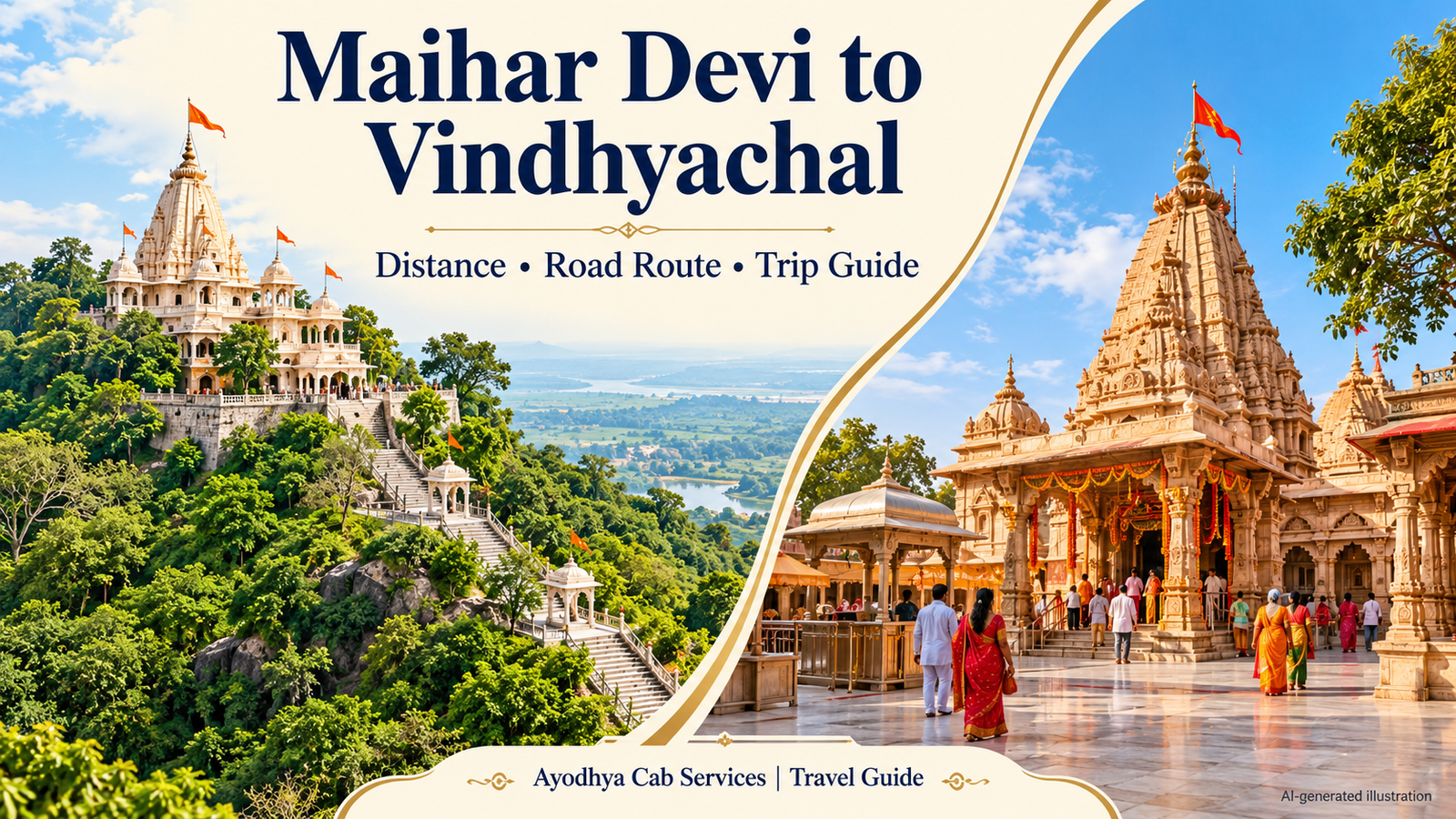
An AI-generated illustration introducing the Maihar–Vindhyachal journey. Check the actual route and temple-access arrangements before travelling.
Maihar Devi to Vindhyachal Temple Distance: What the Estimate Includes
The 230–250 km range is a provisional road-planning estimate, not a surveyed temple-entrance distance.
It reflects the variation between the published Maihar-town and Maihar-Devi listings. Your actual journey may differ because of the selected departure point, final approach, route or diversion.
| Planning item | What to use |
|---|---|
| Initial road-distance estimate | Approximately 230–250 km |
| Exact pickup-to-drop distance | Check a current map using the actual locations |
| Driving duration | Check current navigation and add necessary breaks |
| Time for both temple visits | Plan separately from road travel |
| Ropeway or other approach arrangements | Confirm operating conditions before relying on them |
| A same-day return to Maihar | Assess as a separate return journey |
Do not compare one listing’s town-centre distance with another listing’s temple pin as if they measure precisely the same trip.
The useful number is the distance between the places your vehicle can actually reach.
Separate the Journey into Three Stages
Use this structure:
- Complete the Maihar temple visit and reach the departure point.
- Travel between the two destination areas.
- Complete the Vindhyachal approach and temple visit.
A navigation estimate usually answers the second stage more directly than the whole outing.
For someone travelling with elderly parents, the first and third stages may be as important as the highway journey.
Check Whether the Starting Pin Is Drivable
A temple pin may identify a shrine rather than the vehicle pickup point.
If the map starts at the hilltop location, verify how the group will reach the vehicle and whether the proposed starting point is appropriate.
Do not assume that a map line confirms permission to drive into every approach road.
Use the departure location agreed locally and calculate the route from there.
Use the Destination Entrance You Intend to Approach
Vindhyachal is a destination locality as well as a pilgrimage name.
A route to the general locality may stop short of the place where you intend to begin the temple approach.
Check the correct Maa Vindhyavasini destination, then confirm the permitted stopping arrangement. This also helps when comparing transport quotations.
Identify the Two Temples Correctly
This journey connects Maa Sharda Temple in Maihar, Madhya Pradesh, with Maa Vindhyavasini Temple in Vindhyachal, Uttar Pradesh.
The Maihar district administration places Maa Sharda Temple on Trikut hill in Maihar district. The Mirzapur district website provides the destination information for Vindhyachal Dham. India
Maihar Devi Means Maa Sharda Temple Here
Travellers may search using “Maihar Devi”, “Maihar Mata”, “Maa Sharda” or “Sharda Devi Temple”.
For this article, they refer to the Maihar pilgrimage destination.
Check the city and state when selecting a map result. Do not choose a similarly named shrine merely because the search result contains “Sharda”.
Also distinguish the railway station, accommodation, temple approach and actual shrine. They are different starting points for a journey.
Vindhyachal Temple Means Maa Vindhyavasini Temple Here
The main destination in this guide is Maa Vindhyavasini Temple.
Other temples in the Vindhyachal area can form part of a wider visit, but they should not silently replace your selected endpoint.
When discussing the route, specify whether the driver is taking you to a hotel, a parking location or an agreed temple approach.
A precise destination prevents a quotation for one endpoint being misunderstood as transport to another.
Road Route: A Corridor to Assess Before Departure
A practical corridor to compare on a current map is:
Maihar → Rewa area → Mangawan → Mauganj → Hanumana → Drummondganj/Lalganj side → Vindhyachal approach
This is a planning outline rather than a verified live route for every vehicle.
Government highway records describe NH-135 as connecting the Mirzapur side with Lalganj, Drummondganj and Mauganj, terminating near Mangawan. A Ministry of Road Transport and Highways record also identifies the Rewa–Hanumana section in this corridor. morth.nic.in
Those records establish the corridor’s geographic connection. They do not establish today’s traffic, surface quality or fastest route.
Check the Maihar-to-Corridor Connection
Start with the actual departure location near Maihar.
Compare the current route towards the Rewa side and inspect the connection to the onward corridor. Your navigation may use bypasses or roads outside the town centre.
Do not force the vehicle through a town centre simply because the place appears in the route outline.
The outline provides orientation; current directions determine the road sequence.
Review the Onward Route as One Continuous Journey
Check the route all the way to your agreed Vindhyachal endpoint.
A route to Mirzapur followed by a separately selected temple route may work, but make sure the two legs join sensibly.
Avoid introducing an unnecessary detour by selecting different pins or changing the destination mid-journey without discussing it.
Do Not Confuse Road and Rail Routing
A train may travel through a different set of junctions from the road corridor.
A railway route description through Satna or Prayagraj should not be copied into road directions without checking the map.
Likewise, a driving distance is not the railway journey distance.
Use the appropriate route for the transport you have selected.
Check Any Suggested Shortcut
A shorter map result needs assessment.
Look at the road type, arrival conditions and suitability for the vehicle. Ask the person driving whether the proposed route is appropriate.
This guide does not confirm that a particular shortcut is safe or open.
Do not trade a manageable journey for an unverified reduction in kilometres.
Travel Time: Build an Allowance Instead of a Promise
There is no verified live driving-time measurement in this article.
A useful method is to begin with the current navigation estimate, then add the stops and arrival tasks your group needs.
If no current estimate is available, arithmetic can illustrate why the journey should be treated as an intercity transfer.
At an assumed average progress of 50 km per hour, 230–250 km would take about 4 hours 36 minutes to 5 hours of movement. That assumption is an example, not a measured route speed. Breaks, traffic and access tasks would add time.
Do not publish the calculation as a guaranteed arrival duration.
Add the Time Needed to Finish at Maihar
Leaving the shrine and starting the drive are different moments.
Account for the return to the departure point, collecting belongings and any rest or meal needed before travelling.
For a group using an assisted approach arrangement, establish where the vehicle will meet them.
Avoid setting a departure time that assumes the first darshan will finish exactly as planned.
Add Breaks Deliberately
Choose whether a meal is needed before departure or during the transfer.
A break is easier to manage when it is part of the plan rather than an unexpected argument about stopping.
For children or older travellers, discuss comfort requirements before leaving.
The driver’s need for appropriate rest should also be considered when agreeing on the full day’s programme.
Add the Final Approach Separately
Reaching the destination area does not complete darshan.
Parking, the onward approach, meeting arrangements and the temple queue are separate tasks.
If you have a fixed train or other appointment afterwards, calculate backwards from it rather than assuming that a short final approach means a quick visit.
Can You Visit Both Temples in One Day?
A one-day itinerary may be possible, but it depends on the start time, temple access, group needs and onward plan.
A one-way trip ending near Vindhyachal is different from visiting both temples and returning to Maihar the same day.
Define which plan you mean before arranging transport.
One-Way Transfer with a Night near Vindhyachal
This version can give the itinerary more flexibility.
After completing the Maihar visit, travel towards Vindhyachal and assess whether darshan fits the remaining day. If not, a planned overnight stay can allow the main visit to take place later.
Check accommodation and current temple arrangements before departure. Do not rely on an assumed room or opening period.
Both Visits Followed by an Onward Journey
This can become a long day.
The onward destination adds another leg that must be evaluated separately.
If the next journey is to a railway station, include luggage collection and reaching the correct platform. If it is another city, check that route independently.
Do not describe the trip as a “two-temple day” while ignoring several hours of travel after the second visit.
Same-Day Return to Maihar
A return adds another intercity drive.
Using the provisional one-way range purely for illustration, doubling 230–250 km gives 460–500 km before local movement or detours.
This is arithmetic based on the planning range, not a verified round-trip navigation result.
For some groups, an overnight itinerary may be more manageable. Assess the people travelling and the complete day rather than deciding from distance alone.
Which Temple Should You Visit First?
The best order follows your actual arrival and departure arrangements.
There is no universal rule that every traveller must begin in Maihar or Vindhyachal.
Start in Maihar When You Are Already There
If your accommodation or arrival train brings you to Maihar, visiting Maa Sharda first can avoid an unnecessary intercity transfer before the first darshan.
Organise the onward drive after you understand the departure point and the group’s condition.
If someone needs rest following the temple approach, include that before starting.
Start in Vindhyachal When Your Arrival Fits That End
Travellers arriving in the Mirzapur or Vindhyachal area may find the reverse order more sensible.
Plan that route as a separate journey. Do not assume the same pickup and arrival arrangements apply in reverse.
If the eventual departure is from Maihar or another nearby station, check whether the reversed order reduces backtracking.
Prioritise a Fixed Departure
A confirmed train, hotel checkout or other fixed commitment should influence the order.
A slightly shorter sightseeing sequence is not useful if it creates a difficult connection later.
Put the fixed commitment on the itinerary first and build the temple visits around it.
Road or Train: Compare the Complete Experience
Train travel may be worth checking for this route, but choose using the date-specific timetable and actual stoppages.
Do not book from a cached travel listing alone.
The Mirzapur district website identifies Vindhyachal station, code BDL, at approximately 1 km from Maa Vindhyavasini Temple. It also lists Mirzapur station, code MZP, at approximately 9 km and suggests it for additional train options. India
What to Check for a Train Journey
Confirm:
- The exact boarding and arrival stations.
- Whether the selected train stops at both.
- Departure and arrival dates.
- Running days.
- Seat availability.
- The arrival time and onward temple approach.
A late-night arrival requires a different accommodation and transport plan from a daytime arrival.
No train number, fare or fixed schedule is confirmed in this section.
What to Check for a Road Journey
Confirm the actual pickup, destination approach and route.
Also discuss seating, luggage, breaks, waiting and the final drop.
A road quotation should describe the arrangement you need rather than a general “temple trip”.
Compare Door-to-Door Time
For a train, include reaching the boarding station, waiting and the final local transfer.
For a vehicle, include the agreed pickup, intercity drive and arrival arrangements.
Neither a station-to-station timetable nor a road movement estimate describes the complete pilgrimage outing.
Book Transport Around the Actual Requirement
This article provides travel information and does not offer local pickup services in Maihar or Vindhyachal.
If you independently arrange a vehicle, describe the trip clearly.
Provide Precise Locations
Share the pickup point, not only the temple name.
Explain whether the drop is at accommodation or a permitted temple approach.
If there are intermediate stops, include them when requesting the quotation.
Ask What the Price Includes
Clarify the treatment of applicable tolls, parking, waiting, driver expenses and an overnight arrangement.
No current local transport fare has been verified for this guide.
A low initial quotation is difficult to compare when its exclusions are unclear.
Match the Vehicle to the Group
Check passenger seating and bag space separately.
If the group has mobility needs, discuss boarding comfort and the expected approach after getting out.
Do not assume a vehicle’s size removes the need for walking at either destination.
Plan the Hill Visit and the Intercity Drive Separately
Maihar’s hilltop setting makes the departure sequence important.
Before travelling, confirm the available approach arrangements and any operating restrictions with the relevant local authorities or operator.
Do not build the itinerary around an assumed ropeway schedule.
Ask where the group will meet the vehicle after the visit, then make that point the start of the onward route.
A hypothetical family might finish darshan, return to its accommodation for a meal and collect bags before departing. Another group may leave directly from an agreed pickup point.
Both plans can work when the necessary arrangements are confirmed.
Before You Commit to the Two-Temple Plan
Use the distance estimate to ask better questions:
- Are both map destinations correct?
- Is the departure point reachable by the booked vehicle?
- Has the onward corridor been checked on a current map?
- Is the group comfortable with the planned driving day?
- Is an overnight stop available if needed?
- Does the return or onward journey have a realistic margin?
The Maihar Devi to Vindhyachal Temple distance is only the starting information..
Prepare for the Temple Visits Before Planning the Departure Time
The intercity journey is only one part of this pilgrimage. Temple access, the group’s walking capacity and the day’s operating arrangements influence when you can realistically leave Maihar and begin the Vindhyachal visit.
Do not set the onward departure solely from the Maihar Devi to Vindhyachal Temple distance.
First establish what the group needs to do at each destination. Someone planning darshan only has a different itinerary from someone adding a ritual, an extended stay or the wider Vindhyachal circuit.
Decide Which Activities Are Essential
Ask each traveller what matters most.
Write the two main darshan visits as priorities. Add other activities separately, then mark which ones can be removed if the schedule changes.
A family can preserve the purpose of the trip without completing every nearby stop.
This decision is especially useful when members of the group have different expectations. Discuss them before booking an arrangement that assumes everyone will spend the same time at each place.
Confirm Current Visiting Arrangements
A temple’s general opening period, ritual schedule and the arrangements for joining a particular queue can be different.
Ask about the visit you intend to make rather than only asking, “What time does the temple open?”
No current, authoritative full-day opening timetable for both temples has been established for this draft. Confirm the applicable timings before departure and before publishing exact hours.
That uncertainty should not be replaced with a timetable copied from an unrelated travel page.
Separate Travel Estimates from Religious Activities
A scheduled prayer or aarti is not a guaranteed darshan-completion time.
Likewise, purchasing transport or an approach ticket does not establish when the group will finish the shrine visit.
Leave room around the first temple before committing to an onward departure.
Maihar Ropeway Planning: What to Check
Damodar Ropeways & Infra Limited lists Maihar Ropeway among its projects. This confirms the ropeway’s association with the operator, but not its operation on your travel date. Damodar Ropeways & Infra Limited.
If you intend to use it, treat its operating arrangements as a separate part of the plan.
Check Operation for the Intended Date
Ask whether the service is operating and whether any maintenance or special arrangement affects your visit.
A page describing the ropeway does not establish that it is available at every hour. Nor does an old ticket price confirm the current charge.
Check close to the travel date, particularly if your group cannot comfortably use another approach.
Confirm the Ticket You Need
Understand whether a ticket covers the required direction or return arrangement.
Check the passenger categories, reporting instructions and conditions before payment.
The Book Meri Ride platform currently lists Maihar with Damodar Ropeways & Infra Limited. Verify the authorised booking channel with the operator or local counter before paying, and review the current terms. Book Meri Ride
Do not send money to a personal account simply because a message describes itself as ropeway assistance.
Understand What a Booking Does Not Include
An approach ticket should not be assumed to include temple-queue priority, transport from the hotel or help with every part of the visit.
Read the actual inclusions.
If a combined arrangement is offered, ask for its components separately. This lets you distinguish transport, ropeway access and any other service.
Plan the Descent Before Starting the Ascent
Know how the group intends to return to the departure point.
Confirm the relevant return arrangements and avoid leaving that decision until everyone is tired.
If your transport pickup depends on finishing the hill visit, keep the driver informed about the practical meeting point and the uncertainty of the completion time.
Keep a Contingency That Suits the Group
If the intended approach is unavailable, reconsider the day’s programme.
Do not assume that an older visitor can use a stair route simply because the itinerary otherwise becomes inconvenient.
A revised visit date, additional rest or a different confirmed arrangement may be more sensible than forcing the original plan.
Walking Ability Matters More than a Step Count
Published descriptions can differ on the precise number of steps at a temple.
For an individual trip, a step count does not explain every person’s ability to complete the approach.
Consider gradient, standing, footwear, weather and the total walking already required during the day.
Ask Specific Comfort Questions
Can the traveller manage steps comfortably? Do they find standing harder than walking? Will they need a companion or regular rests?
Those answers are more useful than assuming that every elderly visitor has the same needs.
The same questions can apply to younger adults who have an injury or another limitation.
Confirm Assistance Rather than Assuming It
Ask about the actual arrangement available at the intended approach.
Identify where assistance starts and what remains to be completed independently.
A facility mentioned generally in a guide should not be described as confirmed for your arrival without checking it.
Keep the Intercity Drive in the Same Comfort Assessment
Completing the first visit is not the end of the day.
Consider whether the group is comfortable beginning a several-hour transfer afterwards.
A short rest or an overnight programme can be a legitimate part of the trip, rather than a failure to follow an ambitious itinerary.
Arrival at Vindhyachal: Clarify the Final Approach
Before leaving Maihar, decide whether you will first reach accommodation or continue directly to the temple approach.
An arrival at the general town location is not enough to describe the next steps.
If You Go Directly to Darshan
Arrange a specific permitted drop-off or parking location.
Discuss where belongings will remain and how the group will meet the vehicle afterwards.
Check the approach locally. Do not assume that a vehicle can stop at the precise shrine pin shown on a map.
If You Check into Accommodation First
Confirm that the property expects you at the estimated arrival period.
If the timing changes, communicate the revised arrival rather than assuming that the room or reception arrangement will remain unchanged.
A hotel stop can provide a place to leave bags and prepare for the visit. Its usefulness depends on access and confirmed booking conditions.
If the Group Arrives Tired
Reassess the optional programme.
A planned overnight stay may let you complete the main visit when the group is better rested, subject to current temple arrangements.
Do not add nearby temples simply because the intercity drive has finished earlier than expected.
Choose Accommodation for Access, Not Just Advertised Distance
A property described as “near the temple” may still require an approach from a vehicle stopping point.
Ask how your group and luggage will reach the entrance.
Questions to Ask Before Booking
Confirm:
- Whether a vehicle can reach the property.
- Where luggage is unloaded if it cannot.
- Whether the room requires stairs.
- Whether a lift is available when needed.
- Check-in and checkout conditions.
- Whether meals or refreshments are available at your arrival time.
- Whether luggage can remain after checkout.
Do not treat a booking-platform distance label as a complete access description.
Choose the Overnight Location Around the Next Journey
If the next day begins with Vindhyachal darshan, proximity to the intended approach may be useful.
If an early train is the priority, consider the station journey as well.
There is no universally best location. Compare the temple visit, luggage arrangements and onward departure together.
Keep the Reservation Details Accessible
Save the property name, address, contact number and booking confirmation.
Give another adult in the group a copy where practical.
If your phone is unavailable or its battery runs out, a written address can help communicate the destination.
Travelling with Elderly Parents
A comfortable itinerary begins with the person’s actual capacity and preferences.
Ask what they want to complete and what they would be happy to leave out.
Avoid Requiring the Same Pace from Everyone
A group may need to move at its slowest member’s comfortable pace.
Do not calculate the approach using the walking speed of the most active traveller.
If others want additional sightseeing, discuss a safe meeting arrangement rather than pressuring everyone into a longer programme.
Give One Person Responsibility for Logistics
One adult can handle bookings and communication while another stays with the visitor who needs support.
This avoids leaving someone alone while the group searches for a vehicle or negotiates an arrangement.
Agree on responsibilities before arriving.
Keep Necessary Personal Items Organised
Carry required personal items in accordance with current entry instructions.
Do not leave essential information buried inside a large suitcase that remains with the vehicle.
If a health-related concern affects travel, follow the person’s own medical advice. A pilgrimage guide cannot establish what activity is suitable for an individual condition.
Make Rest an Available Choice
A break should not depend on whether the itinerary is ahead of schedule.
Choose a plan that allows someone to pause without losing the entire purpose of the trip.
For a two-temple journey, that may mean completing the second darshan on the following day.
Travelling with Children
Children need a plan that accounts for meals, rest and several changes of location.
A long road transfer after a temple visit can feel different from the same drive at the beginning of a day.
Explain the Journey in Stages
Tell them what happens next.
For example:
We will finish this visit, return to the vehicle, have a break and then travel to the next place.
Avoid repeatedly saying “we are nearly there” when the next part of the journey still involves several tasks.
Assign a Companion Clearly
When adults are handling tickets, bags and transport, specify who stays with each child.
Do not rely on everyone assuming that another person is watching.
Use a simple meeting plan if the group separates.
Check Food and Belongings Arrangements
Confirm what can be carried into the relevant temple area.
Keep travel food and unnecessary items separate from the belongings needed for darshan.
If your child needs a particular item, ask about the applicable arrangement rather than assuming a general rule covers it.
Keep One Optional Stop
A family-friendly plan can include one additional place if everyone remains comfortable.
It does not need to include the entire local circuit after a long transfer.
Discuss in advance which activity will be dropped if a child becomes tired.
The Wider Vindhyachal Visit
The Mirzapur district website lists Maa Vindhyavasini, Kali Khoh and Ashtbhuja among the area’s religious destinations. Its Kali Khoh page describes that shrine as part of the Trikon pilgrimage circuit. India
Treat the wider circuit as additional travel and temple time.
It is not included automatically in the Maihar-to-Vindhyachal road distance.
Maa Vindhyavasini Temple
This is the main destination of the journey described in Part 1.
Complete the arrangements for this visit before deciding whether other stops fit.
If you have a train or another fixed departure, protect the time needed for it.
Kali Khoh Temple
The district’s official page lists Kali Khoh at approximately 2 km from the main Vindhyavasini Temple. That is a reference distance, not a verified entrance-to-entrance route for your vehicle. India
Check the current approach and how the group will move between the two places.
A short distance does not establish a short darshan visit.
Ashtbhuja Temple
Ashtbhuja is another destination documented by the Mirzapur district administration. India
Check its access and current visiting arrangements before adding it.
Do not assume that a combined local transport quotation includes waiting at every shrine. Ask which stops and charges are covered.
Agree on the Local Programme
Before starting the wider visit, identify:
- The selected temples.
- The order suitable for the confirmed route.
- The expected approach at each.
- Where the vehicle will wait or meet you.
- Which stop is optional.
- What time the programme needs to end.
Avoid presenting one sequence as mandatory for every traveller when arrangements may differ.
Keep Religious Tradition Separate from Operational Information
Pilgrimage guides may discuss stories and beliefs associated with the temples.
Attribute those appropriately instead of presenting every traditional account as a historically verified event.
For journey planning, keep practical information distinct.
A belief about a temple’s significance does not establish its opening hours, ticket conditions or vehicle access.
Readers should be able to find the travel information without confusing it with devotional interpretation.
Prepare for a Navratri Visit Differently
If you intend to travel during Navratri or another major observance, check dated local notices.
The existence of a regular-day arrangement does not establish that it applies during a special event.
Check Access Close to the Visit Date
Ask about approach roads, crowd-management arrangements and any relevant operating changes.
Do not use a previous year’s notice as current guidance.
An old article may help identify questions to ask, but the applicable arrangement needs confirmation.
Make Accommodation Less Dependent on Arrival Luck
Confirm your reservation rather than relying entirely on finding a room after the drive.
Tell the property your likely arrival period and any important requirements.
Keep its cancellation conditions in mind if the travel plan changes.
Reduce Fixed Commitments
A tightly timed programme is harder to maintain when the day’s access arrangements are uncertain.
Prioritise the two main visits and preserve flexibility around them.
Do not promise a particular queue duration in a blog without current, defensible evidence.
Meals and Breaks: Place Them Where They Help
Choose whether a proper meal belongs before leaving Maihar, along the road journey or after reaching accommodation.
The choice should suit the group and the actual departure time.
Avoid Starting with an Unresolved Basic Need
If everyone is hungry before the drive, address that rather than hoping to find a suitable stop immediately.
Likewise, do not postpone a necessary break solely to preserve an optimistic arrival estimate.
Check Practical Facilities at a Stop
A suitable break may need seating, washrooms and a place for the vehicle.
Confirm the needs of the group rather than selecting a stop only from its food photographs or rating.
This guide does not recommend a specific roadside business whose current facilities have not been verified.
Keep the Destination Meal Plan Flexible
If the group arrives later than expected, know whether food is available at the accommodation or needs another stop.
A late arrival should not turn into an unplanned search with tired travellers.
Decide What Happens If the First Visit Takes Longer
The most useful contingency is a clear decision about the next step.
Before leaving Maihar, check how the delay affects:
- The intercity departure.
- The accommodation arrival.
- The intended Vindhyachal visit.
- Any onward train.
- The driver’s agreed programme.
If a fixed commitment is at risk, remove optional activities first.
A delay at the first temple does not mean you must hurry through the second. It may mean the second visit belongs in a revised or overnight plan.
The Maihar Devi to Vindhyachal Temple distance helps describe the transfer. A comfortable pilgrimage also depends on access, rest and a local programme that fits the people travelling.
Choose a One-Day or Overnight Itinerary
Decide the shape of the trip before choosing individual departure times.
A one-way transfer after Maihar darshan is different from a same-day return. An itinerary ending at accommodation is also different from one ending with a fixed railway departure.
The examples below are hypothetical planning models. They do not establish current opening hours, queue lengths or guaranteed journey times.
Option 1: Maihar Darshan and an Overnight Stay near Vindhyachal
This arrangement can suit a group that wants flexibility after the first visit.
A suggested sequence is:
- Complete the Maihar visit.
- Return to the agreed departure point.
- Collect luggage and take a necessary break.
- Begin the confirmed road journey.
- Reach the booked accommodation.
- Complete Vindhyachal darshan that day if the current arrangements and group’s condition allow it.
- Otherwise, use the next suitable visiting period.
The key is confirming the overnight arrangement before relying on it.
Do not describe the final step as guaranteed when the arrival and temple arrangements remain uncertain.
Option 2: Two Visits with an Onward Departure
This version needs a fixed cutoff.
Start with the onward ticket or appointment, then decide whether the intercity transfer and second visit fit with a reasonable margin.
Keep the wider Vindhyachal circuit optional.
If the Maihar visit takes longer than expected, reassess before beginning the drive. The point to revise the plan is when you can still make a useful decision, rather than when you are already approaching a missed departure.
Option 3: A Two-Day Programme with More Local Time
A longer programme can separate the main transfer from additional sightseeing.
Use one day for the first temple and onward travel, then another for the second temple and selected nearby stops.
This does not require filling both days completely.
The benefit is room to organise access, rest and departure without making every delay affect the entire itinerary.
Option 4: Returning to Maihar
A return should be quoted and planned explicitly.
Confirm whether the vehicle returns immediately, waits locally or remains overnight.
The passenger programme and driver’s programme should both be understood. Do not assume that an outward booking includes a comfortable return after extended temple visits.
Build the Railway Connection Backwards
A train departure should anchor the final part of the itinerary.
The station-to-temple distances in Part 1 help with orientation, but they do not establish how late you can remain at darshan.
List Every Task Before Boarding
The sequence may include:
Finish the visit → meet the group → collect belongings → reach transport → collect hotel luggage → reach the station → locate the departure platform
If one of those tasks is missing from the plan, the available margin can look larger than it is.
An Illustrative Timing Exercise
Suppose a hypothetical traveller has a train departing at 8:00 PM and chooses to reach the station by 7:00 PM.
That one-hour margin is a personal planning choice in this example, not a universal railway requirement.
Now suppose the traveller has provisionally allowed 30 minutes to retrieve hotel bags, 30 minutes for the final transfer and another 30 minutes for unexpected delay.
Working backwards, those assumptions suggest being ready to leave the sightseeing portion by 5:30 PM.
None of the three 30-minute allowances is a verified local duration. The exercise shows the method; replace each assumption with your own checked arrangement.
Use the Station on the Actual Ticket
Vindhyachal and Mirzapur are different stations.
Read the exact departure station rather than remembering that the trip ends “near Mirzapur”.
Share the station name with the person arranging transport. If a different station is involved, check that journey separately.
Check the Date Across Midnight
A train departing shortly after midnight belongs to the next calendar date.
Confirm the date before booking accommodation or arranging a pickup.
A late-night arrival also needs a suitable plan for reaching the property. Do not assume that a room booking includes transport from the station.
Check Train Options Without Relying on Old Timetables
Search availability for the actual date, boarding station and destination.
A cached article can identify possible options but cannot establish a confirmed stoppage or seat.
Verify the Exact Service
Check the train number, running days, departure date and arrival date.
Confirm that it stops at both stations you intend to use. A service passing through an area is not the same as a service stopping at the required station.
Keep the booking record accessible.
Compare Practical Arrival Times
An available train may arrive at a time that complicates the temple visit or accommodation check-in.
Assess the complete plan rather than selecting solely by the listed travel duration.
A daytime arrival may suit one group; a night arrival with confirmed accommodation and transport may suit another.
Check Running Information Near Departure
Use current railway information before leaving for the station.
Do not assume that a change in train timing automatically changes hotel or vehicle arrangements. Communicate the revised plan where necessary.
If the delay reduces the usable sightseeing time, remove optional stops instead of trying to recover every lost minute.
Prepare a Budget with Separate Components
The distance alone cannot establish the trip’s cost.
Create a budget using actual quotations and confirmed charges.
| Expense | What to establish |
|---|---|
| Intercity vehicle | Trip type, route, inclusions and final destination |
| Tolls and parking | Included or separately payable |
| Waiting or overnight arrangement | Applicable conditions |
| Accommodation | Room category, taxes and booking terms |
| Ropeway | Current passenger category and ticket conditions |
| Local temple circuit | Selected stops and waiting arrangement |
| Food | Group requirements and planned breaks |
| Railway travel | Date-specific booked fare |
| Contingency | Amount chosen by the group |
Avoid adding unverified charges merely to make the table look complete.
Compare Quotations on Equal Terms
An outward-only ride cannot be compared directly with a quotation that includes a return and waiting.
Ask each provider to describe the same requirement.
A useful enquiry includes the pickup, drop, passenger count, luggage, intermediate stops and whether an overnight arrangement is needed.
Keep Optional Spending Visible
Separate additional sightseeing, special purchases and optional services from the essentials.
This makes it easier to shorten the plan without losing the main purpose.
Agree on the budget before the trip if several families are sharing expenses.
Do Not Present a Sample Budget as a Market Price
If you use illustrative amounts for planning, label them as examples.
A published travel guide should not describe an invented vehicle fare or hotel rate as the normal price for the route.
Replace sample figures with dated, verified quotations when a real booking is being assessed.
If You Drive Your Own Vehicle
Check the vehicle and the full route before departure.
The advice here is a preparation framework, not confirmation that a particular road is currently suitable.
Use the Actual Route for Fuel Planning
A simple estimate is:
Expected fuel quantity = planned distance ÷ assumed fuel efficiency.
For illustration, a 250 km journey at an assumed 15 km per litre would require about 16.7 litres.
Both the distance and efficiency must be replaced with your actual planning values. The calculation excludes local movement, detours and changes in driving conditions.
Multiply by the current fuel price only after checking it. No live fuel price is supplied in this guide.
Include the Return and Local Movement
A one-way calculation does not cover a return.
Add the local programme and any hotel or station transfers that use the same vehicle.
Keep some margin rather than treating the arithmetic as an exact consumption forecast.
Agree on Who Drives and When
Do not plan every hour of the day as passenger sightseeing while overlooking the person driving.
Consider their rest and the length of the complete programme.
If the schedule becomes impractical, revise it before departure.
Adjust the Programme to the Weather
Check the forecast for the actual travel dates and both destinations.
This article does not establish a current weather alert or a universally best month for the journey.
In Hot Conditions
Consider the approach and waiting portions as well as the vehicle journey.
Choose suitable clothing and arrange breaks according to the group’s needs.
A comfortable intercity vehicle does not remove the effort required at the temples.
During Rain
Reassess footwear, exposed waiting areas and the hill approach.
Ask about the operation of any service your plan depends on.
An old report of a closure does not confirm a current closure, and an old photograph of clear weather does not establish current conditions.
In Poor Visibility
Allow the driver to adjust the programme to conditions.
Do not use the article’s planning-distance range as a reason to maintain an optimistic arrival time.
If the journey becomes slower, update the accommodation or onward arrangement.
Keep Documents and Communication Organised
One person can maintain the bookings while another adult holds a copy of essential information.
Avoid making the whole group dependent on one phone.
Keep a Short Travel Note
Include the accommodation address, agreed pickup point, destination, important contacts and onward ticket details.
Use a written note or another suitable offline record.
Do not include unnecessary sensitive payment information.
Charge Devices Before the Intercity Transfer
Check the battery before leaving the first destination.
An offline route can assist with orientation, but it cannot confirm current traffic or a newly changed access arrangement.
Use current information where available.
Share Changes Clearly
If the arrival time changes, tell the accommodation and transport contact.
If the pickup point changes, confirm the new location rather than assuming the other person sees the same map pin.
A short clear message can prevent a lengthy search at the end of the visit.
Verify Published Travel Information by Its Purpose
Different sources answer different questions.
A district page can identify a destination. A highway document can describe a corridor. A booking record can establish your particular train.
None automatically answers every operational question.
Check the Endpoint Behind a Distance
Ask whether the result measures a town, railway station, temple pin or vehicle approach.
Do not average conflicting numbers into a supposedly precise new figure.
Use the approximate range for orientation and verify your actual route.
Check the Date Behind a Notice
A maintenance announcement applies to its stated period.
Do not treat a past closure as the current operating status.
The same principle applies to traffic diversions, festival arrangements and ticket conditions.
Treat Travel Time as Conditional
A duration copied from a planner may exclude the approach, breaks and darshan.
Identify what it measures before placing it in an itinerary.
Readers benefit from a clear explanation of uncertainty more than an unsupported arrival promise.
Avoid These Booking Misunderstandings
Several avoidable issues come from a vague description of the trip.
“Both Temples” Does Not Describe the Full Programme
Specify the main temples, any additional stops and the final destination.
A wider Vindhyachal circuit should be discussed separately.
“Near the Temple” Does Not Identify a Meeting Point
Agree on a recognisable permitted place.
A driver and passenger may interpret the same phrase differently.
“Return Included” Needs Conditions
Clarify the day, waiting arrangement and where the return ends.
Do not assume that an overnight extension is included in a same-day quotation.
“Ticket Booked” Does Not Confirm Every Inclusion
Read the ticket and service description.
A booked approach service is not automatically a priority-darshan arrangement or transport from accommodation.
Useful Questions for the Two-Temple Trip
Does the 230–250 km Estimate Include the Entire Pilgrimage?
No. It is a provisional road-planning range based on published listings with different endpoints.
Local approaches, additional sightseeing and any return journey need separate assessment.
Can We Plan the Reverse Journey?
Yes. Start with the actual Vindhyachal departure point and check the route to the intended Maihar arrival.
Do not assume that the same pickup, parking or access arrangements apply in reverse.
Must We Complete the Wider Vindhyachal Circuit?
That is a personal itinerary choice.
The main Maihar-to-Vindhyachal transfer does not require adding every local shrine. Consider the interests, time and comfort of the group.
Should We Choose Vindhyachal or Mirzapur Station?
Choose the station served by the suitable date-specific train, then assess the local transfer.
A closer station is not necessarily the more practical option if the required train does not stop there.
Can an Online Ropeway Ticket Guarantee the Day’s Programme?
No. Check its conditions and confirm current operation.
Do not infer a guaranteed darshan-completion time from an approach booking.
Can We Publish a Fixed Door-to-Door Duration?
Only if it is presented with an appropriate basis and limitations.
For this draft, no live door-to-door duration has been verified. The arithmetic in Part 1 is an illustration, not an observed journey.
Planning a Pilgrimage from Ayodhya or Lucknow?
A Maihar–Vindhyachal itinerary requires more than knowing the distance. Travellers also need to consider luggage space, rest stops, overnight arrangements and the final drop-off.
For journeys starting from its supported locations, Ayodhya Cab Services accepts enquiries for travel in Ayodhya, Lucknow and Varanasi. If you are planning an outstation cab from Ayodhya, share your destination and dates to confirm whether the complete route can be arranged.
When comparing the best cab service in Ayodhya or top cab services in Lucknow, ask about vehicle suitability, the full quotation, waiting charges and the return programme. These details help families evaluate the arrangement before booking.
For an Ayodhya to Maihar pilgrimage cab or Lucknow to Vindhyachal travel enquiry, discuss availability before making other commitments. The Maihar–Vindhyachal information in this guide does not imply local pickup services in either destination.
Contact Ayodhya Cab Services to discuss a journey starting from Ayodhya, Lucknow or Varanasi.
Conclusion
The Maihar Devi to Vindhyachal Temple distance is approximately 230–250 km for initial road planning, with the actual journey depending on the chosen pickup, route and destination approach.
Confirm the complete map route, temple access and any ropeway arrangements before finalising departure times.
A one-way transfer with an overnight stay may offer more flexibility than a long same-day return. Choose the programme around the group’s needs and fixed commitments, then add nearby temples only when the time and comfort permit.

