
Chitrakoot Railway Station to Ramghat Distance: Route, Local Transport & Travel Guide
The Chitrakoot Railway Station to Ramghat distance is approximately 8–10 km by road, depending on your station exit, the route taken and the point where your vehicle can stop near the ghat. The railway station you need to identify is Chitrakoot Dham Karwi, station code CKTD.
Use that distance as a planning estimate rather than an exact live measurement. A local destination listing gives 8.4 km between the railway station and Ramghat, while Chitrakoot’s official tourism information places the Karvi railway station about 10 km from the pilgrimage area. Check navigation using the station’s actual pickup point and your intended Ramghat entrance before travelling. Chitrakoot Dham
The transfer is only one part of reaching the riverside. You also need time to leave the platform, find suitable transport, unload luggage and complete any final approach on foot.
This guide explains those decisions so you can arrive with a workable plan, whether you are visiting briefly, travelling with parents or staying overnight.
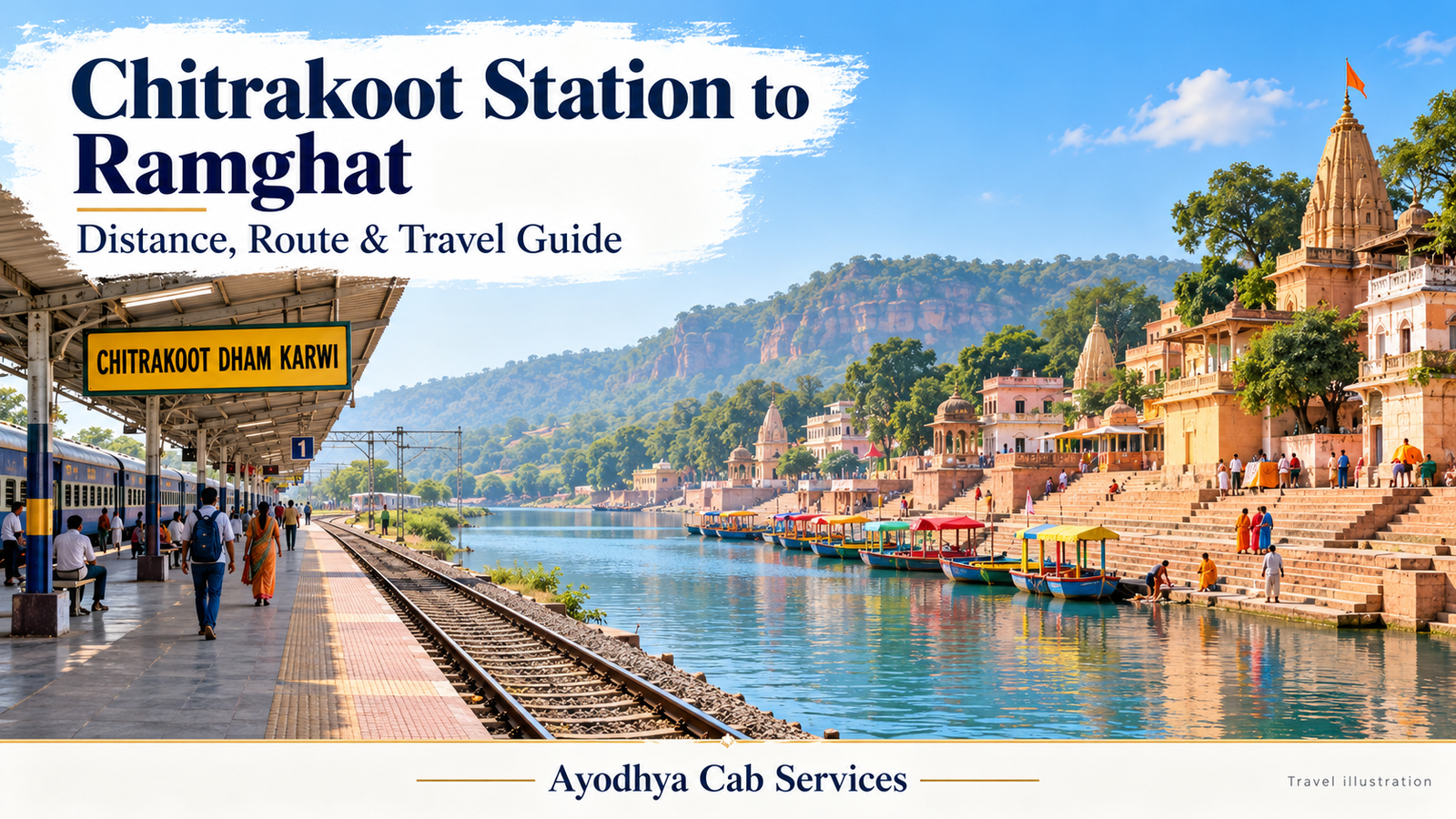
Plan your journey from Chitrakoot Dham Karwi station to Ramghat, including the vehicle drop-off and final walking approach.
Chitrakoot Railway Station to Ramghat Distance at a Glance
| Detail | What to use for planning |
|---|---|
| Station | Chitrakoot Dham Karwi |
| Station code | CKTD |
| Destination | Ramghat, Chitrakoot, on the Mandakini River |
| Approximate road distance | Around 8–10 km; verify the exact endpoints |
| Road journey time | Check live navigation; fixed journey times are unreliable |
| Transport to investigate | Shared local transport, an exclusively hired auto or a taxi |
| Final approach | Confirm the drop-off point and remaining walking distance |
| Fare | Ask for a current quote and clarify whether it is per person or per vehicle |
| Important distinction | Reaching the Ramghat locality does not necessarily mean reaching your preferred riverside steps |
The most useful arrangement is one that matches your luggage, walking ability and arrival time.
For example, a solo traveller with a small backpack can compare shared transport with an individual vehicle. A family carrying several suitcases needs to consider seating and luggage space before comparing prices.
Which Railway Station Does “Chitrakoot Railway Station” Mean?
For this journey, the relevant station is Chitrakoot Dham Karwi, also written with variations such as Chitrakootdham Karvi or Chitrakut Dham Karwi.
Indian Railways’ station-code index identifies CHITRAKOOTDHAM KARVI as CKTD. Use the code when checking your booking, particularly when a travel app displays a shortened or differently spelt station name. —
Chitrakoot’s district administration also identifies Karwi as the location of the main railway station serving the destination. India
Check the station on your ticket before arranging transport
Open your booking and confirm:
- The arrival station name and code.
- The arrival date.
- The scheduled arrival time.
- Whether the train actually stops at CKTD on your travel date.
This matters most when a train arrives shortly after midnight. A booking for the wrong calendar date can create confusion with accommodation and pickup arrangements.
Do not assume that a train described as serving the Chitrakoot region stops at the station used in this guide. Read the actual itinerary.
Manikpur is a different starting point
You may encounter Manikpur while researching trains for Chitrakoot.
If your ticket ends at Manikpur, the 8–10 km estimate in this article does not apply. You need a separate transfer plan from that station.
The same principle applies to Banda, Satna or another railhead. A convenient train connection and a convenient local arrival station are different considerations.
Before booking, compare the complete journey:
Train arrival time + onward road transfer + accommodation access.
A train that looks attractive on its own may create an inconvenient arrival once the road transfer is included.
Where Exactly Is Ramghat?
Ramghat is a riverside destination on the Mandakini River in Chitrakoot. The district administration describes stepped riverbanks, religious activity and an evening aarti among its features. India
For transport planning, the important detail is that “Ramghat” describes a place along the river rather than a single universal vehicle entrance.
Your intended endpoint might be:
- A public approach to the riverside.
- A particular temple near the ghat.
- A hotel or dharamshala in the locality.
- A meeting point agreed with family.
- A place from which you will continue walking.
Those endpoints can produce different navigation results.
Save the destination you actually need
If you are staying overnight, obtain the accommodation’s location directly from the property.
Ask whether the map pin marks:
- The building entrance.
- A nearby road where vehicles stop.
- A general location in the Ramghat neighbourhood.
A pin beside the river is not enough if the property entrance is in another lane.
For a day visit, identify a clear public meeting point near your intended approach. Save its name and a screenshot so you can discuss it even if mobile data becomes unreliable.
Check the map preview
Before confirming the destination, inspect the map.
Does it show Ramghat in Chitrakoot? Is the Mandakini River visible nearby? Does the road route begin at Chitrakoot Dham Karwi station?
This small check helps prevent mistakes caused by similarly named places, automatically selected search suggestions or a map using your current location as the origin.
Why Do Different Websites Show Different Distances?
A station-to-ghat distance can vary without every source necessarily measuring the same journey.
The difference may come from:
- A station building pin versus a road pickup point.
- A broad Ramghat locality pin versus a specific approach.
- Different vehicle routes.
- Walking directions being compared with driving directions.
- An older route measurement.
That is why a rounded estimate is more honest than an unsupported number to two decimal places.
Compare the endpoints before comparing the numbers
Suppose one route is measured to a hotel near Ramghat and another to a riverside access point. Their totals may differ even though both are labelled “station to Ramghat.”
To make a useful comparison:
- Set the origin to Chitrakoot Dham Karwi railway station.
- Select the appropriate vehicle mode.
- Set the destination to your actual arrival point.
- Review the route and final approach.
- Note when you checked it.
If a route appears much shorter or longer than expected, investigate the pins first.
Do not use straight-line distance for a road transfer
A map can show two places close together geographically while the usable road follows a longer course.
For a vehicle journey, use a road route. For walking, check pedestrian directions separately.
Neither measurement tells you whether the approach is comfortable for someone carrying luggage or managing steps. That requires an additional access check.
Road Route from Chitrakoot Dham Karwi to Ramghat
At an orientation level, the journey is:
Chitrakoot Dham Karwi railway station → road connection from Karwi towards the pilgrimage area → the agreed Ramghat drop-off point → any remaining approach on foot.
This is an orientation guide, not a verified street-by-street route.
Use current navigation for the detailed journey. A route copied from an old article may not account for temporary restrictions or the vehicle access available on your travel date.
Agree on the endpoint before the vehicle starts
Show the driver your destination pin and explain where you want to finish.
A useful question is:
“Can you take us to this approach, and how far will we need to walk after getting down?”
For a hotel transfer, show the property name and entrance details as well.
Avoid leaving the endpoint at “somewhere near Ramghat,” particularly when travelling with someone who cannot comfortably walk a long distance.
Confirm whether a change of vehicle is involved
A low-priced local journey may cover only part of the route.
Before boarding, ask:
“Is this direct to the Ramghat drop-off, or do we need to change vehicles?”
If a change is required, find out:
- Where you will change.
- Whether the second fare is included.
- How luggage will be handled.
- Whether the arrangement is practical for your group.
A transfer with one change can be reasonable for some travellers. It becomes a different proposition when managing children, several bags or limited mobility.
How Much Time Should You Allow?
Distance alone does not provide a dependable arrival time.
Your full transfer includes several stages:
| Stage | What affects it |
|---|---|
| Leaving the train | Coach position, luggage and platform conditions |
| Exiting the station | Your walking pace and the route to the exit |
| Finding transport | Availability, fare discussions and group requirements |
| Road journey | Traffic and the selected route |
| Reaching the riverside | Drop-off location, unloading and walking |
Check the live driving estimate shortly before departure, then add time for the other stages.
Understand what a driving estimate excludes
A map’s estimated road journey usually does not represent the moment you step off the train to the moment you are standing at your preferred point on the ghat.
For an illustration, assume navigation shows a 25-minute road journey. If leaving the station and arranging transport takes another 20 minutes, you have already reached 45 minutes before allowing for unloading or walking.
These numbers are a planning example, not measured timings for this route.
The lesson is to build an arrival plan from separate components rather than treating a driving estimate as the complete transfer.
Avoid a tightly timed first activity
If your train is due shortly before an activity you want to attend, leave room for delay.
Do not make a fixed aarti commitment based only on the scheduled train arrival and an optimistic road estimate.
Check the activity’s current arrangements locally. Decide in advance what you will do if your train arrives late—go to your accommodation first, shorten the visit or move it to the following day.
A flexible first activity is easier to manage than a chain of prepaid commitments.
Local Transport: Compare the Arrangement Before the Price
Shared local transport and privately hired vehicles are options to investigate for the transfer. A local destination listing mentions both shared and private road transport, but it does not establish current fares, operating hours or guaranteed availability. Chitrakoot Dham
Treat availability as something to confirm for your arrival.
The word “auto” or “taxi” also does not tell you everything about the arrangement. Ask whether you are paying for a seat, a complete vehicle or only a section of the journey.
Shared local transport
Shared transport may suit a traveller who can wait, carry their own bag and adjust to the vehicle’s stopping pattern.
Before boarding, establish:
- The destination.
- The fare per person.
- Whether luggage has a separate charge.
- Whether departure depends on additional passengers.
- Whether a change is required.
A useful question in Hindi is:
“Ramghat tak seedha jayega? Kiraya ek vyakti ka hai ya poori gaadi ka?”
Do not assume that paying for a seat includes space for a large suitcase.
An exclusively hired auto
An exclusively hired auto may be worth comparing when you want your group to travel together without waiting for other passengers.
Check seating and luggage space in person. A vehicle that fits the group without bags may be unsuitable once suitcases are added.
Clarify that the quoted amount covers the complete vehicle and the agreed drop-off.
Also explain whether anyone needs help with a longer walk. The driver needs that information before selecting a stopping point.
A taxi or larger private vehicle
A larger vehicle may be practical for more luggage or a family requiring additional space, subject to availability.
Confirm:
- Passenger capacity.
- Luggage space.
- The total transfer price.
- Any parking or waiting charges.
- The final drop-off location.
Do not assume a larger vehicle can reach closer to the riverside. Physical access and local restrictions can matter more than the vehicle category.
Questions to Ask Before You Agree to a Fare
No current official fare chart has been verified for this article. Publishing a fixed amount would therefore risk misleading readers.
Instead, compare clear quotes for the same journey.
| Ask this question | Why it matters |
|---|---|
| “Is the amount per person or for the complete vehicle?” | Prevents confusion between shared and exclusive travel. |
| “Does it include our luggage?” | Establishes the full charge. |
| “Where exactly will you drop us?” | Connects the quote to your intended destination. |
| “Will we need another vehicle?” | Identifies an incomplete transfer. |
| “Are parking or waiting charges additional?” | Helps compare the total cost. |
| “How much walking remains?” | Checks suitability for the group. |
A quote is useful only when both sides understand the same service.
If you obtain two quotes, compare the endpoint, vehicle arrangement and included charges. A lower number may describe a different journey.
Agree before loading bags
Settle the arrangement while you can still choose another option.
Once luggage is loaded and family members are seated, clarifying an ambiguous fare becomes more awkward.
For a prearranged transfer, keep a written record of the pickup point, vehicle arrangement, destination and agreed amount. Avoid making promises about a precise arrival time when the train may be delayed.
Should You Visit Ramghat or Your Accommodation First?
The best sequence depends on what you are carrying and how you feel after the train journey.
Go to the accommodation first when luggage is the main constraint
This can make sense if:
- You have several bags.
- Someone needs rest.
- You need to change clothes.
- Your room is confirmed as available.
- The group wants to visit the riverside without carrying belongings.
Confirm check-in arrangements directly with the property. A booking does not automatically guarantee access to a room early in the morning.
Ask about luggage storage if early check-in is unavailable.
Go directly to Ramghat when the group is ready
A direct visit may suit a short stop with light luggage.
Before choosing it, consider where your belongings will remain while you move around. Do not assume storage facilities are available at the ghat.
If you have a return train the same day, plan the return separately rather than relying on finding a vehicle at the last minute.
Part 3 will cover how to build that return plan.
Travelling with Parents, Children or Limited Mobility
The last stretch deserves as much attention as the road distance.
Before finalising transport, ask whether the intended approach involves steps, uneven surfaces or a walk that would be difficult for anyone in the group.
Do not describe the route as wheelchair-accessible without checking the exact approach.
Ask a measurable access question
“Is it nearby?” can produce an answer that means different things to different people.
A better question is:
“From the drop-off point, approximately how far is the walk, and are there steps before we reach the place we want to visit?”
For someone using a wheelchair or walking aid, ask about the full route, not just vehicle access.
If staying nearby, request current entrance photographs from the accommodation. “Near Ramghat” does not establish that a building has step-free access.
Choose a manageable first visit
A family arriving after an overnight train may prefer a shorter riverside visit followed by rest.
Avoid adding several places simply because they appear nearby on a map. Extra stops bring additional walking, waiting and coordination.
Agree on one meeting point before family members separate. Keep the accommodation’s location available to everyone who can use a phone.
A Simple Arrival Plan
Use this sequence to organise the transfer without overcomplicating it:
- Confirm CKTD on the ticket. Check the date and arrival time.
- Save the actual destination. Use a specific Ramghat approach or verified accommodation entrance.
- Assess the group’s needs. Count passengers, bags and anyone who needs a shorter walk.
- Check the current road route. Treat the 8–10 km figure as an approximate reference.
- Compare transport arrangements. Clarify shared versus exclusive travel.
- Agree on the total charge and endpoint.
- Allow for the final approach. The vehicle journey may not end at the riverside steps.
For a family booking accommodation, one useful message is:
“We will arrive at Chitrakoot Dham Karwi station on [date] at approximately [time]. Please share your entrance location, check-in arrangements and the nearest suitable vehicle drop-off.”
After Reaching Ramghat: Get Your Bearings First
Once you finish the station transfer, pause before heading towards the river.
Check where the vehicle has stopped, identify the approach you will use and make sure everyone has their belongings. If your group plans to separate, agree on a meeting point that can be recognised from the road.
“Meet near the river” is too vague. A named entrance, an accommodation reception or another clearly identifiable public landmark is more useful.
For the first few minutes, focus on three things:
- Where you are entering.
- Where you can comfortably return.
- What your group wants to do first.
A short visit becomes easier when those decisions are settled before people begin moving in different directions.
Save the drop-off point, but confirm the return pickup separately
You can mark the place where you arrived on your phone.
However, do not assume it will also be the best return pickup point. Vehicle access, your final location and conditions later in the day may differ.
If arranging a return journey, describe the meeting place clearly and ask whether the vehicle can stop there at the intended time.
Part 3 will explain how to work backwards from your train departure.
Keep the first visit simple
After a long train journey, your group may need food, a washroom or rest before sightseeing.
Decide what matters most:
- Spending time by the river.
- Visiting a particular temple.
- Attending the evening aarti.
- Exploring the immediate surroundings.
- Continuing to another pilgrimage site.
Trying to do everything immediately can turn a straightforward arrival into a rushed sequence of stops.
What Can You Expect at Ramghat?
Ramghat is a religious riverside setting rather than a single enclosed attraction with one entrance and a standard visit duration.
Incredible India describes it through its association with Lord Rama, the Mandakini River and devotional activity. Religious traditions should be understood as traditions, rather than presented as independently verified historical events. incredibleindia.gov.in
Your visit may involve sitting near the river, observing worship, visiting nearby shrines or attending aarti.
How long you stay depends on your purpose. Someone making a brief stop before a return train will have a different visit from a pilgrim staying overnight.
Allow time for the place itself
A useful itinerary does not need to fill every moment.
If Ramghat is your main destination, give it a proper place in the day rather than treating it as a quick photograph between other stops.
For example, leave space to:
- Find a comfortable place to pause.
- Understand where the activity you want to attend takes place.
- Ask locally about current arrangements.
- Return without rushing through the riverside approach.
These are planning suggestions, not a fixed sightseeing schedule.
Distinguish optional activities from essential access
You may encounter offers involving rituals, guiding or boat rides.
Before agreeing, establish what is being offered, the total charge and whether participation is optional.
Ask:
“What exactly does this include, and is this the complete amount?”
If someone describes a payment as compulsory, seek confirmation from an identifiable authorised representative before paying.
Do not agree to an activity merely because you feel hurried after arriving.
Ramghat Evening Aarti: How to Plan Without Relying on an Unverified Time
The Chitrakoot district administration identifies evening aarti as part of the Ramghat experience. However, the official information reviewed for this guide does not establish one verified, year-round start time. India
Check the arrangements for your travel date.
An old photograph, a social media caption or an undated blog should not be your only source for a time-sensitive plan.
Ask about the activity and the location
“Evening aarti” can still leave practical questions unanswered.
Confirm:
- Where the aarti you intend to attend takes place.
- Its expected start time that day.
- Whether visitors need to arrive earlier.
- Where your group can stand or sit without blocking movement.
- How you will leave afterwards.
If you are staying locally, ask the accommodation for guidance, then verify the details at the relevant location when practical.
A property can help with directions, but its advice should not be mistaken for an official schedule.
Keep arrival time separate from aarti time
If the aarti is expected at a particular time, that should not be your target arrival time at the railway station.
You still need to account for the transfer and the final approach described in Part 1.
A workable sequence is:
Train arrival → station exit → transfer → settle belongings → reach the intended aarti location.
If there is little space between those stages, reconsider the plan.
For an overnight stay, attending the following evening may be more comfortable than rushing directly from a delayed train.
Choose a viewing position suited to your group
A clear view is useful, but comfort and an easy route out matter too.
If someone cannot stand for long, ask about a suitable place before the gathering becomes busy. With children, select a meeting point and explain where to return if anyone becomes separated.
Photography should not obstruct worship or access. Keep equipment compact and follow instructions given at the location.
Boat Rides: Decide After Checking the Actual Arrangement
Colourful boats are described in the district’s information about Ramghat. That does not confirm that a ride will be available, suitable or permitted whenever you arrive. India
If you are interested, assess the arrangement in person.
Ask what the quoted fare covers
Clarify:
- Whether the price is per person or for the whole boat.
- The intended route.
- The approximate duration.
- The departure and return points.
- Whether any additional payment is expected.
Do this before boarding.
A “short ride” can mean different things to different people. Agree on the activity rather than relying on a broad description.
Check suitability for your group
Look at boarding conditions and the safety arrangements provided.
If someone finds stepping between the bank and the boat difficult, do not let the rest of the group’s enthusiasm decide for them.
Check for suitable life jackets and follow local instructions. Avoid boarding an overcrowded boat or proceeding when conditions appear unsuitable.
You can enjoy a riverside visit without taking a boat ride. It should remain an optional part of the day.
Choosing Accommodation: Ramghat Area or Karwi?
The decision is mainly about which part of your trip you want to make easier.
Staying near your intended Ramghat approach may suit a visit focused on the riverside and evening activity. Staying closer to the station may suit an early train departure or a brief overnight stop.
Neither location is automatically the better choice.
Your priority What to investigate Attending evening aarti Accommodation with a verified walking route to the intended location Catching an early train Distance and transport arrangements from the property to CKTD Travelling with large bags Vehicle access to the actual entrance Supporting limited mobility Steps, lifts, bathrooms and the complete approach Resting after an overnight journey Confirmed room availability at your arrival time Visiting several places Overall location and realistic travel between stops Compare the complete journey rather than the advertised neighbourhood alone.
“Near Ramghat” is not a complete address
A listing may use “Ramghat” to describe a broader locality.
Before paying, obtain:
- The property’s full name.
- Its exact entrance location.
- A contact number that matches the booking.
- Vehicle access information.
- Check-in and checkout conditions.
If walking distance matters, check the actual route. A straight-line measurement does not account for the entrance, lanes or steps.
Ask specific questions about accessibility
“Senior-citizen friendly” is a broad description.
More useful questions include:
“Are there steps between the road and reception?”
“Is the room on the ground floor, or is a lift available?”
“Can a vehicle stop at the entrance?”
“Is the route from the property to the ghat suitable for someone using a walking aid?”
Request current photographs when the answer affects whether someone can manage the stay.
Do not rely solely on attractive room photographs. The approach to the building may be the more important detail.
Confirm arrangements for early arrival
An overnight train can bring you to Chitrakoot before normal check-in.
Ask the property whether:
- A room is confirmed at that time.
- Early check-in costs extra.
- Luggage storage is available.
- There is somewhere appropriate to wait.
Keep the answer in writing where possible.
“Come when you arrive” is less clear than confirmation of what will actually be available.
Food, Rest and Everyday Needs
An itinerary should leave room for ordinary needs rather than treating them as interruptions.
Before a longer visit, establish where your group can take a meal, refill or obtain drinking water, use a washroom and rest.
Do not assume that every facility will be available at the exact location or time you need.
Eat according to the day’s plan
If your next activity involves substantial walking, allow time for a comfortable meal break.
Ask about ingredients where allergies or dietary requirements matter. “Vegetarian” does not answer every question about preparation.
For families with young children, carry suitable essentials instead of depending on finding a specific product after arrival.
Keep the packing practical. Carrying too much can make moving around more difficult.
Avoid planning every break at the last moment
Choose a point in the itinerary where you will stop and reassess.
For example:
After the first visit, we will eat, check how everyone feels and then decide whether to add another place.
That simple decision prevents an itinerary from continuing automatically when part of the group needs rest.
Nearby Places: Choose According to the Effort Involved
A map can make several pilgrimage sites look easy to combine.
The useful comparison is not just road distance. Consider the time spent arriving, walking, waiting, visiting and returning to the vehicle.
Chitrakoot has several recognised religious places. Choose an additional stop for a clear reason rather than trying to complete a long list.
Kamadgiri and Kamtanath
The district administration identifies Kamadgiri as a principal sacred place in Chitrakoot and describes the associated pilgrimage tradition. India
Before including it, decide whether you intend to:
- Visit a particular temple.
- Spend some time in the area.
- Undertake the parikrama.
Those are different commitments.
Do not describe a full parikrama as a quick stop simply because the starting point is accessible by road.
Check the route, footwear practices, conditions and your group’s walking capacity before committing.
Hanuman Dhara
The district’s description places Hanuman Dhara on a large rock and refers to steps associated with reaching the site. Treat it as a separate access decision, especially for anyone who finds climbing difficult. India
Before travelling there, confirm the current approach and any alternative access arrangements you intend to use.
Do not assume that a facility mentioned in a third-party itinerary is operating on your date. Opening arrangements, queues and charges need their own check.
If the group is tired after the train journey, this may be better considered for another session.
Janaki Kund
The district administration identifies Janaki Kund as a religious site associated with the Mandakini River. India
It can be considered as an additional destination if it matches your interests and available time.
Check the exact route from your current location. Avoid assuming that a road journey and a walk along the river are interchangeable.
The appropriate approach depends on where you start and where you intend to finish.
Sphatik Shila
The district’s information describes Sphatik Shila as a boulder beside the Mandakini, upstream from Ramghat. India
Its setting may appeal to someone interested in the river-associated pilgrimage sites.
However, do not turn that description into a recommendation for an unverified riverside walking route. Check the recognised visitor approach and current conditions.
Choose one addition before choosing four
Use this comparison:
Option Main planning question Kamadgiri area Are you planning a temple visit or the parikrama? Hanuman Dhara Is the approach suitable for everyone? Janaki Kund Does the visit fit the route and remaining time? Sphatik Shila What is the appropriate visitor approach? More time at Ramghat Would a slower visit better serve the group? Spending longer at your main destination is a valid choice.
Three Flexible Visit Plans
The following are planning models, not verified timetables. They deliberately avoid fixed aarti times, journey durations and attraction opening hours.
Plan A: Ramghat-focused visit
This suits visitors whose main purpose is the riverside.
Suggested sequence:
Station arrival → transfer → settle luggage if needed → Ramghat visit → meal or rest → return journey or accommodation.
If evening aarti is important, check whether your actual arrival leaves enough room to attend comfortably.
Keep other destinations optional.
This plan reduces the number of transfers and gives you time to adjust after the train.
Plan B: One overnight stay
An overnight stay can separate arrival from sightseeing.
Arrival day:
Reach accommodation, rest and visit Ramghat when the group is ready.
Following day:
Choose one additional place based on access, interest and your return train.
Confirm checkout and luggage arrangements before leaving the property.
An overnight stay does not automatically justify a full-day sightseeing circuit. The departure time still determines how much you can comfortably do.
Plan C: Ramghat with one additional pilgrimage site
Choose the second destination before arranging transport.
Ask for a quote covering the actual sequence:
Pickup point → selected additional site → Ramghat or accommodation.
Clarify waiting arrangements and where the journey ends.
Do not compare that quote with a simple station transfer as though both cover the same service.
If conditions change, drop the optional stop rather than compressing the visit and return journey into an uncomfortable schedule.
Adjust the Plan for Your Arrival Time
Morning arrival
First establish whether your accommodation can receive you.
If not, decide whether the group is comfortable visiting with its belongings or whether confirmed storage is needed.
Do not build the day around an assumed early check-in.
Afternoon arrival
Choose the main activity and keep the first transfer straightforward.
If you want to attend aarti, verify the current time before adding another destination. Leave room for a meal and the final approach.
Late-evening arrival
Arrange accommodation access before travelling.
Confirm how you will reach the property and who will receive you. A late arrival is not the time to depend on an unverified room listing or an assumed shared-transport departure.
Move optional sightseeing to the next day.
Crowds, Weather and Changing Conditions
A short distance can still require a different plan on a busy day.
The district’s tourism information identifies Amavasya and several religious occasions as important pilgrimage periods. This supports checking conditions for your date; it does not establish a specific crowd level or traffic restriction for every occasion. India
Ask your accommodation or an appropriate local source about current arrangements shortly before arrival.
In hot weather
Reduce unnecessary walking with luggage and plan opportunities to rest.
Carry drinking water appropriate to your needs and reassess optional activities if the group becomes uncomfortable.
Use the current forecast rather than assuming seasonal averages describe the day.
During rain
Check the walking surface and river conditions before approaching the water.
Do not assume the shortest visible path is suitable. Follow any local restrictions and use the recognised approach.
An umbrella or rain cover can help protect belongings, but it does not make an unsuitable route safe.
On a busy pilgrimage date
Allow the itinerary to become simpler.
Confirm the meeting point, transport arrangement and destination access again. Avoid promising family members that every planned stop will remain possible.
The priority is reaching and leaving your main destination comfortably.
Respectful Conduct Around the Ghat
Keep religious activity and other visitors in mind while moving around.
Ask before photographing people closely or recording a ritual. Avoid placing bags or equipment where they obstruct movement.
Use designated waste facilities and follow instructions concerning offerings or disposal. Keep packaging out of the river.
Where bathing or entering the water is concerned, follow current local guidance and your own abilities. A religious visit does not require everyone to participate in every activity.
Keep the group informed
Before moving to another location, tell the people you are travelling with.
A short message containing your destination and meeting point is more useful than assuming everyone will follow.
For children, choose an easy-to-recognise meeting place and ensure they know which adult is accompanying them.
Decide What to Leave Out
A useful Chitrakoot visit plan should have a clear priority and an optional addition.
Before leaving Ramghat for another place, ask:
- Does everyone want to continue?
- Is the approach suitable for the group?
- Have we checked access for today?
- Do we still have enough time for the return?
- Would stopping now make the visit more comfortable?
Ramghat to Chitrakoot Dham Karwi: Plan the Return Before Your Last Activity
The return journey needs its own plan. The approximate station-to-Ramghat distance does not tell you when to leave the riverside for a particular train.
Your starting point may have changed during the visit. You might need to collect luggage, return to your accommodation or reach a pickup point away from the ghat.
Before beginning your final activity, establish:
- Where your bags are.
- Where the vehicle will meet you.
- How you will reach that meeting point.
- The current road estimate to the station.
- How much time your group needs inside the station.
This is especially useful after evening aarti, when leaving the immediate gathering and meeting a vehicle are separate stages.
Work backwards from the train departure
Use this planning formula:
Train departure − station arrival allowance − road journey allowance − luggage collection and walking time = time to end your visit.
The allowances depend on your group and the conditions. They are not fixed local timings.
For example, imagine a train scheduled to depart at 8:00 pm. A family chooses to reach the station by 7:00 pm and allows:
- 40 minutes for the road journey, including its chosen contingency.
- 20 minutes to collect bags and reach the pickup point.
In this hypothetical example, the family would need to finish its visit by 6:00 pm.
Those figures illustrate the calculation. They are not verified travel times or an official requirement to arrive one hour early.
Use your own train, route and walking needs to build the plan.
Include the slowest part of the group’s journey
A fit traveller carrying a backpack may leave the ghat quickly. Someone collecting suitcases and helping a parent manage steps will need a different allowance.
Build the schedule around the group travelling together.
Avoid a plan that works only if everyone walks quickly, the vehicle arrives immediately and the road remains clear.
If the return feels tight before the final activity begins, shorten that activity or leave it for another visit.
Check Your Return Booking Carefully
Before leaving your accommodation or final stop, reopen the booking.
Confirm the station, date, train number and scheduled departure. Check your current ticket status through the official booking channel.
For tickets booked through IRCTC, use the official website or app rather than links sent by an unfamiliar account. IRCTC’s published booking information identifies its official website as the channel for relevant booking services. contents.irctc.co.in
Check the date around midnight
A departure shortly after midnight belongs to the next calendar day.
This can affect:
- The accommodation night you need.
- Checkout arrangements.
- The time you should collect luggage.
- Your transport booking.
- Messages sent to anyone meeting you.
Write the date with the time when arranging a transfer.
For example:
“Pickup requested on 18 October at 11:00 pm for a train departing after midnight on 19 October.”
Use your actual details. A clear written message prevents ambiguity that “tonight” can create.
Do not turn a reported train delay into extra sightseeing time automatically
A delay estimate can change.
Continue checking official railway information and station announcements. Do not assume a reported delay guarantees that you can leave Ramghat later.
If uncertain, reach the station according to a cautious plan rather than depending on an estimate remaining unchanged.
This is particularly important when your onward journey has a connection that would be difficult to replace.
Agree on a Recognisable Return Pickup Point
A location pin helps, but it is not a complete arrangement.
Tell the driver the name of the meeting point and confirm where the vehicle can actually stop.
A useful message includes:
“We will wait at [specific meeting point] at [time]. There are [number] passengers and [number] bags. Please confirm the pickup location and total charge.”
If your group includes someone who cannot walk far, explain that before finalising the point.
Decide what happens if you cannot find each other
Agree on a simple backup:
- Which number to call.
- Which named landmark to use.
- Whether the vehicle will wait.
- Whether waiting changes the price.
Avoid walking towards a moving vehicle while the driver is trying to reach your original location.
Stay at the agreed point until you have clearly discussed a change.
Keep a second transport option in mind
A prearranged vehicle can still encounter a problem.
Before your final activity, consider what you would do if it became unavailable. Ask your accommodation about an alternative, where appropriate.
This does not mean booking multiple vehicles unnecessarily. It means avoiding a return plan with no workable alternative and no time to arrange one.
Do not assume shared transport will depart exactly when your train schedule requires it.
Build the Budget Around the Whole Visit
The station transfer is only one possible expense.
A useful budget separates essential travel from optional activities.
Expense What to establish Station-to-destination transfer Total charge, vehicle arrangement and endpoint Return transfer Whether separately priced or included Accommodation Room charge, taxes and check-in conditions Meals and drinking water Your group’s expected needs Additional sightseeing Route, waiting arrangement and final destination Optional boat ride Agreed activity and complete price Optional rituals or offerings What you choose to participate in Contingency Money for a changed plan or unexpected need No verified current local fare chart has been established for this article. Obtain quotes for your travel date rather than treating an online estimate as a guaranteed price.
Compare equivalent quotes
Two quotes can only be compared fairly when they cover the same arrangement.
For example, one might include:
Station pickup and a direct drop near your accommodation.
Another might include:
Station pickup, two sightseeing stops, waiting and an evening accommodation drop.
The second quote describes more work. Comparing only the final amounts hides the difference.
Write the route and included waiting before asking for prices.
Separate individual and group expenses
A shared fare may be quoted per passenger. A privately hired vehicle may be quoted for the whole group.
For a family, calculate the total amount rather than comparing a per-person figure with a complete-vehicle figure.
Use this simple calculation:
Shared option = passenger fares + applicable luggage or additional transfer charges.
Exclusive option = complete vehicle quote + agreed additional charges.
Do not insert guessed charges. Ask which ones apply.
The cheaper option may still be unsuitable if it cannot accommodate your bags or requires a difficult change.
Decide Whether a Waiting Vehicle Is Worth Paying For
For a short visit, you may be offered a vehicle that waits and takes you back.
For a longer visit, separate transfers may give you more flexibility.
Neither arrangement is automatically better.
Arrangement Useful when Clarification needed One-way transfer Your visit has no fixed finish time How you will arrange the return Vehicle waiting nearby Your visit is short and reasonably predictable Waiting duration, location and extra charges Separate return pickup You know when and where you want to leave Confirmation and a backup plan Multi-stop journey You have selected specific additional places Route, waiting and final drop-off An arrangement described as a “full-day trip” needs a clear definition.
Ask what time it starts and ends, which places it includes and whether distance or waiting limits apply.
For a Ramghat-focused visit, a large sightseeing arrangement may add cost without helping your main purpose.
Booking Mistakes That Can Disrupt an Otherwise Simple Trip
The most expensive mistake is not always paying a slightly higher fare. Booking the wrong location or relying on an unconfirmed arrangement can have a greater effect.
Mistake 1: Choosing a property by neighbourhood alone
A property described as being in the Ramghat area may not offer the entrance access your group needs.
Check its location, vehicle approach and room arrangements before payment.
If the property sends a location pin, compare the name and address with your booking.
Mistake 2: Treating an online listing as live availability
A displayed room, vehicle or activity does not establish availability for your date.
Obtain confirmation through a reliable booking channel and retain the booking conditions.
For accommodation, read cancellation and early-arrival terms before paying.
Mistake 3: Paying without a clear description
Before an advance payment, establish what the payment reserves.
The record should identify the date, service or room, amount paid, balance and applicable cancellation conditions.
Avoid a situation where the payment is clear but the arrangement is not.
Mistake 4: Adding stops without revising the return plan
An extra destination changes more than the sightseeing list.
It can change the road journey, walking requirement, waiting charge and station departure time.
Before accepting another stop, recalculate the return. If it no longer fits comfortably, decline the addition.
Keep Essential Details Available Offline
Mobile connectivity, battery charge and access to a particular app can change during a trip.
Save a small set of useful information before leaving the station or accommodation:
- The train booking.
- The accommodation’s address and entrance location.
- The agreed pickup details.
- Important contact numbers.
- A screenshot of the relevant route.
- Any written confirmation of charges.
Keep sensitive booking information within your group. You do not need to share a complete ticket publicly to ask for directions.
Give the group access to the plan
If one person holds every detail on one phone, the group becomes dependent on that device.
Share the accommodation name and meeting point with another adult. For someone who does not use a smartphone, write down a contact number and the place where you are staying.
This is particularly useful when family members choose different activities.
Same-Day Visit or Overnight Stay?
Choose according to your actual train timings and priorities.
A same-day visit can work when the arrival and departure leave a comfortable window for the transfer and your main activity.
An overnight stay may be more practical when you want to attend evening aarti, rest after travel or visit an additional place without rushing.
Make the decision using usable time
Calculate:
Usable visit time = time between trains − arrival transfer − return preparation and transfer − essential breaks.
The result is the time you can allocate, not the number of hours between the train schedules.
For example, a six-hour gap between trains is not a six-hour sightseeing window.
Avoid choosing a long itinerary before performing this calculation.
Give overnight stays a specific purpose
An extra night is useful when it solves a real problem.
That might be:
- Avoiding a late, rushed transfer.
- Allowing rest before further walking.
- Attending aarti without a same-evening train deadline.
- Making a second destination manageable.
Check whether the additional accommodation and meals fit your budget.
If your main purpose can be completed comfortably within the available day, an overnight stay is a preference rather than a requirement.
What to Do When the Plan Changes
A flexible plan should identify which activity is optional.
If your train arrives late, remove the optional stop first. Do not try to recover every lost minute by eliminating meals, rest and return contingency.
If your room is not ready
Use the arrangements confirmed with the property.
If luggage storage was agreed, check how belongings are recorded and when you can collect them. Do not assume that leaving bags means a room will become available at a particular time.
Adjust the first activity to what the group can comfortably manage.
If transport takes longer than expected
Reassess the remaining day after reaching your destination.
A delayed arrival is a reason to simplify the itinerary, especially if the departure train is fixed.
Contact anyone expecting you at a later stop rather than allowing several arrangements to become uncertain.
If someone wants to stop sightseeing
Choose a clear place to rest or return to accommodation.
Do not leave a traveller at an unfamiliar meeting point without an agreed contact and return arrangement.
For a mixed-age group, splitting the itinerary can work when the coordination is clear. Everyone does not need to complete every optional activity.
Keep a Short Trip Record for Future Planning
After the visit, record the practical details you would otherwise forget:
- Your actual station exit and pickup point.
- The Ramghat drop-off used.
- Whether a further walk was involved.
- The transport arrangement and date.
- Which accommodation access details mattered.
- What you would change next time.
If sharing a fare publicly, state the date and what it covered. Do not present one personal quote as a permanent official rate.
A dated observation is more useful than an unexplained number.
The same principle applies to journey time. Explain whether the figure includes waiting, luggage collection or only time in the vehicle.
Questions Worth Resolving Before You Travel
The following questions add detail beyond the basic distance answer.
Does a vehicle drop mean access to the riverside steps?
Not necessarily. Ask where the vehicle will stop and what remains between that point and your intended destination.
A location described as “near Ramghat” should be checked against your walking needs.
Can you leave luggage at the station or ghat?
Do not assume storage is available.
Verify the facility, opening arrangements and conditions through an appropriate current source before depending on it. If staying overnight, ask your accommodation what it can provide.
Should you book a room before arriving?
If your plan depends on resting, changing or leaving bags, confirmed accommodation is more dependable than assuming a suitable room will be available after arrival.
Check the cancellation terms and arrival conditions before booking.
Can you include evening aarti before a night train?
Only if the confirmed activity arrangements, exit, transfer and station arrival all fit comfortably.
Work backwards from your departure rather than deciding from the road distance alone.
Looking for the Best Cab Service in Ayodhya and Lucknow?
A pilgrimage involves more than reaching a destination. Clear pickup details, suitable luggage space and a manageable itinerary help travellers plan with confidence.
Ayodhya Cab Services provides cab services in Ayodhya, Lucknow and Varanasi. If your wider pilgrimage includes these cities, contact the team to discuss your pickup point, travel dates, passenger count and luggage requirements.
When comparing the best cab service in Ayodhya, ask for a clear quotation covering the vehicle, route, waiting charges and any additional costs. For Lucknow to Ayodhya cab booking or an Ayodhya pilgrimage taxi, confirm the specific journey and availability before paying.
Planning to continue towards Chitrakoot or another destination? Share your complete itinerary and ask whether an onward journey from a supported city can be arranged. Confirm route availability directly before booking.
Contact Ayodhya Cab Services to discuss travel from Ayodhya, Lucknow or Varanasi and request a quotation for your confirmed itinerary.https://ayodhyacabservice.in/
Conclusion: Plan the Endpoint as Carefully as the Distance
The Chitrakoot Railway Station to Ramghat distance is approximately 8–10 km by road, using Chitrakoot Dham Karwi station, code CKTD, as the starting point. The exact distance depends on the route and the Ramghat approach you select.
Confirm your station, save the actual destination and agree on a clear transport arrangement. Give equal attention to the final walk, luggage and return-train timing.
A comfortable visit does not require the longest itinerary. Reach the right place, leave room for the activity that matters to you and keep the return journey manageable.

