
Ayodhya to Tungnath Temple: Distance, Train Route & Nearest Railway Station 2026
Ayodhya to Tungnath Temple Distance is an important search for travellers planning a journey from Uttar Pradesh to the Chopta–Tungnath region of Uttarakhand. The trip combines a long road or rail journey with mountain travel and, finally, a trek from Chopta. Unlike many temples that can be reached directly by road, Tungnath requires travellers to reach Chopta first and then continue on foot.
Tungnath is located in Rudraprayag district at an elevation of about 3,680 metres. The commonly described trek from Chopta is around 4 km. Therefore, planning the journey only by checking the distance between Ayodhya and Uttarakhand is not enough. Travellers should understand the railway options, the road connection to Chopta, weather conditions, trek difficulty, accommodation, and the best season before leaving.
This 2026 travel guide explains the complete journey in simple language. It covers the nearest railway station, train planning, road route, Chopta connection, trek, Chandrashila extension, family planning, expected travel time, and common problems travellers may face.
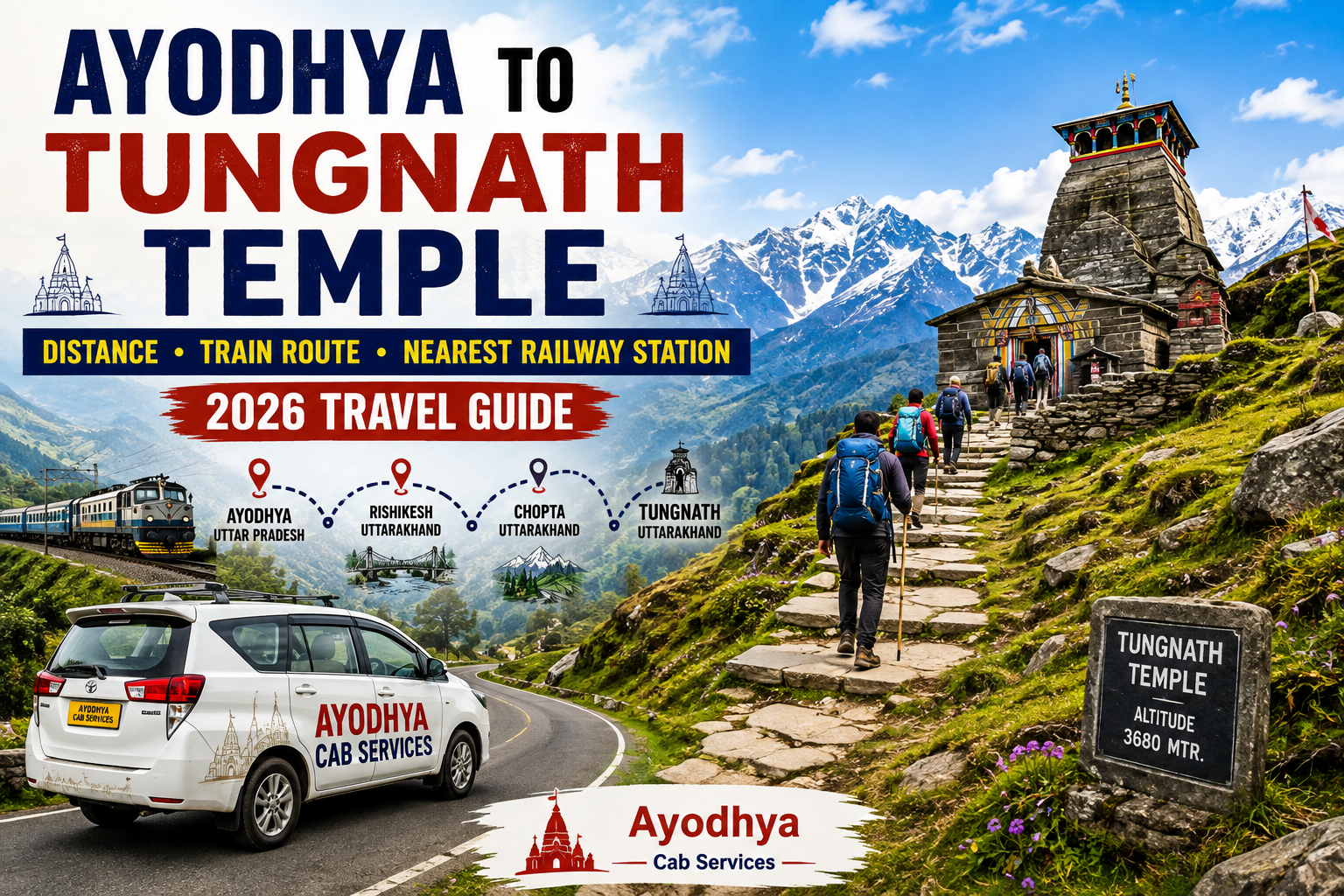
Ayodhya to Tungnath Temple journey via Uttarakhand and Chopta, covering the mountain road, Tungnath trek and complete 2026 travel route.
Ayodhya to Tungnath Temple Distance
The Ayodhya to Tungnath Temple Distance should be understood as a multi-stage journey rather than one simple road distance. Tungnath itself does not have direct motor-road access up to the temple entrance. Travellers first need to reach the Chopta area in Uttarakhand and then complete the final section on foot.
The exact road distance from Ayodhya to Chopta can change according to the route selected, current road conditions, diversions, and the starting point within Ayodhya. Therefore, it is better to check live navigation before departure instead of depending on one fixed kilometre figure.
Once you reach Chopta, the journey changes completely. Uttarakhand Tourism describes the Tungnath trek as about 4 km from Chopta. The temple stands at roughly 3,680 metres, which means altitude can make the short distance feel more demanding than an ordinary four-kilometre walk.
For this reason, travellers should calculate the journey in three parts: Ayodhya to the Uttarakhand rail or road gateway, the mountain road to Chopta, and the final trek to Tungnath. This gives a much more realistic picture of the trip.
How to Reach Tungnath Temple from Ayodhya
The easiest way to understand the route is to treat Chopta as your main destination before the trek. Tungnath cannot be approached like a normal city-to-city journey because the final section must be completed on foot.
Travellers starting from Ayodhya can choose between rail and road depending on their available time. A train-based journey usually means reaching a practical Uttarakhand railway gateway and then continuing by road. A complete road trip offers greater flexibility, particularly for travellers who want to stop at Haridwar, Rishikesh, Rudraprayag, or Ukhimath.
After reaching the mountain region, the route gradually becomes slower. Distances that appear short on a map can take considerably longer because of bends, traffic, weather, and elevation.
Eventually, travellers reach Chopta. From here, the Tungnath trek begins.
This final stage is what makes the journey different from an ordinary temple road trip. Plan enough time for both the ascent and descent instead of treating Chopta merely as a short stop.
Ayodhya to Tungnath Temple by Train
Searching for Ayodhya to Tungnath Temple by train can be slightly confusing because no railway line reaches Tungnath or Chopta. Train travel covers only the first major section of the journey.
A practical plan is to travel from Ayodhya toward Uttarakhand and then switch to road transport for Chopta. Depending on your travel date, connections through Haridwar, Rishikesh, Dehradun, or another suitable railway point may be worth comparing.
However, railway schedules can change. Direct availability also depends on the specific date and station selected. Ayodhya Dham Junction and Ayodhya Cantt are different stations, so travellers should check both while searching for a convenient train.
Do not book the onward mountain journey with an extremely tight connection. Train delays can affect the entire plan.
A comfortable itinerary leaves enough time between railway arrival and the hill journey. If your train reaches late in the day, staying overnight at a suitable gateway can be more comfortable than beginning a long mountain drive immediately.
Tungnath Temple Nearest Railway Station
Tungnath Temple Nearest Railway Station is one of the most important questions for travellers who do not want to drive all the way from Uttar Pradesh.
The official Rudraprayag district information lists Rishikesh as the nearest railhead for Chopta and places it at about 200 km from Chopta. However, travellers should remember that railway proximity and train convenience are not always the same thing.
Depending on the date, Haridwar can also be useful because it is a major railway junction with broader connectivity. Yog Nagari Rishikesh may be another station worth checking for current services.
Therefore, do not select a station only because it appears geographically closest.
Compare three things: train availability from your origin, arrival time, and onward road convenience. A station that gives you a better train and an early arrival may create an easier overall journey even if the road portion is slightly longer.
This is especially important for families and groups carrying luggage.
Rishikesh to Chopta Distance and Route
Rishikesh is a common gateway for travellers heading deeper into Garhwal. Official Rudraprayag district information places Chopta roughly 200 km from the Rishikesh railhead.
However, mountain kilometres should never be compared directly with highway kilometres.
The journey can take much longer than travellers initially expect because the route moves through hill roads. Traffic, weather, road repairs, landslides, and seasonal pilgrimage movement can also affect travel time.
Starting early is therefore helpful.
Travellers should avoid creating an itinerary where they reach Rishikesh around noon and expect to complete a relaxed mountain journey, check in, trek, and return on the same day.
Instead, treat Rishikesh to Chopta as an important travel stage. Once you enter the hill section, enjoy the journey without trying to maintain plains-style driving times.
A night halt near Chopta, Baniyakund, Duggalbitta, or another suitable nearby location can make the next morning much easier.
Haridwar to Chopta Route for Tungnath
Haridwar is another practical gateway for travellers arriving from Uttar Pradesh. Its major advantage is railway connectivity.
From Haridwar, the journey continues by road toward the Garhwal region and then toward Chopta. Depending on current conditions and navigation, travellers commonly move through the Rishikesh side before continuing deeper into the hills.
The road portion requires patience.
Although the overall distance may look manageable, mountain travel can involve slower average speeds. Therefore, families should avoid planning the journey based only on kilometres.
Haridwar can work particularly well when the available train reaches early in the morning. This gives travellers more daylight for the onward drive.
On the other hand, a late-night or evening arrival may justify an overnight halt.
When comparing Haridwar and Rishikesh, the better option is the one that creates the smoother complete itinerary. Railway timing can matter more than a relatively small difference in road distance.
Ayodhya to Chopta by Train
There is no railway station at Chopta. Therefore, Ayodhya to Chopta by train actually means using rail for the plains section and road transport for the remaining mountain journey.
Start by comparing trains from both major Ayodhya stations. Then check practical Uttarakhand gateways according to your travel date.
Do not assume that the geographically nearest station will always produce the fastest trip.
For example, one route may require multiple train changes but leave you closer to Chopta. Another may involve a longer road transfer but provide a convenient direct train.
For many travellers, fewer transfers are worth considering.
Changing trains with large bags can be tiring. The problem becomes more noticeable when trekking equipment and winter clothing are included.
Therefore, compare the complete door-to-Chopta travel time instead of rail kilometres alone. Once the railway portion ends, allow a separate day or substantial daylight window for the hill drive.
Ayodhya to Chopta Road Trip
A road trip offers the greatest flexibility because travellers can control stops, luggage, and overnight breaks.
However, the journey is long enough that fatigue should be taken seriously.
Drivers accustomed mainly to plains roads may also find the mountain section slower and more demanding. Therefore, a rested driver becomes particularly important after entering Uttarakhand.
The route can be divided into comfortable stages rather than completed as one exhausting drive.
An overnight break around Haridwar or Rishikesh can work for travellers who prefer a relaxed itinerary. Others may continue farther toward the mountain region depending on arrival time and driving comfort.
Weather should also influence the plan.
Heavy rain can slow hill traffic, while winter conditions can affect higher sections. As a result, check current road information shortly before travelling.
A flexible schedule is much safer than an itinerary that depends on reaching Chopta at one exact hour.
Chopta to Tungnath Temple Trek Distance
The Chopta to Tungnath section is the defining part of this journey.
Uttarakhand Tourism describes the trek as approximately 4 km. Some travel references give a slightly shorter figure, but around four kilometres is a sensible planning estimate.
The route climbs significantly.
Tungnath stands at approximately 3,680 metres. At this elevation, people who normally walk several kilometres without difficulty may still feel tired.
Therefore, trek difficulty should not be judged by distance alone.
Start slowly and maintain a comfortable pace. Short breaks are usually better than walking too quickly and becoming exhausted early.
Weather can also change the character of the trail. A clear route in one month may feel very different during rain, snow, or freezing conditions.
Comfortable footwear with reliable grip is particularly important.
For most visitors, reaching the temple is not a race. Give yourself enough time to enjoy the mountain scenery and complete the climb without unnecessary pressure.
Is Tungnath Trek Difficult for Beginners?
For reasonably active beginners, the trek is often described as manageable. However, “easy” can be misleading when altitude is ignored.
The trail begins around the high-altitude Chopta region and continues upward to approximately 3,680 metres. As elevation increases, some travellers may experience faster breathing and reduced stamina.
Beginners should therefore walk steadily.
Someone who regularly walks or exercises may find the climb easier than a person with a very sedentary routine. Still, individual responses to altitude vary.
Weather adds another variable.
A dry, clear trail can feel considerably easier than the same path during rain or snow.
Beginners should carry only necessary items and avoid an unnecessarily heavy backpack. Water, basic weather protection, suitable clothing, and dependable shoes matter more than carrying too many accessories.
Starting early also gives you more time to complete the trek without rushing.
Tungnath Temple Height and Altitude
Tungnath stands at around 3,680 metres above sea level. This high elevation is one reason the destination feels dramatically different from the plains of Uttar Pradesh.
Altitude influences temperature, breathing, walking speed, and weather.
Travellers coming directly from Ayodhya may notice the change more strongly because they move from low elevation to the Himalayan region within a relatively short period.
Do not underestimate cold conditions simply because the plains are warm.
Mountain temperatures can remain much lower, especially early in the morning and later in the day.
Wind can make conditions feel colder as well.
For this reason, carrying an additional warm layer is sensible even when the forecast appears comfortable.
Altitude also makes hydration important. Drink water regularly during the trek, but avoid forcing yourself to walk faster than feels comfortable.
If someone feels seriously unwell at elevation, continuing upward simply to complete the trek is not a sensible decision.
Chopta to Tungnath Trek Time
Trek duration varies significantly from person to person.
Fitness, age, weather, crowd levels, rest breaks, photography, and altitude can all influence the total time.
A traveller who regularly hikes may climb considerably faster than a first-time visitor. Families may need additional breaks.
Therefore, avoid building your itinerary around one fixed trek time.
The better strategy is to start early and keep enough daylight available for the return.
The descent is generally faster for many people, but it still requires care. Knees can feel more strain while walking downhill, and slippery sections can become challenging.
Stopping for photographs also adds time.
That is not a problem. The route itself is an important part of the experience.
A relaxed trek with sufficient time is usually more enjoyable than trying to meet an unrealistic schedule.
Tungnath Temple to Chandrashila Trek
Many visitors combine Tungnath with Chandrashila because the trail continues beyond the temple.
However, Chandrashila should be treated as an additional trek rather than an automatic part of every Tungnath visit.
The section beyond the temple becomes steeper, and the elevation increases further. Weather can also change quickly.
Therefore, assess your energy after reaching Tungnath.
If conditions are good and everyone in the group feels comfortable, Chandrashila may be considered. If someone is already exhausted, returning from the temple can be the wiser choice.
This is especially relevant for families, beginners, and travellers with limited daylight.
Do not allow social-media photographs to determine your decision.
Mountain travel rewards flexibility. Reaching Tungnath comfortably is already a complete journey.
Chandrashila should remain an optional extension based on current conditions, fitness, and available time.
Ayodhya to Tungnath and Chandrashila Trip
Travellers interested in both Tungnath and Chandrashila should add more flexibility to the itinerary.
The journey from Ayodhya is already substantial. After reaching Chopta, visitors need enough energy for the trek.
Trying to complete a long overnight journey and immediately begin climbing is not ideal.
Instead, reach the Chopta region, rest properly, and start the trek the following morning.
This creates a much more comfortable experience.
Early morning also provides more time if the Chandrashila extension takes longer than expected.
Keep the return journey in mind as well.
After descending to Chopta, tired travellers may not want to immediately begin another long mountain drive.
A nearby overnight stay can therefore improve the trip significantly.
This approach requires an additional night, but it reduces pressure throughout the journey.
Best Time to Visit Tungnath Temple in 2026
The best time depends on what you want from the trip.
Spring and early summer can provide pleasant trekking opportunities when conditions are suitable. Post-monsoon months can also attract travellers because mountain visibility may improve.
However, high-altitude weather is never completely predictable.
The temple itself operates seasonally rather than remaining open throughout the year. Therefore, anyone specifically travelling for temple darshan should verify the current opening status before departure.
This is especially important in late autumn and winter.
Rainy periods require additional caution because mountain roads and trekking trails can be affected.
Instead of selecting a month only because an old blog calls it the “best,” check current weather and local conditions close to your travel date.
For families and first-time trekkers, stable weather is generally more valuable than chasing snow or extreme conditions.
Tungnath Temple Opening Date 2026
For 2026 travel planning, the temple’s seasonal status is important.
Tungnath does not remain open in the same manner throughout winter. Therefore, travellers should distinguish between visiting the region and visiting the temple for darshan.
Opening and closing dates are determined seasonally.
Because these dates can change each year, always verify the current official status before finalizing travel.
This matters even more if your journey falls close to the beginning or end of the operating season.
Do not depend solely on an old video or previous year’s article.
Weather conditions can also affect practical accessibility even when the calendar suggests that travel should be possible.
A quick status check before leaving Ayodhya can prevent a major disappointment after a very long journey.
Tungnath Temple in Winter
Winter changes the Chopta–Tungnath experience significantly.
Snow can transform the landscape, but it also creates additional travel challenges. The temple follows a seasonal closure, and conditions on the trek can become much more demanding.
Therefore, winter travellers should not use a normal summer itinerary.
Road conditions need to be checked carefully. Suitable winter clothing becomes essential, while trekking footwear requires better grip.
Daylight is also shorter.
Moreover, people visiting mainly for darshan should understand the seasonal temple status before travelling.
Winter trekking may appeal to experienced travellers looking for snow, but beginners should avoid assuming that a short trek automatically means an easy winter hike.
Mountain conditions matter more than kilometre count.
Tungnath Temple During Monsoon
Monsoon travel requires extra flexibility.
Rain can affect both the mountain drive and the trekking route. Visibility may reduce, surfaces can become slippery, and road disruptions are possible in Himalayan areas.
Therefore, a tight schedule is particularly risky during this period.
Check the weather before leaving and again before beginning the mountain section.
If heavy rainfall is expected, changing the plan can be better than forcing the journey.
Footwear with good grip becomes even more important on wet trekking surfaces.
Carry rain protection, but avoid overloading your backpack.
Travellers should also keep buffer time for the return journey.
A road that was moving normally in the morning can experience delays later because of weather or traffic.
Monsoon landscapes can be beautiful, but the trip requires more caution than a stable-weather visit.
Tungnath Temple with Family
A family trip can be memorable when planned according to the slowest member of the group.
Do not create the itinerary based on the fastest trekker.
Children, parents, and older family members may need additional rest. Therefore, start early and maintain a pace that keeps everyone comfortable.
Accommodation location becomes important as well.
Staying closer to the trekking base can reduce early-morning travel.
Families should also carry only necessary luggage during the climb. Leave large bags at the accommodation or another suitable safe location.
Weather protection is important because children and older travellers may feel cold sooner.
Most importantly, avoid turning the trek into a compulsory target.
If someone becomes exhausted or uncomfortable, returning early is a perfectly reasonable decision.
The objective should be a safe and enjoyable family journey.
Tungnath Temple Trip for Senior Citizens
Senior travellers need more thoughtful planning because altitude and climbing can increase physical demand.
Age alone does not determine whether someone can complete the trek. Fitness, mobility, existing limitations, and previous trekking experience matter more.
However, anyone with relevant medical concerns should seek appropriate professional advice before attempting a high-altitude climb.
During the trip, keep the pace slow.
Allow frequent breaks and avoid carrying unnecessary weight.
A walking stick may help some travellers, particularly during descent.
The itinerary should also include proper rest before the trek.
Arriving after an exhausting overnight journey and immediately beginning the climb can make the experience much harder.
If the objective is a family pilgrimage, build the schedule around comfort rather than speed.
Tungnath Temple Trip with Kids
Children often enjoy the Chopta landscape, but parents should plan according to age and walking ability.
A child who regularly walks outdoors may manage better than one who is not used to extended climbing.
Cold weather is another consideration.
Children may not always communicate discomfort early, so parents should monitor them carefully.
Carry warm layers, water, and simple food without making the backpack unnecessarily heavy.
Frequent short breaks can make the climb easier.
Parents should also avoid setting Chandrashila as a compulsory extension.
First complete the journey to Tungnath comfortably. Then evaluate energy, weather, and daylight before considering anything further.
A successful family trek is one where everyone returns comfortably, not one where every possible viewpoint is completed.
Places to Stay Near Chopta for Tungnath Trek
Accommodation around the Chopta region is generally simpler than what travellers may expect in major tourist cities.
Nearby areas such as Baniyakund, Duggalbitta, and other settlements around the route can provide accommodation options depending on season and availability.
Travellers should book early during popular periods.
Do not judge a mountain stay only by luxury features.
Location, road access, heating arrangements, parking, meal availability, and distance from the trek starting point may matter more.
Electricity and connectivity can also differ from urban expectations.
Therefore, confirm essential facilities directly before travelling.
Families may prefer a comfortable room with reliable access over a visually attractive stay located far from the morning trekking point.
A well-chosen overnight base can make the entire Tungnath experience much easier.
Chopta or Ukhimath: Where Should You Stay?
Both locations can serve different travel styles.
Staying closer to Chopta makes an early trek easier. You spend less time travelling before beginning the climb.
However, accommodation options can vary by season.
Ukhimath is lower and more established, so some travellers may find it practical for certain itineraries.
The disadvantage is additional travel before reaching Chopta.
Therefore, choose according to your priority.
If Tungnath is the main objective, staying as close to the trek as reasonably possible can save morning time.
If you are exploring a wider part of Rudraprayag district, Ukhimath may fit better into the route.
Always check current road conditions and actual accommodation location before booking. Some properties marketed using “Chopta” may not be directly at the trek starting point.
What to Carry for Tungnath Trek
Packing should remain simple.
Good walking shoes are more important than fashionable trekking accessories. Carry water, basic food, sun protection, a light rain layer, and appropriate warm clothing.
Temperatures can change quickly at elevation.
A small backpack is generally more comfortable than carrying a heavy bag uphill.
Keep important personal items protected from rain.
A power bank can also be useful because travellers should not assume that charging facilities will always be convenient throughout the mountain journey.
Offline maps or saved booking details may help if connectivity becomes weak.
Most importantly, pack according to the season.
A summer visit and a winter trek require very different clothing.
Checking the weather immediately before departure is more useful than following a generic packing list written for another month.
Mobile Network and Internet in Chopta
Travellers should prepare for weaker connectivity than they are used to in major cities.
Network availability can vary by exact location and provider.
Therefore, download important information before reaching the higher mountain region.
Keep accommodation details, identification information, maps, and essential contact numbers accessible offline.
If travelling in a group, decide meeting points instead of depending entirely on phone calls.
This becomes particularly useful if members walk at different speeds.
Digital payments are convenient, but carrying some cash can provide backup where connectivity creates problems.
Avoid treating weak network access as an emergency by preparing before the journey.
A little planning can make the trip much smoother.
Food Options During Chopta Tungnath Trip
Food availability can change according to season and visitor numbers.
Travellers should not expect the same range of restaurants found in Rishikesh or Haridwar.
Simple meals and local food options are more realistic expectations.
Before beginning the trek, eating a comfortable breakfast can help maintain energy.
However, avoid an excessively heavy meal immediately before climbing.
Carry a small snack for the route.
Water is important too, particularly because the combination of climbing and altitude can increase fatigue.
Families travelling with children should carry a familiar snack in case suitable options are not available exactly when needed.
At the same time, avoid carrying excessive food and creating unnecessary waste.
Mountain areas are best enjoyed when visitors leave them clean.
Ayodhya to Tungnath Temple Travel Time
Total journey time depends heavily on the transport method.
Train travellers need to account for railway time, waiting time, the onward mountain drive, overnight rest, and the final trek.
Road travellers have more flexibility but still face a long journey from the plains into Uttarakhand.
Therefore, the fastest-looking route on paper is not always the most comfortable.
The hill section deserves its own time allocation.
Once Chopta is reached, the trek should also be treated as a separate activity rather than squeezed into the remaining hours of a travel day.
For most first-time visitors, a multi-day itinerary is far more realistic than trying to complete everything quickly.
Build buffer time into the plan.
This becomes especially useful when travelling during busy weekends, festival periods, rain, or uncertain mountain weather.
Ayodhya to Tungnath Temple 3 Day Itinerary
A three-day itinerary is possible only when transport connections work efficiently and the group is comfortable with substantial travel.
The first day can focus on moving from Ayodhya toward Uttarakhand and progressing toward the mountain region.
Depending on arrival time, an overnight stop may be needed before Chopta.
The second day should ideally prioritize the Tungnath trek.
Starting early gives enough time for a comfortable climb, darshan, rest, and descent. Chandrashila can be considered only if conditions and fitness allow.
After returning, staying near the mountain region can be more comfortable than beginning a very long return journey immediately.
The third day can then be used for the return toward the railway gateway or onward journey.
However, travellers should remember that three days can feel rushed.
A fourth day creates much better flexibility.
Ayodhya to Tungnath Temple 4 Day Itinerary
Four days provide a more comfortable structure for many travellers.
Day one can cover the journey from Ayodhya toward Haridwar or Rishikesh, depending on the chosen transport.
The second day can be dedicated to reaching Chopta and settling into accommodation.
This removes the pressure of trekking immediately after a long journey.
Day three becomes the main Tungnath day.
Start early, complete the climb at a comfortable pace, and return before conditions deteriorate. If the group is fit and weather remains favourable, Chandrashila can be evaluated separately.
Day four can then begin the return journey.
This schedule contains more rest and less rushing.
For families, first-time trekkers, and people travelling from the plains, that extra day can significantly improve the experience.
Ayodhya to Tungnath Temple Trip Cost
Trip cost varies too much for one fixed figure to remain reliable.
Train class, accommodation category, local transport, meals, season, and group size all affect the final budget.
A solo traveller using public transport may spend differently from a family hiring private transport for the hill section.
Accommodation prices can also rise during popular periods.
Therefore, calculate the budget in categories.
Start with the Ayodhya-to-Uttarakhand journey. Then add onward transport to Chopta, accommodation, food, and return travel.
Keep a small emergency buffer as well.
Mountain delays can occasionally create an extra meal, night stay, or transport expense.
Travellers should also avoid choosing a difficult connection merely to save a small amount.
Sometimes spending slightly more for a smoother route provides much better overall value.
Cheapest Way to Reach Tungnath from Ayodhya
Budget travellers should focus on reducing expensive road segments without creating an exhausting itinerary.
Rail can cover a large portion of the plains journey economically. After reaching Uttarakhand, shared transport may reduce the cost of travelling toward the mountain region when available.
However, public transport requires flexibility.
Departure timings may not perfectly match your train.
Connections can also involve waiting.
Therefore, the cheapest route is not always the shortest route.
Solo travellers may find shared options worthwhile, while groups can sometimes divide private transport costs among several people.
Accommodation choice also affects the budget significantly.
Simple stays closer to the trek can sometimes save both time and morning transport.
Compare the complete cost rather than one ticket price.
Is Tungnath Temple Worth Visiting from Ayodhya?
For travellers interested in Himalayan landscapes, trekking, Shiva temples, and Panch Kedar, Tungnath can justify the long journey.
The experience is not limited to the temple.
Chopta’s mountain environment, the trekking route, high-altitude views, and optional Chandrashila extension make the journey distinctive.
However, travellers should know what they are signing up for.
This is not a simple drive-to-the-gate temple visit.
The trip involves substantial travel from Ayodhya, a long mountain road, high elevation, and a trek.
Someone expecting an effortless weekend trip may find the schedule tiring.
On the other hand, travellers who plan enough time and enjoy walking may find the journey rewarding.
Understanding the route before departure is therefore the key to enjoying it.
Common Problems While Planning a Tungnath Trip
One common mistake is assuming that a train reaches close to the temple.
It does not.
Another problem is underestimating the mountain drive after leaving the railway station.
Travellers may also look at the short Chopta trek distance and assume the climb will be effortless. Altitude changes that calculation.
Weather creates another planning challenge.
Rain, snow, or road disruption can affect a carefully planned itinerary.
Poor accommodation planning can also create unnecessary morning travel.
Finally, some visitors try to include Chandrashila regardless of fitness or conditions.
A better approach is flexible planning.
Separate the trip into rail or road travel, mountain transfer, overnight rest, and trek. Once these stages are clear, the entire journey becomes easier to organize.
Best Route for First-Time Travellers from Ayodhya to Tungnath
First-time travellers should prioritize simplicity.
Choose a rail connection that provides a convenient arrival rather than creating several complicated changes merely to save a little time or money.
After reaching Uttarakhand, allow enough daylight for the mountain journey.
Stay near the Chopta region before trekking.
The next morning, start early and keep the day focused primarily on Tungnath.
This approach reduces pressure at every stage.
It also leaves room for unexpected delays.
If Chandrashila is important, consider adding enough time so that it remains optional rather than compulsory.
First-time mountain travellers often enjoy the trip more when the itinerary contains fewer destinations.
Tungnath itself is enough to build a memorable journey around.
Ayodhya to Chopta Tungnath Travel Guide 2026
A successful 2026 trip begins with realistic expectations.
Tungnath is situated at high elevation in Rudraprayag district. Chopta serves as the practical trekking base, while Rishikesh is identified by the district administration as the nearest railhead for Chopta.
From Chopta, travellers continue on foot.
That means the journey contains very different travel environments. You begin in the plains, enter winding Himalayan roads, reach a high-altitude base, and finally trek to the temple.
Each stage needs separate planning.
Rail schedules should be checked for the exact date. Road conditions should be reviewed close to departure. Weather needs another check before the trek.
Accommodation should also be confirmed in advance during busy periods.
When these basics are handled properly, the journey becomes far easier.
Planning the Ayodhya to Tungnath Temple Distance properly means looking beyond one kilometre figure. The complete journey includes plains travel, a long mountain-road section, arrival at Chopta, and the final high-altitude trek.
Rishikesh is officially listed as the nearest railhead for Chopta, while other railway gateways can still be worth comparing according to your exact travel date. Once travellers reach Chopta, the approximately four-kilometre climb becomes the final and most memorable stage.
For a comfortable 2026 journey, avoid rushing. Check train schedules before booking, verify mountain road and weather conditions shortly before departure, and stay close enough to Chopta for an early trek. Keep Chandrashila optional, especially for beginners and families.
Why Ayodhya Cab Services Is a Leading Cab Service in Ayodhya
Ayodhya Cab Services focuses on convenient and dependable cab travel for customers in Ayodhya. Travellers may need transportation for railway station pickup, airport transfers, local sightseeing, family journeys, business travel, or an outstation trip starting from the city. Having one travel service that can help plan different journey requirements makes the process simpler.
Our aim is to build a strong reputation as one of the best cab services in Ayodhya through professional travel support and customer-focused trip planning. Instead of treating every booking in the same way, the journey can be planned according to destination, group size, luggage, travel schedule, and vehicle requirement.
For travellers researching routes such as Ayodhya to Tungnath, the same principle matters. A long-distance journey requires better planning than a short city ride. Route conditions, overnight stops, mountain travel, and total journey time should all be considered before departure.
Best Cab Service in Ayodhya for Local and Outstation Travel
People searching for the best cab service in Ayodhya usually want more than a vehicle. Clear communication, suitable travel planning, comfortable transportation, and dependable coordination can be equally important.
Ayodhya Cab Services caters to travel requirements originating from its service areas while helping customers plan suitable outstation journeys. This can include family trips, business travel, railway transfers, airport travel, and longer routes beginning from Ayodhya.
However, an important distinction should remain clear. Outstation travel from Ayodhya does not mean we operate local taxi services in every Indian city. Our core service presence remains focused on Ayodhya, Lucknow, and Varanasi.
This clarity helps travellers understand the service correctly while keeping the brand connected with its strongest locations.
Top Cab Service in Ayodhya for Comfortable Travel
Ayodhya has become an important destination for visitors arriving from different parts of India. As travel demand grows, customers increasingly search for a top cab service in Ayodhya that can support both short and longer journeys.
Ayodhya Cab Services aims to meet this need with a straightforward travel approach. Customers can plan transportation according to their pickup point, destination, number of passengers, and trip requirements.
For tourists, this can make local movement easier. Meanwhile, residents planning an outstation journey can organize transportation from Ayodhya toward their destination without searching for multiple options at the last moment.
The objective is simple: make cab planning easier while maintaining clear communication about where our local services are actually available.
Ayodhya Cab Services for Outstation Trips from Ayodhya
Outstation cab from Ayodhya is an important search term for travellers planning longer journeys. Families may be travelling for holidays, temple visits, weddings, personal work, or other purposes. In such cases, a planned road journey can offer more flexibility than depending on several separate transport connections.
Ayodhya Cab Services can be relevant when the journey starts from Ayodhya and continues toward an outstation destination, subject to route and booking availability.
This wording is important for customers. For example, discussing an Ayodhya-to-Uttarakhand route does not imply that the company provides local taxi operations throughout Uttarakhand.
Instead, the service can be positioned around journeys originating from Ayodhya. This keeps the information accurate while still allowing the website to publish useful travel guides covering destinations across India.
Ayodhya to Anywhere in India Cab Travel
Travellers frequently search for Ayodhya to anywhere in India cab travel when planning long-distance road journeys. Such searches can include destinations across Uttar Pradesh as well as other states.
Ayodhya Cab Services can help with suitable outstation journeys that start from Ayodhya and travel toward destinations across India, depending on route feasibility and booking requirements.
That does not mean local cab service is available in every destination city.
For instance, someone reading an Ayodhya-to-Tungnath guide should understand that the article provides route and travel information. If an outstation journey begins from Ayodhya, it can be discussed separately according to the actual requirement.
This positioning allows the website to target national travel searches without creating the impression of having branches or local taxi operations across India.
Ayodhya to Uttarakhand Outstation Cab Travel
Travellers researching an Ayodhya to Uttarakhand outstation cab may be planning destinations such as Haridwar, Rishikesh, Chopta, or other mountain regions.
Long-distance mountain journeys require more preparation than ordinary highway trips. Driving time increases after entering hill roads, while weather and route conditions can affect the schedule. Therefore, sufficient rest and realistic travel timing become important.
For a Tungnath journey, road access generally takes travellers toward the Chopta region. The final section to the temple involves trekking, so a cab cannot take passengers directly to the temple itself.
Anyone considering such a long outstation route from Ayodhya should plan the road and trekking portions separately. This provides a more realistic picture of the complete journey.
Ayodhya to Tungnath Temple Cab Travel Planning
People searching for an Ayodhya to Tungnath Temple cab should first understand how the destination is accessed. Tungnath is not a location where a taxi can simply stop outside the temple entrance.
The road portion takes travellers toward Chopta. After reaching the trekking base, the remaining journey is completed on foot.
Therefore, an Ayodhya-to-Tungnath road trip needs enough time for the long drive, mountain roads, rest, accommodation, and trekking day.
Ayodhya Cab Services can be associated with the Ayodhya-origin outstation journey, rather than being described as a local Tungnath or Uttarakhand taxi operator. This distinction prevents confusion while keeping the travel guide useful for people genuinely planning the route from Ayodhya.
Best Outstation Cab Service from Ayodhya
A traveller looking for the best outstation cab service from Ayodhya may compare options based on comfort, communication, vehicle suitability, route planning, and overall convenience.
Long-distance journeys require different planning from local rides. A family carrying several bags may have different vehicle requirements from two people travelling together. Similarly, a mountain journey needs a different schedule from a straightforward expressway trip.
Ayodhya Cab Services can focus on understanding these practical requirements before the journey begins.
By keeping the service centered on trips originating from its actual operating areas, the brand can build stronger customer trust. Clear service information is more valuable than claiming availability in places where local operations are not provided.
Cab Service in Ayodhya for Railway Station and Airport Transfers
Transport connections are another important part of travel planning. Visitors arriving in Ayodhya may need transportation from a railway station to their hotel, accommodation, or another destination within the service area.
Similarly, travellers beginning a longer journey may need coordinated pickup according to their train or travel schedule.
An Ayodhya railway station cab service can therefore be useful for both tourists and local residents. Airport-related travel can also be planned according to the customer’s route and requirements.
These searches are highly relevant for a local travel business because they connect directly with people who already need transportation in Ayodhya.
Cab Service from Lucknow to Ayodhya
Lucknow to Ayodhya cab service is another useful branded search area because Lucknow is within the company’s actual service coverage.
Travellers arriving in Lucknow may want to continue toward Ayodhya by road. A cab provides flexibility for families carrying luggage and groups that prefer direct transportation instead of changing between several modes of travel.
The reverse journey can also be useful for customers travelling from Ayodhya toward Lucknow.
By building detailed content around these genuine service routes, Ayodhya Cab Services can attract customers who are more likely to need an actual booking rather than enquiries from unsupported locations.
Varanasi to Ayodhya Cab Service
Varanasi and Ayodhya are two major travel destinations in Uttar Pradesh. Therefore, Varanasi to Ayodhya cab service is another valuable long-tail keyword for the website.
Travellers may want to combine both cities within one itinerary. Road travel provides the flexibility to choose departure time and manage luggage without depending entirely on railway schedules.
Ayodhya Cab Services can build useful route information around both directions. Articles can explain travel planning, approximate journey considerations, pickup options, and itinerary ideas.
Since Varanasi is part of the actual service area, this type of content has stronger commercial relevance than targeting unrelated local taxi searches in distant states.
Why Choose Ayodhya Cab Services?
Choosing a travel company is ultimately about confidence in the complete booking experience. Ayodhya Cab Services aims to build that confidence through clear communication, practical route planning, and service focused on its genuine operating locations.
The company can support travel requirements around Ayodhya, Lucknow, and Varanasi, while suitable outstation journeys may begin from these service areas and continue toward other destinations.
This distinction is central to the brand.
Publishing travel guides about Tungnath, Kedarnath, Gujarat, Rajasthan, South India, or other destinations does not mean Ayodhya Cab Services operates local taxis in every state. Those guides are created to help travellers research routes and plan journeys.
For customers specifically searching for a top cab service in Ayodhya, best cab service in Ayodhya, outstation cab from Ayodhya, or Ayodhya to anywhere in India cab, the brand can remain strongly associated with its home market while still building nationwide travel-topic visibility.

