
Tulsipur Railway Station to Devi Patan Temple Distance: Route & Travel Guide
The journey from Tulsipur Railway Station to Devi Patan Temple is approximately 1.6–2 km, according to Balrampur district’s official information. Check the route from your actual station exit to the temple entrance you intend to use before deciding whether to walk or arrange local transport. India
The railway station is Tulsipur, code TLR. The destination is Devi Patan Temple in Tulsipur, also identified in district information as the temple of Maa Pateshwari.
Although the distance is short, your arrival still needs a little planning. Luggage, weather, walking ability and the available temple approach can matter more than the number of kilometres.
This guide explains how to identify the correct station, check the route, compare walking with local transport and avoid confusing this short transfer with a longer journey from another town.
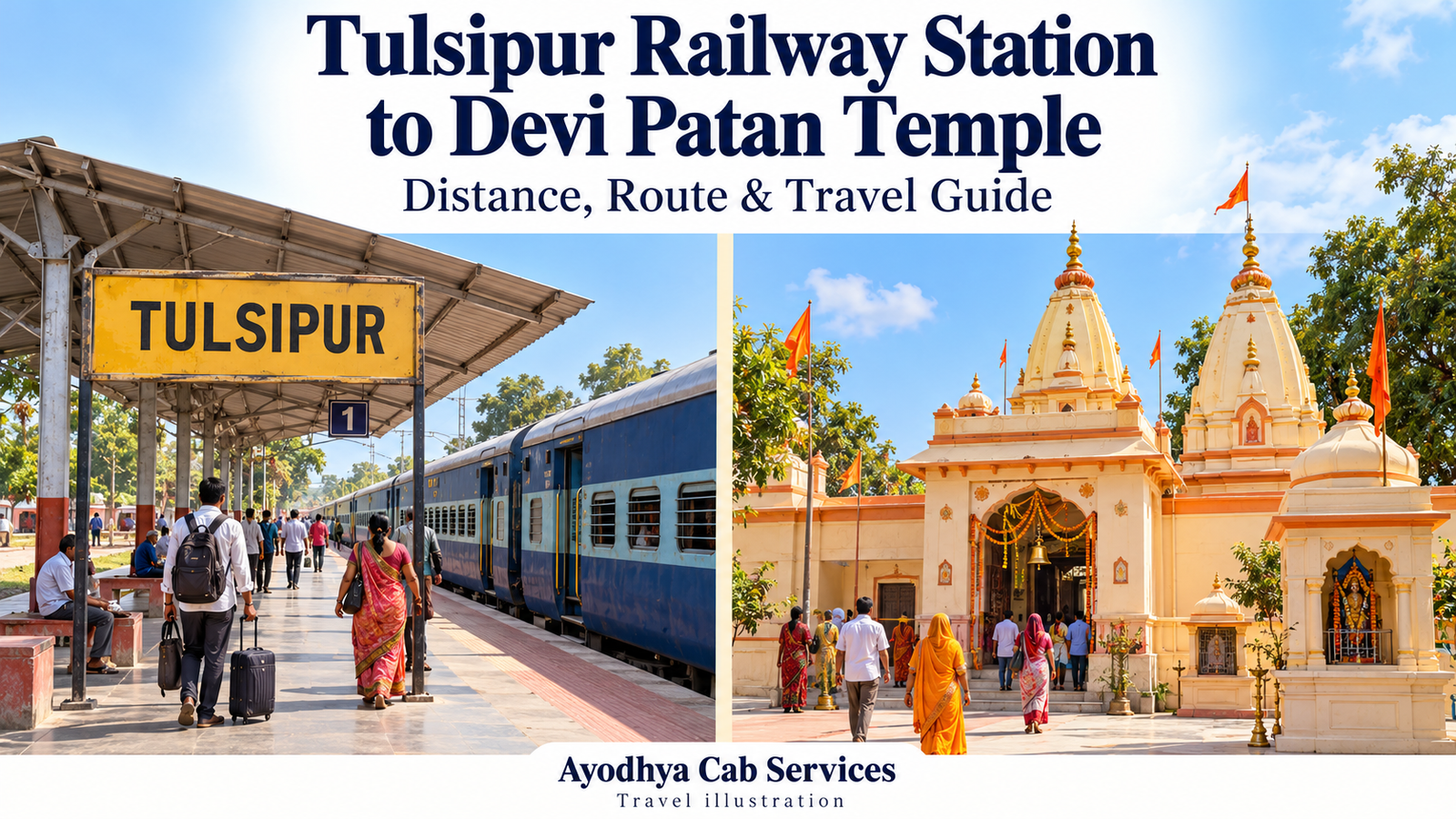
Plan the journey from Tulsipur railway station to Devi Patan Temple by checking the route and visitor approach.
Tulsipur Railway Station to Devi Patan Temple: Quick Travel Details
| Detail | What to know |
|---|---|
| Arrival station | Tulsipur railway station |
| Station code | TLR |
| Destination | Devi Patan Temple, Tulsipur |
| Alternative temple name | Maa Pateshwari Devi Temple |
| District | Balrampur, Uttar Pradesh |
| Published station distance | Approximately 1.6–2 km |
| General orientation | District information places the temple northwest of the station |
| Exact route | Check the selected station exit and temple approach |
| Walking time | Calculate from the actual walking route and your pace |
| Vehicle time | Check current conditions; no fixed duration is verified here |
| Transport fare | Obtain a current quote |
| Final access | Confirm where a vehicle can stop and whether walking remains |
Use this table to establish the journey, not as a substitute for checking arrangements on your travel date.
A traveller with a light bag may be comfortable considering a walk. Someone arriving with children, suitcases or limited mobility may make a different choice.
Confirm That Your Train Stops at Tulsipur
Indian Railways’ station listing identifies Tulsipur as TLR, in Balrampur district, Uttar Pradesh. Use that code when checking your booking rather than relying only on a shortened place name. Old Station
Before arranging the local transfer, open your ticket and check:
- The arrival station name.
- The station code.
- The arrival date.
- The scheduled arrival time.
- Whether the selected service stops at TLR on your date.
A route passing through the area is not the same as a train stopping at the station.
Do not confuse the temple’s district with the arrival station
Devi Patan Temple is in Balrampur district, but a ticket to another station in the district creates a different transfer.
If your booking ends at Balrampur rather than Tulsipur, the 1.6–2 km figure in this guide does not apply.
The same principle holds for an arrival at Gonda, Gorakhpur or another railhead. Check the actual final station before estimating the onward journey.
For this article, every station-to-temple reference starts at Tulsipur railway station.
Check dates carefully around midnight
A train arriving shortly after midnight arrives on the next calendar date.
When discussing accommodation or a pickup, write both the date and time. “Tonight” can become unclear when different people interpret it differently.
For example:
“Our train reaches Tulsipur on [date] at [time]. Please confirm arrangements for that arrival.”
Use the actual booking details and update the person expecting you if the arrival changes.
Identify the Correct Devi Patan Temple
Balrampur district’s temple page identifies Devi Patan as a shrine in Tulsipur dedicated to Maa Pateshwari. It describes its importance in the Shakti Peetha tradition. India
For travel planning, the main task is selecting that destination rather than another place with a similar name.
Useful search terms include:
- Devi Patan Temple Tulsipur.
- Devipatan Mandir Tulsipur.
- Maa Pateshwari Devi Temple Tulsipur.
These are name variations for identifying the destination. They do not need to be repeated throughout your itinerary.
Check the location preview
Before starting navigation, confirm that the result:
- Identifies Tulsipur.
- Refers to the temple you intend to visit.
- Uses Tulsipur railway station as the origin.
- Shows a suitable route for your chosen mode.
A map can accidentally use your current location as the starting point. It may also select a broad locality rather than the entrance.
Read the route preview before accepting the first result.
Save the entrance or approach you need
A temple location pin may identify the complex generally.
If someone is meeting you, ask for the specific public meeting point. If you have accommodation nearby, obtain its entrance location directly from the property.
The useful destination is the place where your next task begins—not simply the centre of a map label.
Why Do Official Sources Say Both 1.6 km and 2 km?
One district page gives a more specific location description: 1.6 km northwest of Tulsipur station. Another uses a rounded distance of 2 km.
That difference does not establish two competing live routes.
The sources do not specify every detail of measurement, such as the station exit, pedestrian entrance or vehicle stopping point. Use approximately 1.6–2 km as the published reference range.
Check the travel mode
Walking and driving directions may follow different routes.
A pedestrian route should be assessed for usable public access. A vehicle route should be assessed for the point where the vehicle can actually stop.
Do not assume that a straight line between two pins represents either journey.
Avoid unsupported precision
An exact-looking figure such as “1.73 km” needs an identifiable measurement.
If you check a map, record:
- The origin selected.
- The destination selected.
- The travel mode.
- The date of the check.
That makes the figure useful and reproducible.
Without those details, a rounded reference is more appropriate than claiming a precise gate-to-gate distance.
Route from Tulsipur Station to the Temple
At an orientation level, the journey is:
Tulsipur railway station → the public road route towards Devi Patan Temple → the permitted drop-off or pedestrian approach → the temple entrance.
District information places the temple northwest of the station. This provides orientation; it is not a verified turn-by-turn instruction.
Use current navigation or directions from an identifiable local source for the actual route.
Check before leaving the station area
Once you are outside, identify where you intend to go before moving away with luggage.
If walking, open pedestrian directions and inspect the entire route. If hiring transport, show the destination and confirm the endpoint.
A useful question is:
“Does this route reach the temple entrance, or does it finish at a vehicle stopping point?”
That question is especially important for someone who cannot comfortably manage additional walking.
Do not improvise railway shortcuts
Use public exits and recognised routes.
A path that appears shorter on a map is not necessarily a permitted crossing or a suitable way through railway land.
Do not cross tracks or enter restricted areas to reduce a short road journey. Follow station signs and staff directions where needed.
Ask for directions that identify the next step
“Which way is the temple?” may give you only a general direction.
More useful questions include:
“Which public road should we take from this exit?”
“Is this the walking route to Devi Patan Temple?”
“Where does the vehicle drop passengers?”
Confirm the answer against your map where possible.
Can You Walk from Tulsipur Railway Station to Devi Patan Temple?
The published distance makes walking worth considering, but distance alone does not establish that it suits everyone.
Assess:
- Your luggage.
- Your usual walking ability.
- The current weather.
- The time of arrival.
- The actual pedestrian route.
- Any remaining walking inside the destination.
Someone arriving after an overnight journey may prefer to rest or take transport even if they normally walk similar distances comfortably.
Estimate walking time using your own pace
For illustration, a person walking at 4 km per hour would cover:
- 1.6 km in approximately 24 minutes.
- 2 km in approximately 30 minutes.
That is a mathematical example. It is not a verified walking time for this route.
It excludes station exit time, road crossings, stops, luggage handling and any extra approach beyond the selected map endpoint.
If your group walks more slowly, adjust the calculation rather than adopting the example as a promise.
Include the whole group
A walking plan should suit everyone expected to follow it.
Before setting off, ask whether anyone would find the distance difficult with the bags they are carrying.
For a family, a short transport journey may preserve energy for the visit. For another group, walking could be a comfortable option after checking the route.
Neither choice is automatically better.
Reconsider walking when conditions are unsuitable
Choose another arrangement if you cannot establish a suitable public route or if the journey would be uncomfortable for your group.
Arriving after dark with several bags is a different situation from walking in daylight with a small backpack.
You do not need to justify taking transport simply because the destination is nearby.
Local Transport: Confirm Availability Before Depending on It
For a short station transfer, ask locally about an auto-rickshaw, e-rickshaw or another suitable vehicle.
This guide does not verify that a particular type operates at every hour, that an app-based service covers the journey or that shared transport departs on a timetable.
Avoid building a tightly timed visit around those assumptions.
Clarify whether the quote is shared or exclusive
Before boarding, ask:
“Is this the fare for one passenger or for the complete vehicle?”
Then confirm whether the journey is direct.
A price that looks low may cover one seat or only part of the route. An exclusive quote may cover the whole vehicle.
Compare the complete arrangement.
Check seating and luggage together
Count both passengers and bags.
A vehicle can have enough seats but insufficient practical luggage space. Do not assume a large suitcase will fit comfortably because the passenger count is acceptable.
Explain the group’s needs before agreeing:
“We are [number] people with [number] bags. Can this vehicle carry everyone comfortably to the agreed drop-off?”
Inspect the arrangement before loading.
Confirm the stopping point
Ask where the vehicle journey ends.
If someone has limited mobility, ask approximately how far remains and whether the approach involves steps or uneven ground.
Do not describe the temple as fully accessible based only on a close vehicle drop-off. Accessibility depends on the complete journey.
What Should the Station Transfer Cost?
No current official local fare has been verified for this article.
Rather than publishing an unsupported price, obtain a quote on your date and clarify what it includes.
| Question | Why ask it? |
|---|---|
| Is the fare per person or per vehicle? | Establishes the actual total |
| Is the journey direct? | Identifies any required change |
| Are bags included? | Prevents uncertainty about luggage |
| Where will we get down? | Connects the quote to the destination |
| Are any additional charges expected? | Helps compare complete prices |
| Is waiting included? | Matters if discussing a return arrangement |
If comparing quotes, keep the destination and vehicle arrangement the same.
Agree before loading luggage
Settle the route and charge while you still have a clear choice.
Once everyone is seated, resolving an ambiguous price becomes more difficult.
For an arrangement confirmed in advance, retain the message identifying the date, destination and agreed charge.
A written record is useful without turning an informal quote into a permanent fare claim.
How Much Time Should You Allow After the Train Arrives?
The station-to-temple journey includes more than time spent walking or riding.
Break it into stages:
| Stage | Planning consideration |
|---|---|
| Leaving the train | Bags, coach position and group coordination |
| Reaching the exit | Actual platform and exit route |
| Choosing the onward arrangement | Walking check or transport discussion |
| Local journey | Route and conditions |
| Final approach | Drop-off, bags and walking |
| Entering the visit | Current temple arrangements |
Do not add a short vehicle estimate directly to the train timetable and assume that is your darshan arrival.
Separate arrival time from queue time
Reaching the temple area does not establish when you will complete darshan.
Entry arrangements and waiting need their own check. This article does not verify a fixed queue duration.
If your return train leaves soon afterwards, calculate whether the available window remains comfortable after all stages are included.
Part 3 will show how to work backwards from the departure.
Keep the first activity flexible
If the train is late, simplify the plan.
Avoid a sequence that requires immediate departure from the platform, immediate transport and immediate entry without any room for change.
For a short visit, identify the main purpose and keep extra activities optional.
Luggage: Decide Before You Reach the Entrance
The short transfer can make it tempting to go directly to the temple with every bag.
First consider what you will do with those belongings during the visit.
Do not assume that station storage, temple storage or a cloakroom is available. Those facilities and their conditions need current confirmation.
If you have accommodation
Ask whether you can check in or leave bags at your arrival time.
Confirm:
- The entrance location.
- Room availability.
- Luggage-storage arrangements, if offered.
- Any charge.
- When you can collect the bags.
A room booking does not automatically mean early access.
If you are visiting between trains
Travel light where practical, and establish a suitable luggage plan before committing to the schedule.
If no storage is confirmed, account for carrying the bags or revise the arrangement.
Leaving bags somewhere without an agreed process is not a substitute for a storage facility.
A Family Arrival Plan
Consider a hypothetical family arriving with two suitcases and an older parent.
Their sensible sequence might be:
- Confirm the group and bags are together.
- Check the intended temple approach.
- Ask about a suitable exclusive vehicle.
- Establish the drop-off and remaining walk.
- Settle luggage arrangements.
- Begin the visit once everyone is ready.
This is an illustrative plan, not a report of a journey or a local service offer.
A solo traveller with a small bag could instead check the pedestrian route and decide to walk. The planning method remains the same: match the arrangement to the person.
Keep These Details Available on Your Phone
Before leaving the station, save:
- Your train booking.
- The destination location.
- Accommodation details, if applicable.
- Any agreed pickup information.
- A contact number for someone in your group.
- A screenshot of the route.
If another adult is travelling with you, share the essential details rather than keeping everything on one device.
For someone who does not use a smartphone, write down the accommodation name or meeting point.
Before You Begin the Temple Visit
Once you reach the destination, pause and establish:
- Where you arrived.
- Where you will meet if separated.
- What will happen to the bags.
- Which activity is the priority.
- When you need to reconsider the return.
The distance from Tulsipur Railway Station to Devi Patan Temple is short enough that practical access decisions deserve more attention than an elaborate road itinerary.
After Reaching Devi Patan Temple: Check the Day’s Arrangements
The journey from Tulsipur station is short, but reaching the temple area is not the same as being ready for darshan.
Before joining a queue, identify the public entrance, check where belongings should remain and confirm any instructions displayed for visitors.
If you are travelling with family, establish one meeting point outside the queue. Choose something specific that everyone can recognise rather than saying “near the entrance.”
Then decide your priority:
- Darshan only.
- Darshan followed by time in the complex.
- A particular religious observance.
- A family ceremony arranged in advance.
This helps you estimate the visit more sensibly than assuming everyone needs the same amount of time.
Ask before choosing a queue
Do not assume that every line or gathering leads to the activity you want.
Ask an identifiable member of staff or an authorised representative:
“Is this the general darshan queue?”
If you are visiting for a ceremony, explain that separately. A person arriving for ordinary darshan and a family attending a prearranged observance may need different instructions.
Follow the arrangements in operation on the day rather than relying on an old video.
Why Is Devi Patan Temple Important?
Devi Patan Temple is dedicated to Maa Pateshwari. Balrampur district’s official description identifies it as an important shrine in the Shakti Peetha tradition.
According to the belief recorded there, Mata Sati’s right shoulder fell at this location. Present this as a religious tradition, rather than an independently verified historical event. India
That distinction allows a travel guide to explain the temple’s significance respectfully and accurately.
For visitors, understanding the shrine’s purpose can also help shape the day. Some come for a brief darshan, while others have a particular family or devotional reason for visiting.
You do not need a complicated itinerary
A meaningful visit does not require adding several destinations.
If this is your main pilgrimage stop, leave space to understand the arrangements, complete your intended worship and depart without rushing.
An itinerary that lists many places may look comprehensive while leaving little time for the one that matters most.
Distinguish the shrine from the wider region
“Devipatan” can also appear in regional and administrative references.
For this journey, keep the destination specific: Devi Patan Temple in Tulsipur.
That becomes useful when checking accommodation, transport or directions. A reference to the wider region does not necessarily identify a property or attraction close to the temple.
Devi Patan Temple Timings: What the Official Listing Says
Balrampur district’s places-of-interest page lists the following opening periods under its Devi Patan information:
| Period | Published opening hours |
|---|---|
| Early morning to afternoon | 4:00 am–3:30 pm |
| Evening | 6:30 pm–10:00 pm |
Treat these as published reference hours, not a live confirmation for your travel date. The listing should not be interpreted as an aarti schedule or a guarantee that every activity is available throughout those hours. India
Confirm current arrangements before making a tightly timed journey.
Opening hours and aarti timings are different
A temple being open does not establish when a particular ritual begins.
If attending aarti is important, ask:
- Which aarti you intend to attend.
- Its expected time on your date.
- Where visitors should gather.
- Whether you need to arrive earlier.
- Whether the ordinary darshan arrangement changes around it.
No current aarti timetable has been independently verified for this guide.
Avoid using a general opening-time table to infer ritual timings.
Be careful with an afternoon arrival
The published listing separates the day into two periods.
If your train arrives around the gap between them, check whether your intended visit is possible immediately or whether you should plan a meal, rest or accommodation first.
Do not assume that a short station transfer means every arrival time is equally convenient.
For example, a traveller arriving during an interval may have more usable time by resting first than by waiting with luggage near an entrance.
Check again when the date matters
Festival arrangements, special observances or local instructions can affect a visit.
Use the official district information as a starting point, then seek a current confirmation where your plan depends on a particular time.
A useful enquiry is:
“We plan to visit on [date] after arriving at Tulsipur station around [time]. What are the current general darshan hours, and is there any special arrangement that day?”
Keep the answer separate from assumptions about queue duration.
Darshan Duration: Allow for the Queue, Not Just the Distance
The short distance from the station does not predict how long the temple visit will take.
Your total time may include:
- Reaching the correct approach.
- Settling bags and footwear.
- Finding the general queue.
- Waiting and completing darshan.
- Returning to your meeting point.
- Preparing for the onward journey.
No dependable fixed queue duration has been verified here.
Ask about the present situation
When you arrive, ask how the queue is operating rather than asking for a guaranteed completion time.
A current observation can help you decide whether to continue with optional activities. It still cannot promise exactly when you will finish.
If you have a return train, establish the latest time you need to leave before entering a lengthy activity.
Part 3 will explain that calculation.
Keep your next commitment flexible
Avoid arranging another stop on the assumption that darshan will finish at an exact minute.
For a same-day visitor, the sensible priority is:
Complete the main visit comfortably, then decide what else fits.
If the queue takes longer than expected, remove the optional activity rather than reducing your station-transfer allowance.
Visiting During Navratri and Other Important Observances
The district’s temple description specifically notes heavy attendance during Navratri. That supports planning for a busier visit, but it does not establish a queue length or a particular restriction for every date. India
Before travelling during an important observance, check:
- Current entry arrangements.
- Whether the usual vehicle approach is available.
- Accommodation confirmation.
- Any instructions relevant to your intended ceremony.
- How you will return to the station.
The plan should work even if you need more time than on a quieter visit.
Chaitra-related traditions
Balrampur district’s cultural information describes a Navratri fair and a tradition involving Pir Ratan Nath, brought from Dang in Nepal on Chaitra Panchami for worship at Devi Patan. India
This is useful background to the temple’s regional connections.
It is not a current event programme. If your visit is specifically connected with that tradition, verify the year’s dates and arrangements before booking.
A general cultural description cannot confirm the timing of a particular procession or ceremony.
Choose comfort over a crowded checklist
On a busy date, a simpler itinerary is easier to manage.
Consider whether everyone in the group can comfortably wait, stand and move together. Explain the meeting point before entering a crowd and keep essential belongings manageable.
Do not assume a vehicle can remain at the same place where it dropped you. Confirm the return meeting arrangement independently.
Mundan and Other Family Ceremonies
The district administration notes that families visit Devi Patan for children’s mundan ceremonies and hair offerings. This establishes the practice’s association with the shrine, not the current booking process, fee or availability of a particular provider. India
If a ceremony is the purpose of your journey, organise it separately from the station transfer.
Confirm the process before travelling
Ask the appropriate temple representative:
- Whether advance arrangements are needed.
- Where the family should report.
- What the ceremony involves.
- Which items, if any, you should bring.
- Whether there are stated charges.
- How offerings or ceremony materials should be handled.
Do not rely only on someone approaching you outside.
A clear explanation before payment helps distinguish an agreed service from an unexpected additional request.
Leave room for the child’s routine
A ceremony plan should allow for ordinary needs such as feeding, rest and changing clothes.
Avoid placing a ceremony immediately between a train arrival and a tightly timed departure without checking the full sequence.
For an infant or young child, an overnight stay may be useful if it makes the day more manageable. It is not automatically necessary; the decision depends on the confirmed arrangements.
Keep the family’s belongings organised
Prepare the items you need together rather than searching through several suitcases at the location.
Nominate one adult to hold the booking details or instructions. Another can manage the bags while the immediate ceremony takes place.
This simple division can prevent the whole group from moving back and forth unnecessarily.
Surya Kund: Understand the Context Before Participating
The district’s places-of-interest page identifies Surya Kund within the temple complex and records a belief connecting it with Karna. India
Treat the religious association as a tradition.
Its inclusion in tourism information does not establish current bathing access, water conditions or whether a visitor should enter the water.
Follow the instructions in operation
If you intend to participate in any water-related observance, ask about the recognised arrangement and follow local instructions.
Do not assume every step or edge is suitable for access.
Visitors can choose how to participate in the pilgrimage. Being present at the shrine does not require every member of the group to undertake the same activity.
Offerings, Donations and Optional Services
Before agreeing to a paid activity, understand what is being offered.
A devotional purchase, a donation and a service charge are different things. Ask for clarification if the distinction is unclear.
Useful questions include:
“Is this optional?”
“What does the amount cover?”
“Is there an official counter or receipt?”
Do not feel obliged to make an immediate decision because you have just arrived.
Keep purchases practical
If you wish to bring offerings, check what is permitted and appropriate.
Avoid buying more than you can comfortably carry or items that you cannot use as intended.
Follow the shrine’s instructions for disposal and do not leave packaging in public areas.
Ask before photographing worship
Photography rules can differ between areas.
Check before recording inside the temple or photographing a ceremony closely. Avoid blocking access while taking pictures.
If photography is restricted, respect that instruction rather than relying on images you have seen online.
Food and Rest: Plan Them Around the Confirmed Visit
District information mentions dharamshala and food arrangements associated with the temple. It does not establish that a particular room or meal is available to every visitor at every arrival time. India
Confirm what your group intends to rely on.
Do not base the whole day on an assumed meal
If a meal arrangement is important, ask about its current operation and timing.
For dietary requirements, establish the details directly. Do not infer ingredients or preparation from a general description.
Families with children may prefer to carry suitable essentials rather than depending on finding a particular item after arrival.
Place a reassessment break in the plan
After darshan, pause before adding anything else.
A useful family decision is:
We will complete the main visit, take a break and then decide whether to continue.
This avoids allowing the original itinerary to continue automatically when people are tired.
Choosing Whether to Stay Overnight
An overnight stay should solve a specific planning problem.
It may be useful when:
- Your train arrives late.
- A ceremony requires an early start.
- You want time to rest before returning.
- The return train does not leave a comfortable same-day window.
- You are coordinating people arriving separately.
If your main visit fits comfortably between confirmed trains, accommodation may be a preference rather than a requirement.
Compare the complete location
“Near Devi Patan Temple” is not enough to judge a property.
Ask for:
- The exact entrance location.
- The route from the station.
- The route to the temple approach.
- Vehicle access.
- Check-in and checkout conditions.
- Room arrangements relevant to your group.
A property may be geographically close while involving an inconvenient approach with bags.
Confirm step-free access where needed
Broad descriptions such as “family friendly” do not establish accessibility.
Ask specific questions:
“Are there steps from the road to reception?”
“Which floor is the room on?”
“Is there a lift?”
“Can a vehicle stop at the building entrance?”
Request current photographs if the answers affect whether someone can manage the stay.
Do not describe the entire journey as accessible based on one feature.
Check early check-in and bag storage
A booking for the night does not automatically provide a room early in the morning.
Ask what will be available at your actual arrival time, whether there is a charge and what happens if the room is not ready.
If storage is offered, clarify how and when bags can be collected.
Keep written confirmation where practical.
Three Visit Plans You Can Adapt
The following are suggested planning models. They are not verified timetables and do not promise a particular darshan duration.
Plan A: Darshan-focused same-day visit
Sequence:
Tulsipur station → agreed onward route → temple visit → meal or rest → return to the station.
This works best when the time between trains comfortably covers the whole journey.
Keep additional sightseeing optional. Do not use the short station distance to justify a narrow return margin.
Plan B: Overnight stay before the visit
Arrival session:
Reach accommodation, settle bags and rest.
Visit session:
Attend the temple during confirmed hours, complete your intended activity and return according to the onward plan.
This arrangement may suit a late train arrival or a family that needs a slower start.
Confirm accommodation access before booking the travel around it.
Plan C: Family ceremony with a separate travel allowance
Sequence:
Station arrival → accommodation or confirmed preparation point → ceremony → rest → onward journey.
Build this around the ceremony instructions, not an assumed quick visit.
If several relatives are joining, share the same location and reporting time with everyone. Keep the return flexible enough for the activity you have actually arranged.
Should You Add Other Places?
Start by asking whether another destination improves the trip for your group.
A nearby attraction is not automatically a useful addition. It introduces another transfer, access decision and time commitment.
Before including it, confirm:
- The exact destination.
- The purpose of visiting.
- Current opening arrangements.
- The route from where you will be.
- How it affects the return train.
Do not treat a regional tourism list as a ready-made same-day circuit.
Be careful with border-related additions
The temple visit described here is in Tulsipur, Uttar Pradesh.
If someone suggests extending the journey towards Nepal, treat that as a separate trip requiring its own current checks. A short local temple transfer does not establish the permissions, documents or arrangements needed for a border journey.
There is no need to add an international excursion simply because the wider region has cross-border cultural connections.
Adjust the Visit to Conditions on the Day
Use the current weather forecast and local instructions.
In warm conditions, reduce unnecessary walking with luggage and allow time to rest. During rain, assess the public approach rather than assuming the shortest path remains suitable.
If the arrival is delayed, choose which optional element to remove.
A workable plan has a clear priority and a point at which you reassess. It does not depend on every stage going perfectly.
Before Leaving the Temple Area
Bring the group together at the agreed meeting point.
Check bags, footwear and belongings before walking away. If collecting luggage from accommodation, include that stop in the onward plan.
Confirm your next destination before boarding transport. “Station” should mean Tulsipur railway station, TLR, if that is where your booking starts.
Returning from Devi Patan Temple to Tulsipur Railway Station
Plan the return journey before beginning your final activity.
The temple’s proximity to the station is useful, but it does not remove the need to collect belongings, reach the public road and find the correct station entrance.
Your return starting point may also differ from your arrival drop-off. You could be leaving from accommodation, a meal stop or another part of the temple area.
Confirm:
- Where you will finish the visit.
- Whether you need to collect bags.
- How you will reach the station.
- Where a vehicle can meet you, if needed.
- How much time your group needs inside the station.
Keep the return destination specific: Tulsipur railway station, TLR.
Indian Railways’ station list identifies Tulsipur by that code. Check it against your actual booking before arranging the journey. indianrailways.gov.in
Work backwards from the train departure
Use this calculation:
Train departure − station arrival allowance − local transfer allowance − luggage collection and walking time = time to finish your visit.
Choose allowances that suit your group and the current conditions.
For illustration, imagine a train departing at 6:00 pm. A family decides to reach the station by 5:15 pm. It allows 25 minutes for reaching the road, meeting transport and completing the transfer, plus 20 minutes to collect bags.
That family would need to finish its activity by 4:30 pm.
These figures demonstrate the method. They are not verified local journey times or an official requirement to arrive 45 minutes early.
Include the slower stages
A short ride can sit between two longer tasks.
For example, collecting luggage from a room and bringing a group together may take more time than expected. Someone using a walking aid may need a different approach from a traveller with a backpack.
Build the schedule around the group that is actually travelling.
Avoid a plan that works only if everyone moves quickly, transport arrives immediately and no stop takes longer than expected.
Confirm the Return Ticket Before Leaving the Temple Area
Open your booking and check the departure station, date, train number and scheduled time.
For an e-ticket, use your official booking channel to review the current status. IRCTC’s ticket guidance explains booking-related conditions, including acceptable identification and cancellation procedures; check the conditions relevant to your ticket rather than relying on an old screenshot alone. contents.irctc.co.in
Keep the identification required for your booking available.
Check departures after midnight carefully
A train leaving shortly after midnight belongs to the next calendar date.
Write both the date and time when arranging accommodation or transport.
For example:
“We need to reach Tulsipur station late on [date] for a train departing at [time] on [following date].”
Replace the placeholders with the actual details.
A clear message is more dependable than “we are leaving tonight,” especially when someone else is arranging the pickup.
Do not assume a reported delay gives you extra sightseeing time
Train-running information can change.
Continue checking official railway information and station announcements. Do not automatically move your departure from the temple later because an earlier update showed a delay.
If the consequences of missing the train are significant, retain a cautious plan.
A delay estimate is information to monitor, not a promise that the departure cannot change.
Check the platform locally
Do not rely on a platform number remembered from another journey or shown in an old post.
Use current station displays, announcements or staff guidance.
Reaching the station compound and reaching the correct place to board are separate stages. Allow for that distinction when carrying bags or travelling with family.
Arrange a Return Pickup Without Ambiguity
If you are using a vehicle, agree on a recognisable meeting point.
A map pin is helpful, but it should be accompanied by a name or description that both parties understand.
Send a message containing:
“Pickup from [meeting point] on [date] at [time]. We are [number] passengers with [number] bags. Destination: Tulsipur railway station, TLR. Please confirm the stopping point and complete charge.”
That message connects the quote to a specific journey.
Confirm whether the driver waits or returns later
These are different arrangements.
A waiting vehicle may have a waiting limit or an additional charge. A later pickup needs a confirmed time and meeting point.
Do not leave the arrangement at “take us back after darshan” without discussing how the return will be coordinated.
If your finish time is uncertain, explain that before agreeing to a waiting arrangement.
Keep a simple backup
Consider what you will do if the original vehicle becomes unavailable.
That might mean asking accommodation staff about an alternative or identifying where to enquire locally.
You do not need to reserve several vehicles. You need enough time and information to respond if one arrangement changes.
If the train departure is approaching, do not continue an optional activity while waiting to resolve the transport problem.
Compare Walking and Transport Again Before Returning
The choice you made on arrival does not have to remain the right choice later.
A traveller who walked comfortably from the station may be tired after standing or walking during the visit. Weather and luggage arrangements may also have changed.
Reassess:
- How everyone feels.
- Whether you are carrying more belongings.
- The remaining daylight.
- The usable pedestrian route.
- The time available before the train.
Do not turn the earlier walking decision into a commitment that someone must complete regardless of comfort.
Use the full remaining journey
If you are collecting bags from accommodation, compare routes from that property rather than from the temple.
A saved temple-to-station route may no longer describe your actual journey.
Check the origin before following navigation, particularly when an app automatically uses your current position.
Choose one clear group arrangement
For a small family, splitting between walking and transport may create unnecessary coordination.
If you do split, establish who is with whom, where everyone will meet and who holds the tickets and essential contact details.
The train plan should remain accessible to the people who need it.
Budget for the Complete Visit
A short station transfer does not describe the whole cost of the trip.
Separate necessary travel expenses from optional activities.
| Expense | What to establish |
|---|---|
| Arrival transfer | Shared or exclusive arrangement and complete charge |
| Return transfer | Whether separately priced or included |
| Accommodation | Room cost, taxes and arrival conditions |
| Meals and drinking water | What your group expects to need |
| Luggage storage | Availability and any stated charge |
| Ceremony arrangements | Scope and charges confirmed with the appropriate representative |
| Offerings or donations | Your voluntary choices |
| Additional travel | Route, waiting and final destination |
| Contingency | Money for a changed plan |
No current official local transport fare has been verified for this article.
Obtain quotes for the journey you intend to make. Do not treat a price from another date or another group as a fixed rate.
Calculate shared and exclusive options correctly
Use the whole-group cost.
For shared travel:
Passenger fares × number of passengers + applicable agreed extras.
For an exclusive vehicle:
Complete vehicle quote + applicable agreed extras.
Ask which extras apply before inserting them into the comparison.
A per-person figure cannot be compared directly with a complete-vehicle figure.
Do not pay for flexibility you do not need
A full-day arrangement may be unnecessary for a station-to-temple visit.
Ask whether separate transfers would better match the day. Conversely, if you have a confirmed ceremony or additional destination, explain that before seeking a quote.
The appropriate arrangement depends on the route and timing—not on which option sounds more comprehensive.
Make Optional Spending an Actual Choice
A pilgrimage budget can become unclear when purchases, donations and services are discussed together.
Before paying, identify:
- What you are buying.
- Whether it is optional.
- The amount.
- What is included.
- Whether a receipt is available or appropriate.
If the explanation is unclear, pause and ask.
You do not need to decide every optional activity immediately after arrival.
Keep ceremony payments separate
If a ceremony has been arranged, retain its details independently of the transport booking.
Write down who confirmed it, where you should report and what the quoted amount covers.
A driver or accommodation contact may help communicate, but that does not automatically make them the authority for temple procedures.
Confirm religious arrangements through the appropriate representative.
Check Accommodation Before Making an Advance Payment
If staying overnight, verify the property’s identity and location.
Use contact details that match the booking channel or the property’s own information. Confirm that the entrance location corresponds to the place you intend to reserve.
Before payment, establish:
- The room type.
- The number of guests.
- Check-in and checkout.
- Early-arrival conditions.
- Total amount and balance.
- Cancellation terms.
- Any access requirements discussed in Part 2.
Avoid paying on the basis of a room photograph and a vague promise.
Write down what the advance reserves
A useful confirmation identifies the date, room arrangement, amount paid and remaining balance.
If the property is offering only luggage storage before check-in, record that accurately. Do not assume the room is available simply because someone agrees to receive your bags.
For a late arrival, confirm who will receive you and how to contact them.
Compare accommodation by its role in the trip
A property close to the temple may suit the visit. A property convenient for the station may suit an early departure.
Compare the complete sequence:
Station → accommodation → temple → accommodation or station.
The shortest single leg does not necessarily produce the easiest overall plan.
Keep One Trip Sheet for the Group
A simple trip sheet reduces repeated phone calls and conflicting information.
You can keep it in a note or message shared with the adults travelling.
| Field | Your details |
|---|---|
| Arrival train and date | Fill from the booking |
| Arrival station | Tulsipur, TLR |
| Intended temple approach | Save the checked location |
| Luggage plan | Carry, confirmed storage or accommodation |
| Main activity | Darshan or separately arranged ceremony |
| Accommodation | Confirmed property and entrance |
| Return train | Number, date and departure |
| Time to finish the visit | Calculate using the return plan |
| Pickup arrangement | Meeting point and contact, if applicable |
| Optional activity | Include only if time remains |
Do not share full ticket details publicly. Keep the information within the group or with the person who genuinely needs it.
Give another adult access
Avoid keeping every detail on one phone.
Share the accommodation name, return train and meeting point with another adult. For someone who does not use a smartphone, write down the relevant contact and location.
This becomes useful if the group separates or one device loses charge.
What If Your Arrival Train Is Late?
Review the remaining plan after you know the actual arrival.
Do not try to preserve every original activity by removing meals, rest and the return allowance.
Use this order:
- Confirm the temple’s current access arrangements.
- Check the time remaining before your onward commitment.
- Settle luggage needs.
- Decide whether the main visit fits comfortably.
- Remove optional additions first.
A delayed arrival may change a same-day plan. It does not automatically require another destination or a more expensive transport arrangement.
Contact anyone expecting you
If accommodation or a ceremony representative is waiting, send the updated arrival.
Ask what the change means for the arrangement rather than assuming everything remains available.
Keep the discussion specific: a later check-in, a different reporting time or cancellation of an optional service.
What If You Arrive During the Published Afternoon Interval?
Part 2 records the district listing’s separate morning-to-afternoon and evening periods.
If your arrival falls between them, confirm whether the listing applies on your date.
Depending on your confirmed arrangements, you might use the interval for:
- Accommodation check-in.
- A meal.
- Rest.
- Collecting information about the visit.
Do not stand with luggage at an entrance simply because the station transfer was short.
If waiting until evening would leave insufficient time before the return train, reassess the plan before committing further money.
Avoid Adding a Regional Circuit at the Last Minute
A suggestion to visit another place can sound easy when described as “nearby.”
Before agreeing, ask for the actual route and consider:
- Travel in both directions.
- Access at the destination.
- Time spent there.
- Waiting arrangements.
- The return to Tulsipur station.
A general tourism recommendation is not a verified itinerary for your remaining hours.
For this guide, the main purpose remains the journey from Tulsipur Railway Station to Devi Patan Temple.
Protect the main visit
If Devi Patan is the reason you travelled, complete that purpose before considering additions.
You do not need to fill the day to justify the journey.
A meal, rest and an unhurried return can be more useful than another stop that creates uncertainty.
Record Useful Details After the Journey
A dated trip note helps with future visits.
Record:
- The station exit used.
- The actual temple approach.
- Whether the route was walked or travelled by vehicle.
- The transport arrangement.
- Any additional walking.
- Accommodation access details.
- What you would change next time.
If sharing a fare, state the date, passenger arrangement and what it covered.
Do not present one quote as an official permanent rate.
Distinguish measured experience from general advice
If you record a journey time, say whether it included waiting and walking or only time in the vehicle.
Similarly, a queue observation belongs to that visit. It cannot establish a guaranteed darshan duration for everyone.
Clear context makes a personal observation useful without overstating it.
Questions to Resolve Before Booking
Is Tulsipur the right station for this distance?
Yes. The published 1.6–2 km reference in this guide concerns Tulsipur station. A ticket ending at another station requires a separate transfer calculation.
Can you depend on reaching the temple within ten minutes?
No fixed vehicle time has been verified here. Station exit, finding transport, the permitted drop-off and the final approach all affect the total transfer.
Does the short distance mean an overnight stay is unnecessary?
Not always. Train timings, rest needs and a separately arranged ceremony can make an overnight stay useful. The distance alone cannot decide it.
Are temple rooms or meals guaranteed?
No. Official information mentions arrangements associated with the temple, but availability and conditions must be confirmed for your arrival.
Should the map destination be the general temple pin?
Use it to identify the destination, then establish the actual approach or meeting point. A general pin may not describe where your vehicle can stop.
Looking for the Best Cab Service in Ayodhya for Your Pilgrimage?
A temple journey needs clear pickup arrangements, suitable luggage space and enough time for the visit. Ayodhya Cab Services provides cab services in Ayodhya, Lucknow and Varanasi. Share your itinerary with the team to discuss availability and request a quotation.
If your pilgrimage includes Devi Patan Temple, ask specifically about Ayodhya to Devi Patan Temple cab availability or Lucknow to Tulsipur pilgrimage travel. Confirm whether the proposed journey can be arranged from your pickup city before booking.
When comparing the best cab service in Ayodhya, review the complete arrangement:
- Vehicle suitability for your passengers and bags.
- Confirmed pickup and drop-off locations.
- Fare inclusions, waiting charges and additional costs.
- Return timing and cancellation conditions.
Planning an onward journey from Ayodhya to another destination in India? Submit the exact route for confirmation. Availability must be checked for each itinerary; this does not imply nationwide local pickup coverage.
Contact Ayodhya Cab Services to discuss your Ayodhya or Lucknow travel requirements and obtain a clear quote for a confirmed route.https://ayodhyacabservice.in/
Conclusion: Keep the Short Transfer Simple and the Visit Well Planned
The journey from Tulsipur Railway Station to Devi Patan Temple is approximately 1.6–2 km, according to district information. Confirm Tulsipur station code TLR, check the actual approach and choose walking or transport according to your group’s needs.
Keep luggage, darshan arrangements and the return train in the same plan. Verify time-sensitive details rather than assuming a short distance guarantees a quick visit.
A clear destination, an agreed transfer and enough room for the main purpose of your trip will serve you better than an overloaded itinerary.

