
Ayodhya to Kapilvastu Distance: Route & Road Trip Guide
The Ayodhya to Kapilvastu Distance is an important travel query for people planning a journey between two historically significant parts of Uttar Pradesh. However, before checking kilometres or choosing a road, travellers need to understand exactly which “Kapilvastu” they are planning to visit.
For an Indian road trip, Kapilvastu is commonly associated with the Piprahwa-Ganwaria archaeological area in Siddharthnagar district, Uttar Pradesh. The official Siddharthnagar district website describes Piprahwa as a village near Birdpur and notes that some scholars identify the Piprahwa-Ganwaria area with ancient Kapilavastu. It also acknowledges another proposed location at Tilaurakot in present-day Nepal. Siddharth Nagar
This distinction matters.
A traveller heading towards Piprahwa in Uttar Pradesh needs a different route plan from someone intending to cross the international border and visit Tilaurakot in Nepal.
This guide focuses primarily on the Ayodhya to Kapilvastu road journey towards the Piprahwa-Ganwaria archaeological area in Siddharthnagar, Uttar Pradesh.
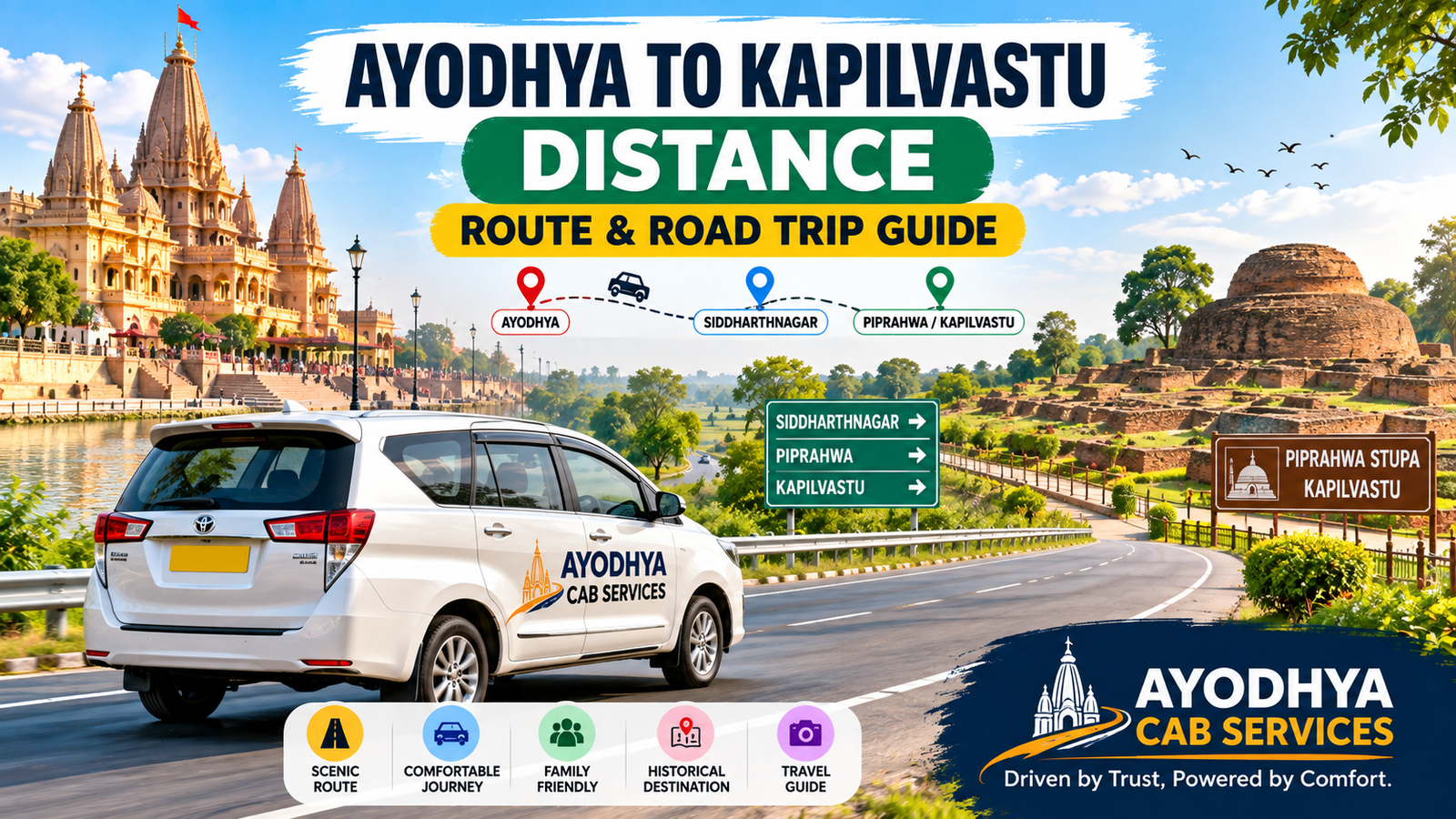
Ayodhya to Kapilvastu Distance road trip towards Piprahwa, with route planning and practical travel guidance from Ayodhya.
Ayodhya to Kapilvastu Distance: What Should You Enter in Navigation?
Instead of entering only “Kapilvastu” into your navigation app, use a more specific destination such as:
Piprahwa Stupa, Siddharthnagar, Uttar Pradesh
This can prevent the navigation app from selecting a similarly named location or directing you towards the Nepal-side destination.
The Ayodhya to Kapilvastu Distance should therefore be treated as a route-specific figure rather than one universal number.
Your actual distance can change according to:
- starting point within Ayodhya,
- final point around Piprahwa or Ganwaria,
- road selected by navigation,
- diversions and construction,
- local access roads near the archaeological area.
For that reason, check your live navigation shortly before departure rather than relying entirely on a kilometre figure from an old travel article.
Where Is Kapilvastu in Uttar Pradesh?
The Indian location relevant to this guide lies in Siddharthnagar district of Uttar Pradesh, close to India’s border with Nepal.
Piprahwa is near Birdpur and is known for its archaeological remains. According to the Siddharthnagar district administration, the site includes a large stupa, remains of monasteries and a museum. Archaeological remains have also been found at the nearby Ganwaria mound. Siddharth Nagar
The district’s tourism information lists Piprahwa/Ganwaria Stupa among its principal tourist attractions. Siddharth Nagar
For road-trip planning, remembering the following relationship is useful:
Ayodhya → Siddharthnagar region → Birdpur/Piprahwa → Kapilvastu archaeological area
This is much more useful than treating “Kapilvastu” as a single modern city centre.
Is Kapilvastu in India or Nepal?
This is one of the most important questions to answer before starting the journey.
The name Kapilavastu/Kapilvastu is associated with archaeological locations on both sides of the present India-Nepal border.
The Siddharthnagar district administration states that some scholars identify Piprahwa-Ganwaria with the ancient city of Kapilavastu. The same official page notes that others locate ancient Kapilavastu at Tilaurakot, around 16 km northwest, in present-day Nepal. Siddharth Nagar
Therefore, do not assume every Google result for “Kapilvastu” refers to the same destination.
For this article:
Kapilvastu = Piprahwa-Ganwaria archaeological area, Siddharthnagar, Uttar Pradesh, India.
Travellers intending to visit Tilaurakot should plan a separate international-border journey and verify current border-entry requirements before departure.
Ayodhya to Kapilvastu Route by Road
A practical journey from Ayodhya towards the Indian Kapilvastu archaeological area generally moves north-east towards the Siddharthnagar region.
Rather than memorising a fixed chain of towns, use live navigation for the exact route on your travel date.
Road conditions, diversions and local approaches can change.
Siddharthnagar district is accessible by road from major Uttar Pradesh cities including Lucknow, Gonda, Basti and Gorakhpur. Its official district website also confirms that road and rail connections serve the district. Siddharth Nagar
Once you enter Siddharthnagar, set the final navigation point specifically for Piprahwa Stupa rather than stopping at the district headquarters.
That last distinction is important because Siddharthnagar/Naugarh and Piprahwa are not the same place.
The district administration places Piprahwa roughly 22 km from district headquarters Naugarh. Siddharth Nagar
Why a Live Route Is Better Than a Fixed Route List
Travel blogs often present one route as though it will remain the best option permanently.
Real road travel is more complicated.
A route that looks shorter on paper can take longer because of town traffic, construction or narrower local roads.
Another option may add kilometres but provide easier driving.
Weather can also affect travel time.
For an Ayodhya Kapilvastu road trip, use the article to understand the geography and live navigation to make the final road decision.
Check the route once before leaving Ayodhya.
Review it again when approaching the Siddharthnagar region, particularly before turning towards Birdpur and Piprahwa.
Ayodhya to Kapilvastu Travel Time
Travel time should be treated as an estimate rather than a fixed promise.
The journey depends on your departure point in Ayodhya, chosen route, traffic, road conditions, breaks and final destination around Kapilvastu.
A family taking two food breaks will naturally need longer than a traveller driving with minimal stops.
Similarly, reaching Siddharthnagar does not mean the journey is finished.
You still need to continue towards the archaeological site.
For practical planning, avoid building your day around the fastest time displayed by navigation.
Keep a buffer for breaks and local travel near the destination.
Best Time to Leave Ayodhya
An early start is generally more convenient for a road trip of this type.
Leaving early gives you more daylight for the journey and reduces the pressure to rush through the archaeological area.
It also provides flexibility if you encounter a diversion or need an unexpected stop.
Before leaving, check the weather forecast and live traffic.
During winter, visibility conditions can occasionally affect road travel in northern India, particularly early in the day.
In the monsoon, heavy rain may also slow sections of the journey.
The safest departure time should therefore be chosen according to actual conditions on your travel date.
What Is Piprahwa Stupa?
Piprahwa is much more than a destination pin on a map.
The archaeological site is one of the main reasons travellers search for Kapilvastu in this part of Uttar Pradesh.
According to the Siddharthnagar district administration, excavations at Piprahwa have revealed a large stupa and remains of monasteries. The official description also discusses archaeological findings connected with relics traditionally associated with the Buddha’s Sakya clan. Siddharth Nagar
Nearby Ganwaria contains remains of ancient residential complexes and shrines.
Together, these archaeological areas make the destination particularly interesting for travellers interested in Buddhist history, archaeology and the wider historical landscape of the region.
Piprahwa, Ganwaria and Kapilvastu: Understanding the Names
These names can become confusing during trip research.
Piprahwa is a present-day village and archaeological site.
Ganwaria is a nearby archaeological mound.
Kapilavastu/Kapilvastu refers to the ancient city associated with the Shakya kingdom.
Siddharthnagar’s official tourism material connects the Piprahwa-Ganwaria area with scholarly discussions about the location of ancient Kapilavastu. Siddharth Nagar
Understanding these terms makes online route research much easier.
It also prevents travellers from assuming that “Kapilvastu” is simply the modern name of one Indian town.
Historical Importance of Kapilavastu
Kapilavastu is closely associated with the early life of Siddhartha Gautama, who later became the Buddha.
The Siddharthnagar district administration describes ancient Kapilavastu as the capital of the Shakya kingdom and notes the association of the Piprahwa-Ganwaria site with the place where Siddhartha Gautama spent the early years of his life. Siddharth Nagar
However, the archaeological identification should be described carefully.
There is scholarly disagreement over the precise location of ancient Kapilavastu.
That is why this guide does not present the Piprahwa identification as an uncontested archaeological fact.
For visitors, this debate adds another layer of interest to the region.
What Can You See at Piprahwa?
The official district description identifies several important features around the site.
Visitors can explore the archaeological remains associated with the Piprahwa Stupa.
Ruins of monasteries form another part of the complex.
A museum is also mentioned in the district’s description of the archaeological site. Siddharth Nagar
Nearby Ganwaria provides another archaeological dimension through the remains discovered there.
Opening arrangements, visitor access and museum timings can change, so verify them locally or through an official source before planning your day around a particular time.
Ayodhya to Kapilvastu Road Trip Planning
A good road trip begins before the vehicle moves.
First, save the exact destination pin.
Use Piprahwa Stupa, Siddharthnagar, Uttar Pradesh rather than a generic Kapilvastu search.
Next, download an offline map for the area.
Mobile connectivity can vary during road journeys, and an offline route provides useful backup.
Keep identification documents with you.
Carry water and basic snacks, especially when travelling with children or older family members.
Finally, leave enough time for the archaeological site itself.
Driving several hours only to rush through the destination defeats the purpose of the journey.
Fuel and Food Stops
Do not wait until the fuel gauge is close to empty before looking for a station.
Refuelling on a major road or in a larger town is generally easier than depending on a specific facility near the final archaeological site.
The same logic applies to meals.
If you have dietary preferences or are travelling with children, plan your main food stop before reaching the more local approach roads.
Keep drinking water in the vehicle.
However, avoid carrying excessive disposable packaging that may become litter during the trip.
A little preparation makes the journey noticeably easier.
Travelling With Senior Citizens
The Ayodhya to Kapilvastu road trip can be more comfortable for senior travellers when the schedule includes adequate breaks.
Avoid treating the fastest navigation estimate as the target.
Plan a rest stop during the journey.
Carry regular medicines and drinking water.
If mobility is limited, check accessibility conditions at the archaeological site before travelling.
It is also sensible to avoid a schedule that combines a long road journey with too many additional destinations on the same day.
Comfort matters more than fitting every possible stop into one itinerary.
Travelling With Children
Families with children should keep the journey flexible.
Carry snacks, water and any regular medicines.
Plan breaks before children become tired or restless.
At the destination, explain the historical significance in simple language rather than treating the site as only a photo stop.
Older children may find the archaeology more interesting if they understand the connection between Piprahwa, the Shakya kingdom and the historical debate around Kapilavastu.
The road trip can therefore become educational as well as recreational.
Ayodhya to Kapilvastu by Train
A direct train does not take travellers into the Piprahwa archaeological complex itself.
The official Siddharthnagar district page identifies Siddharthnagar railway station as the nearest railway station to Piprahwa Stupa, at approximately 25 km. Siddharth Nagar
The district has several railway stations, including Siddharthnagar, Shohratgarh, Barhni, Uska Bazar and Bridgmanganj. Official information states that stations in the district connect with destinations including Gorakhpur, Lucknow, Delhi and Mumbai. Siddharth Nagar
Train travellers therefore need to plan the final road connection separately.
Check current railway schedules before booking because services and timings can change.
Ayodhya to Kapilvastu by Bus
Siddharthnagar is also connected by bus with major cities in Uttar Pradesh.
The district administration confirms UPSRTC bus connectivity to Siddharthnagar. Siddharth Nagar
However, reaching Siddharthnagar district is only one part of the trip.
You still need onward local transport towards Piprahwa.
For travellers using public transport, planning this final connection in advance is particularly important.
Do not assume every bus going towards Siddharthnagar continues directly to the archaeological site.
Nearest Railway Station to Kapilvastu/Piprahwa
For the Indian-side archaeological destination discussed in this guide, the official district information identifies Siddharthnagar railway station as the nearest station to Piprahwa Stupa.
The stated distance is approximately 25 km. Siddharth Nagar
This makes Siddharthnagar a useful rail reference point when comparing road and train options.
Still, verify your train’s actual stopping station before booking.
Depending on the service available on your date, another station in the district may sometimes be operationally convenient even if it is not geographically the closest.
Nearest Airport to Kapilvastu/Piprahwa
According to the official Piprahwa Stupa tourism page, Gorakhpur Airport is approximately 140 km from Piprahwa Stupa. Siddharth Nagar
The broader Siddharthnagar district travel page also identifies Gorakhpur as the nearest airport to the district. Siddharth Nagar
These figures refer to different reference points—Piprahwa itself versus the district generally—so travellers should not treat them as contradictory door-to-door measurements.
Always calculate the route from your actual arrival point to your final destination.
Starting the Journey From Ayodhya
Ayodhya itself has strong road and rail connectivity.
The Ayodhya district administration identifies Ayodhya Cantt and Ayodhya Dham as major railway stations.
It also notes that Maharishi Valmiki International Airport Ayodhya is approximately 10 km from Ayodhya Dham. Ayodhya
For a road trip, your exact starting point matters.
A traveller beginning near Ayodhya Dham may receive a different navigation estimate from someone starting on the outer side of the city.
Therefore, calculate the route from your hotel, home or actual pickup point rather than from a generic “Ayodhya” pin.
Can Ayodhya and Kapilvastu Be Covered in One Day?
A same-day journey may be possible depending on your starting time, road conditions, desired sightseeing time and whether you intend to return to Ayodhya that night.
However, “possible” and “comfortable” are not always the same.
If your main interest is archaeology and Buddhist history, rushing the destination may reduce the value of the trip.
Consider how much time you want at Piprahwa and Ganwaria.
Add meal and rest breaks.
Then calculate the return journey.
Travellers who dislike long driving days may prefer a more relaxed itinerary with an overnight halt in the broader region.
Should You Combine Kapilvastu With Other Buddhist Sites?
Kapilvastu can form part of a wider Buddhist-history itinerary, but avoid forcing too many distant sites into one day.
Start with the purpose of your trip.
If Piprahwa and Ganwaria are the priority, give them enough time.
Travellers planning a longer Buddhist circuit can separately research places such as Kushinagar and Shravasti.
Route order should depend on where you are staying next rather than on a generic list found online.
A well-paced itinerary is usually more rewarding than collecting destination names.
Kapilvastu India vs Tilaurakot Nepal: Don’t Make This Navigation Mistake
This deserves repeating once because it can completely change the journey.
Piprahwa-Ganwaria is in Uttar Pradesh, India.
Tilaurakot is in Nepal.
Both appear in discussions about ancient Kapilavastu. The official Siddharthnagar page itself acknowledges these competing identifications. Siddharth Nagar
If your intention is to stay within India, set Piprahwa Stupa as your destination.
Do not blindly follow a Kapilvastu search result that routes you across an international border.
Travellers specifically planning Tilaurakot should separately check current immigration, identification, vehicle and border-crossing requirements from official authorities.
Best Season for an Ayodhya Kapilvastu Road Trip
Weather can significantly affect how comfortable a road journey feels.
North Indian summers can become very hot, particularly during the middle of the day.
Monsoon travel may involve rain and slower road conditions.
Winter usually brings cooler temperatures, although fog or poor visibility can sometimes affect early-morning driving.
Instead of treating one month as universally “best,” check the forecast close to your travel date.
Visitors interested in walking around archaeological remains may naturally prefer moderate daytime weather.
Road safety should remain more important than following a fixed seasonal recommendation.
Monsoon Travel Considerations
Heavy rain changes road-trip planning.
Allow additional time.
Avoid assuming yesterday’s travel duration will apply during a spell of bad weather.
Keep essential belongings protected from water.
Check the weather before leaving Ayodhya and again before the return journey.
If severe conditions are forecast, changing the departure time can be more sensible than trying to maintain the original itinerary.
A historical destination will still be there another day.
Winter Road Trip Considerations
Winter can make daytime exploration comfortable, but visibility needs attention.
Dense fog can affect parts of Uttar Pradesh.
Do not start unusually early simply because an itinerary says “leave before sunrise.”
Check actual visibility.
If conditions are poor, wait until driving becomes safer.
Keep some flexibility in your sightseeing schedule so a delayed departure does not create pressure to speed later.
Summer Road Trip Considerations
Summer travel requires a different approach.
Carry enough drinking water.
Avoid leaving children or older travellers in a parked vehicle.
Plan outdoor exploration around the actual temperature.
A very early start can help reduce exposure to afternoon heat, provided driving conditions are safe.
Light clothing, sun protection and regular hydration can make the visit more comfortable.
Common Ayodhya to Kapilvastu Travel Mistakes
The biggest mistake is searching only for Kapilvastu without checking the destination pin.
Another is assuming Siddharthnagar railway station and Piprahwa Stupa are the same location.
Some travellers may also rely on an old distance figure without checking their exact starting point.
Others plan the fastest possible itinerary with no time for meals, rest or archaeological exploration.
A final mistake is treating the India-Nepal Kapilavastu location debate as irrelevant to route planning.
It is directly relevant because choosing the wrong map result can send you towards an entirely different destination.
Ayodhya to Kapilvastu Distance: Final Travel Advice
The Ayodhya to Kapilvastu Distance is best understood as a journey from Ayodhya towards the Piprahwa-Ganwaria archaeological area of Siddharthnagar when the traveller intends to remain on the Indian side.
Do not rely on one fixed kilometre figure without confirming the final destination.
Search for Piprahwa Stupa, Siddharthnagar, Uttar Pradesh in your navigation app.
Check the live road route before departure.
Allow time for local travel after reaching the Siddharthnagar region.
Most importantly, distinguish Piprahwa-Ganwaria in India from Tilaurakot in Nepal before finalising your itinerary.
That single check can prevent the biggest planning error associated with this journey.
Useful FAQs
What is the Ayodhya to Kapilvastu Distance?
The exact road distance depends on where you start in Ayodhya, the route selected and whether your final destination is Piprahwa, Ganwaria or another location associated with Kapilvastu. For the Indian archaeological destination, use Piprahwa Stupa, Siddharthnagar, Uttar Pradesh in live navigation rather than relying on a generic Kapilvastu distance.
Is Kapilvastu in Uttar Pradesh?
Piprahwa-Ganwaria in Siddharthnagar district, Uttar Pradesh, is associated by some scholars with ancient Kapilavastu. Another proposed location is Tilaurakot in Nepal. Siddharth Nagar
Which railway station is nearest to Piprahwa Stupa?
The Siddharthnagar district administration identifies Siddharthnagar railway station, approximately 25 km away, as the nearest railway station to Piprahwa Stupa. Siddharth Nagar
Which airport is nearest to Piprahwa Stupa?
The official Piprahwa tourism page identifies Gorakhpur Airport as the nearest airport and places it approximately 140 km from the stupa. Siddharth Nagar
Is Piprahwa the same as Kapilvastu?
Not exactly. Piprahwa is a present-day village and archaeological site. Some scholars identify the Piprahwa-Ganwaria area with ancient Kapilavastu, while others favour Tilaurakot in Nepal. Siddharth Nagar
Do I need to cross the Nepal border for Piprahwa?
No. Piprahwa is in Siddharthnagar district, Uttar Pradesh, India. Siddharth Nagar A visit to Tilaurakot in Nepal would be a separate international-border journey.
Ayodhya to Kapilvastu Road Trip: How to Plan the Day
A road trip becomes much easier when the day is divided into three stages rather than treated as one continuous drive.
The first stage is leaving Ayodhya and covering the main road journey towards Siddharthnagar.
The second begins when you enter the destination region and move towards Birdpur and Piprahwa.
The final stage is the actual visit to the archaeological area.
Keeping these stages separate in your mind prevents a common planning mistake: assuming that reaching Siddharthnagar means you have reached Kapilvastu.
The official Siddharthnagar tourism information places Piprahwa away from the district headquarters, so additional local road travel remains after reaching the broader Siddharthnagar area.
Build that final section into your schedule.
Don’t Plan the Journey Around the Fastest Google Maps Estimate
Navigation apps are useful, but the first travel-time estimate should not become a deadline.
Road conditions can change during the journey.
Traffic near towns may add time.
Food, fuel and washroom stops will also affect your arrival.
Families travelling with children or senior citizens should keep an even larger buffer.
A better approach is to use navigation for direction and current conditions while treating the arrival time as flexible.
This reduces the temptation to rush simply because the original ETA has changed.
What to Check One Day Before Travelling
Open your navigation app and confirm that the destination is Piprahwa Stupa, Siddharthnagar, Uttar Pradesh.
Do not stop after typing “Kapilvastu.”
Next, check the weather for both Ayodhya and Siddharthnagar.
Review the road for any major diversions.
Confirm the archaeological site’s current visitor access if the visit is the main purpose of your trip.
If you intend to visit a museum or another facility with fixed hours, verify its current timing separately.
Finally, download the relevant offline map area.
These checks take only a few minutes but remove several avoidable uncertainties.
What to Carry for the Ayodhya Kapilvastu Road Trip
There is no need to overpack for a road journey.
Carry identification documents, water, basic snacks, necessary medicines, charging cables and a power bank.
A small amount of cash can also be useful during road travel even when digital payments are normally preferred.
Keep sunglasses or sun protection during hotter months.
In winter, carry an extra layer because morning and evening temperatures can feel considerably cooler than the middle of the day.
Families should also keep essential items accessible rather than buried underneath luggage.
A simple travel bag inside the cabin can save repeated stops.
Why Piprahwa Should Be Your Main Navigation Point
Using Piprahwa Stupa as the destination does more than improve route accuracy.
It also clarifies the purpose of the journey.
Kapilvastu is a historical-geographical term with more than one archaeological identification, while Piprahwa is a specific present-day location in Uttar Pradesh.
The Siddharthnagar district administration describes Piprahwa as a village near Birdpur and discusses its archaeological association with ancient Kapilavastu.
This makes Piprahwa much more practical for road navigation.
Once you arrive in the area, you can plan nearby archaeological exploration separately.
Piprahwa Stupa: The Main Historical Stop
Piprahwa Stupa is the obvious focal point for most travellers making this journey.
The site is archaeologically significant and forms an important part of discussions about the historical location of Kapilavastu.
Official Siddharthnagar information describes a large stupa at Piprahwa along with monastic remains discovered through excavation.
Rather than visiting only for a quick photograph, give yourself time to understand the layout.
Archaeological ruins often appear less dramatic than reconstructed monuments.
Their value comes from what the remains reveal about the history and settlement of the area.
Reading some background before arrival can therefore make the visit much more meaningful.
Ganwaria: Don’t End the Trip at Piprahwa
Travellers researching only Ayodhya to Kapilvastu Distance may never come across Ganwaria.
That would leave out an important part of the archaeological landscape.
Ganwaria is located near Piprahwa and contains archaeological remains associated with an ancient settlement.
The Siddharthnagar administration discusses Piprahwa and Ganwaria together when explaining the area’s possible association with ancient Kapilavastu.
If access and time permit, consider the two sites as connected parts of the visit rather than unrelated attractions.
This approach provides more context than seeing only one stupa and immediately beginning the return drive.
Kapilvastu Museum: Verify Before You Depend on It
Official district information mentions a museum in connection with the Piprahwa archaeological site.
However, museum opening arrangements can change.
Do not build your entire itinerary around an opening time copied from an old blog, review or social-media post.
Check the latest official or locally confirmed information shortly before travelling.
If the museum is available during your visit, it can provide useful context for understanding the archaeological material associated with the area.
The ruins outside and the historical explanation inside can complement each other.
How Much Time Should You Keep for Kapilvastu?
There is no universal sightseeing duration.
Someone interested primarily in reaching the location may spend much less time than a traveller interested in archaeology and Buddhist history.
Avoid planning the visit so tightly that every unexpected delay becomes a problem.
Keep enough time for Piprahwa.
Add time for Ganwaria if you intend to explore it.
Allow for walking and reading information at the site.
If a museum visit is possible, include that separately.
The destination deserves more than whatever minutes remain after the drive.
Why This Trip Is Different From Regular Sightseeing
A trip to Kapilvastu is not the same as visiting a large modern tourist attraction.
Much of the experience depends on historical context.
Archaeological sites ask visitors to imagine earlier structures through surviving foundations, mounds and excavated remains.
Without background information, someone may see only bricks and open ground.
With context, those remains become part of a much larger historical story involving the Shakya kingdom and the early life associated with Siddhartha Gautama.
That is why reading before travelling can genuinely improve the visit.
Understanding the Shakya Connection
The historical importance of Kapilavastu is closely linked with the Shakyas.
Siddharthnagar district’s official description associates ancient Kapilavastu with the Shakya kingdom and the early life of Siddhartha Gautama.
This association explains why the region appears in Buddhist-history itineraries.
However, responsible travel writing should retain an important qualification.
The precise archaeological identification of ancient Kapilavastu remains debated.
Piprahwa-Ganwaria in India and Tilaurakot in Nepal both appear in that discussion.
Visitors do not need to resolve the scholarly debate themselves.
They simply need to understand that it exists.
Ayodhya and Kapilvastu: Why Travellers Combine Them
Ayodhya and Kapilvastu represent very different historical traditions.
That contrast can make the journey particularly interesting for travellers exploring the cultural history of northern India.
Ayodhya is a major historical and religious destination in Uttar Pradesh.
Kapilvastu is associated with Buddhist history and archaeological research.
Combining the two allows a traveller to move from a living pilgrimage city into a quieter archaeological landscape.
Still, avoid presenting the connection as though the two destinations form one officially defined tourism circuit unless an authoritative source supports that claim.
The road trip can simply be valuable on its own terms.
Ayodhya to Kapilvastu Road Conditions: What Can Actually Be Said?
Road-condition claims become outdated quickly.
A road described as “excellent” today may have construction work next month.
Likewise, an older article may warn about a section that has since improved.
For this reason, avoid relying on static claims about the entire route.
Check current navigation information before departure.
Ask locally when approaching smaller roads if your navigation shows an unusual diversion.
Drive according to actual road conditions rather than expected journey time.
This advice is less dramatic than giving every road a rating, but it remains useful for much longer.
Highway Driving vs Local Roads Near the Destination
The character of a road trip often changes near the final destination.
Main roads may allow relatively consistent progress.
Local approaches can involve narrower roads, settlements, pedestrians, motorcycles, animals or slower-moving vehicles.
Therefore, the final few kilometres should not automatically be calculated using the average speed achieved earlier in the journey.
Reduce speed where necessary.
Watch navigation carefully at junctions.
If you are uncertain about the final turn, confirm locally rather than continuing several kilometres in the wrong direction.
The goal is to arrive safely, not preserve an average speed.
Fuel Planning for the Ayodhya to Kapilvastu Route
Begin with sufficient fuel.
That sounds obvious, but it removes unnecessary uncertainty later.
If refuelling becomes necessary, prefer established stations on the main journey rather than waiting until the archaeological destination is close.
Electric-vehicle users need more careful planning.
Charging availability, connector compatibility and operational status should be checked using current charging-network information before departure.
Do not depend on an EV charging location simply because an old travel page mentions it.
Infrastructure changes too quickly for static assumptions.
Food Planning on the Road
A road trip becomes uncomfortable quickly when food stops are left entirely to chance.
For families, a planned meal stop can also double as a proper rest break.
Look for established restaurants or busy food stops along the main route.
Do not expect the archaeological area itself to provide the same range of food options as a larger city.
Carry light snacks as backup.
Avoid eating heavily immediately before a long driving section if it makes the driver tired.
Simple planning is enough; there is no need to turn the journey into a fixed minute-by-minute schedule.
Washroom Breaks Matter More Than People Admit
This becomes particularly important when travelling with children, senior citizens or larger families.
Use clean facilities when you find suitable stops along the main route.
Do not postpone every break until reaching Piprahwa.
The final destination is an archaeological area rather than a large commercial tourist complex.
A planned break before entering the more local section of the journey can make the rest of the drive easier.
It also gives everyone a chance to stretch after sitting for a long period.
Carry Offline Maps
Mobile internet is generally useful, but road-trip planning should not assume uninterrupted connectivity.
Download the relevant map area before departure.
Save Piprahwa Stupa as a destination.
You can also save important intermediate locations.
If the network weakens, offline navigation provides a backup.
Take a screenshot of the final route if necessary.
This is particularly helpful when the last part of a journey involves smaller roads.
Technology is most useful when you have a fallback for the moment it stops working.
Keep Your Phone Charged
Navigation, photographs, calls and online payments can drain a phone faster than expected.
Carry a functioning vehicle charger or power bank.
The driver’s phone should remain sufficiently charged for navigation and emergencies.
If several passengers are using devices, avoid depending on one charging cable.
These are minor details at home.
On a road trip, they become practical necessities.
Driving After Sunset
If possible, understand the local approach before darkness.
A traveller unfamiliar with smaller roads may find navigation easier during daylight.
This does not mean the route becomes automatically unsafe after sunset.
It simply means visibility and orientation can become more challenging.
If your schedule is running late, avoid compensating by driving faster.
Arriving later is preferable to turning an archaeological trip into a stressful drive.
Ayodhya to Kapilvastu With an Overnight Stay
Some travellers may prefer not to complete the outward journey, sightseeing and return drive in one day.
An overnight plan can make the trip more relaxed.
Choose accommodation based on your wider itinerary rather than simply selecting the geographically closest property.
Siddharthnagar/Naugarh or another practical nearby centre may provide options depending on your route.
Check recent reviews, parking, check-in timings and actual map location before booking.
Do not assume a hotel using “Kapilvastu” in its name sits next to Piprahwa Stupa.
Confirm the distance on the map.
Should You Stay in Siddharthnagar?
Staying in the broader Siddharthnagar area can make sense when Kapilvastu is part of a multi-day journey.
It reduces the need to immediately begin a long return drive after sightseeing.
A stay can also provide flexibility for visiting nearby locations the following morning.
However, travellers making a simple day trip may not need accommodation at all.
Compare the total driving time with your comfort level.
Families and senior travellers may value the slower schedule more than travellers accustomed to long road journeys.
There is no single correct itinerary.
Ayodhya to Kapilvastu and Shravasti: Should You Combine Them?
Shravasti is another major destination associated with Buddhist history in Uttar Pradesh.
That makes it tempting to combine multiple sites into one trip.
The idea can work as part of a multi-day itinerary, but avoid assuming both should be rushed into the same day.
Calculate actual road distances between each overnight stop.
Consider how much time you want at the sites.
Then decide whether adding Shravasti improves the trip or merely creates more driving.
A Buddhist circuit should still feel like travel, not a race between map pins.
Ayodhya to Kapilvastu and Kushinagar
Kushinagar is another important destination in the Buddhist landscape of Uttar Pradesh.
Travellers with several days can research a broader itinerary connecting relevant historical locations.
Again, route order matters.
Do not automatically return to Ayodhya after every destination if the next stop lies elsewhere.
A multi-day itinerary should minimise unnecessary backtracking.
Use current maps to compare route options.
Keep one major historical destination as the focus of each day when practical.
That usually creates a more comfortable experience.
Building a Multi-Day Buddhist History Itinerary
A thoughtful itinerary can combine historical sites without reducing them to checkboxes.
For example, a traveller beginning in Ayodhya might first visit the Kapilvastu/Piprahwa area.
The next destination can then depend on whether the journey continues towards Shravasti, Kushinagar or another region.
There is no reason to force one universal sequence.
Your return city matters.
Hotel availability matters.
Train or flight plans may determine the final stop.
Build the route around your actual journey rather than copying somebody else’s circuit exactly.
Is Kapilvastu Suitable for a Family Road Trip?
Yes, families interested in history can find the destination worthwhile.
Expectations should be realistic.
Piprahwa is an archaeological destination rather than a theme park or entertainment complex.
Children who enjoy history may find the visit much more engaging when adults explain what they are seeing.
Show them the route before leaving.
Explain that archaeologists study surviving structures to understand earlier settlements.
This turns the site into a story rather than a collection of ruins.
Photography at Archaeological Sites
Follow the rules displayed at the site.
Outdoor photography may be permitted in many archaeological areas, but restrictions can apply to museums, protected objects or particular sections.
Do not assume permission simply because another visitor uploaded photographs online.
Look for signage.
Ask staff if uncertain.
Avoid climbing on protected remains for a photograph.
Historical structures should be treated as archaeological evidence, not as props.
Responsible behaviour helps preserve the site for future visitors.
Keep the Archaeological Area Clean
Carry back any waste you create if suitable disposal facilities are not available.
Plastic bottles, snack wrappers and disposable cups can quickly spoil a historical site.
Avoid leaving anything on walls, ruins or open ground.
Do not scratch names into structures.
This advice sounds basic, yet archaeological locations are particularly vulnerable to careless visitor behaviour.
The best travel footprint is one that is barely visible after you leave.
Respect Restricted Areas
Archaeological sites may contain barriers or areas where entry is restricted.
Do not cross them for a closer photograph.
Excavated structures can be fragile even when they appear solid.
Follow marked walking routes where provided.
If staff request visitors to remain outside a particular section, respect the instruction.
Seeing every corner is less important than protecting what remains.
Why You Should Avoid Relying on Viral Travel Reels
Short videos can provide visual inspiration, but they are weak sources for detailed trip planning.
A reel may show an empty road filmed early in the morning and make the entire route appear traffic-free.
Another creator may quote a distance from their hotel rather than central Ayodhya.
Museum timings could also be months old.
Use social media for ideas.
Use live navigation and official information for decisions.
That distinction prevents attractive content from becoming unreliable travel advice.
Search for the Destination in Both Spellings
You may encounter both Kapilvastu and Kapilavastu online.
The spelling varies across modern references and transliterations.
If a search using one spelling produces limited results, try the other.
For navigation within India, however, Piprahwa Stupa remains the more precise destination term.
This also helps separate archaeological information from broader results about Nepal’s Kapilvastu District.
Kapilvastu District in Nepal Is Not Your Indian Destination
Online search results may display Kapilvastu District, Nepal.
That does not mean your Indian road journey has suddenly become international.
Piprahwa lies in Uttar Pradesh.
Tilaurakot lies in Nepal and is associated with the competing archaeological identification of ancient Kapilavastu.
The modern Nepalese district name creates additional confusion for first-time researchers.
Always inspect the country and map pin before accepting a distance estimate.
One overlooked location label can completely change the route.
If You Intend to Visit Tilaurakot Instead
This article should not be used as a complete Tilaurakot border-crossing guide.
A trip from India to Tilaurakot involves different route and border considerations.
Entry rules, accepted identification, vehicle requirements and border procedures can change.
Verify current requirements through relevant official Indian and Nepalese authorities before departure.
Do not rely on an old blog for international travel documentation.
Most importantly, specify Tilaurakot, Nepal in navigation rather than using only “Kapilvastu.”
That makes your actual destination clear from the beginning.
Road Trip Safety Should Come Before the Itinerary
A well-planned itinerary is useful only while conditions remain suitable.
If weather becomes severe, stop somewhere safe.
When the driver is tired, take a break.
Avoid speeding to recover time lost during lunch or traffic.
Do not use a phone while driving.
Keep important documents accessible.
Check tyres and essential vehicle functions before a longer journey.
None of these steps is exciting enough for a travel reel.
They are still more important than reaching a destination 20 minutes earlier.
Emergency Preparation
Save essential contact information before travelling.
India’s integrated emergency response number is 112, according to the Government of India’s Emergency Response Support System.
Keep basic medicines and a first-aid kit available.
If someone travelling has a known medical condition, carry the necessary medication rather than assuming it will be easy to purchase along the route.
Know the nearest larger town if assistance is needed.
Preparation does not mean expecting something to go wrong.
It simply makes unexpected situations easier to manage.
How to Make the Return Journey Easier
The return trip often receives less planning than the outward journey.
Before leaving Piprahwa, check the route again.
Traffic conditions may have changed.
Make sure the driver has rested.
Refuel if necessary before entering a long section.
If everyone is tired, take a proper meal or tea break rather than immediately beginning the entire return journey.
For a same-day trip, avoid spending so long at the destination that most of the return drive happens under pressure.
A flexible departure is better than an unrealistic deadline.
Ayodhya to Kapilvastu Distance for a Weekend Trip
A weekend gives travellers more flexibility than a tightly packed single-day schedule.
You can leave Ayodhya without trying to reach every location before lunch.
Piprahwa and Ganwaria can receive proper attention.
An overnight stay also allows the wider region to be explored without immediately retracing the road.
If another historical destination is added, keep the second day realistic.
Do not fill every available hour simply because you have two days.
A weekend road trip should leave room for unplanned discoveries and rest.
What This Journey Is Best For
The Ayodhya to Kapilvastu road trip is particularly suitable for travellers interested in history, archaeology and Buddhist heritage.
It can also work for families who want an educational road journey.
Photographers may appreciate the quieter archaeological landscape, subject to site rules.
Researchers and students can use the visit to understand how archaeological evidence connects with historical traditions.
Travellers looking primarily for shopping, nightlife or entertainment should recognise that this destination offers a very different experience.
Understanding that before departure helps set realistic expectations.
A Simple Ayodhya to Kapilvastu Itinerary
A practical day can remain intentionally simple.
Morning: Leave Ayodhya after checking live weather and road conditions.
During the journey: Take a planned food or rest break rather than stopping repeatedly.
On reaching Siddharthnagar region: Recheck navigation towards Piprahwa Stupa.
At the destination: Explore Piprahwa without rushing.
If time and access allow: Include Ganwaria and available museum facilities.
Before returning: Rest, check traffic and confirm the return route.
This structure leaves flexibility without turning the trip into an hourly checklist.
Who Should Consider an Overnight Itinerary?
An overnight trip can be more comfortable for senior citizens, families with young children and anyone who does not enjoy extended same-day driving.
It also suits travellers who want to study the archaeological area carefully.
People combining Kapilvastu with another Buddhist-history destination should strongly consider a multi-day plan.
The extra time can reduce fatigue and make sightseeing more meaningful.
Choose the schedule according to the slowest traveller in the group rather than the person most comfortable with long drives.
That small decision often improves the experience for everyone.
Final Planning Advice for the Ayodhya to Kapilvastu Road Trip
A successful trip does not depend on memorising one Ayodhya to Kapilvastu Distance figure.
It begins with selecting the correct Kapilvastu.
For an India-only journey covered in this guide, set Piprahwa Stupa, Siddharthnagar, Uttar Pradesh as the destination.
Plan additional time after entering Siddharthnagar.
Keep Piprahwa and Ganwaria at the centre of the visit rather than treating them as quick stops between long stretches of driving.
Use official information for historical and destination facts.
Rely on live navigation for current road conditions.
Most importantly, do not confuse the Indian Piprahwa-Ganwaria archaeological area with Tilaurakot or modern Kapilvastu District in Nepal.
Ayodhya to Kapilvastu Distance by Road: Why Different Websites Show Different Numbers
It is normal to find different distance figures online.
One website may calculate from central Ayodhya, while another starts from a particular neighbourhood or highway junction. The destination point can also vary.
Some route planners may use Siddharthnagar as the endpoint.
Others may calculate up to Piprahwa.
A search for Kapilvastu can even produce results connected with Nepal.
Different road choices create another variation. A shorter route is not necessarily the route that navigation recommends on every travel date.
For this reason, an Ayodhya to Kapilvastu Distance by Road figure should always be read together with its starting point, destination and selected route.
For this guide, the relevant Indian destination remains Piprahwa Stupa in Siddharthnagar district, Uttar Pradesh.
Enter that complete destination into navigation before trusting the displayed distance.
Ayodhya to Kapilvastu Route: How to Choose Between Alternatives
A navigation app may display more than one Ayodhya to Kapilvastu Route.
Do not automatically choose the option with the fewest kilometres.
Compare estimated travel time.
Look at the type of roads involved.
Check whether one alternative passes through significantly more urban areas.
Also review any traffic warnings or road closures shown at the time.
A slightly longer route can sometimes be easier if it avoids congested town centres or difficult local sections.
However, this decision should be made using current information rather than a permanent recommendation from a travel article.
Road conditions change.
The best route on one date may not remain the best route several months later.
Ayodhya to Kapilvastu Travel Time: What Actually Affects It?
The Ayodhya to Kapilvastu Travel Time depends on more than road distance.
Traffic is an obvious factor, but it is not the only one.
Your starting location within Ayodhya matters.
The route selected by navigation matters as well.
Weather, construction, local traffic, meal stops and fuel breaks can all change the journey duration.
The final approach towards Piprahwa should also be included.
Travellers sometimes calculate only the time required to reach the broader Siddharthnagar area and underestimate the remaining local journey.
Instead of building your day around the shortest possible ETA, create a reasonable buffer.
That approach is particularly useful when travelling with children or senior citizens.
Is Ayodhya to Kapilvastu a Good Road Trip?
For travellers interested in archaeology and Buddhist history, it can be a worthwhile journey.
The experience is different from a conventional leisure road trip built around resorts, shopping or entertainment.
Here, the destination is the main reason to travel.
Piprahwa and nearby Ganwaria provide archaeological context associated with discussions about ancient Kapilavastu.
The journey can therefore appeal to history enthusiasts, students, families and people exploring important Buddhist locations in northern India.
However, expectations matter.
Do not expect a heavily commercialised tourist zone.
A quieter archaeological experience is part of the character of the destination.
Is the Ayodhya to Kapilvastu Road Trip Suitable for One Day?
A one-day itinerary depends on how much driving you are comfortable doing and how long you want to spend at the destination.
Do not answer this question only by looking at the outward driving time.
Calculate:
Ayodhya → Piprahwa + sightseeing + breaks + Piprahwa → Ayodhya
That is your real day.
If the resulting schedule leaves little time at the archaeological site, an overnight journey may provide a better experience.
A same-day trip becomes more demanding when travelling with senior citizens or small children.
Travellers who regularly undertake longer road journeys may find the schedule easier.
Personal comfort should determine the decision rather than an arbitrary rule.
One-Day Ayodhya to Kapilvastu Itinerary
If you choose a day trip, keep the itinerary uncomplicated.
Start after checking current visibility, weather and traffic.
Use Piprahwa Stupa as the destination.
Take a sensible break during the outward journey rather than repeatedly stopping.
Once you reach the site, focus first on Piprahwa.
Explore Ganwaria if current access, daylight and your available time permit.
If museum facilities are open, include them without rushing the archaeological area.
Before starting back, rest and check the return route.
Do not add several distant destinations simply because they appear nearby on a zoomed-out map.
A focused itinerary usually works better.
Two-Day Ayodhya to Kapilvastu Road Trip
Two days provide more flexibility.
Day one can focus on the journey and the principal archaeological locations.
An overnight stay in a practical nearby area removes the pressure of immediately driving back to Ayodhya.
Day two can be used for additional historical exploration or a relaxed return journey.
Travellers building a wider Buddhist-history itinerary can continue towards their next destination rather than automatically returning to Ayodhya.
This approach also reduces unnecessary backtracking.
Check accommodation locations carefully before booking.
A property using “Kapilvastu” in its name is not automatically beside Piprahwa.
Always inspect its actual map location.
Ayodhya to Piprahwa Distance vs Ayodhya to Kapilvastu Distance
These searches may appear interchangeable, but Ayodhya to Piprahwa Distance is usually more precise for an India-side road trip.
Piprahwa is a specific present-day location.
Kapilvastu is a historical name and can generate geographically ambiguous search results.
This distinction matters for both travellers and navigation apps.
Someone researching history may naturally search for Kapilvastu.
When it is time to drive, switching to Piprahwa Stupa as the destination provides greater clarity.
Think of “Kapilvastu” as the historical search intent and “Piprahwa” as the practical Indian navigation point for the journey described here.
Ayodhya to Kapilvastu via Siddharthnagar
Siddharthnagar is an important geographical reference for the journey because Piprahwa lies within the district.
However, avoid treating the district headquarters as the final destination.
The official district information places Piprahwa away from Naugarh/Siddharthnagar headquarters.
That means reaching the broader urban area does not complete your Ayodhya to Kapilvastu road trip.
Keep navigation active until Piprahwa.
This is especially useful for first-time visitors who may otherwise assume that a Kapilvastu attraction will be immediately visible after entering Siddharthnagar.
The final local section is part of the journey and should be included in your timing.
Why Destination Accuracy Matters More Than an Exact Kilometre Figure
Suppose one travel page says the journey is a particular number of kilometres.
That number is useless if it points to the wrong Kapilvastu.
A correct destination with a slightly changing road distance is more useful than a precise-looking figure attached to the wrong map location.
This principle is particularly important here because the historical Kapilavastu question involves locations in both India and Nepal.
Before comparing kilometre figures, confirm:
Country → State/District → Exact archaeological site
For this guide, that becomes:
India → Uttar Pradesh → Siddharthnagar → Piprahwa Stupa
Once those details are correct, live navigation can handle the final distance calculation.
Kapilvastu or Kapilavastu: Which Spelling Is Correct?
Both spellings appear in English-language searches.
Kapilavastu is widely used in historical and archaeological contexts.
Kapilvastu is also common in modern searches and geographical references.
A traveller does not need to worry about choosing one spelling exclusively.
Instead, use both when researching historical information.
For navigation, search for Piprahwa Stupa.
This avoids the ambiguity created by spelling variations and similarly named locations.
It also makes it easier to distinguish the Indian archaeological destination from modern administrative references in Nepal.
What Makes Piprahwa Historically Important?
Piprahwa has attracted archaeological interest because of the stupa and other remains discovered in the area.
Official Siddharthnagar tourism information discusses excavations, monastic remains and archaeological discoveries associated with the site.
The area is also part of the debate about the historical location of ancient Kapilavastu.
That historical discussion should be presented carefully.
It is better to say that Piprahwa-Ganwaria is associated by some scholars with ancient Kapilavastu than to present the identification as universally settled.
This distinction improves factual accuracy and helps travellers understand why both Indian and Nepalese locations appear during research.
Why Ganwaria Matters to the Kapilvastu Story
Piprahwa receives more attention in general travel searches, but nearby Ganwaria adds important archaeological context.
Remains discovered there contribute to understanding the settlement landscape around the area.
For a traveller interested in more than photographs, visiting or learning about both locations creates a fuller picture.
Do not think of Kapilvastu only as one isolated stupa.
Archaeological interpretation often depends on understanding a wider settlement rather than a single surviving structure.
This is one reason to leave enough time at the destination instead of planning a hurried stop.
Is Kapilvastu Worth Visiting From Ayodhya?
The answer depends on your interests.
If you enjoy archaeology, Buddhist history or quieter heritage destinations, the journey can add a very different experience to an Uttar Pradesh itinerary.
People expecting a large entertainment-oriented attraction may find it less suitable.
The value of Piprahwa comes primarily from its archaeological and historical significance.
Reading about the site before arrival makes the physical remains easier to understand.
That preparation can transform what might otherwise look like a simple mound or foundation into evidence of a much larger historical landscape.
Best Time of Day to Reach Piprahwa
Daylight is useful for an archaeological visit.
It makes outdoor exploration easier and reduces pressure when finding local approaches for the first time.
Rather than targeting one universal arrival hour, work backwards from current visitor access and sunset conditions on your travel date.
Avoid arriving so late that you must rush.
During hotter periods, the middle of the afternoon may also be less comfortable for extended outdoor exploration.
In winter, daylight is shorter.
Season and current weather should therefore influence your departure from Ayodhya.
How Weather Can Change the Ayodhya Kapilvastu Road Trip
Weather affects both driving and sightseeing.
Heavy monsoon rain can reduce visibility and increase travel time.
Summer heat may make outdoor exploration uncomfortable during the afternoon.
Winter can offer pleasant daytime temperatures, but fog may affect early-morning road conditions.
Check forecasts close to departure.
Do not rely on a generic statement such as “winter is always best.”
A clear summer morning may sometimes be easier for driving than a severely foggy winter morning.
Current conditions matter more than seasonal labels.
What If Navigation Suggests a Nepal Route?
Stop and inspect the destination.
Do not continue simply because the app displays a valid route.
Check whether the final pin is in India or Nepal.
For the journey described in this article, your destination should remain Piprahwa Stupa, Uttar Pradesh, India.
If navigation has selected Tilaurakot or another location across the border, change the destination.
An international border should never appear unexpectedly in an India-only road-trip plan.
This simple check can prevent a major travel mistake.
Can You Visit Nepal’s Tilaurakot From the Same Region?
Geographically, the wider region lies close to the India-Nepal border.
However, visiting Tilaurakot should be treated as a separate international journey rather than an extension automatically included in this guide.
Current border procedures, identification requirements and vehicle rules should be verified through official authorities.
Requirements can change.
Do not assume that information from an old travel article remains valid.
If Tilaurakot is specifically part of your plan, research the relevant border crossing before departure and build additional time into the itinerary.
Documents to Keep During the Road Trip
Carry valid personal identification.
The driver should keep the documents legally required for the vehicle and driving.
If your journey remains entirely within India, ordinary domestic-road-trip preparation applies.
The situation changes if you intentionally plan to cross into Nepal.
In that case, verify current official requirements separately.
Do not use this India-focused guide as documentation advice for an international border crossing.
Keeping those two journeys separate prevents confusion.
Cash or UPI During the Journey?
UPI is widely used across India, but carrying some cash remains sensible on a road trip.
Network connectivity can occasionally affect digital payments.
Small purchases may also be easier with cash in some locations.
There is no need to carry an excessive amount.
Use a combination of digital payment options and modest cash backup.
Keep cards and important documents secure.
The same principle applies to fuel and food stops: flexibility is more useful than depending entirely on one payment method.
Mobile Network and Connectivity
Do not assume continuous high-speed mobile data throughout every section of a road journey.
Save essential information before departure.
Download offline maps.
Screenshot important booking details if you have accommodation.
Save destination names and phone numbers locally rather than only inside an online app.
If travelling in a group, more than one person should have the route available.
These precautions take little effort and can be useful when mobile connectivity becomes inconsistent.
Vehicle Check Before Leaving Ayodhya
A basic vehicle check is more useful than a complicated travel checklist.
Inspect tyre condition and pressure.
Make sure the spare tyre and essential tools are available.
Check fuel or battery range.
Confirm that lights, indicators and wipers work properly.
Keep the windscreen clean.
During monsoon or winter travel, visibility-related equipment becomes particularly important.
If the vehicle has an unresolved mechanical problem, deal with it before beginning the journey rather than hoping it will remain minor.
Travelling by Motorcycle
A motorcycle journey requires different planning from a car trip.
Weather exposure is greater.
Fatigue can build more quickly.
Carry appropriate protective gear and avoid riding continuously for long periods without breaks.
Check tyres, brakes and lights before departure.
Do not overload the motorcycle with luggage.
During fog or heavy rain, visibility becomes a serious consideration.
The fact that a route is manageable by car does not automatically mean the same schedule is comfortable on two wheels.
Plan according to the vehicle being used.
Electric Vehicle Planning
EV travellers should verify charging infrastructure shortly before departure.
Do not rely on charging information copied from an old article.
Check charger availability, compatibility, operational status and realistic battery range.
Keep a reserve rather than planning to arrive at a charger with almost no remaining battery.
Temperature, air conditioning, speed and traffic can affect range.
If the final approach has limited charging options, complete necessary charging earlier.
Current charging apps are more useful for this decision than static travel content.
Avoid Overloading the Return Day
One of the easiest itinerary mistakes is adding “just one more place.”
A destination may appear close on a map but still require substantial road time.
Every additional stop also adds parking, walking and sightseeing time.
If you are returning to Ayodhya the same day, protect enough time for the return journey.
Do not create a schedule that only works when every road remains empty and every stop takes exactly as planned.
Real travel rarely follows that pattern.
A smaller itinerary with comfortable margins is usually better.
Should You Book Accommodation in Advance?
Advance booking can be useful during busy periods or when travelling with family.
However, check the property’s actual location before paying.
Look at recent reviews.
Confirm parking if you are driving.
Check reception and late-arrival policies.
Do not choose accommodation based only on the word “Kapilvastu” appearing in its name.
The property may be much farther from Piprahwa than expected.
Map location is more informative than marketing language when planning a road trip.
What to Avoid at Piprahwa and Ganwaria
Do not climb on archaeological remains.
Avoid entering restricted sections.
Never scratch names or messages onto structures.
Do not remove stones, fragments or other material from the site.
Follow photography restrictions where displayed.
Keep food waste and plastic away from archaeological areas.
If a section is closed, respect the closure even when another visitor ignores it.
Heritage sites survive through careful conservation.
A visitor’s responsibility is to leave the place as they found it.
How Students Can Make the Trip More Useful
Students can prepare a short reading list before travelling.
Learn the basic history of the Shakya kingdom.
Understand why Kapilavastu matters in accounts of Siddhartha Gautama’s early life.
Read about the Piprahwa-Ganwaria and Tilaurakot identification debate.
At the site, compare what you read with the surviving archaeological landscape.
Take notes rather than only photographs.
After returning, check interpretations against credible archaeological or institutional sources.
This turns the road trip into a useful learning exercise rather than passive sightseeing.
How Families Can Explain Kapilvastu to Children
Start with a simple idea.
Explain that archaeologists study objects and structures left by people who lived long ago.
Then introduce Kapilavastu as a historical place associated with the Shakya kingdom and the early life of Siddhartha Gautama.
At Piprahwa, encourage children to look at foundations and imagine the buildings that once stood there.
Avoid overwhelming them with dates and competing theories.
A story-based explanation can make archaeological sites much easier for children to understand.
Don’t Treat Every Search Result as Historical Proof
Travel search results mix government pages, tourism portals, blogs, videos, map listings and user-generated content.
They do not all carry equal evidentiary value.
For archaeological claims, prefer credible institutional and official sources.
For current road navigation, use live mapping information.
For train schedules, use current railway information.
For weather, use a current forecast.
One source does not need to answer every question.
Using the right source for the right purpose produces a more reliable trip plan.
Why Old Distance Articles Become Unreliable
Road networks evolve.
Bypasses open.
Construction begins and ends.
Navigation algorithms change.
A hotel or attraction may also use a different location pin.
This is why an article should help readers understand the route instead of pretending one distance number will remain perfect forever.
The Ayodhya to Kapilvastu Distance is useful as a planning query.
Your live navigation result is more useful for the actual drive.
The article provides context; the current map provides the final route.
Practical Checklist Before Leaving Ayodhya
Before departure, confirm the exact destination as Piprahwa Stupa.
Check weather and visibility.
Review the current road route.
Make sure the vehicle is ready.
Carry identification, medicines and water.
Download offline maps.
Keep phones charged.
Plan at least one sensible break.
Verify any museum or site timing you specifically depend on.
Finally, check that the navigation destination remains in Uttar Pradesh, India.
That final step is unusually important for this particular journey.
Frequently Asked Questions About Ayodhya to Kapilvastu Distance
What is the correct destination for Ayodhya to Kapilvastu by road?
For the India-side archaeological journey discussed here, use Piprahwa Stupa, Siddharthnagar, Uttar Pradesh as the navigation destination. This is more precise than searching only for Kapilvastu.
Why does Ayodhya to Kapilvastu Distance vary online?
Different starting points, destination pins and road routes produce different figures. Some searches may also refer to locations in Nepal rather than Piprahwa in Uttar Pradesh.
Is Piprahwa in India?
Yes. Piprahwa is in Siddharthnagar district, Uttar Pradesh, India.
Is Tilaurakot the same as Piprahwa?
No. They are separate archaeological locations. Piprahwa-Ganwaria is in India, while Tilaurakot is in Nepal. Both feature in scholarly discussions concerning the location of ancient Kapilavastu.
Is Kapilvastu and Kapilavastu the same name?
Both spellings are commonly encountered in English-language searches. When navigating to the Indian archaeological site, searching for Piprahwa Stupa is clearer.
Can I travel from Ayodhya to Kapilvastu and return the same day?
A same-day journey may be manageable depending on current road conditions, departure time, sightseeing plans and your tolerance for longer driving. Calculate the complete return journey rather than only the outward travel time.
What should I see at Kapilvastu in Uttar Pradesh?
Piprahwa Stupa and the nearby Ganwaria archaeological remains are central to the India-side visit. Check current access and museum arrangements before travelling.
Is Siddharthnagar the final destination?
Not necessarily. Piprahwa lies within Siddharthnagar district, so additional road travel is required after reaching the broader Siddharthnagar area.
Should I rely on an exact distance mentioned in an old blog?
Use it only as an approximate reference. Live navigation from your actual starting point in Ayodhya to Piprahwa Stupa is more useful for the travel date.
Do I need to enter Nepal to visit Piprahwa?
No. Piprahwa is in Uttar Pradesh, India. Nepal border planning becomes relevant only if you separately intend to visit a Nepal-side destination such as Tilaurakot.
Conclusion: Planning the Ayodhya to Kapilvastu Journey Properly
The most important lesson behind the Ayodhya to Kapilvastu Distance is surprisingly simple: identify the destination before comparing kilometres.
For an India-side archaeological journey, Piprahwa Stupa in Siddharthnagar district provides a much clearer navigation point than the generic word Kapilvastu.
Use current maps to calculate the road distance from your exact starting location in Ayodhya.
Keep additional time for the final local approach, breaks and archaeological exploration.
Piprahwa and Ganwaria deserve enough time to be understood rather than treated as quick photo stops.
Travellers should also remember that Piprahwa-Ganwaria in India and Tilaurakot in Nepal are separate locations associated with the historical Kapilavastu discussion.
Once that distinction is clear, planning becomes considerably easier.
A useful travel guide should not pretend that one kilometre figure or one permanent road route answers every question. It should help you understand where you are going, why the destination matters, how to plan realistically, and what needs to be checked again on the day of travel.
Why Choose Ayodhya Cab Services for Your Ayodhya to Kapilvastu Road Trip?
After understanding the Ayodhya to Kapilvastu Distance, route and travel requirements, the next important decision is choosing a comfortable option for the journey.
Ayodhya Cab Services is positioned as a top and best cab service in Ayodhya, serving travellers who need local travel in Ayodhya and Lucknow as well as outstation journeys starting from Ayodhya.
Whether you are planning an Ayodhya to Kapilvastu road trip, travelling with family, visiting historical destinations, or beginning a longer journey from Ayodhya to another part of India, the focus is on comfortable and practical road travel.
Our service model is simple: local cab requirements are focused on Ayodhya and Lucknow, while travellers can start an outstation journey from Ayodhya towards destinations across India.
This distinction is important. We are not claiming to provide local cab services in Kapilvastu, Siddharthnagar or every destination across India.
Top Cab Service in Ayodhya for Local and Outstation Travel
Travellers have different requirements.
Someone visiting Ayodhya may need a vehicle for local sightseeing, railway station transfer, airport travel or nearby destinations. Another traveller may be looking for an outstation cab from Ayodhya for a longer road journey.
Ayodhya Cab Services brings these requirements under a straightforward travel model.
For an Ayodhya to Kapilvastu trip by car, travellers can begin their journey from Ayodhya and continue towards the Piprahwa/Kapilvastu region according to their planned itinerary.
The same approach applies to longer journeys originating in Ayodhya.
Instead of presenting ourselves as a local operator in every destination, our focus remains on making Ayodhya-origin outstation travel easier to plan.
Best Cab Service in Ayodhya for Family Road Trips
Family road trips require more than simply reaching the destination.
Luggage space, seating comfort, planned breaks and a manageable itinerary become particularly important when children or senior citizens are travelling.
This becomes even more relevant on historical journeys such as Ayodhya to Kapilvastu by road, where travellers may want enough time to explore Piprahwa and nearby archaeological locations before returning.
Ayodhya Cab Services focuses on road journeys that begin in Ayodhya, allowing travellers to plan their trip according to the destination and group requirements.
For longer routes, the itinerary should always leave enough time for rest rather than being designed only around the shortest possible travel time.
Ayodhya to Kapilvastu Cab for an Outstation Journey
Travellers searching for an Ayodhya to Kapilvastu cab should first confirm that their intended destination is Piprahwa/Kapilvastu in Siddharthnagar, Uttar Pradesh, rather than a similarly named location in Nepal.
Once the destination is clear, the road journey can be planned from Ayodhya.
This is an outstation journey originating from Ayodhya.
It should not be confused with a claim that Ayodhya Cab Services operates a local taxi network within Kapilvastu or Siddharthnagar.
That clarity helps travellers understand exactly what they are booking and prevents misleading service-area expectations.
Outstation Cab From Ayodhya to Destinations Across India
Kapilvastu is only one possible road-trip destination.
Travellers may also need an outstation cab from Ayodhya to other cities and destinations across India.
The important distinction is the origin of the service.
The journey starts from Ayodhya.
This positioning allows Ayodhya Cab Services to support longer road-trip requirements without presenting itself as a local cab provider in every state or city where a journey may end.
So, someone searching for an Ayodhya outstation taxi service, cab from Ayodhya for an outstation trip, or long-distance cab from Ayodhya can understand the service correctly.
Cab Service in Lucknow for Local Travel
Along with its Ayodhya-focused operations, Ayodhya Cab Services also serves local travel requirements in Lucknow.
This is separate from the Ayodhya-to-India outstation positioning.
Travellers looking for a cab service in Lucknow can enquire according to their local travel requirement, while long-distance routes promoted throughout the website should clearly identify their actual starting point.
Keeping local and outstation services separate makes the website more transparent for users.
Why Ayodhya Cab Services?
Ayodhya Cab Services positions itself as a top cab service in Ayodhya by keeping its service communication straightforward.

