
Ayodhya to Chintpurni Temple Distance: Route, Train & Travel Guide 2026
Ayodhya to Chintpurni Temple Distance is an important search for travellers planning a journey from Uttar Pradesh to Mata Chintpurni in Himachal Pradesh. The trip is a long inter-state journey, so choosing the right road route, railway connection and final approach to the temple can make a significant difference to the overall travel experience.
Chintpurni is located in Una district of Himachal Pradesh. Himachal Tourism describes Shree Chintpurni Devi Temple as a major pilgrimage centre and identifies it as a Shaktipeeth. The official tourism information places Chintpurni about 54–55 km from Una town. Himachal Tourism
If you are travelling from Ayodhya in 2026, do not plan the journey around distance alone. Road conditions, traffic near major cities, weather, railway connections and crowd levels around Chintpurni can all influence your trip.
This guide explains how to plan the journey practically without relying on an unrealistic single route or outdated train information.
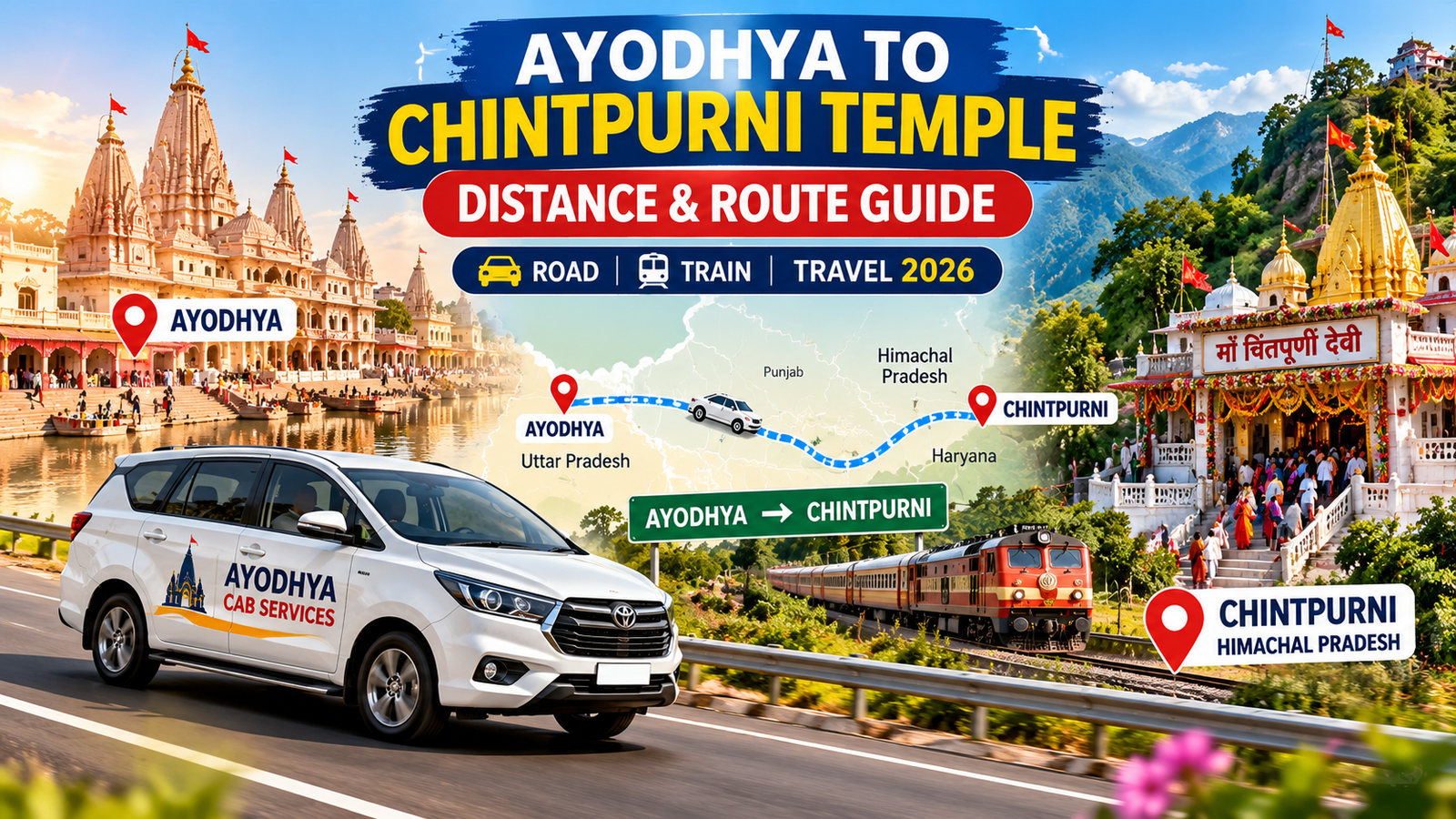
Ayodhya to Chintpurni Temple Distance and route guide for travellers planning a journey from Ayodhya to Chintpurni in Himachal Pradesh.
Ayodhya to Chintpurni Temple Distance by Road
The Ayodhya to Chintpurni Temple Distance by road should be checked in live navigation immediately before departure.
Why not depend on one fixed number?
Ayodhya and Chintpurni are separated by a long journey across multiple states. Navigation applications may suggest different approaches depending on traffic, road restrictions, highway conditions and your exact starting point in Ayodhya.
For SEO articles, it is tempting to publish a precise distance and travel time. For an actual traveller, however, an outdated figure is less useful than understanding the journey properly.
A practical road journey generally moves west and north-west from Ayodhya through the plains before approaching Punjab and the lower Himalayan region of Himachal Pradesh. Your final approach will depend on the route selected by your navigation system.
Before leaving, compare at least two live route options. Check total kilometres, estimated driving hours, tolls, road closures and expected arrival time.
The final part of the journey deserves particular attention because driving conditions near a pilgrimage destination can differ considerably from long highway stretches.
Ayodhya to Chintpurni Temple Route
There is more than one possible Ayodhya to Chintpurni Temple Route, so travellers should avoid treating a long list of intermediate cities as compulsory stops.
A better approach is to divide the trip into three stages.
Stage 1: Ayodhya to the Major North Indian Highway Network
The first part takes you away from Ayodhya and towards the major highway network connecting Uttar Pradesh with Delhi/NCR and north-western India.
For this section, the fastest route can vary according to your departure point, traffic and current road conditions.
An early departure can be useful on a journey of this length because it gives you more flexibility later in the day.
Stage 2: Towards Punjab and Himachal Pradesh
The middle section brings the journey towards Punjab and the Himachal Pradesh region.
This is where travellers should check whether their navigation application is routing them towards Una, Amb, Bharwain or another suitable approach to Chintpurni.
Do not manually force a route simply because an older travel article recommends it. A route that was convenient previously may not be the best option on the day you travel.
Stage 3: Final Approach to Chintpurni
The last section requires more attention than simply following the total distance counter.
Chintpurni is a busy pilgrimage town, particularly during major religious periods. Himachal Tourism notes that visitors have to walk to the temple because vehicles are not permitted within the temple premises. Himachal Tourism
Accordingly, reaching Chintpurni does not necessarily mean reaching the temple entrance in your vehicle.
Allow additional time for parking, walking and local crowd management.
Ayodhya to Chintpurni Temple Travel Time
Travel time for the Ayodhya to Chintpurni Temple Distance should be treated as a planning estimate rather than a guaranteed duration.
Several factors can change it significantly:
- departure time from Ayodhya;
- traffic through major urban areas;
- chosen highway;
- meal and rest stops;
- weather;
- road works;
- congestion approaching Chintpurni;
- Navratri or holiday crowds.
For a long road trip, the shortest ETA displayed by navigation should not become your entire schedule.
Build a reasonable buffer into the journey.
Families travelling with children or elderly passengers may also need more frequent stops. If multiple people can safely share the driving, plan driver changes before departure rather than deciding only after fatigue begins.
The objective should be a comfortable arrival, not simply completing the route as quickly as possible.
Ayodhya to Chintpurni Temple by Car
Travelling Ayodhya to Chintpurni Temple by car gives you considerable flexibility.
You can choose your departure time, stop when required and carry luggage more conveniently. A private vehicle can also make it easier to combine Chintpurni with other destinations if you are planning a longer Himachal itinerary.
Before departure, check tyres, spare tyre, brakes, coolant, engine oil, lights and FASTag balance.
Keep essential documents available and save your accommodation details offline.
It is also sensible to download an offline map of the relevant region. Mobile connectivity is generally useful for navigation, but your travel plan should not depend entirely on a continuous data connection.
Avoid planning every stop in advance. Instead, identify broad rest intervals and choose busy, well-maintained fuel stations or food outlets along the live route.
Ayodhya to Chintpurni Temple by Train
For travellers who do not want to complete the entire journey by road, Ayodhya to Chintpurni Temple by train can be considered as a rail-plus-road journey.
There is an important distinction here: your train journey and your temple journey are not necessarily the same thing.
You need to identify a practical railway station first and then plan the remaining road section separately.
Himachal Tourism confirms that Una is connected by rail and that Indian Railways operates services on the Una–Chandigarh–Delhi corridor. The state’s official tourism information also lists the Una Himachal railway line as one of the rail gateways serving Himachal Pradesh. Himachal Tourism
For travellers starting in Ayodhya, actual train availability may involve direct or connecting services depending on the travel date.
Do not rely on a train number copied from an old blog.
Railway schedules, operating days and availability can change. Check the current journey through the official Indian Railways/IRCTC system before booking.
Nearest Railway Station to Chintpurni Temple
Travellers frequently search for the nearest railway station to Chintpurni Temple, but the most useful station is not always determined purely by geographical distance.
Your decision should consider:
Train availability from your origin: A slightly more distant station with a practical connection can sometimes be easier than a geographically closer station with inconvenient rail options.
Last-mile transport: Check how you will travel from the station to Chintpurni before confirming the ticket.
Arrival time: Arriving very late at night may complicate the final road journey.
Travelling group: Families, senior citizens and passengers carrying substantial luggage may prefer fewer transfers.
Una is an important rail gateway for the district. Official Himachal Tourism information states that Chintpurni is approximately 54 km from Una town. Himachal Tourism
Still, check the current rail options from Ayodhya for your exact date before deciding where to terminate the train journey.
Ayodhya to Chintpurni Temple by Flight
Flying is another possible way to reduce the long overland portion of the journey, but Chintpurni itself does not have an airport.
You therefore need a flight plus road-transfer plan.
Official Himachal Tourism information for Una identifies Chandigarh International Airport as an important air gateway and places it roughly 132 km from Una. The state tourism portal also describes Pathankot and Gaggal-Kangra as gateways serving the broader Kangra, Hamirpur and Una region. Himachal Tourism
For someone travelling from Ayodhya, the best airport should therefore be decided by comparing the complete journey rather than air distance alone.
Check:
flight availability from your practical departure airport, airfare, baggage requirements, landing time, onward road distance and ground-transport availability.
Sometimes a longer flight itinerary with multiple transfers saves little time compared with rail or road travel.
Where Is Chintpurni Temple?
Shree Chintpurni Devi Temple is located in Una district, Himachal Pradesh.
The destination lies in the lower hill region rather than the high-altitude Himalayan areas that travellers may associate with destinations such as Manali.
Himachal Tourism places Chintpurni approximately 54–55 km from Una. The same official source describes it as a major pilgrimage centre and Shaktipeeth township. Himachal Tourism
This geographical context matters when planning your trip.
You are not simply travelling to “Himachal Pradesh.” Una district lies comparatively close to the Punjab side of the state, which influences the practical road and rail approaches to Chintpurni.
About Mata Chintpurni Temple
Mata Chintpurni is one of Himachal Pradesh’s prominent pilgrimage destinations.
According to Himachal Tourism, Chintpurni is regarded as a Shaktipeeth. The tourism department records the traditional belief associated with Sati and identifies the temple as a major pilgrimage centre. Himachal Tourism
The temple is also formally recognised among Himachal Pradesh’s administered temple trusts. Government records list Chintpurni Temple at Chintpurni, Una among the state’s temple trusts. LAC Haryana
Visitors should approach religious traditions respectfully while distinguishing matters of faith from historically verifiable information.
For a travel guide, the most useful point is simple: Chintpurni attracts substantial pilgrimage traffic, so crowd conditions should form part of your journey planning.
Chintpurni Temple During Navratri
Navratri is especially important when deciding when to visit.
Himachal Tourism states that Navratra fairs take place at Chintpurni during March/April for Chaitra Navratri and September/October for Ashwina Navratri. The pilgrim town becomes particularly busy during these periods. Himachal Tourism
That affects more than darshan.
Road traffic, accommodation demand, parking availability, walking time and queues may all differ from an ordinary weekday.
If your main goal is to participate during Navratri, plan specifically for the larger crowds.
If your priority is a quieter journey, check the religious calendar and major local events before fixing the date.
Chintpurni Temple Parking and Final Walk
This is one of the practical details worth knowing before arrival.
Official Himachal Tourism information states that vehicles are not allowed inside the temple premises and visitors need to walk to the temple. Himachal Tourism
Therefore, your navigation destination should not be treated as a guaranteed drop-off point at the shrine.
Look for authorised parking and follow current local traffic instructions.
Travellers accompanying elderly family members should check current accessibility arrangements before visiting. Do not assume that an old parking or shuttle arrangement remains unchanged in 2026.
During busy periods, keep extra time between parking and your planned darshan.
Best Time to Visit Chintpurni from Ayodhya
There is no single “best” month for every traveller.
Your preferred season depends on whether you value comfortable weather, Navratri celebrations, lighter crowds or school-holiday convenience.
Official tourism information for Una describes March–June as summer, July–September as monsoon and December–February as winter. Himachal Tourism
Summer can be warm in Una district.
Monsoon travel requires greater attention to weather and road conditions.
Winter can be more comfortable for some visitors, but early mornings and evenings may feel considerably cooler.
Navratri offers a very different experience because pilgrimage activity increases.
Before a monsoon or winter trip, check the latest Himachal weather and road advisories rather than relying on seasonal averages alone.
What to Carry for the Ayodhya to Chintpurni Journey
For a journey this long, packing should focus on practical needs rather than carrying too much.
Keep identity documents, booking confirmations, medicines, charging cables, a power bank, water and some cash accessible.
Carry footwear suitable for walking because the final temple approach involves travelling on foot.
Seasonal clothing matters too. A trip during summer requires different preparation from a December journey.
If travelling during monsoon, keep rain protection readily available instead of buried under luggage.
People who take regular medicines should carry enough for the entire journey plus a small buffer. Do not assume that the same medicine or brand will be immediately available at every stop.
Travelling with Senior Citizens
A pilgrimage trip with elderly family members requires a different schedule from a solo road trip.
Avoid building the itinerary around the minimum possible driving time.
Plan more frequent rest stops and keep food, water and prescribed medication within easy reach.
Accommodation location becomes important too. A cheaper room far from your practical arrival area may create unnecessary additional travel.
Because the temple’s final approach requires walking, check current accessibility and local assistance arrangements shortly before departure.
Most importantly, avoid assuming that arrangements described in old videos or blogs are still operational.
Travelling with Children
Children can make a long road or rail journey more enjoyable, but they also require more flexible planning.
Keep snacks, water, basic medicines, spare clothing and entertainment accessible.
On a road trip, regular breaks are useful. Avoid extending driving simply because the remaining distance appears manageable.
Crowded pilgrimage periods require additional attention. Agree on a meeting point with older children and keep younger children close in busy areas.
Writing a parent’s phone number on a small card carried securely by the child can also be a useful precaution in crowded public places.
Ayodhya to Chintpurni Temple Road Trip Planning
A good road trip begins before the engine starts.
The evening before departure, check your live route and weather forecast. Confirm your accommodation and note its phone number separately.
On departure day, compare traffic conditions again.
During the journey, do not chase an ETA that keeps changing. Navigation estimates respond to current traffic and should be treated as guidance.
Once you reach the Himachal side of the journey, give yourself additional time for local roads and destination traffic.
A simple rule works well: plan the highway journey for efficiency and the final approach for patience.
Should You Complete the Journey in One Day?
This depends on your drivers, departure time and tolerance for long-distance road travel.
A navigation application may display a technically possible same-day arrival. That does not automatically make it the most comfortable plan.
Driving fatigue matters.
If only one person is driving, consider whether an overnight break would make the journey safer and more enjoyable.
Families with young children or elderly passengers may also prefer splitting the trip.
If you do stop overnight, choose the halt according to your actual route rather than selecting a city before checking navigation.
Places Near Chintpurni Temple
Chintpurni can also form part of a wider pilgrimage or Himachal itinerary.
One relevant nearby destination is Jwala Ji Temple. Official Kangra temple information places Mata Chintpurni about 35 km from Jwala Ji, while Himachal Tourism’s Kangra information lists Chintpurni about 59 km from Kangra. Kangra Temples
These figures are useful for regional planning, although actual driving distance can differ according to the route and exact start/end points.
Do not attempt to include every nearby temple merely because they appear close on a map.
If travelling with family, one or two well-planned destinations can be more comfortable than rushing through several places in a day.
Chintpurni and Jwala Ji in One Trip
Combining Chintpurni and Jwala Ji can make sense for travellers already undertaking the long journey from Ayodhya.
Official information from the Jwala Ji temple administration lists Mata Chintpurni Temple at approximately 35 km from Jwala Ji. Kangra Temples
However, distance is only one part of the decision.
Darshan queues, parking, meal breaks and accommodation can consume significant time.
If both destinations are important to you, consider allocating sufficient time rather than planning them around an aggressive driving schedule.
This also gives you flexibility if one temple is busier than expected.
Chintpurni and Kangra Travel Planning
Travellers extending their trip towards Kangra have additional pilgrimage and sightseeing possibilities.
Himachal Tourism lists Chintpurni at approximately 59 km from Kangra. Its regional information also identifies Jwalaji, Chamunda Devi and Bajreshwari Devi among important destinations in the Kangra area. Himachal Tourism
This makes a multi-destination itinerary possible.
Still, remember that map distance is not equivalent to sightseeing time.
Mountain and hill-region travel can progress differently from driving on expressways in the plains.
Build the itinerary around realistic daily movement rather than the maximum number of places you can put on a list.
Common Mistakes When Planning Ayodhya to Chintpurni
The first mistake is treating an old distance figure as permanent.
The second is booking a train without checking the last-mile road journey.
Another common problem is planning arrival and darshan as though vehicles can drive directly into the temple premises.
Travellers also underestimate festival crowds.
Navratri can significantly change the character of the destination, so ordinary-day assumptions may no longer apply.
Finally, avoid creating an itinerary with no buffer. Long journeys can encounter traffic, weather changes, road work and unexpected breaks.
A flexible plan is usually more useful than a schedule accurate to every minute.
How to Plan Ayodhya to Chintpurni Temple Distance in 2026
Start by selecting your travel date.
Next, check the Ayodhya to Chintpurni Temple Distance on a live navigation service for that date or shortly before departure.
Compare road and rail options rather than automatically assuming one is faster.
If choosing rail, confirm the actual train on the official railway booking system and separately calculate the station-to-Chintpurni journey.
Then check accommodation and current local conditions.
Before departure, review the weather forecast and any relevant road advisories.
For Navratri travel, give yourself substantially more flexibility around Chintpurni.
This process takes only a little extra planning but produces a much more realistic itinerary than copying a route from an old article.
FAQs About Ayodhya to Chintpurni Temple Distance
What is the Ayodhya to Chintpurni Temple Distance?
The exact road distance depends on the route selected and your precise starting point in Ayodhya. Check live navigation immediately before travelling rather than relying on a single fixed kilometre figure.
Where is Chintpurni Temple located?
Chintpurni Temple is located in Una district of Himachal Pradesh. Himachal Tourism places it approximately 54–55 km from Una town. Himachal Tourism
Can I travel from Ayodhya to Chintpurni by train?
Yes, a rail-plus-road journey can be planned. Una is an important rail gateway in the region, but actual services from Ayodhya should be checked for your exact travel date. Himachal Tourism
Can vehicles go directly to Chintpurni Temple?
Himachal Tourism states that vehicles are not allowed in the temple premises and visitors have to walk to the temple. Check current parking and accessibility arrangements before travelling. Himachal Tourism
Is Chintpurni Temple crowded during Navratri?
Navratri is a major festival period at Chintpurni. Official tourism information notes Navratra fairs during March/April and September/October, so travellers should plan for increased pilgrimage activity. Himachal Tourism
Can Chintpurni and Jwala Ji be visited on the same trip?
Yes, they can be incorporated into the same regional itinerary. Official Jwala Ji temple information lists Mata Chintpurni Temple about 35 km from Jwala Ji. Actual road conditions and darshan time should still be considered. Kangra Temples
Conclusion
Planning the Ayodhya to Chintpurni Temple Distance is easier when you look beyond a single kilometre figure.
A successful journey involves choosing the right route, checking current road conditions, comparing train options, understanding the final approach to Chintpurni and leaving enough time for rest and darshan.
Chintpurni’s location in Una district makes road and rail combinations possible, while nearby destinations such as Jwala Ji can be added if you have sufficient time.
For a 2026 journey, verify your live route, railway schedule, weather and current temple arrangements shortly before departure. That will give you a more reliable travel plan than depending on an old fixed itinerary.
Ayodhya to Chintpurni Route: How to Choose the Right Option
When searching for the Ayodhya to Chintpurni Route, you may see different suggestions depending on the navigation service, traffic conditions and exact starting point.
Rather than memorising one fixed chain of cities, use the route suggested by live navigation on the day of travel and examine it before accepting it.
Look at the complete journey rather than only the headline ETA.
For example, suppose one route is marginally shorter but passes through more congested urban sections. Another may add some distance while providing longer highway stretches. For a family journey, the second option could still be more comfortable.
That does not mean the longer route will always be better. It simply shows why distance and travel quality should be evaluated separately.
Before leaving Ayodhya, compare:
- total road distance;
- current ETA;
- toll roads;
- major congestion points;
- available fuel and rest stops;
- weather towards the destination;
- the final approach into Chintpurni.
Do the comparison again on the morning of departure because conditions can change.
Ayodhya to Mata Chintpurni Distance: Why Different Websites Show Different Figures
Travellers sometimes become confused when different websites provide different values for the Ayodhya to Mata Chintpurni Distance.
This does not necessarily mean one of them is deliberately providing incorrect information.
Road distance depends on the selected route and exact start and end points. One map may calculate from central Ayodhya while another begins from a different part of the city. Similarly, a destination pin may represent Chintpurni town rather than the precise parking area used by visitors.
Highway changes can create further differences.
A newly opened bypass, diversion or road restriction can alter the recommended journey even if the two destinations remain unchanged.
For this reason, treat a distance mentioned in a travel article as orientation rather than live navigation.
Immediately before departure, enter your actual starting location and destination into your preferred mapping service. That gives you a much more useful figure for fuel, breaks and arrival planning.
Ayodhya to Chintpurni by Road: Planning the Long Highway Section
A large portion of the Ayodhya to Chintpurni by Road journey takes place before you reach Himachal Pradesh.
This section is where efficient planning can save considerable fatigue.
Leaving early can help because the first few hours often determine how comfortably the rest of the day progresses. However, departure time should suit the driver rather than forcing someone to start without adequate sleep.
Plan the first major break before you become tired.
After that, use sensible intervals rather than stopping every time the navigation screen shows a familiar city.
Fuel stops are another consideration. Do not wait until the tank is almost empty, particularly later in the journey when you may be less familiar with the road.
Keep FASTag ready for toll sections and carry an alternative payment method as a backup.
Most importantly, resist the temptation to reduce breaks merely because the ETA has increased. Arriving later is preferable to driving while excessively fatigued.
How to Plan Rest Stops Without Making the Journey Too Long
Too many stops can make a long road trip frustrating. Too few can make it exhausting.
A practical balance is better.
Instead of choosing every restaurant before leaving home, identify approximate intervals at which you expect to stop. When the time approaches, look for a suitable place on your current route.
A good stop should ideally offer:
clean washrooms, safe parking, food or refreshments and enough space to stretch for a few minutes.
Families may need longer breaks than solo travellers.
Senior citizens can require more frequent stops, while children may benefit from shorter but predictable breaks.
If one person is doing all the driving, rest becomes even more important.
The objective is not to achieve the shortest possible recorded journey. It is to reach Chintpurni alert enough to enjoy the destination.
Fuel Planning for Ayodhya to Chintpurni
Fuel calculation should be based on your own vehicle rather than a generic online estimate.
Start with the live road distance displayed for your selected route.
Then use the vehicle’s realistic highway mileage—not its advertised maximum mileage—to estimate approximate fuel consumption.
For example, the basic calculation is:
Estimated fuel required = Total journey distance ÷ realistic vehicle mileage
Then:
Approximate fuel cost = estimated fuel required × current fuel price
Do not treat the result as an exact budget.
Traffic, air-conditioning, driving style, diversions, idling and local movement around your destination can all affect consumption.
For a return trip, calculate both directions and add the local travel you expect to do around the destination.
This gives you a much more useful budget than copying a fuel-cost figure from an article that may have been written when prices were different.
Toll Cost From Ayodhya to Chintpurni
A fixed Ayodhya to Chintpurni toll cost can become outdated quickly because it depends on the chosen roads, vehicle category and applicable toll rates.
Check the toll estimate through your current navigation or route-planning service before departure.
Keep adequate FASTag balance.
It is also worth checking whether your route has changed after you begin travelling. A navigation application may reroute you around congestion, which can change the toll calculation.
Do not choose a substantially slower road simply to avoid a relatively small toll unless you have a specific reason.
For a long family journey, road quality and travel time can matter more than minimising every individual toll charge.
Best Departure Time From Ayodhya
There is no universal departure time that works for every traveller.
An early-morning departure can be practical because it allows you to cover a significant portion of the journey during daylight.
However, starting at 3:00 or 4:00 AM is not automatically a good idea if the driver has not slept properly.
Choose a time that provides both rest and useful daylight.
If your route passes through major urban areas, review expected traffic before fixing your departure.
People splitting the journey across two days have greater flexibility. They can travel a comfortable first section, stop for the night and continue after adequate rest.
A well-rested 6:00 AM start can be better than an exhausted 3:00 AM departure.
One-Day vs Two-Day Ayodhya to Chintpurni Road Trip
Whether you should complete the Ayodhya to Chintpurni Temple Distance in one day depends primarily on the people travelling.
A group with two experienced drivers may view the journey differently from a family with one driver, small children and elderly passengers.
One-Day Journey
A one-day trip reduces hotel changes and allows you to reach the destination sooner.
However, it can involve many hours on the road.
If attempting it, avoid creating a rigid temple schedule immediately after your expected arrival. Traffic delays can easily move the ETA.
Two-Day Journey
Breaking the journey gives the driver more rest and can make the overall trip more comfortable.
The overnight location should be chosen after checking your actual route.
Ideally, the first day should cover a meaningful portion of the journey without forcing you to drive late simply to reach a predetermined hotel.
For many families, a two-day plan can turn a tiring transfer into a manageable road trip.
Should You Book a Hotel Before Reaching Chintpurni?
Advance accommodation can be useful, especially during weekends, festivals and Navratri periods.
But do not book purely on the basis of the words “near Chintpurni Temple.”
Check the actual map location.
A property may advertise proximity while still requiring an inconvenient drive or walk.
Consider parking, accessibility, check-in time and the needs of your travelling group.
If elderly family members are travelling, ask the property directly about stairs and lift availability rather than assuming these facilities exist.
During busier periods, booking ahead reduces uncertainty. On quieter dates, travellers may have more flexibility, but advance research is still worthwhile.
Reaching Chintpurni Late at Night
Try to understand the final approach before deciding that a late-night arrival is acceptable.
A long highway journey can feel straightforward until the final hours, when the driver is most tired.
If your ETA slips substantially, reconsider whether continuing is sensible.
Accommodation reception hours should also be checked beforehand.
Do not assume that every property accepts unrestricted late check-in.
Save the property’s phone number and map location offline. If possible, speak to them before arrival when you know you will be late.
The same principle applies to railway passengers arriving at a regional station late at night: confirm onward transport before beginning the journey.
Chintpurni Temple Darshan Planning
Darshan planning should remain separate from your road ETA.
Suppose your navigation app says you will arrive in Chintpurni at a particular time. That does not mean you will be standing inside the temple at that exact time.
You may still need to reach authorised parking, collect your belongings and walk towards the temple.
Queues can add further time.
Festival periods can be considerably busier than ordinary days.
For this reason, avoid booking another activity immediately after your estimated temple visit.
Leave enough space in the itinerary for the destination to operate at its own pace.
What to Do After Reaching Chintpurni
Once you reach Chintpurni, the first priority should be settling in rather than immediately trying to complete every planned activity.
If you have travelled all day, check into your accommodation and rest.
Confirm current local arrangements for the temple, including the approach and any restrictions that may apply on that date.
Keep unnecessary luggage at your accommodation.
Carry only essential belongings during the temple visit, particularly when crowds are expected.
If you plan to continue towards another destination after Chintpurni, review the next day’s route before sleeping. This is especially useful if weather or traffic conditions have changed during your journey.
Chintpurni to Jwala Ji Distance and Trip Planning
Travellers researching Chintpurni often consider adding Jwala Ji to the same itinerary.
The two destinations are close enough regionally for a combined trip to be practical, but the plan should not be based only on kilometres.
The official Kangra temple portal has listed Mata Chintpurni at approximately 35 km from Jwala Ji.
Actual driving distance can differ according to your starting point and route.
If you intend to visit both, start by deciding which destination will be your overnight base.
Then check the live road route between them.
Allow time for parking and darshan at both locations instead of calculating the itinerary only from driving time.
This approach is particularly important during Navratri.
Chintpurni to Kangra Travel
Kangra can be the next stage for travellers extending their journey deeper into Himachal Pradesh.
The wider Kangra region contains several well-known religious and tourist destinations.
However, do not assume that places appearing geographically close on a map can all be visited quickly.
Road travel in the region differs from long expressway sections.
The practical time required includes local traffic, parking, meal breaks, sightseeing and darshan.
If Kangra is part of your itinerary, consider spending a night in the region instead of driving back and forth unnecessarily.
This creates a more relaxed route and provides flexibility if one stop takes longer than expected.
Chintpurni, Jwala Ji and Kangra: A Practical Itinerary
A simple multi-day structure can work better than attempting everything immediately after the drive from Ayodhya.
Day 1 — Ayodhya to Overnight Halt
Begin the journey after proper rest.
Cover a comfortable portion of the road distance and stop for the night according to the route you are actually following.
Day 2 — Reach Chintpurni
Continue towards Himachal Pradesh and reach Chintpurni.
Check into your accommodation and plan darshan according to current conditions.
Day 3 — Chintpurni to Jwala Ji
Visit Jwala Ji if it forms part of your pilgrimage plan.
If you are continuing towards Kangra, move forward rather than returning unnecessarily.
Day 4 — Kangra Region
Use this day for whichever destinations genuinely matter to your group.
Do not treat this as a checklist that must be followed exactly. It is a framework that can be shortened or extended depending on your available time.
Ayodhya to Chintpurni With Family
A family journey requires more than route planning.
Before departure, decide who will manage documents, medicines, accommodation details and navigation.
This avoids searching through bags at every stop.
Keep one small day bag containing items everyone may need during the journey.
Larger luggage can remain in the boot.
Children and elderly passengers should not have to wait for the driver to unpack the vehicle simply to find water or medicine.
If your family has different food preferences, carry a few familiar snacks as backup. This becomes useful when the nearest convenient stop does not match everyone’s needs.
Ayodhya to Chintpurni With Senior Citizens
For senior citizens, convenience can matter more than completing the journey quickly.
Choose accommodation after checking accessibility.
Keep medicines in the passenger compartment, not inside luggage buried in the boot.
Plan enough rest before temple darshan.
A person who has spent many hours travelling may not be comfortable beginning a long walk immediately after arrival.
Current local accessibility arrangements should be checked directly before the trip because facilities can change.
If anyone has mobility or health limitations, base the itinerary around their requirements rather than the fastest possible schedule.
Food Planning During the Journey
There is no need to carry meals for the entire trip, but a few basic items can be helpful.
Water, dry snacks and simple food provide a backup when the next suitable stop is farther away than expected.
Avoid overeating during driving breaks.
Heavy meals can make some drivers sleepy, particularly during afternoon highway travel.
Use established food stops where possible and pay attention to hygiene.
If travelling with children, elderly passengers or anyone with dietary restrictions, identify suitable options before entering long sections where choices may be limited.
Weather Planning for Chintpurni
Weather should be checked close to the travel date rather than inferred only from the month.
Himachal Pradesh experiences substantial seasonal variation, and conditions in Una district are not identical to those at high-altitude destinations elsewhere in the state.
During monsoon, check rain and road advisories.
In winter, pack warmer clothing for mornings and evenings even if the plains felt comfortable when you left Ayodhya.
Summer travellers should carry adequate water and sun protection.
Weather also affects the final walking portion of the temple visit, so footwear should suit current conditions.
Monsoon Travel to Chintpurni
A monsoon trip requires a more flexible itinerary.
Do not rely solely on the weather forecast you checked several days earlier.
Review conditions on the morning of travel and again before entering the hill region.
Keep rain protection easily accessible.
Avoid unnecessary night driving in unfamiliar areas during poor weather.
If authorities issue restrictions or road advisories, follow them rather than attempting to maintain the original schedule.
A delayed itinerary is easier to manage than an avoidable road problem.
Winter Travel From Ayodhya to Chintpurni
Winter creates a different set of considerations.
The journey begins in the plains and ends in Himachal Pradesh, so temperature can vary significantly along the route.
Keep jackets or warmer layers accessible instead of packing all winter clothing at the bottom of your luggage.
Daylight hours are also shorter than in summer.
If you are uncomfortable driving unfamiliar roads after dark, structure the journey accordingly.
Check weather conditions before travelling rather than assuming that every Himachal destination will experience the same conditions.
Navratri Travel Planning
Navratri deserves separate planning because Chintpurni receives significant pilgrimage activity during festival periods.
If you specifically want the festival atmosphere, book accommodation early and keep the itinerary flexible.
Allow more time for local traffic, parking and queues.
Avoid planning a tightly timed onward journey immediately after darshan.
Families travelling with elderly people or small children should consider whether the busiest period matches their comfort level.
If your dates are flexible and your priority is a quieter visit, travelling outside major festival days may provide a different experience.
Train Journey Planning: Think Beyond the Ticket
Finding a train is only the first step.
Before booking, examine the arrival station and time.
Then calculate the remaining journey to Chintpurni.
A train arriving at a convenient regional gateway during daylight may be more useful than another service that appears faster but leaves you with a difficult late-night transfer.
Check whether your itinerary requires a connection.
Also consider the buffer between connecting trains. A very short interchange can create unnecessary stress on a long trip.
Train numbers and timetables should always be confirmed through official railway channels for your actual travel date.
Road Trip vs Train: Which Makes More Sense?
Neither option is universally better.
Road travel offers greater flexibility. It can work well for families carrying luggage or travellers planning several destinations.
Rail can reduce the amount of continuous driving.
However, you still need to arrange the last-mile journey from the station.
Compare the complete door-to-door experience.
For example, do not compare ten hours on a train with the entire road journey while ignoring the time needed to reach the station, wait, change trains and complete the final road transfer.
Once the whole journey is considered, the more practical choice usually becomes clearer.
How Much Time Should You Keep for the Complete Trip?
Start with the number of days you actually have available.
Then subtract the days needed for comfortable travel from Ayodhya and back.
What remains is your usable destination time.
This method prevents the common mistake of planning four days of sightseeing inside a four-day trip while forgetting that a large portion of those days will be spent travelling.
For a longer pilgrimage circuit, additional days provide much more flexibility.
If Chintpurni is your only destination, the itinerary can remain simpler.
Do not add locations merely to make the journey appear more worthwhile.
Create an Offline Travel Backup
Most travellers now depend heavily on their phones.
That is convenient until the battery dies, mobile data becomes weak or an app stops loading.
Before departure, save:
your hotel address, booking confirmation, important phone numbers, railway details if applicable and screenshots of key route information.
Download offline maps for the relevant areas if your navigation service supports them.
Carry a charged power bank.
This takes only a few minutes and can make an unfamiliar journey considerably easier if connectivity becomes unreliable.
Avoid These Planning Errors
Do not assume the shortest route is automatically the fastest.
Avoid using an old train timetable.
Do not calculate temple arrival directly from the road ETA.
Never build the itinerary without rest time.
Avoid booking accommodation without checking its actual map position.
Do not schedule too many nearby destinations simply because their map distances look small.
Most importantly, do not treat an online travel article—including this one—as a substitute for live information.
A useful guide should help you make better decisions. Current navigation, railway information, weather alerts and local instructions should determine the final journey.
A Simple Checklist Before Leaving Ayodhya
The evening before departure, confirm your route and accommodation.
Check weather conditions for both the plains and destination region.
Ensure your vehicle is ready if travelling by road.
Keep FASTag funded and carry an alternative payment method.
Save important addresses offline.
Charge phones and power banks.
Keep medicines, identity documents and water accessible.
On the morning of departure, check the route again.
If conditions have changed, adjust the plan rather than forcing the itinerary you created earlier.
Final Travel Planning Advice
The Ayodhya to Chintpurni Temple Distance is only the starting point for planning this journey.
A useful itinerary combines live navigation, sensible rest stops, realistic arrival expectations and enough flexibility for Chintpurni itself.
Road travellers should choose routes based on current conditions rather than memorising a fixed city-by-city sequence. Rail passengers should evaluate the complete journey from Ayodhya to the temple, including the final road transfer.
If you are combining Chintpurni with Jwala Ji or Kangra, allow those destinations enough time rather than turning the trip into a race between map pins.
A little flexibility is especially valuable during Navratri, monsoon conditions and family travel.
Once the Ayodhya to Chintpurni Temple Distance, route and transport options are understood, the next step is turning that information into a workable trip. This becomes particularly important when you are travelling with family, combining Chintpurni with other destinations or returning to Ayodhya after the visit.
Instead of repeating the road and train information from Parts 1 and 2, this section focuses on itinerary building, budgeting, local planning, return travel and practical decisions that can make the overall journey easier.
Ayodhya to Chintpurni Temple Distance for a Round Trip
When planning a road journey, do not budget only for the outward Ayodhya to Chintpurni Temple Distance.
Your actual driving will include the return journey plus any local travel between your accommodation, parking area and additional destinations.
If Jwala Ji, Kangra or another place is added to the itinerary, calculate those sections separately.
A simple planning formula is:
Ayodhya → Chintpurni + local travel + additional destinations + return journey = realistic total trip distance
Use live navigation to calculate each leg shortly before travelling.
This is more accurate than simply doubling one online distance figure. Your return route may change because of traffic, road conditions or another destination added to the itinerary.
The same principle applies to fuel and toll budgeting.
How to Build a Realistic Chintpurni Trip Budget
Rather than searching for a fixed Ayodhya to Chintpurni trip cost, build the budget around your own travel style.
Divide expenses into a few practical categories:
Transport: fuel, tolls, railway tickets or other transportation.
Accommodation: overnight halt plus your stay near Chintpurni or another destination.
Food: meals during the highway journey and at the destination.
Local movement: parking and any local transport you genuinely require.
Additional destinations: extra travel if you extend the journey towards Jwala Ji or Kangra.
Emergency buffer: money reserved for an unexpected additional stay, route change or other essential expense.
Avoid copying a total trip budget from somebody else’s journey.
A family of five travelling by car and staying for several nights will naturally spend differently from two travellers using rail and budget accommodation.
A Practical 3-Day Chintpurni Itinerary
A three-day itinerary can work only if your transport plan and available time make it realistic.
Day 1: Travel Towards Chintpurni
Start from Ayodhya after proper rest.
If you are driving, follow the live route and take sensible breaks. Whether you reach Chintpurni on the same day or use an overnight halt should depend on driving conditions and driver fatigue.
Rail passengers should use this day according to their confirmed train schedule.
Do not attach a strict darshan deadline to your arrival time.
Day 2: Chintpurni Temple
Use the second day primarily for Chintpurni.
This gives you more flexibility around the final approach, walking and queues.
If conditions are comfortable and sufficient time remains, you can explore the surrounding area without forcing another major destination into the day.
Day 3: Return or Continue the Journey
Travellers with limited time can begin the return journey.
Those extending their itinerary can continue towards another planned destination instead.
The important point is to avoid turning the temple visit into a rushed stop between two long driving days.
A Practical 4-Day Chintpurni and Jwala Ji Plan
If Jwala Ji Temple is also important to your family, an additional day creates a more comfortable schedule.
Day 1: Ayodhya to Planned Halt or Chintpurni
Travel according to current road or railway conditions.
Day 2: Chintpurni
Keep sufficient time for the temple visit and rest.
Day 3: Chintpurni to Jwala Ji
Travel towards Jwala Ji using the current navigation route.
Complete your visit without assuming that road distance alone determines how much time you need.
You can then stay according to the next stage of your itinerary.
Day 4: Return or Continue
Begin your return journey or continue towards another destination if you have planned a larger Himachal trip.
This structure is intentionally flexible. Your actual itinerary should follow current conditions rather than the article.
Ayodhya to Chintpurni and Jwala Ji Trip
Combining Chintpurni and Jwala Ji is one of the more logical extensions of this journey because the destinations are in the same broader region.
Still, they should be treated as two separate visits.
Do not calculate the day simply as:
Driving time + 30 minutes at one temple + driving time + 30 minutes at another temple.
Real travel includes parking, walking, queues, meals and breaks.
Crowd conditions can also differ substantially between ordinary weekdays and major religious periods.
If your schedule allows, keep one destination as the main focus for each part of the day rather than rushing continuously.
This gives elderly travellers and children more time to rest as well.
Should You Add More Temples to the Same Journey?
A long trip from Ayodhya naturally creates the temptation to visit as many places as possible.
That is not always the best itinerary.
Adding another destination makes sense when it falls reasonably within your route and you genuinely have enough time.
It makes less sense when visiting it requires several extra hours of driving followed by an immediate return.
Before adding any location, ask three questions:
How much additional road travel does it require?
How much time will we realistically spend there?
Does adding it make the next day’s journey unnecessarily difficult?
If the answers create a tiring schedule, leave the destination for another trip.
Planning Chintpurni With Jwala Ji, Kangra and Dharamshala
Travellers with more days can build a wider Himachal itinerary after Chintpurni.
A practical progression may involve travelling from the Chintpurni area towards Jwala Ji and then further into the Kangra region.
Dharamshala can be considered if it genuinely fits your available time.
However, each added destination changes the nature of the trip.
A Chintpurni pilgrimage can be relatively focused. Once Kangra and Dharamshala are included, accommodation changes and additional hill travel become more important.
For a larger itinerary, calculate every road leg separately in live navigation.
Do not calculate only Ayodhya to Chintpurni and assume the remaining destinations are minor local movements.
Where to Stay: Chintpurni or Continue Ahead?
The best overnight location depends on what you are doing the next morning.
If Chintpurni is your primary destination and you want a relaxed visit, staying in or around the town can be convenient.
If you complete your visit early and your next destination lies further ahead, continuing may reduce unnecessary backtracking.
However, do not drive onward solely to save time if the driver is already tired.
Accommodation should support the itinerary, not control it.
Before booking, check:
actual map location, parking, accessibility, check-in policy and recent property information.
For elderly travellers, ask about stairs and lifts directly.
Hotel Location Matters More Than a Small Price Difference
Two hotels may both describe themselves as being close to Chintpurni.
Their practical locations can still be very different.
One may be convenient for your route and parking, while another requires extra local driving.
A small saving on room price may not be worthwhile if the property creates unnecessary movement for the whole family.
Open the accommodation in a map before booking.
Check the route from your likely arrival direction and understand how you will continue the following morning.
This simple check is particularly useful during crowded periods.
Planning the Return Journey to Ayodhya
The return trip deserves the same attention as the outward journey.
Travellers often plan extensively for reaching a destination but assume the return will automatically be straightforward.
Before leaving Chintpurni, check the live route again.
Do not assume the road you used while arriving will still be the fastest option.
Traffic, weather or diversions may produce another recommendation.
If you have visited Jwala Ji, Kangra or another location after Chintpurni, calculate your return from your actual final destination, not from Chintpurni.
This prevents inaccurate estimates of distance and arrival time.
When Should You Start the Return Journey?
Your return departure should account for how much travelling you completed on the previous day.
After several days of sightseeing and road travel, fatigue can accumulate.
A very early departure is useful only when the driver has slept adequately.
If you are breaking the return journey into two days, there is less reason to rush.
Families should also consider when they want to reach Ayodhya.
Arriving extremely late at night after a long driving day may be less convenient than using an overnight stop and reaching home the following day.
What to Check Before Leaving Chintpurni
Before beginning the return journey, take ten minutes to organise everything.
Check the vehicle if travelling by road.
Confirm that no important belongings have been left at the accommodation.
Review your navigation route and fuel level.
Check weather conditions along the next section.
If travelling by train, reconfirm your ticket details and allow sufficient time to reach the station.
Keep frequently needed items accessible rather than repacking everything deep inside the luggage.
These simple steps reduce avoidable delays after departure.
What If Your Chintpurni Trip Falls During Heavy Rain?
A fixed itinerary should become flexible when weather conditions deteriorate.
If heavy rain is forecast, review official weather and road information before travelling.
Do not assume that conditions in Ayodhya represent what you will encounter later in the journey.
Similarly, weather in Una district should not be inferred from reports about distant high-altitude parts of Himachal Pradesh.
If local authorities issue travel restrictions, follow them.
A hotel booking or planned return date should never be treated as a reason to ignore a serious road advisory.
Keep an additional day’s financial buffer when travelling during periods when weather disruption is more plausible.
Mobile Network and Navigation Preparation
Mobile navigation makes long-distance road travel considerably easier, but prepare for situations where connectivity is weaker.
Download the relevant offline map areas before departure.
Save screenshots of your accommodation and important booking information.
If multiple adults are travelling, share key details with at least one other person.
Do not keep every booking only on one phone.
A power bank and charging cable should remain inside the passenger compartment.
For road navigation, a secure phone mount is safer and more practical than repeatedly holding the device while driving.
Documents to Keep During the Journey
Road travellers should check the documents legally required for their vehicle and driver before departure.
Do this at home rather than while already on the highway.
Rail passengers should keep the identification required for their booking readily accessible.
Hotel booking details should also be saved offline.
If travelling with elderly family members who take regular medication, carrying their prescription or relevant medical information can be useful.
Avoid keeping every document in one bag that is difficult to access.
Digital backups are convenient, but essential documents should be available in the form appropriate to their actual requirement.
Packing for Chintpurni Without Overpacking
A long journey does not necessarily require excessive luggage.
Pack according to the number of days, expected weather and planned activities.
Comfortable walking footwear is particularly useful because the temple visit includes movement on foot.
Keep a smaller bag for the journey itself.
It can contain:
water, essential medicines, charging accessories, tissues, light snacks and other frequently needed items.
Leave larger luggage packed until you reach the accommodation.
This avoids repeatedly unloading bags at highway stops.
Clothing for Chintpurni
Choose clothing according to the season and current forecast.
Comfortable, respectful clothing is practical for the temple visit.
During summer, lightweight clothing can be useful for the warmer conditions around Una district.
Monsoon travellers should keep rain protection.
Winter visitors should carry layers because mornings and evenings can feel cooler than the plains.
Avoid relying on the generic idea that “Himachal is always cold.”
Conditions vary considerably across the state, elevation and season.
Checking the destination forecast shortly before travel provides better guidance.
Food and Water Near the Destination
Long travel days can disrupt normal meal times.
Try to maintain regular meals rather than depending entirely on snacks.
Carry drinking water during the journey, but avoid filling the vehicle with unnecessary supplies that are easily available along developed routes.
People with dietary restrictions should research food options around their accommodation.
Families with children may want to carry a small quantity of familiar food for emergencies.
During crowded festival periods, allow extra time for meals because restaurants and public areas may be busier.
Cash or Digital Payment?
Digital payments are widely useful during travel, but relying on only one payment method is unnecessary.
Carry a modest amount of cash for situations where a small vendor, parking facility or network problem makes digital payment inconvenient.
At the same time, avoid carrying excessive cash.
Keep money divided between responsible adults rather than storing everything in one wallet.
Ensure FASTag has sufficient balance if travelling by car.
A backup card or another digital payment account can also prevent a minor payment problem from disrupting the journey.
How to Keep the Journey Comfortable for Children
For children, a long trip can feel much longer than it does to adults.
Build breaks into the journey before they become restless.
Carry water, simple snacks, spare clothing and any necessary medicines.
Offline entertainment can help when network connectivity becomes inconsistent.
Avoid giving children heavy meals immediately before long winding road sections if they are prone to motion sickness.
Parents who already know their child experiences travel sickness should follow advice previously given by their healthcare professional rather than experimenting with medication during the trip.
Planning for Elderly Travellers at the Destination
The final temple visit may be more demanding than the highway journey for some elderly travellers.
Allow them time to rest after arrival.
Do not assume that reaching the hotel means everyone is ready to begin walking immediately.
Check the latest local accessibility arrangements before the visit.
If your family member uses mobility assistance, verify what is currently practical around the temple approach.
This information can change, so it is better checked shortly before travelling than copied from an old video.
Avoiding Overcrowded Travel Days
Some travellers specifically want to experience Navratri and other busy religious periods. Others prefer a calmer visit.
Both are valid choices.
If you want fewer crowds, look at the festival calendar before booking.
Weekends and public holidays may also attract more visitors than an ordinary weekday.
However, there is no guarantee that a particular non-festival day will be quiet.
Use dates as a planning factor rather than a promise about crowd size.
If travelling during a peak period, compensate by keeping fewer activities in the same day.
Photography and Responsible Travel
Follow current photography restrictions around the temple and any controlled areas.
Do not assume that because other visitors have posted photographs online, photography is permitted everywhere.
Keep phones and valuables secure in crowded areas.
Avoid blocking walking routes for photographs.
Outside the temple, dispose of food packaging and other waste responsibly.
These are small considerations, but pilgrimage destinations receive large numbers of visitors and individual behaviour contributes to the overall experience.
How to Use Google Maps Without Blindly Following It
Navigation is extremely useful, but it should support judgment rather than replace it.
Review the complete route before starting.
If the application suddenly suggests leaving a major road for an unfamiliar shortcut, examine the alternative before accepting it.
A technically shorter road is not always the easiest road.
During difficult weather, prioritise official road instructions over an app’s estimated time saving.
Similarly, when local police or traffic personnel direct vehicles differently near Chintpurni, follow the on-ground arrangement.
The final kilometres around a busy destination can involve temporary traffic management that an app does not immediately reflect.
What to Do If Your ETA Changes Significantly
Long journeys rarely proceed exactly according to the original ETA.
Traffic can add time. Longer meal stops may delay departure. Weather can slow the final section.
If your ETA changes substantially, update the next decision rather than trying to recover every lost minute by driving faster or skipping necessary rest.
Call your accommodation if late check-in becomes likely.
If you planned darshan immediately after arrival, move it to a more comfortable time where practical.
Flexibility is one of the most valuable tools on a long road journey.
Ayodhya to Chintpurni Temple Distance: Planning by Travel Type
Different travellers should approach the same journey differently.
Solo Traveller
Prioritise rest and avoid excessive continuous driving.
Keep accommodation and emergency contact details easily accessible.
Couple
Choose road or rail according to the overall itinerary and the amount of luggage.
A flexible plan can make it easier to extend the journey to another destination.
Family With Children
Build more stops into the schedule and avoid an excessively packed sightseeing plan.
Family With Senior Citizens
Prioritise accessibility, rest and accommodation location over squeezing the journey into the shortest possible duration.
Group Travel
Agree on major stops before departure and keep everyone’s important information accessible.
The same Ayodhya to Chintpurni Temple Distance can therefore produce very different practical itineraries.
A Better Way to Compare Road, Train and Flight
Do not compare only the advertised duration of each transport mode.
Compare door-to-door time.
For road travel, that means departure from your actual location in Ayodhya to your accommodation near Chintpurni.
For rail, include travel to the station, waiting time, train journey, connections and final road transfer.
For air travel, include the journey to the departure airport, airport reporting time, flight, baggage collection and onward road travel.
Then compare cost, convenience and fatigue.
This gives you a much more realistic answer than asking only which mode is fastest.
Frequently Asked Planning Questions
Is Ayodhya to Chintpurni suitable for a family road trip?
It can be planned as a family road trip, but the journey is long. Rest breaks, driver fatigue, accommodation and the needs of children or elderly passengers should determine whether you travel continuously or use an overnight halt.
Should I stay overnight near Chintpurni?
An overnight stay can be useful if you want a less rushed temple visit or are arriving after a long journey. Check the actual hotel location and facilities before booking.
Can I add Jwala Ji after Chintpurni?
Yes, Jwala Ji can be considered as part of the same regional itinerary. Check the live route and allow separate time for travel, parking and the temple visit.
Should I book trains using information from travel blogs?
No. A blog can explain the journey, but train numbers, schedules, operating days, fares and availability should be checked through official railway booking information for your exact date.
Is one fixed Ayodhya to Chintpurni distance accurate for every traveller?
No. The road distance can vary according to your exact starting point, destination pin and route selected by navigation.
Final Ayodhya to Chintpurni Travel Checklist
Before finalising the journey, make sure you know your actual travel dates and preferred mode of transport.
Check the live Ayodhya to Chintpurni Temple Distance and route.
If travelling by train, verify the current schedule rather than relying on an old article.
Confirm accommodation and understand its actual location.
Review the weather forecast close to departure.
Keep an alternative plan if conditions change.
Calculate your total budget using your own vehicle, group size and accommodation preference.
Finally, leave enough time for the reason you are making the journey in the first place. Reaching Chintpurni should not become merely another checkpoint in an overloaded itinerary.
Conclusion
The Ayodhya to Chintpurni Temple Distance is best planned as a complete journey rather than a single number on a map. Your actual experience depends on the route, transport mode, rest schedule, weather, travelling group and the number of additional destinations you include.
A road trip offers flexibility, while rail can reduce continuous driving. Combining Chintpurni with Jwala Ji or the Kangra region is possible when sufficient time is available, but adding destinations should never come at the cost of an exhausting schedule.
For a 2026 journey, use this guide to understand the planning process and use current navigation, railway information, weather updates and local instructions to make the final decisions.
Why Choose Ayodhya Cab Services for Outstation Travel from Ayodhya?
When planning the Ayodhya to Chintpurni Temple Distance, travellers often focus on kilometres and routes first. For those who prefer a private road journey starting from Ayodhya, choosing a reliable cab provider is another important part of the plan.
Ayodhya Cab Services positions itself as a top and best cab service in Ayodhya, with a focus on comfortable local and outstation journeys. Travellers can begin their journey from Ayodhya and plan road trips to destinations across India, including long-distance pilgrimage routes such as Chintpurni in Himachal Pradesh.
Best Cab Service in Ayodhya for Long-Distance Travel
A long journey requires more planning than a short city transfer. Vehicle comfort, luggage requirements, pickup timing, route planning and suitable breaks all become important.
Ayodhya Cab Services focuses on providing a practical option for travellers looking for an outstation cab from Ayodhya. Depending on trip requirements and vehicle availability, travellers can discuss suitable vehicle options before confirming a long-distance journey.
For an Ayodhya to Chintpurni road trip, this means the journey starts from Ayodhya and continues towards the destination. It does not mean Ayodhya Cab Services operates a local taxi service in Chintpurni, Una or elsewhere in Himachal Pradesh.
Top Cab Service in Ayodhya for Outstation Trips Across India
Travellers do not always want to restrict their road journey to nearby Uttar Pradesh destinations.
Ayodhya Cab Services can be positioned for outstation travel from Ayodhya to destinations across India. This makes the service relevant for pilgrimage journeys, family trips, holidays and other long-distance road travel originating in Ayodhya.
Whether the planned destination is Chintpurni, Jwala Ji, Mahakaleshwar, Maihar or another city, the important distinction remains the same: the journey originates from Ayodhya.
This keeps the service information clear and avoids creating the impression that local cab operations are available in every destination mentioned in a travel guide.
Ayodhya to Chintpurni Cab for a Private Road Journey
Travellers researching an Ayodhya to Chintpurni Cab may prefer a private road journey because it provides greater control over departure time, luggage and rest breaks.
The route is long, so travellers should check the latest road conditions and expected journey time before departure.
Families travelling with children or elderly passengers can also plan breaks according to their own requirements rather than following a public transport schedule.
For the Ayodhya to Chintpurni Temple Distance, the final route should always be based on current navigation rather than an old fixed kilometre figure.
Outstation Cab From Ayodhya to Anywhere in India
One of the strongest ways to position your brand is:
Start from Ayodhya. Travel across India.
Ayodhya Cab Services can promote outstation cab services from Ayodhya to destinations across India, while keeping local-service claims limited to the cities where you actually operate.
This wording is much safer for your SEO pages because someone reading an article about Himachal Pradesh will understand that you are offering the journey from Ayodhya, rather than claiming to be a local cab operator in Himachal Pradesh.
Cab Service in Lucknow and Ayodhya
For your actual service locations, you can separately target phrases such as Best Cab Service in Ayodhya, Top Cab Service in Ayodhya, Cab Service in Lucknow, Outstation Cab From Ayodhya, Ayodhya Outstation Taxi Service and Long Distance Cab From Ayodhya.
For this Chintpurni article, however, keep the primary commercial intent around Ayodhya → destination.
That maintains a clean relationship between the travel guide and your business.
Why Travellers Can Consider Ayodhya Cab Services
Ayodhya Cab Services is positioned around a simple promise:
“Driven by Trust, Powered by Comfort.”
For travellers starting their journey in Ayodhya, the service can be considered for local travel as well as long-distance outstation journeys originating from the city.

