
Chamunda Devi Temple Kangra to Hidimba Devi Temple Manali: Distance, Route & Travel Time
Chamunda Devi to Hidimba Devi Temple is a scenic Himachal Pradesh journey connecting the Kangra region with Manali. Travellers planning this route usually want to know the Chamunda Devi Temple to Manali distance, Chamunda Devi to Hidimba Devi Temple distance, best road route, travel time, road conditions, and places to stop between Kangra and Manali. Since this journey passes through changing hill terrain, planning the route properly can make the trip more comfortable and predictable.
The journey is not only about covering kilometres. Road conditions, mountain traffic, weather, rest breaks, and the route chosen can influence the actual travel time. Therefore, travellers should keep some flexibility in their schedule rather than relying only on the estimated time shown by a navigation app.
This detailed guide explains the journey from the Chamunda Devi Temple area near Kangra to Hidimba Devi Temple in Manali. It also covers practical route planning, approximate distance, driving conditions, stopovers, and other useful information for a Himachal road trip.
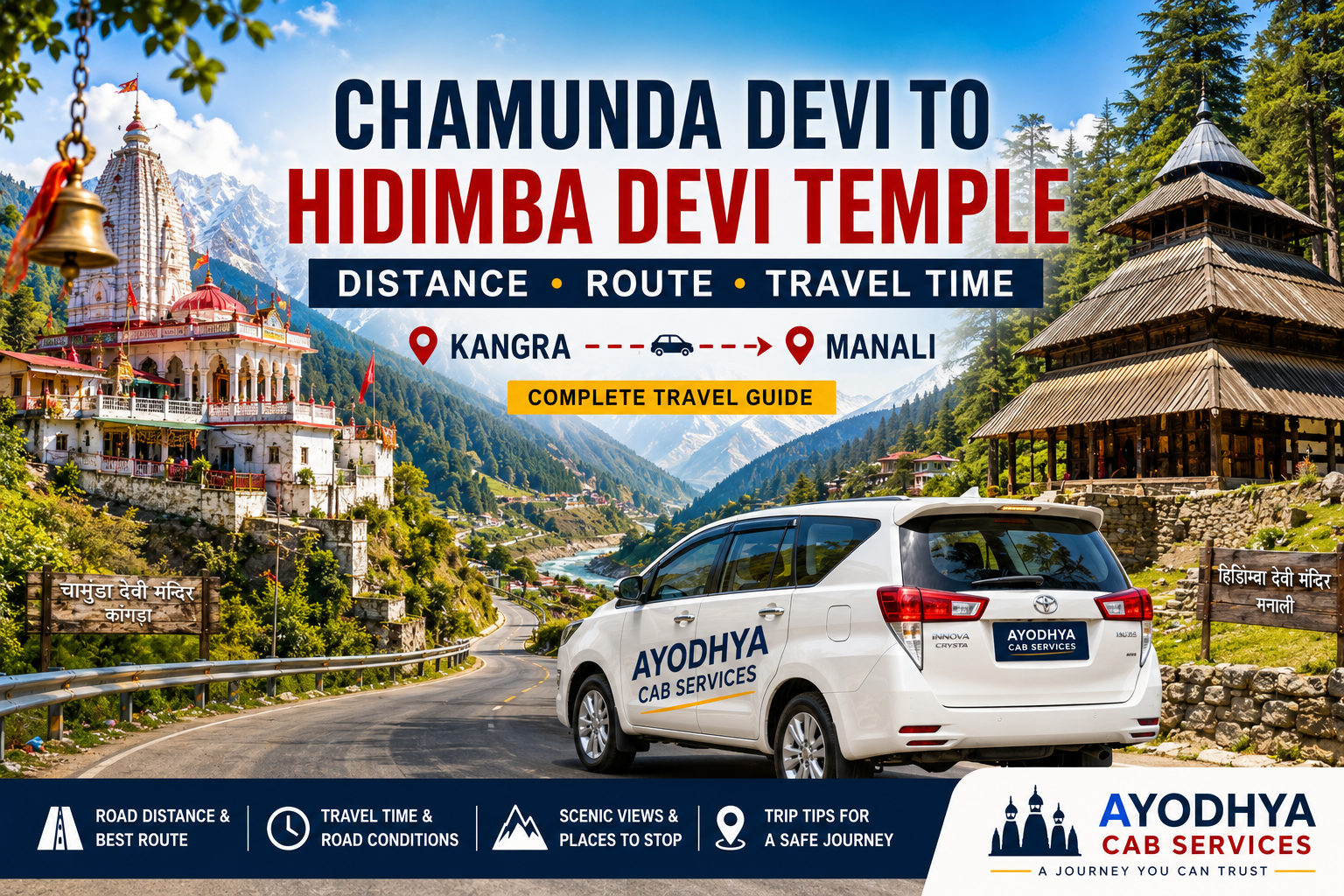
Chamunda Devi to Hidimba Devi Temple road journey from Kangra to Manali with distance, route and travel time guide.
Chamunda Devi to Hidimba Devi Temple Distance and Travel Overview
The road journey between Chamunda Devi and Hidimba Devi Temple takes travellers from the Kangra Valley towards the higher mountain landscape of Manali. Depending on the exact starting point, selected route, diversions, and local road conditions, the road distance is roughly 220–250 km. However, travellers should verify the live route before departure because mountain-road conditions can change.
A distance of around 220–250 km may not sound very large when compared with a highway journey in the plains. Yet travel in Himachal Pradesh works differently. Mountain roads have curves, elevation changes, narrow sections, local traffic, and occasional construction activity. Therefore, the same number of kilometres can require considerably more time.
The complete drive commonly requires around 7–9 hours, although this should be treated only as a planning estimate. Weather, traffic near busy towns, meal breaks, road repairs, and the final approach into Manali can extend the journey.
Travellers who prefer a relaxed trip should avoid creating a very tight schedule around the estimated arrival time. Starting earlier gives more flexibility for food breaks, photography, unexpected congestion, and slower sections of the road.
Chamunda Devi Temple Kangra to Manali Distance by Road
The Chamunda Devi Temple Kangra to Manali distance by road depends on the route suggested at the time of travel. Navigation applications can sometimes provide different options based on traffic and temporary road conditions.
The journey begins around the Kangra Valley before gradually moving towards central Himachal. As the drive progresses, the landscape changes noticeably. Urban sections give way to mountain roads, valleys, riverside stretches, and smaller settlements.
Although travellers naturally look for the shortest route, the smallest distance is not always the fastest or most comfortable choice in the hills. A slightly longer road can sometimes provide better driving conditions.
Therefore, route selection should consider road quality as well as kilometres.
Before leaving, check the live navigation route and recent road conditions. During monsoon or winter, this becomes even more important because weather can influence mountain roads quickly.
A sensible plan also includes fuel, food, and rest stops. Once the journey enters quieter hill sections, facilities may be farther apart than travellers expect.
Best Route from Chamunda Devi Temple to Hidimba Devi Temple Manali
The best route from Chamunda Devi Temple to Hidimba Devi Temple Manali can vary according to live road conditions. A commonly considered direction connects the Kangra side towards Palampur, Mandi, Kullu and Manali, although the exact navigation can differ depending on the starting point and current road status.
Palampur is an important reference point early in the journey. From there, travellers continue through the hill network towards the Mandi side. The road eventually connects with the major corridor towards Kullu and Manali.
The later part of the journey becomes easier to understand because Kullu and Manali are connected by a major travel corridor. However, traffic can increase as you approach popular tourist areas.
Once you reach Manali, Hidimba Devi Temple is located away from the main highway. Therefore, the final kilometres involve local roads rather than simply continuing on the main route.
Always keep live navigation active during the journey. Mountain routes occasionally change because of construction, maintenance, landslides, or traffic management.
Chamunda Devi Temple to Manali Travel Time
The Chamunda Devi Temple to Manali travel time should be planned more generously than a similar-distance journey on an expressway.
A practical estimate is approximately 7–9 hours, but the actual journey may be shorter or longer. Several variables influence the final time.
The first is road geometry. Mountain roads naturally reduce average speed because drivers need to handle curves and changing elevation carefully.
Traffic is another factor. Congestion near towns, tourist areas, roadwork, or narrow sections can add significant time.
Weather also matters. Heavy rain, fog, snowfall, or poor visibility can slow the journey considerably.
Breaks should be included as well. A long hill journey becomes tiring without proper rest. Food, tea, washroom, and photography stops can easily add an hour or more to the total trip.
For that reason, travellers should avoid planning an important activity immediately after the navigation application’s estimated arrival time.
Chamunda Devi to Manali Road Route for First-Time Travellers
The Chamunda Devi to Manali road route may feel challenging for someone travelling through Himachal for the first time. However, good preparation makes the journey much easier.
Start by downloading an offline map of the route. Mobile connectivity can become inconsistent in some hill sections. Offline navigation provides useful backup when the network becomes weak.
Next, avoid calculating the entire journey according to plains-road driving speeds. Mountain travel requires patience. Overtaking opportunities can be limited, and rushing on unfamiliar curves is never worthwhile.
Fuel planning is equally important. Filling the tank before entering longer mountain sections reduces unnecessary stress.
Travellers should also carry water, light snacks, basic medicines, chargers, and important documents. During winter, warm clothing should remain accessible rather than packed at the bottom of the luggage.
Finally, keep enough buffer time. Arriving slightly later than expected is normal on a long hill journey.
Kangra to Manali Distance and Why Travel Time Feels Longer
The Kangra to Manali distance can sometimes create unrealistic expectations. Travellers look at the kilometres and estimate travel time based on their experience driving between cities in the plains.
That calculation rarely works accurately in the mountains.
A vehicle may cover a long distance quickly on a wide highway. However, hill roads require slower speeds because of bends, slopes, settlements, narrow sections, and changing traffic.
The route also involves different road environments. Some stretches can be smooth and relatively quick. Others may require significantly slower driving.
This variation explains why the average speed across the complete journey remains lower.
Instead of asking only how many kilometres remain, travellers should think about the type of road ahead.
Navigation applications are helpful, but their estimated arrival times can change during the journey. Therefore, avoid treating the first ETA as a guaranteed arrival time.
Chamunda Devi Temple to Hidimba Devi Temple Road Conditions
The Chamunda Devi Temple to Hidimba Devi Temple road conditions can vary significantly across the journey.
Some sections may offer comfortable driving, while others can become narrow or winding. Road construction can also temporarily affect travel.
Conditions become particularly important during the monsoon. Heavy rainfall can increase the risk of debris, landslides, waterlogging, or temporary restrictions on mountain roads.
Winter creates different challenges. Higher areas around Manali can experience snow, ice, fog, and very low temperatures. Daylight hours are also shorter.
During normal weather, the journey is manageable for travellers accustomed to hill driving. First-time mountain drivers should remain cautious and avoid unnecessary overtaking.
Checking conditions on the morning of departure is better than relying on information collected several days earlier.
Mountain roads are dynamic. A route that was clear yesterday may face temporary restrictions today.
How to Reach Hidimba Devi Temple from Chamunda Devi Temple
Travellers researching how to reach Hidimba Devi Temple from Chamunda Devi Temple have several stages to consider.
The main part of the journey involves reaching Manali from the Kangra side. Once travellers arrive in the Manali area, they need to continue towards the temple’s local location.
Hidimba Devi Temple is situated in the Dhungri area of Manali. Therefore, it should be entered as the final destination in navigation rather than simply selecting “Manali.”
This small detail can prevent confusion after reaching town.
Local traffic in Manali can become heavy during peak tourist periods. Parking availability near popular attractions can also vary.
Therefore, reaching Manali does not necessarily mean the journey is finished. Keep extra time for the final local drive, parking, and walking where required.
Travellers arriving late in the evening should also consider reduced daylight, especially during winter.
Chamunda Devi Temple to Hidimba Devi Temple by Car
Travelling Chamunda Devi Temple to Hidimba Devi Temple by car gives travellers greater flexibility than a journey dependent on several public transport connections.
A private vehicle allows stops according to personal preference. Families can take breaks when required, while photographers can pause at suitable viewpoints where stopping is permitted.
However, flexibility comes with responsibility.
The driver needs to remain comfortable with mountain roads. Long stretches of curves can cause fatigue, particularly after several hours behind the wheel.
Take regular breaks instead of trying to complete the entire journey without stopping.
Vehicle condition should also be checked before departure. Brakes, tyres, lights, coolant, wipers, and fuel become particularly important on a hill journey.
Avoid overloading the vehicle with unnecessary luggage.
A comfortable, well-maintained vehicle combined with patient driving makes the journey considerably more enjoyable.
Chamunda Devi to Hidimba Devi Temple Route via Palampur
The Chamunda Devi to Hidimba Devi Temple route via Palampur is useful to understand because Palampur is one of the major reference points around this part of Himachal.
The town is known for its mountain setting and tea-growing landscape. Therefore, travellers may choose it as an early food or tea break depending on departure time.
However, a stop should fit naturally into the schedule.
If you have already started late, spending too much time at every town can push the arrival into the evening.
After the Palampur side, the journey continues through changing mountain terrain towards the Mandi region and eventually the Kullu-Manali corridor.
The road experience changes several times along the way. This variety is one reason the journey can feel longer than its kilometre count suggests.
Keep navigation active even when the overall direction seems straightforward.
Mandi to Manali Route During the Journey
The Mandi to Manali route forms an important later stage of the trip.
Once travellers reach this part of Himachal, the journey begins moving more directly towards Kullu and Manali. The landscape also becomes increasingly associated with the Beas Valley.
However, this corridor can experience traffic because it serves both local and tourist movement.
Construction and road improvements can occasionally create slower sections. Tourist-season traffic can add further delays.
Therefore, travellers should resist the temptation to assume the remaining kilometres will be covered quickly.
This section can be visually impressive, so passengers may want photography stops. Always stop only where parking is safe and permitted.
As Kullu approaches, Manali begins to feel closer. Yet depending on traffic, the final portion can still require patience.
Kullu to Manali Distance and Final Road Section
The Kullu to Manali distance is roughly around 40 km, depending on the exact points used. Yet this final section should not be underestimated.
Traffic around Kullu, Bhuntar, and Manali can influence travel time, particularly during busy tourism periods.
The road follows a beautiful valley landscape. Mountains become more prominent as travellers continue towards Manali.
However, drivers should keep attention on the road rather than the scenery.
Once Manali approaches, navigation should be changed or confirmed for Hidimba Devi Temple specifically.
The final destination is not located directly on the main Kullu-Manali highway. Local roads lead towards Dhungri.
Therefore, allow additional time after entering Manali.
This becomes particularly important if you are travelling during a long weekend, summer holiday period, or another high-demand tourism season.
Best Time to Travel from Chamunda Devi Temple to Manali
The best time to travel from Chamunda Devi Temple to Manali depends on the experience you want and your comfort with mountain weather.
Spring and early summer often attract travellers because temperatures are pleasant and daylight hours are useful for road trips.
The monsoon brings greener landscapes, but rainfall can create road uncertainty. Landslide-related delays are possible in mountainous areas.
Autumn can offer comfortable weather and clearer views. Therefore, many travellers find it suitable for Himachal road journeys.
Winter creates an entirely different experience around Manali. Snow can make the destination attractive, but driving conditions may become more demanding.
Whichever season you choose, check the forecast shortly before travelling.
For a long road journey, an early morning departure is usually practical. It provides more daylight and leaves buffer time for unexpected delays.
Chamunda Devi to Manali Road Trip in Summer
A Chamunda Devi to Manali road trip in summer can be enjoyable because daylight remains available for longer and temperatures are generally comfortable compared with the plains.
However, summer is also a busy tourism period in Himachal Pradesh.
Traffic near Manali can increase substantially. Hotels, parking areas, and popular attractions may also become crowded.
Therefore, advance accommodation planning can save time.
An early start remains useful even in summer. Reaching the Kullu-Manali corridor before the busiest part of the day can sometimes make the drive more comfortable.
Carry water even if the weather feels cool.
Strong sunlight at altitude can still cause dehydration.
Travellers should also keep a light jacket accessible because temperatures can change as elevation increases.
Chamunda Devi to Manali Trip During Monsoon
A Chamunda Devi to Manali trip during monsoon requires additional caution.
Himachal’s mountains look exceptionally green during the rainy season. However, heavy rainfall can affect road reliability.
Landslides, falling stones, debris, and temporary closures are possible on hill routes.
Therefore, avoid relying on a fixed schedule.
Check weather conditions before leaving and monitor official local travel advisories where available.
If heavy rainfall is forecast across the route, delaying the journey can sometimes be the safer decision.
Driving after dark during intense rain should also be avoided where possible.
Visibility decreases, while unfamiliar mountain roads become more difficult to judge.
Monsoon travellers should keep luggage protected from moisture and carry footwear suitable for wet conditions.
Chamunda Devi to Manali Trip in Winter
A Chamunda Devi to Manali trip in winter needs different preparation.
Temperatures decrease significantly as travellers approach Manali. Snowfall can affect local roads, while ice can make driving more difficult.
Warm clothing should therefore remain accessible throughout the journey.
Do not keep every jacket inside a tightly packed suitcase.
The vehicle should also be prepared for cold weather. Tyres, battery condition, brakes, coolant, lights, and windshield equipment deserve attention.
Daylight is shorter during winter, so starting early becomes even more valuable.
If snow is forecast, check local road conditions before beginning the trip.
Visitors unfamiliar with snow driving should avoid unnecessary risks.
The destination will still be there later. Reaching safely matters more than maintaining a fixed itinerary.
Places to Stop Between Kangra and Manali
Travellers searching for places to stop between Kangra and Manali have several options depending on the route and available time.
Palampur can make a convenient early break. The wider Mandi region can work well for a longer rest or meal depending on timing.
Later, Kullu provides another natural reference point before reaching Manali.
The purpose of a stop should influence its length.
A tea break may need only 15–20 minutes. A proper meal can require considerably longer.
If you stop for sightseeing at several locations, the journey can easily turn into a full-day road trip.
That is not necessarily a problem.
However, it should be planned intentionally rather than discovered after sunset.
Travellers with children or elderly family members may benefit from shorter, more frequent breaks.
Food Stops on the Chamunda Devi to Manali Route
Finding food stops on the Chamunda Devi to Manali route is generally manageable around larger towns.
Still, it is better to eat at established locations rather than waiting until everyone becomes hungry.
Palampur, Mandi, Kullu, and other populated areas provide opportunities depending on the exact route.
Keep light snacks and water inside the vehicle as backup.
Heavy meals can sometimes increase discomfort on winding roads, especially for travellers prone to motion sickness.
Therefore, lighter food may be preferable during the drive.
Tea and coffee breaks can also help the driver rest.
However, avoid relying on excessive caffeine instead of proper breaks.
Driver fatigue is a genuine concern during long hill journeys.
Motion Sickness on the Kangra to Manali Road
Motion sickness on the Kangra to Manali road can affect travellers who are not accustomed to continuous mountain curves.
Sitting where there is a clear forward view may help some passengers.
Reading books or looking at a phone continuously can worsen discomfort for certain people.
Fresh air and regular breaks can also help.
Travellers who already know they experience motion sickness should discuss suitable medication with a healthcare professional before the trip rather than experimenting during the journey.
Avoid very heavy food immediately before long winding sections.
Families travelling with children should keep tissues, water, and disposable bags easily accessible.
Simple preparation can prevent a small problem from making several hours of the journey uncomfortable.
Is Chamunda Devi to Manali Road Safe for Families?
Families often ask, is Chamunda Devi to Manali road safe for families?
Under normal conditions, this is a commonly travelled Himachal route. However, mountain-road safety depends heavily on weather, vehicle condition, driver experience, and driving behaviour.
Avoid rushing.
Seat belts should be used wherever available. Children should travel with appropriate restraints.
The driver should remain rested and avoid unnecessary overtaking on blind curves.
Night driving can be more demanding, particularly for someone unfamiliar with the route.
Weather deserves special attention during monsoon and winter.
A family trip should include enough buffer time so that delays do not create pressure to drive faster.
Good planning usually makes the journey much more comfortable.
Chamunda Devi Temple to Manali One-Day Travel Plan
A Chamunda Devi Temple to Manali one-day travel plan is practical if the objective is mainly to reach Manali rather than complete extensive sightseeing along the route.
Starting early is the key.
Morning departure provides daylight for most of the journey and allows enough time for breaks.
Keep the first stop relatively short unless you specifically want to explore Palampur.
A longer meal break can be planned around the middle of the journey.
Continue towards Mandi, Kullu, and Manali while monitoring the ETA.
If traffic remains normal, you can reach Manali with enough time to settle into accommodation.
Trying to add too many attractions on the same day can make the schedule exhausting.
For a relaxed experience, treat the journey itself as the main activity.
Hidimba Devi Temple Manali Location and Final Approach
The Hidimba Devi Temple Manali location is in Dhungri, surrounded by a distinctive forest environment.
Once travellers enter Manali, they should continue following navigation towards the temple rather than assuming it is located around the main Mall Road area.
Local traffic can affect the final approach.
During busy tourism periods, the surrounding roads may become congested.
Parking conditions can also change according to season and visitor volume.
Therefore, keep some time between reaching Manali and actually reaching the temple entrance area.
The forested surroundings create a noticeably different atmosphere from the busier parts of town.
Comfortable walking footwear can be useful, particularly if parking is available some distance away.
Chamunda Devi to Hidimba Devi Temple for a Himachal Itinerary
Adding Chamunda Devi to Hidimba Devi Temple to a broader Himachal itinerary can work well because the journey connects two popular regions of the state.
However, avoid treating the drive as a short transfer.
It occupies a significant part of the day.
If Manali sightseeing is important, keeping the following day relatively open can create a more relaxed itinerary.
Likewise, travellers coming from a long previous journey should consider whether another 7–9 hours on mountain roads is realistic.
Good itineraries balance sightseeing with recovery time.
This becomes particularly important for families, elderly travellers, and people who experience motion sickness.
A slower itinerary can sometimes create a better holiday than trying to cover the maximum number of destinations.
Common Mistakes While Planning Kangra to Manali Travel
One common mistake in Kangra to Manali travel planning is estimating the journey using plains-highway speeds.
Another is trusting an ETA without adding time for breaks.
Travellers may also forget that weather can change quickly in mountain areas.
Starting late creates another problem. A minor delay can then push a large portion of the journey into darkness.
Overloading the itinerary with sightseeing stops can have the same effect.
Vehicle preparation is sometimes overlooked as well.
A hill journey puts different demands on tyres and brakes than normal city driving.
Finally, avoid following unfamiliar shortcuts simply because a navigation application shows a slightly shorter distance.
Road quality matters.
When uncertain, verify the route locally before leaving a major road.
How to Plan a Comfortable Kangra to Manali Road Journey
A comfortable Kangra to Manali road journey begins before the vehicle starts moving.
Sleep properly the previous night.
Check the weather and live route in the morning. Keep identification, booking details, water, medicines, chargers, and warm clothing accessible.
Start with enough fuel.
Plan one or two major rest stops but remain flexible.
Passengers should avoid pressuring the driver to maintain an unrealistic arrival time.
If conditions become poor, reduce speed.
Mountain travel rewards patience.
The scenery itself is part of the experience, so there is little benefit in turning the journey into a race against the navigation ETA.
Chamunda Devi to Manali Travel Guide for First-Time Visitors
A Chamunda Devi to Manali travel guide for first-time visitors should emphasize flexibility above everything else.
Distances in Himachal can be deceptive.
Weather can influence road conditions. Tourist traffic can increase unexpectedly. Construction can slow particular stretches.
Therefore, leave enough room in the itinerary for changes.
Offline maps are useful. Cash can also be helpful in smaller locations, even though digital payments are widely used.
Keep hotel contact details saved before entering areas with weak connectivity.
Most importantly, avoid planning the trip around an exact minute-by-minute schedule.
A realistic plan gives travellers enough time to enjoy the journey without becoming stressed whenever the ETA changes.
Best Road Trip Planning Tips for Chamunda Devi to Manali
The best road trip planning tips for Chamunda Devi to Manali are simple but important.
Start early, keep the vehicle in good condition, monitor weather, take proper breaks, and avoid unnecessary night driving.
Keep luggage organized so essential items remain accessible.
Download offline navigation.
Do not depend entirely on one estimated route if local conditions suggest otherwise.
Families should consider the comfort of children and elderly passengers when planning stops.
If one passenger experiences motion sickness, choose smoother driving over speed.
These decisions may appear small, but together they can determine whether the journey feels exhausting or enjoyable.
Long-Tail Search Guide: Chamunda Devi Temple Kangra to Manali by Road
Travellers searching Chamunda Devi Temple Kangra to Manali by road generally need more than a distance number.
They need to know how long the journey realistically takes, what type of roads they will encounter, where breaks are practical, and how weather can affect the drive.
This is why road-trip planning should combine navigation data with real travel considerations.
The route passes through several different landscapes and road environments.
As a result, average speed changes throughout the day.
Allow enough time for those variations.
If navigation shows an arrival time that leaves no room for breaks, do not build the rest of your itinerary around it.
A little extra buffer can make the entire journey more relaxed.
Chamunda Devi Temple to Hidimba Devi Temple Travel Time for Families
The Chamunda Devi Temple to Hidimba Devi Temple travel time for families may be longer than the fastest navigation estimate.
Children may need additional washroom stops. Elderly passengers can benefit from opportunities to stretch. Someone experiencing motion sickness may need an unscheduled break.
Therefore, families can reasonably add extra buffer time to the basic 7–9 hour planning range.
This does not mean the journey is excessively difficult.
It simply means comfort should take priority over speed.
Starting early helps enormously because there is less pressure to rush later.
A relaxed lunch and two short breaks can make a long hill journey much more manageable.
Planning the Journey Without Depending on Cab Availability Outside Your City
Travel articles sometimes create confusion when a business name appears alongside a destination. Readers may assume that the company operates locally at every place mentioned.
That assumption should be avoided.
This guide is intended primarily to provide useful travel information about the Kangra-Manali journey. Travellers should independently confirm transport availability at their actual starting location before finalizing the trip.
This distinction is especially important for long-distance travel blogs.
A useful article can help readers understand a route even when the publisher does not operate transportation services at the destination.
Clear information builds more trust than implying service availability where none exists.
Final Thoughts on Chamunda Devi Temple Kangra to Hidimba Devi Temple Manali
Chamunda Devi to Hidimba Devi Temple is a memorable Himachal road journey that combines the Kangra Valley with the mountain environment of Manali. The drive is approximately 220–250 km depending on the route, while travellers should generally keep around 7–9 hours or more available for realistic road conditions and breaks.
The most important factor is not finding the fastest possible route. Instead, choose a practical road, check live conditions, start early, and keep enough buffer time.
Weather deserves particular attention during monsoon and winter. Likewise, tourist-season traffic can affect the final approach towards Manali.
For first-time travellers, the journey becomes much easier when expectations are realistic. Mountain kilometres take time, and that slower pace is part of travelling through Himachal Pradesh.
With good planning, comfortable breaks, and flexible timing, the journey from Kangra towards Hidimba Devi Temple can become an enjoyable part of the trip rather than simply the distance between two destinations.
Chamunda Devi to Hidimba Devi Temple Distance by Road for a Comfortable Journey
The Chamunda Devi to Hidimba Devi Temple journey needs more planning than simply checking the kilometres on a map. Travellers move through changing hill terrain, so road quality, traffic, weather, and rest stops can affect the total travel time. For this reason, the fastest-looking route is not always the most comfortable option.
On mountain roads, average driving speed remains lower than on highways in the plains. A section that appears short on the map may take longer because of curves, settlements, roadwork, or slow-moving traffic. Therefore, keeping additional time in the schedule makes the journey easier.
Before departure, check the live route instead of relying on a screenshot saved several days earlier. It is also useful to check the weather around Kangra, Mandi, Kullu, and Manali. Conditions can differ considerably between the starting point and destination.
Travellers should also avoid scheduling an important booking immediately after the expected arrival time. A flexible schedule provides room for food, washroom breaks, traffic, and unexpected road delays without making the journey stressful.
Chamunda Devi Temple to Manali Best Road Route for Tourists
Travellers looking for the Chamunda Devi Temple to Manali best road route should consider road conditions along with distance. Navigation apps may suggest more than one option, and the shortest route is not automatically the best choice for every traveller.
A practical journey generally moves from the Kangra side towards the Palampur region and then continues through Himachal towards Mandi. From the Mandi side, travellers can proceed towards Kullu and finally Manali, subject to the route available on the day.
This journey offers changing scenery throughout the drive. The early sections around Kangra and Palampur have a different character from the mountain and valley stretches that appear later. As travellers move towards Kullu and Manali, the landscape becomes increasingly mountainous.
However, scenic surroundings should not encourage unnecessary stops on narrow roads. Use proper parking areas wherever possible.
Most importantly, check live navigation before departure and again during major breaks. Temporary road changes can make an alternative route more practical on a particular day.
How Long Does It Take from Chamunda Devi Temple to Manali?
Travellers often ask how long does it take from Chamunda Devi Temple to Manali, but there is no single guaranteed travel time.
For planning purposes, keeping approximately 7–9 hours or more available is sensible. However, the actual duration depends on the route, weather, traffic, stops, and current road conditions.
Mountain driving naturally lowers average speed. Moreover, a short traffic jam on a narrow section can create a larger delay than similar congestion on a multi-lane highway.
Meal breaks also matter. A family travelling comfortably may spend more time on the route than someone taking only one short stop.
Instead of trying to beat the navigation ETA, use it as a changing estimate. The arrival time may move forward or backward throughout the journey.
An early departure gives travellers the greatest flexibility. It also reduces the possibility of completing unfamiliar mountain sections after dark.
Kangra to Manali Road Trip: What to Expect on the Way
A Kangra to Manali road trip combines several types of mountain landscapes within one journey. That variety makes the drive interesting, but it also means road conditions and driving speeds are not consistent throughout the route.
Near populated areas, local traffic can reduce speed. Other stretches may feel relatively open. Later, travellers encounter the busy corridor leading towards Kullu and Manali.
The scenery can make the journey enjoyable for passengers. However, drivers should keep their attention on the road, especially around curves and narrow sections.
It is useful to divide the journey mentally into stages rather than constantly checking the remaining distance. Palampur, the Mandi region, Kullu, and Manali can serve as useful reference points depending on the chosen route.
This approach also makes rest planning easier.
Instead of driving until everyone becomes tired, decide approximately where a tea, meal, or washroom break may be needed.
Chamunda Devi to Manali Route via Palampur and Mandi
The Chamunda Devi to Manali route via Palampur and Mandi gives travellers several recognizable points during the journey.
Palampur can appear relatively early depending on the exact starting location. Travellers who begin without breakfast may choose to stop around this part of the journey. However, those who start after a proper meal can continue further before taking their first significant break.
The journey towards the Mandi side takes travellers deeper into Himachal’s hill-road network. Driving conditions can vary, so it is better to focus on steady progress rather than maintaining a fixed average speed.
Mandi becomes another important reference point before the route continues towards Kullu.
From there, the journey increasingly follows the direction of the Kullu-Manali corridor.
Even when navigation suggests this general direction, road conditions should still be checked on the day of travel. Construction, diversions, and weather can influence which route is preferable.
Chamunda Devi to Manali Distance via Mandi
The Chamunda Devi to Manali distance via Mandi should be understood as a road-trip estimate rather than a fixed number that remains identical on every navigation app.
Different starting points around Chamunda Devi, alternative road sections, diversions, and the exact destination in Manali can change the final kilometre count.
For this reason, travellers may see slightly different figures on different devices.
That difference is normal.
The more important question is whether the selected route offers suitable road conditions.
A slightly longer route can occasionally save time if it avoids a difficult or disrupted section. Similarly, a shorter mountain road can take longer if it contains narrow stretches or heavy local traffic.
Always compare both estimated time and road characteristics before making the final choice.
Live information becomes particularly valuable during monsoon and winter.
Mandi to Kullu Road Conditions and Travel Planning
The Mandi to Kullu road conditions can strongly influence the later part of the journey towards Manali.
This corridor carries significant traffic and has undergone road-development work over time. As a result, travellers should check current conditions rather than assuming the experience will be identical to an earlier trip.
Roadwork can occasionally create slow sections.
Likewise, tourist traffic can increase during holidays and peak seasons.
Keep enough fuel before entering a long section and avoid waiting until the vehicle is nearly empty.
Food and washroom facilities are easier to find around populated areas, so plan stops accordingly.
If travelling during rain, remain alert for local advisories.
The objective should be steady, safe progress. Trying to recover time lost in traffic by driving aggressively later is never a sensible strategy on mountain roads.
Mandi to Manali Distance and Approximate Travel Time
The Mandi to Manali distance is an important part of the overall Kangra-Manali journey. Depending on the exact route and endpoints, travellers should expect roughly around 100 km or more between the wider Mandi and Manali areas.
However, kilometres alone do not determine the travel time.
Traffic around important junctions can create delays. Road construction can reduce speed further. In addition, tourist traffic tends to increase as travellers approach the Kullu-Manali region.
Therefore, do not assume the final 100 km will pass as quickly as 100 km on a major expressway.
This part of the journey is also visually attractive. The landscape changes considerably as the route moves deeper into the valley.
Passengers can enjoy the surroundings, while the driver should remain focused on the road.
If you are running behind schedule, it is still better to reach Manali later than to rush through the remaining mountain sections.
Kullu to Manali Travel Time During Peak Season
The Kullu to Manali travel time during peak season can differ considerably from normal conditions.
During summer holidays, long weekends, festival periods, or heavy tourist movement, more vehicles enter the Manali region.
Therefore, the last part of the journey may take longer than expected.
This is particularly important for travellers who see that Manali is only around 40 km away and assume they will arrive very quickly.
Traffic around towns, junctions, and tourist areas can change that estimate.
If hotel check-in has a specific requirement, keep the property informed if you are delayed.
Avoid creating another sightseeing commitment immediately after reaching Manali.
After a long drive from the Kangra side, travellers may appreciate some rest before beginning local exploration.
Manali Traffic During Tourist Season
Manali traffic during tourist season deserves consideration while planning the final arrival.
Tourist demand can rise significantly during summer, snowfall periods, weekends, and holidays. Consequently, roads that appear short on the map may take longer.
The busiest areas are not always limited to the highway.
Local Manali roads can also experience congestion.
Therefore, entering the town is only one stage of reaching the final destination.
If your hotel is in another part of Manali, or you are heading directly towards Dhungri, allow additional local travel time.
Parking can also influence the schedule.
Travellers who plan to visit multiple attractions immediately after arriving may find the day unnecessarily tiring.
A more comfortable approach is to reach Manali, check in, rest, and then decide whether enough daylight and energy remain for local sightseeing.
Distance from Manali Mall Road to Hidimba Devi Temple
The distance from Manali Mall Road to Hidimba Devi Temple is relatively short, roughly around 2–3 km depending on the exact starting point and local route.
However, local traffic can influence the time required.
Hidimba Devi Temple is located in the Dhungri area rather than directly on Mall Road. Therefore, travellers should enter the temple itself as the navigation destination.
Some visitors may choose to travel by local vehicle, while others may explore nearby areas on foot depending on weather, fitness, and accommodation location.
The approach becomes particularly attractive because the surroundings change from the busy town environment to a more forested setting.
During busy tourist periods, parking may require additional time.
Therefore, avoid planning the visit with only a few spare minutes before another booking or activity.
Best Time of Day to Start from Chamunda Devi for Manali
The best time of day to start from Chamunda Devi for Manali is generally early morning.
Leaving early provides several advantages.
First, travellers receive more daylight for a long mountain journey. Second, they have greater flexibility if traffic or road conditions create unexpected delays.
An early departure also allows proper food and rest breaks without creating pressure to reach Manali before dark.
The exact departure time depends on season.
During winter, daylight is shorter, so an early start becomes even more useful. During summer, longer daylight offers slightly more flexibility, although tourist traffic can be heavier.
Avoid beginning the journey after a tiring night.
The driver should be properly rested before spending several hours on mountain roads.
Good preparation at the beginning can improve the entire day’s travel experience.
Chamunda Devi to Manali Morning Departure Plan
A Chamunda Devi to Manali morning departure plan should remain simple.
Complete packing the previous evening wherever possible. Keep essential items separate from large luggage.
Before leaving, check weather conditions and the current navigation route.
Start with sufficient fuel.
A light breakfast can help travellers avoid stopping too early unless they specifically want to spend time around Palampur.
After a few hours, take a proper rest.
Stretching and walking for several minutes can help the driver remain alert.
A longer meal break can then be planned around the middle of the journey depending on progress.
As the vehicle moves towards Kullu, check the latest ETA for Manali.
This gives a more realistic picture of the remaining schedule than the ETA shown at the beginning of the trip.
Where to Take a Break Between Kangra and Manali
Travellers searching where to take a break between Kangra and Manali should choose locations according to timing rather than simply following a fixed list.
Palampur can work as an early stop.
If travellers do not need a break that soon, they can continue and choose another populated location later.
The wider Mandi area can be useful for a substantial break because it falls deeper into the journey.
Kullu provides another option closer to the destination.
Instead of taking several long breaks, combine short rest stops with one proper meal break.
This approach keeps the journey moving while preventing driver fatigue.
Travellers with children or elderly passengers may need additional stops.
That is completely reasonable.
The schedule should adapt to passenger comfort rather than forcing everyone to follow an unrealistic arrival target.
Kangra to Manali Road Trip with Family
A Kangra to Manali road trip with family requires slightly different planning from a solo journey.
Children may become restless during several hours of mountain driving. Elderly passengers may need more frequent opportunities to stretch or use a washroom.
Therefore, families should include extra time in the itinerary.
Keep water, light food, tissues, basic medicines, and warm clothing within easy reach.
If anyone is prone to motion sickness, plan accordingly before departure.
Families should also avoid packing the day with activities immediately after reaching Manali.
Even passengers who are not driving can feel tired after a long journey through winding roads.
A comfortable arrival and relaxed evening can make the following day’s sightseeing much more enjoyable.
Kangra to Manali Road Trip with Senior Citizens
A Kangra to Manali road trip with senior citizens can be planned comfortably when the journey is not rushed.
Regular breaks become particularly important.
Sitting in one position for many hours can be uncomfortable, so stopping periodically gives passengers an opportunity to walk and stretch.
Medicines should remain in hand luggage rather than inside a suitcase buried under other bags.
Carry drinking water and some familiar food.
Temperature changes should also be considered. The weather around Manali may be noticeably cooler than at the starting point.
Therefore, jackets or shawls should remain accessible.
If a passenger has a medical condition that may affect long-distance mountain travel, professional medical advice before the trip can be useful.
Comfort should always take priority over reaching the destination at a specific time.
Kangra to Manali with Children: Travel Planning Tips
Travelling Kangra to Manali with children becomes easier when parents expect the journey to take most of the day.
Young children may not remain comfortable through several continuous hours of curves.
Short breaks can therefore make a noticeable difference.
Carry water, simple snacks, tissues, extra clothes, and any regularly required items where they can be reached quickly.
Avoid giving children a very heavy meal immediately before long winding sections if they tend to experience travel sickness.
Entertainment can help, but staring at screens continuously may worsen motion discomfort for some passengers.
Instead, combine music, conversation, sleep, and occasional breaks.
The journey becomes much easier when the schedule is designed around the family rather than around the fastest possible ETA.
Chamunda Devi to Manali Bike Trip: What Riders Should Know
A Chamunda Devi to Manali bike trip can appeal to riders who enjoy mountain journeys, but preparation is essential.
Weather exposure is much greater on a motorcycle than inside a car.
Rain, cold wind, strong sunlight, and sudden temperature changes can affect comfort quickly.
Proper riding gear is therefore important.
The motorcycle should be checked before departure, particularly tyres, brakes, chain condition, lights, and fluid levels.
Fuel should be planned in advance.
Avoid riding continuously for several hours without proper rest.
Fatigue affects concentration, and mountain roads require constant attention.
Riders should also avoid attempting aggressive overtakes simply to maintain a planned arrival time.
During poor weather, reducing speed or stopping temporarily can be the sensible choice.
Chamunda Devi to Manali Self-Drive Car Journey
A Chamunda Devi to Manali self-drive car journey gives travellers complete control over timing and stops.
However, the driver should be comfortable with mountain roads.
Continuous curves, uphill and downhill sections, local traffic, and changing road widths require concentration.
Before leaving, check tyres, brakes, lights, wipers, coolant, and fuel.
Do not ignore small mechanical problems before a long hill journey.
Use lower gears appropriately on descents rather than relying excessively on the brakes.
If the driver begins feeling tired, stop.
A 15-minute break can be more valuable than pushing through fatigue.
Passengers should also help by monitoring navigation and avoiding distractions during difficult sections.
Self-driving can be enjoyable when the journey is treated as part of the trip rather than an obstacle to finish quickly.
Fuel Stops Between Kangra and Manali
Planning fuel stops between Kangra and Manali is straightforward when travellers avoid waiting until the tank becomes nearly empty.
Fuel stations are available around larger towns and populated areas along major routes.
However, travellers should begin the journey with adequate fuel.
This provides flexibility if a planned station is crowded, temporarily unavailable, or located off the preferred route.
During a food break, checking the fuel level takes only a few seconds.
That simple habit can prevent unnecessary worry later.
Motorcycle riders may need to plan more carefully because of smaller tank capacity.
Regardless of vehicle type, do not carry fuel in unsafe containers.
Use regular filling stations and keep the journey simple.
Mobile Network on Kangra to Manali Road
The mobile network on Kangra to Manali road may vary as travellers move through different mountain sections.
Strong connectivity around towns should not create the assumption that mobile data will remain equally reliable everywhere.
For this reason, download offline maps before departure.
Save important phone numbers as well.
Hotel details, booking information, identification documents, and other useful information should not depend entirely on an active internet connection.
A car charger or power bank is also useful because navigation can consume battery quickly.
If the network disappears temporarily, avoid repeatedly changing routes without understanding the road.
Continue using offline navigation until connectivity returns.
Technology is helpful, but basic preparation remains important on a long mountain journey.
Weather on the Kangra to Manali Route
The weather on the Kangra to Manali route can differ considerably between locations.
Conditions near the starting point may be pleasant while Manali experiences rain, cold, or snow.
Therefore, checking only one city’s weather forecast is not enough.
Look at conditions across the major areas along the route.
During monsoon, rainfall deserves particular attention.
During winter, check for snowfall and icy conditions around the destination.
Summer travellers should still carry a light layer because temperatures can fall in the evening.
Weather forecasts are not perfect, but they provide useful planning information.
If authorities issue warnings for severe conditions, those advisories should take priority over a sightseeing schedule.
Kangra to Manali Road During Rain
The Kangra to Manali road during rain requires slower and more careful driving.
Wet surfaces can reduce tyre grip. Visibility may decrease, while fog can develop in some sections.
Heavy rainfall can also affect mountain slopes.
Therefore, travellers should avoid treating rain as merely an inconvenience that needs to be “made up for” by driving faster later.
Keep greater distance from the vehicle ahead.
Use headlights appropriately and avoid sudden braking.
If visibility becomes extremely poor, stopping at a safe location can be preferable to continuing unnecessarily.
Never park below an unstable slope or in a location where the vehicle obstructs traffic.
During prolonged heavy rainfall, check local road updates before proceeding further.
Kangra to Manali Winter Road Conditions
Kangra to Manali winter road conditions can vary considerably depending on temperature and recent snowfall.
The lower sections may remain clear while conditions closer to Manali become colder and more challenging.
Ice can be difficult to see, particularly during early morning or evening.
Therefore, drivers unfamiliar with winter mountain conditions should remain especially cautious.
Tyres should have adequate tread.
The vehicle battery should also be in good condition because cold weather can expose existing weaknesses.
Carry warm clothing inside the cabin.
If snowfall becomes heavy, follow local instructions regarding road movement.
A winter trip can be memorable, but flexibility is essential.
There is little benefit in forcing a journey through conditions that make driving unnecessarily risky.
Is Night Driving Safe from Kangra to Manali?
Travellers sometimes ask, is night driving safe from Kangra to Manali?
For someone unfamiliar with the route, completing most of the journey during daylight is generally more comfortable.
At night, curves become harder to judge and visual reference points are reduced.
Oncoming headlights can also affect visibility.
Animals, roadwork, and unexpected obstacles may be more difficult to notice.
The problem becomes greater during rain, fog, or winter conditions.
If unavoidable circumstances push the journey into the evening, reduce speed and take additional care.
However, planning an early departure can prevent most of these concerns.
A road trip should not become unnecessarily difficult simply because the starting time was too late.
How to Avoid Delays on the Kangra to Manali Route
Knowing how to avoid delays on the Kangra to Manali route begins with accepting that some delays cannot be controlled.
Weather, construction, and traffic are outside a traveller’s control.
However, unnecessary delays can be reduced.
Pack before the morning of departure. Start with enough fuel. Keep navigation ready. Decide roughly where to stop for meals.
Avoid spending too long at every viewpoint unless sightseeing along the road is part of the plan.
During peak tourist season, starting early can also help.
If navigation suggests a diversion, understand why before following an unfamiliar mountain shortcut.
Saving ten kilometres does not always save time.
Good planning cannot eliminate every delay, but it prevents small avoidable problems from accumulating throughout the day.
What to Pack for a Kangra to Manali Road Trip
Knowing what to pack for a Kangra to Manali road trip can make the journey more comfortable without filling the vehicle with unnecessary items.
Keep identification, booking information, chargers, medicines, water, light snacks, tissues, and some cash accessible.
Clothing should match the season.
Even during warmer months, a light jacket can be useful as travellers approach Manali.
During winter, warmer layers become essential.
A basic vehicle emergency kit can also be useful for self-drive travellers.
Avoid placing every important item in the boot.
If something is likely to be needed during the journey, keep it inside the cabin where practical.
Organized packing saves time at rest stops and prevents luggage from being repeatedly unpacked.
Hotels in Manali After a Long Kangra Road Journey
Choosing hotels in Manali after a long Kangra road journey depends on what travellers plan to do next.
Those interested in Mall Road may prefer accommodation within convenient reach of central Manali.
Travellers focused on Hidimba Devi Temple can consider areas where reaching Dhungri is practical.
Parking is another important factor for self-drive visitors.
A hotel that appears centrally located may not always offer convenient vehicle access.
Therefore, confirm parking before booking rather than assuming it is available.
During peak tourism periods, advance reservations can be useful.
After several hours on the road, searching for accommodation at the last minute can become tiring.
A confirmed room makes the arrival much easier.
Places to Visit Near Hidimba Devi Temple Manali
Travellers searching for places to visit near Hidimba Devi Temple Manali can combine the temple visit with other attractions depending on available time.
The surrounding Dhungri forest itself creates a distinctive experience.
Central Manali and Mall Road are also relatively nearby.
Other attractions around the wider Manali region can be planned on separate days rather than attempting to cover everything immediately after arrival.
The best itinerary depends on the number of nights available.
Visitors staying only briefly may prioritize central attractions.
Those with several days can explore the wider Manali region more comfortably.
Avoid adding too many destinations simply because they appear close on a map.
Local traffic, parking, and sightseeing time can make a short distance take longer than expected.
How Many Days Are Enough for Manali After Kangra?
Travellers often ask how many days are enough for Manali after Kangra.
For a basic visit, two to three nights can provide enough time for several major attractions without making the schedule extremely rushed.
Travellers who want a slower holiday can stay longer.
The first day should account for the journey itself.
After spending many hours travelling from the Kangra side, trying to complete half of Manali’s sightseeing on arrival day can be tiring.
Instead, use the evening for a relaxed walk or rest depending on arrival time.
Begin the main sightseeing plan the following morning.
This creates a more comfortable itinerary and leaves some flexibility for weather changes.
Chamunda Devi Temple and Hidimba Devi Temple Trip Planning
A Chamunda Devi Temple and Hidimba Devi Temple trip can form part of a wider Himachal itinerary rather than being treated as two isolated destinations.
The Kangra region has its own attractions, while Manali offers an entirely different mountain experience.
Travellers should therefore decide how many days they want to spend in each region before planning the transfer.
Avoid squeezing both regions into an overly short schedule.
The road journey itself consumes a substantial part of one day.
Keeping a dedicated travel day makes the itinerary much more realistic.
This approach also leaves room for unexpected delays.
A holiday becomes more enjoyable when every hour is not committed before the journey begins.
Budget Planning for Kangra to Manali Road Travel
Budget planning for Kangra to Manali road travel depends on the mode of transport, accommodation, food choices, season, and number of travellers.
Self-drive visitors should consider fuel, parking, meals, and possible toll or road-related charges where applicable.
Hotel prices in Manali can vary substantially according to season.
Peak dates usually cost more than quieter periods.
Food expenses also depend on whether travellers choose simple roadside meals or restaurants in tourist areas.
Instead of estimating only transportation cost, create a daily travel budget.
Include some extra money for unexpected expenses.
A small financial buffer is useful during any mountain trip because weather or road conditions can occasionally require changes to the original plan.
Best Season for Kangra to Manali Road Travel
The best season for Kangra to Manali road travel depends on personal preference.
Spring and early summer attract visitors who want pleasant weather and longer daylight.
Monsoon brings greener scenery but requires greater attention to rainfall and road conditions.
Autumn can offer comfortable temperatures and attractive mountain views.
Winter appeals to travellers hoping to experience colder conditions or snowfall around Manali.
However, winter driving requires more preparation.
There is no single perfect month for every traveller.
Families may prioritize stable weather. Photographers may prefer seasonal landscapes. Snow lovers may accept greater uncertainty for a winter experience.
Choose the season according to your comfort level and travel priorities.
Why Live Navigation Matters More Than a Fixed Route Map
Live navigation is particularly useful on a long Himachal road journey because mountain routes can change temporarily.
Construction may create diversions. Traffic can build near towns. Weather can affect particular stretches.
A route map published online should therefore be treated as general guidance rather than a guarantee.
At the same time, blindly following every navigation shortcut is not ideal.
If an app suddenly directs you onto a narrow unfamiliar road to save a few minutes, consider whether the alternative is suitable for your vehicle and driving experience.
Local advice can be useful in such situations.
The best approach combines technology with common sense.
Why Travel Time Can Change Even When Distance Stays the Same
One of the most important lessons in Himachal road travel is that distance does not change much, but travel time can.
The same route may take significantly longer on a rainy day than during clear weather.
Holiday traffic can add another delay.
Construction can reduce a normally smooth section to slow-moving traffic.
Even one minor incident on a narrow road can temporarily affect movement.
Therefore, travellers should avoid asking only, “How far is it?”
A better question is, “What are the road and traffic conditions today?”
That mindset produces more realistic planning and reduces frustration when the ETA changes.
Final Travel Advice for Chamunda Devi to Hidimba Devi Temple
The Chamunda Devi to Hidimba Devi Temple road journey is best approached as a full mountain travel experience rather than a simple transfer between two points. Distance matters, but road conditions, weather, breaks, traffic, and the final approach into Manali matter just as much.
Start early whenever possible. Check live navigation and weather before departure. Keep food and rest stops flexible, and avoid measuring the journey using plains-highway driving speeds.
Families should add extra buffer time. Self-drive travellers should ensure the vehicle is prepared for hill roads. During monsoon and winter, current conditions deserve even greater attention.
Most importantly, do not rush because an app changes the estimated arrival time. A comfortable journey through Kangra, the Mandi region, Kullu, and finally Manali is far more valuable than saving a few minutes.
With realistic planning, the drive towards Hidimba Devi Temple becomes part of the Himachal experience rather than simply a long road between two destinations.
Chamunda Devi to Hidimba Devi Temple Route for a Multi-Day Himachal Trip
The Chamunda Devi to Hidimba Devi Temple journey can fit naturally into a longer Himachal Pradesh itinerary. Instead of treating Manali as a destination that must be reached and explored on the same day, travellers can keep the road journey as a dedicated travel day. This creates a much more comfortable schedule.
The Kangra region and Manali offer different experiences. Therefore, rushing from one destination to another can reduce the time available to enjoy both. A better itinerary gives enough time around Kangra before moving towards Manali.
Once the journey begins, keep sightseeing stops limited unless they are already part of the plan. Palampur, Mandi, and Kullu can provide useful breaks. However, adding several long detours can push the arrival late into the evening.
After reaching Manali, check into the hotel and rest. Hidimba Devi Temple and nearby attractions can then be explored comfortably the next day.
This approach also protects the itinerary against traffic or weather delays. In mountain regions, flexibility often creates a better trip than trying to cover the maximum number of places every day.
How to Plan Kangra, Palampur, Mandi, Kullu and Manali Together
A Kangra Palampur Mandi Kullu Manali itinerary works well because these locations can form a logical travel direction through Himachal Pradesh. However, travellers should distinguish between places they want to explore and towns they will simply pass through.
Palampur can deserve additional time if tea gardens, mountain scenery, or local sightseeing interest you. Mandi may function mainly as a major reference point and rest location during the journey. Kullu can either become a stop or remain part of the route towards Manali.
Manali usually deserves more time because visitors often want to explore several attractions around the town and surrounding valley.
Before finalising the itinerary, calculate driving hours rather than only distances. A map can make two destinations look close, but hill-road travel can consume a significant part of the day.
Therefore, avoid planning several major sightseeing activities after a long transfer. A realistic itinerary should include enough time for meals, breaks, check-in, local traffic, and unexpected delays.
Chamunda Devi Temple to Manali Road Trip Itinerary
A Chamunda Devi Temple to Manali road trip itinerary should begin with an early departure. Travellers who leave in the morning gain more daylight and can stop without constantly worrying about reaching Manali after dark.
The first section can be covered before taking a short tea or breakfast break. Depending on the chosen route and departure time, the Palampur side can be considered for an early stop.
Continue towards the Mandi region while monitoring live navigation.
A proper meal break around the middle portion of the journey can give both the driver and passengers useful rest. After that, continue towards Kullu and Manali.
Once you enter the Kullu-Manali corridor, check the updated arrival time. Traffic can change significantly in this section.
On reaching Manali, head towards your accommodation rather than trying to complete several attractions immediately.
A relaxed evening prepares travellers better for the following day’s local sightseeing.
Two-Day Chamunda Devi Temple to Manali Travel Plan
A two-day Chamunda Devi Temple to Manali travel plan is useful for travellers who have limited time but do not want an excessively rushed journey.
The first day can focus almost entirely on reaching Manali. Start early from the Kangra side, take comfortable breaks, and aim to arrive with enough time for hotel check-in and dinner.
If you arrive early and still have energy, a short walk around the nearby area can be considered. However, there is no need to force sightseeing into the evening.
The second day can begin with Hidimba Devi Temple. Visiting earlier can sometimes provide a more relaxed experience than arriving during the busiest hours.
Afterwards, travellers can explore other parts of Manali according to weather and interest.
The key is to avoid turning the first day into both a long road journey and a complete sightseeing schedule.
Even a short itinerary feels better when driving time and sightseeing time are separated.
Three-Day Kangra to Manali Travel Itinerary
A three-day Kangra to Manali travel itinerary provides greater flexibility.
Day one can remain the main travel day. Reach Manali comfortably and use the evening for rest or a light local outing.
Day two can focus on Manali’s central attractions, including Hidimba Devi Temple and other nearby locations. Since several popular places are spread across different parts of the town, local traffic should be considered while deciding the order.
Day three can be reserved for a wider excursion depending on season, road access, weather, and personal interests.
This extra day also acts as a buffer.
If rain, snowfall, or traffic affects the first day, the entire itinerary does not immediately collapse.
Families often benefit from this slower schedule because children and senior citizens get more recovery time between long journeys.
Rather than counting how many attractions are covered, judge the itinerary by how comfortably everyone experiences them.
Best Places to Visit in Manali After Hidimba Devi Temple
Travellers searching for best places to visit in Manali after Hidimba Devi Temple can build the rest of the day according to location and available time.
Hidimba Devi Temple lies in the Dhungri area, surrounded by tall deodar trees. After spending time there, visitors can continue towards other attractions around central Manali.
Mall Road is one of the obvious choices for travellers interested in shopping, food, and an evening walk. Old Manali can provide a different atmosphere and is another commonly explored area.
Other destinations around the wider Manali region may require additional driving. Therefore, avoid assuming every attraction can be combined conveniently on the same day.
Weather also matters.
A clear day can support a longer sightseeing schedule. Rain or snow may make a shorter local plan more practical.
Instead of following an overloaded online itinerary, choose places according to your available time and travel pace.
Hidimba Devi Temple to Mall Road Manali Travel Plan
A Hidimba Devi Temple to Mall Road Manali travel plan is relatively easy to include in a local sightseeing day because both locations are within the wider Manali town area.
After visiting the temple and spending some time around the forested surroundings, travellers can continue towards central Manali.
Mall Road provides restaurants, cafes, shops, and a lively evening environment.
However, local traffic and parking can influence how quickly travellers move between these locations.
During peak season, walking can sometimes become part of the experience because vehicle movement around busy areas may be slow.
If you are staying near central Manali, it can make sense to park at the hotel where permitted and explore some areas without repeatedly moving the vehicle.
A little local planning can save significant time during crowded periods.
Hidimba Devi Temple to Old Manali Distance and Travel Planning
The Hidimba Devi Temple to Old Manali distance is relatively short, making the two areas suitable for the same day’s itinerary. However, the exact time required depends on the starting point, traffic, parking, and whether travellers choose to walk part of the way.
Old Manali has a different atmosphere from central Mall Road. Therefore, travellers who have enough time may enjoy exploring both.
Still, short distances inside a hill station should not automatically be treated as quick transfers.
Busy roads, pedestrian movement, parking limitations, and tourist-season traffic can add time.
Comfortable footwear is useful because walking often becomes part of Manali sightseeing.
Instead of moving the car for every short journey, travellers can check whether nearby places are practical to explore on foot.
This can make the day more relaxed while reducing time spent searching for parking.
Hidimba Devi Temple Manali Opening Time Planning
Travellers searching for Hidimba Devi Temple Manali opening time should verify current timings locally or from an official/current source shortly before visiting because operating hours can change.
Planning the visit earlier in the day can be convenient, especially during busy tourism periods.
Morning visits may also leave more time for other Manali attractions.
However, do not create an itinerary based entirely on an old blog’s opening hours. Seasonal changes, local arrangements, special occasions, or operational decisions can affect timings.
The same principle applies to parking and local access.
A travel guide can help with overall planning, but time-sensitive information should always be checked closer to the actual travel date.
This small habit prevents avoidable disappointment.
Best Time to Visit Hidimba Devi Temple in Manali
The best time to visit Hidimba Devi Temple in Manali depends on whether you are considering the time of day or season of travel.
During busy months, visiting earlier can help travellers avoid some of the peak tourist movement. The forest environment around the temple can also feel pleasant during the morning.
Seasonally, Manali changes dramatically.
Spring and summer offer greener surroundings and generally comfortable sightseeing conditions. Monsoon creates lush scenery but brings rain-related uncertainty.
Autumn often attracts travellers who prefer clearer weather.
Winter can transform the surroundings with colder conditions and possible snowfall.
Each season offers a different experience.
Therefore, there is no universal best month. The better choice depends on whether you prefer comfortable road travel, green landscapes, colder weather, or the possibility of snow.
What to Wear During a Manali Temple and Sightseeing Trip
Knowing what to wear in Manali for sightseeing depends strongly on the season.
Summer days can feel comfortable, but mornings and evenings may still be cooler than travellers arriving from the plains expect.
Therefore, carrying a light jacket is sensible.
During winter, proper warm layers become essential. A jacket, warm inner layers, socks, and suitable footwear can make outdoor sightseeing much more comfortable.
Monsoon visitors should consider quick-drying clothing and footwear with reasonable grip.
Comfortable shoes are useful throughout the year because local sightseeing can involve walking on slopes or uneven surfaces.
Avoid packing entirely according to the temperature at your starting point.
The weather in Manali can be significantly different from Kangra and even more different from cities in the plains.
Kangra to Manali Travel During Long Weekends
A Kangra to Manali trip during long weekends needs additional buffer time because tourist movement can increase significantly.
More vehicles on the Kullu-Manali corridor can affect arrival time. Hotels may also become more expensive or sell out faster.
Therefore, accommodation should ideally be booked in advance if travel dates coincide with a popular holiday.
Start the road journey earlier than you would on an ordinary weekday.
The extra time becomes useful if congestion develops near major towns or around Manali.
Restaurant waiting times and parking availability can also change during busy periods.
Travellers should keep expectations realistic.
A long weekend can still be enjoyable, but attempting to follow the same schedule used during a quiet weekday may create unnecessary frustration.
Manali Peak Season Travel Guide for First-Time Visitors
A Manali peak season travel guide should begin with one simple idea: allow more time for everything.
Driving takes longer when roads are crowded. Parking can require patience. Restaurants may have waiting periods. Popular attractions can receive more visitors.
Accommodation should be booked carefully.
Do not select a hotel based only on price or photos. Location and parking can have a major impact on convenience.
First-time visitors should also avoid trying to cover every famous attraction in one day.
Choose a few priorities and leave enough time between them.
If the weather changes or traffic becomes heavy, adjust the schedule rather than rushing.
Manali is more enjoyable when the itinerary leaves room for spontaneous stops and rest.
Chamunda Devi to Manali Travel During Summer Holidays
Chamunda Devi to Manali travel during summer holidays can involve considerably more tourist traffic than quieter periods.
Families from different parts of India travel towards Himachal to escape the heat of the plains. As a result, accommodation demand and vehicle movement around Manali can increase.
Starting early from the Kangra side becomes particularly useful.
If possible, avoid entering Manali at the busiest part of the day.
However, traffic patterns can vary, so live navigation remains important.
Carry enough water during the road journey even if the temperature becomes cooler as elevation increases.
Sun protection can also be useful.
Once in Manali, keep sightseeing flexible. If one attraction is extremely crowded, changing the order can sometimes create a better experience.
Chamunda Devi to Manali During Snow Season
A Chamunda Devi to Manali trip during snow season can be attractive for travellers hoping to experience winter scenery.
However, snow changes travel planning significantly.
Road conditions closer to Manali can become more challenging. Local traffic can also increase when fresh snowfall attracts visitors.
Check the forecast before departure.
More importantly, check current road conditions.
A forecast telling you that Manali may receive snow does not explain whether your chosen road is operating normally.
Warm clothing, suitable footwear, and additional travel time become essential.
Drivers without experience in icy conditions should remain cautious.
Never attempt to maintain normal dry-road speeds simply because other vehicles appear to be moving quickly.
Winter travel rewards preparation and patience.
Chamunda Devi to Manali Monsoon Road Trip Planning
A Chamunda Devi to Manali monsoon road trip should remain highly flexible.
Rainfall can vary substantially across the route.
One location may experience light rain while another section receives much heavier weather.
Mountain slopes can become unstable during prolonged rainfall. Therefore, road updates deserve more attention than usual.
Avoid scheduling the journey around a non-refundable activity immediately after arrival.
If weather creates delays, having an open evening prevents the entire trip from becoming stressful.
Carry waterproof protection for important documents and electronics.
A rain jacket or umbrella can also be useful during stops.
Most importantly, do not continue through severe weather merely because accommodation has already been booked.
Travel plans can be changed. Safety should remain the priority.
Road Trip Photography Between Kangra and Manali
Kangra to Manali road trip photography can be rewarding because the landscape changes throughout the journey.
The Kangra and Palampur side provides mountain views and green surroundings. Later sections introduce different valleys and river landscapes.
However, photography should never interfere with road safety.
Passengers can take pictures from suitable locations, but the driver should not use a phone while driving.
If a viewpoint looks attractive, stop only where the vehicle can be parked safely without obstructing traffic.
Do not stop suddenly on a curve.
Mountain roads can have limited visibility, so a poorly parked vehicle creates unnecessary risk.
A few well-chosen stops are better than stopping every few kilometres.
Scenic Route from Kangra to Manali for Nature Lovers
The scenic route from Kangra to Manali gives nature lovers plenty to observe even without making major sightseeing detours.
The landscape changes gradually as travellers leave the Kangra region.
Green hills, mountain settlements, valleys, and river sections appear throughout the journey.
The transition towards Kullu and Manali becomes especially noticeable.
Yet travellers should remember that the objective is still to reach the destination comfortably.
Adding every scenic detour can turn an already long journey into an exhausting day.
Instead, choose one or two suitable stops.
Enjoying the scenery from the vehicle is also part of the road-trip experience.
A relaxed journey often creates better memories than a checklist of rushed viewpoints.
Best Food to Eat During a Long Himachal Road Journey
Choosing the best food during a Himachal road trip is partly about comfort.
Heavy meals can make some travellers feel uncomfortable on winding roads.
Therefore, lighter meals may be preferable while several hours of mountain driving remain.
Freshly prepared food from clean, busy establishments is generally a practical choice.
Keep packaged snacks as backup rather than replacing every meal with them.
Water is essential.
Travellers sometimes drink less because the weather feels cooler, but dehydration can still occur.
Tea stops can provide a useful break for the driver.
However, the purpose of the stop should be rest as much as refreshment.
A few minutes away from the steering wheel can improve concentration for the next section.
Motion Sickness Prevention for Manali Road Trips
Motion sickness prevention for Manali road trips becomes important for passengers who are sensitive to winding roads.
Continuous phone use or reading can worsen symptoms for some people.
Looking ahead through the windshield may feel more comfortable.
Fresh air and regular breaks can also help.
Avoid beginning the journey immediately after a very heavy meal.
Travellers with a known history of severe motion sickness should seek appropriate medical guidance before travelling.
Keep water and tissues accessible.
Children may not always explain that they feel unwell until symptoms become stronger, so parents should watch for early signs of discomfort.
Planning a short break before someone becomes very sick can save considerable trouble later.
Driving Tips for Himachal Mountain Roads
Useful driving tips for Himachal mountain roads begin with patience.
Do not attempt to maintain the same speed you would use on an expressway.
Approach blind curves cautiously.
Avoid unnecessary overtaking.
Keep enough distance from the vehicle ahead, particularly on wet roads.
Use gears appropriately while descending rather than depending entirely on continuous braking.
If another driver wants to pass, allow space when it is safe instead of turning the situation into a competition.
Use the horn appropriately where required on blind mountain sections, while respecting local rules and conditions.
Most importantly, stop when tired.
Mountain driving requires concentration. Fatigue can reduce judgement long before a driver realizes how tired they have become.
Self-Drive Safety Tips from Kangra to Manali
Self-drive safety from Kangra to Manali begins with vehicle preparation.
Tyres should have adequate tread. Brakes should function properly. Lights and wipers need to work reliably.
Check coolant and other basic fluid levels before departure.
Keep important vehicle documents available.
The driver should also know how the vehicle behaves on steep descents.
Avoid riding the brakes continuously.
If the vehicle shows unusual warning lights, overheating, brake problems, or another serious issue, stop and investigate rather than hoping the problem disappears.
The mountains are not the ideal place to ignore mechanical warning signs.
A properly maintained vehicle removes one major source of uncertainty from the journey.
Electric Car Travel from Kangra to Manali
Travellers considering an electric car trip from Kangra to Manali need more planning than petrol or diesel vehicle users.
Charging availability should be verified before departure because infrastructure can change over time.
Do not rely solely on a charging station shown in an old article or map screenshot.
Confirm whether the charger is currently operational and compatible with your vehicle.
Elevation changes can also affect energy consumption.
Therefore, maintain a sensible battery buffer instead of planning to arrive at a charger with almost no remaining range.
Accommodation with charging facilities can make the trip easier if available.
Electric road trips through the hills are increasingly practical, but route-specific charging preparation remains essential.
Petrol and Diesel Planning for Kangra to Manali
Petrol and diesel planning for Kangra to Manali is comparatively straightforward.
Fuel stations are available around populated areas, but beginning with a healthy fuel level is still sensible.
There is little benefit in waiting for the warning light before looking for a filling station.
A full or adequately filled tank gives travellers more flexibility if traffic, road diversions, or unexpected delays occur.
Check the fuel gauge during major stops.
This simple habit takes almost no time.
Drivers should also consider that mountain conditions can influence fuel consumption compared with normal city driving.
Therefore, avoid calculating the trip using an extremely precise fuel estimate.
Keep a reasonable margin.
Best Car Type for Kangra to Manali Hill Roads
Travellers often search for the best car for Kangra to Manali hill roads.
A particular body style is less important than vehicle condition and driver competence under normal road conditions.
A well-maintained hatchback, sedan, MPV, or SUV can handle many regular hill routes when driven appropriately.
Ground clearance can become more relevant if road conditions deteriorate.
Vehicle size also affects manoeuvrability on narrow sections.
Large vehicles may provide more luggage space but require greater care in tight areas.
Regardless of the vehicle, brakes and tyres matter significantly.
Do not assume an SUV automatically makes careless driving safe.
Good driving technique remains more important than appearance or vehicle category.
Parking Near Hidimba Devi Temple Manali
Parking near Hidimba Devi Temple Manali can depend on visitor volume and local arrangements.
During quieter periods, reaching the area may be relatively straightforward.
Peak season can be different.
More tourist vehicles mean greater competition for available parking.
Therefore, keep extra time in the itinerary.
If local traffic authorities or parking attendants direct vehicles to designated areas, follow those arrangements rather than trying to stop closer to the entrance.
Comfortable footwear becomes useful if some walking is required.
Visitors staying nearby can also ask their hotel about the easiest way to reach Dhungri.
Local advice can sometimes save time compared with repeatedly circling busy roads looking for parking.
Hotels Near Hidimba Devi Temple Manali
Travellers searching for hotels near Hidimba Devi Temple Manali should compare more than distance.
Parking, road access, room quality, heating during colder months, and proximity to the areas you actually want to explore all matter.
A hotel very close to one attraction may be less convenient for the rest of your itinerary.
Likewise, a property that looks slightly farther away on the map may provide easier vehicle access.
Read recent guest feedback rather than relying entirely on old reviews.
If travelling in peak season, confirm parking directly with the property.
Families should also check whether the room configuration suits their needs.
A thoughtful hotel choice can reduce unnecessary local travel after a long road journey.
Budget Hotels Near Hidimba Devi Temple
Budget hotels near Hidimba Devi Temple can vary considerably according to season.
A room that is affordable during a quiet month may cost significantly more during summer holidays, long weekends, or snowfall periods.
Therefore, travellers should compare rates for their actual dates.
Do not choose accommodation based only on the lowest price.
Location, cleanliness, parking, guest reviews, and access can justify a modest difference in cost.
During peak periods, advance booking can provide more choice.
However, read cancellation terms carefully if travelling during monsoon or winter because road or weather conditions may affect plans.
A flexible booking can sometimes be worth slightly more than the cheapest non-refundable option.
Manali Hotel Booking Tips for Peak Season
Useful Manali hotel booking tips for peak season start with booking early enough to compare options.
Popular properties can fill quickly.
Check the exact location on a map.
A hotel labelled “Manali” may be located farther from central attractions than expected.
Self-drive travellers should confirm parking.
Families may want to check lift availability if the property has several floors.
During winter, ask about heating arrangements.
Also verify whether taxes, meals, or other charges are included in the displayed price.
A clear understanding before booking reduces unpleasant surprises at check-in.
Local Manali Sightseeing After Reaching from Kangra
Local Manali sightseeing after reaching from Kangra should depend on arrival time and energy levels.
If the journey takes most of the day, rest may be the best plan.
Travellers who arrive earlier can consider a relaxed evening around Mall Road or another nearby area.
However, avoid beginning a long sightseeing circuit simply because a few daylight hours remain.
The following morning provides a fresh start.
Hidimba Devi Temple can then be included comfortably with other nearby attractions.
This slower approach is particularly useful for families.
Road-trip fatigue is easy to underestimate until everyone leaves the vehicle.
A relaxed first evening can improve the entire Manali stay.
How to Reduce Your Kangra to Manali Travel Budget
Travellers researching how to reduce Kangra to Manali travel costs do not necessarily need to sacrifice comfort.
Accommodation dates can make a large difference. Avoiding major holiday periods may reduce hotel prices.
Booking suitable accommodation in advance can also prevent expensive last-minute choices.
Carry some snacks and water rather than buying everything at tourist locations.
At the same time, do not compromise on vehicle maintenance or necessary safety equipment to save money.
For groups, sharing transportation and accommodation costs can make the trip more economical.
The best budget strategy is planning.
Unexpected expenses often increase when travellers make decisions only after reaching a busy tourist destination.
Common Tourist Mistakes in Manali
Several common tourist mistakes in Manali can make an otherwise enjoyable trip stressful.
The first is overplanning.
Trying to visit too many places every day creates more time in traffic than at attractions.
Another mistake is ignoring weather forecasts.
Visitors sometimes plan a fixed outdoor schedule without considering rain or snow.
Poor hotel-location research can also create unnecessary local driving.
Self-drive travellers may assume parking will be available everywhere.
Finally, some visitors underestimate how tiring the journey into Manali can be.
Keeping the arrival day lighter solves many of these problems.
A flexible itinerary usually performs better than an overloaded one.
Why Road Distance Should Not Be Your Only Planning Metric
When planning a hill journey, road distance provides only part of the answer.
Two routes with similar kilometres can require very different travel times.
Road width, traffic, elevation, construction, weather, and local settlements all influence speed.
Therefore, compare estimated time along with distance.
Then add a buffer.
This is particularly important for travellers with hotel check-in deadlines or onward bookings.
If the journey finishes earlier than expected, the extra time becomes useful.
If a delay occurs, the buffer prevents immediate stress.
Mountain travel becomes easier when travellers stop treating the shortest distance as the only measure of a good route.
Why Flexible Itineraries Work Better in Himachal Pradesh
A flexible Himachal Pradesh itinerary is useful because mountain travel contains variables that cannot always be predicted.
Rain can affect roads.
Snow can alter local plans.
Traffic can increase suddenly during holidays.
An attraction may require more time than expected.
Instead of scheduling every hour, identify priority activities and optional ones.
If conditions remain good, optional attractions can be added.
If the day becomes slower, they can be removed without affecting the main trip.
This planning style reduces pressure.
It also allows travellers to spend more time somewhere they genuinely enjoy instead of leaving simply because the itinerary says they must.
Long-Tail Travel Search: Chamunda Devi Temple Kangra to Hidimba Devi Temple Manali
Travellers searching Chamunda Devi Temple Kangra to Hidimba Devi Temple Manali usually want a complete answer rather than only a kilometre figure.
They want to understand the route, realistic travel time, road conditions, weather, rest stops, Manali traffic, and the final approach towards Dhungri.
These factors should be considered together.
A route that looks straightforward on a map can feel very different when weather or holiday traffic is added.
Therefore, plan the trip around a realistic day rather than a perfect navigation estimate.
Start early. Keep breaks flexible. Check current conditions.
These simple decisions can make the road journey substantially more comfortable.
Chamunda Devi Temple to Hidimba Devi Temple Complete Route Planning
For Chamunda Devi Temple to Hidimba Devi Temple complete route planning, begin by confirming your exact starting location.
Then enter Hidimba Devi Temple itself as the destination rather than simply selecting Manali.
Compare the available routes.
Check both distance and estimated travel time.
Next, look at weather conditions across the wider journey.
Decide where a major meal break may fit naturally.
Keep enough fuel and download offline navigation.
Finally, add extra time for entering Manali and reaching Dhungri.
This process takes only a few minutes before departure, yet it removes several common uncertainties.
Good route planning does not guarantee that there will be no delays.
It ensures that a small delay does not immediately become a major problem.
Final Conclusion: Planning a Better Kangra to Manali Journey
The road from the Chamunda Devi area towards Hidimba Devi Temple combines long-distance hill driving with one of Himachal Pradesh’s most popular tourist destinations. Therefore, the journey deserves more planning than simply checking the distance and pressing “start” on navigation.
Travellers should consider current road conditions, weather, daylight, traffic, vehicle readiness, food breaks, and accommodation location.
During summer holidays, extra tourist traffic may affect the final section. Monsoon travellers should pay closer attention to rainfall and road advisories. Winter visitors need additional preparation for cold weather and possible snow.
Once Manali is reached, avoid overloading the arrival day. Hidimba Devi Temple and surrounding attractions can be explored more comfortably after proper rest.
Ultimately, a successful Himachal road trip is not measured by how quickly the kilometres disappear. It is measured by how comfortably and safely the journey fits into the complete travel experience.
Why Ayodhya Cab Services Is a Trusted Choice for Cab Booking in Ayodhya and Lucknow
For travellers searching for the best cab service in Ayodhya, Ayodhya Cab Services offers a convenient way to plan local and long-distance road journeys. Whether the trip starts from Ayodhya or Lucknow, the focus is on comfortable travel, clear trip planning, suitable vehicles, and dependable customer support. Travellers can plan journeys from Ayodhya towards destinations across India, including long-distance routes such as Himachal Pradesh.
Best Cab Service in Ayodhya for Local and Outstation Travel
Choosing the best taxi service in Ayodhya becomes important when a journey involves several hours on the road. Ayodhya Cab Services focuses on helping travellers arrange suitable vehicles according to passenger count, luggage, journey type, and travel requirements.
For local movement, airport transfers, railway station pickup, family travel, or an outstation journey starting from Ayodhya, travellers can discuss their itinerary before finalising the trip. This makes planning easier, particularly for families and groups.
Long-distance journeys need more preparation than local transfers. Therefore, route timing, rest breaks, luggage requirements, and the overall itinerary should be considered before departure.
Ayodhya to Anywhere in India Cab Service
Travellers often search for an Ayodhya to anywhere in India cab service when they prefer road travel instead of changing between several modes of transport. Ayodhya Cab Services can be positioned around outstation cab booking from Ayodhya for travellers planning long road journeys to different parts of India.
However, a long-distance booking should always be discussed according to the specific destination and travel dates. Distance, vehicle availability, route conditions, and journey duration can influence the final travel plan.
This is particularly relevant for hill journeys. A route towards Himachal Pradesh requires different planning from a highway journey across the plains. Therefore, travellers should confirm the complete itinerary before departure rather than considering distance alone.
Best Outstation Cab Service from Ayodhya
People looking for the best outstation cab service from Ayodhya usually want more than a vehicle. They want a journey that is properly planned from pickup to destination.
Ayodhya Cab Services focuses on understanding the route before travel begins. For a family trip, enough luggage space may be important. A larger group may need a different vehicle category. Meanwhile, a long road journey may require more attention to comfort and travel time.
This approach is particularly useful for multi-day trips where several destinations are included in one itinerary.
Instead of treating every booking identically, the journey can be discussed according to its actual requirements.
Ayodhya to Himachal Pradesh Road Trip Planning
For readers exploring routes such as Chamunda Devi to Hidimba Devi Temple, a journey from Ayodhya towards Himachal requires careful planning because the final sections involve mountain roads.
Travellers beginning from Ayodhya should divide such a long journey realistically. Driving conditions change considerably after reaching the hill regions. Therefore, adequate rest and sensible overnight stops may be required depending on the complete itinerary.
Ayodhya Cab Services can help travellers plan an Ayodhya to Himachal Pradesh road trip starting from Ayodhya, subject to destination, route, vehicle availability, and booking requirements.
This distinction is important: the company does not need to claim local cab operations within every city mentioned in a travel article. Instead, the journey is arranged from the service location towards the required destination.
Lucknow Cab Booking for Outstation Travel
Travellers looking for cab booking in Lucknow for outstation travel can also consider Ayodhya Cab Services for eligible journeys originating from Lucknow.
Lucknow is an important starting point for road trips across Uttar Pradesh and beyond. Therefore, travellers may require airport pickup, family transportation, long-distance travel, or customised road-trip planning.
For longer journeys, the selected vehicle should match both passenger comfort and luggage requirements.
A good outstation journey is not simply about covering kilometres. Proper pickup planning, sensible breaks, route selection, and realistic travel time make a significant difference.
Affordable Cab Service in Ayodhya
Finding an affordable cab service in Ayodhya should not mean choosing only the lowest quoted amount.
Travellers should consider the complete journey.
Vehicle type, trip distance, route, travel duration, pickup location, and other booking requirements can influence the overall cost. Therefore, discussing the complete itinerary before confirming a booking provides better clarity.
Ayodhya Cab Services can position itself around transparent trip planning rather than unrealistic “cheapest cab” claims.
For customers, knowing what their journey requires before departure is more valuable than discovering important details midway through the trip.
Family Cab Booking from Ayodhya for Long-Distance Trips
A family cab booking from Ayodhya requires greater attention to comfort, particularly when children or senior citizens are travelling.
Enough luggage space matters. Rest breaks matter as well. Moreover, a vehicle that feels comfortable for a short city ride may not be ideal for a very long journey.
Ayodhya Cab Services can help customers select a vehicle according to their travel requirements.
For mountain destinations, families should also consider motion sickness, weather, temperature changes, and longer road times.
Good planning at the beginning can make a substantial difference across a multi-day journey.
Why Choose Ayodhya Cab Services?
Travellers searching for the top cab service in Ayodhya, best taxi service in Ayodhya, outstation taxi from Ayodhya, Lucknow outstation cab booking, family cab service in Ayodhya, or long-distance cab booking from Ayodhya can consider Ayodhya Cab Services for journeys originating from its service areas.
The brand’s focus can remain simple: comfortable vehicles, practical route planning, customer-focused assistance, and dependable travel arrangements.
For long-distance routes, including journeys towards Himachal Pradesh and other parts of India, customers should confirm their exact destination and travel requirements before booking.
That creates a clearer message for search visitors: Ayodhya Cab Services helps travellers begin their journey from Ayodhya or Lucknow and travel towards destinations across India without falsely suggesting that the company operates a local taxi network in every destination mentioned in its travel guides.

