
Ayodhya to Dhari Devi Temple, Rudraprayag: Distance, Route & Nearest Railway Station
Ayodhya to Dhari Devi Temple is a long road journey from Uttar Pradesh to the mountains of Uttarakhand. The route towards Dhari Devi Temple, Rudraprayag takes travellers through several important towns and changing landscapes. If you are planning an Ayodhya to Dhari Devi Temple trip, knowing the route, travel time, road conditions and nearest railway station can make the journey much easier.
The temple is located at Kalyasaur between Srinagar and Rudraprayag in Uttarakhand. It stands beside the Alaknanda River and is connected by road through the Srinagar–Rudraprayag route.
For travellers coming from Ayodhya, the road journey is the most practical option if the goal is to reach the temple directly. However, a train journey can also be planned by reaching Rishikesh first and continuing by road. The official Rudraprayag district information identifies Rishikesh as the nearest railway station for Rudraprayag, around 140 km away.
This guide covers the journey in detail, including the Ayodhya to Dhari Devi Temple route, approximate travel planning, railway connectivity, road travel, nearby places and useful tips for making the trip comfortable.
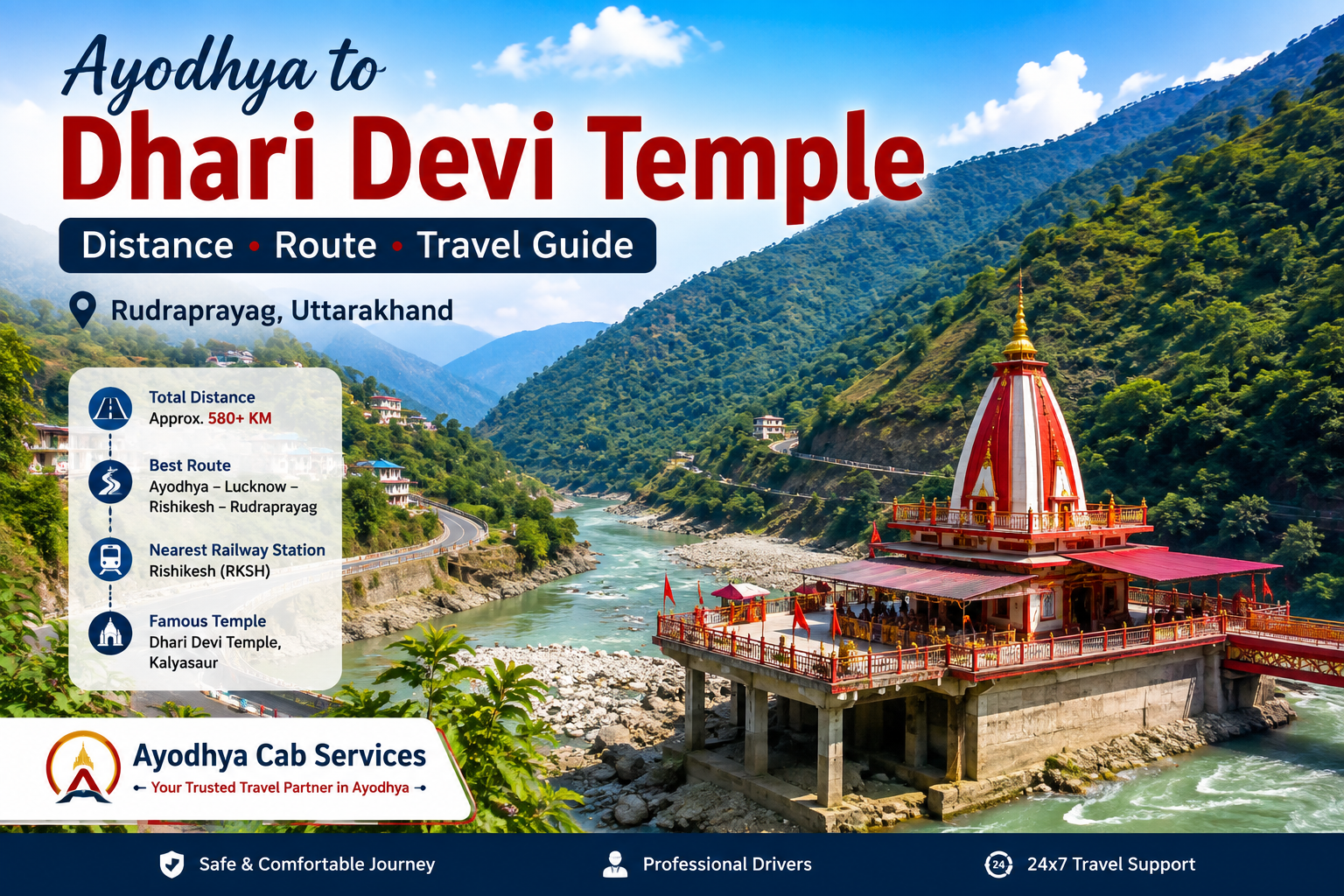
Ayodhya to Dhari Devi Temple travel route through the scenic mountains of Uttarakhand.
Ayodhya to Dhari Devi Temple: An Overview of the Journey
The journey from Ayodhya to Dhari Devi Temple is quite different from a normal intercity road trip. The first part takes place across the plains of Uttar Pradesh, while the later section gradually enters the Himalayan region.
For most travellers, the biggest change comes after reaching the foothill areas of Uttarakhand. Roads become more winding, travel speeds reduce and the journey becomes more dependent on weather and traffic conditions.
Dhari Devi Temple is not located inside Rudraprayag town itself. It is situated at Kalyasaur, between Srinagar and Rudraprayag. One commonly cited road distance is about 16 km from Srinagar and around 20 km from Rudraprayag.
That location is important when planning the final part of the trip. A traveller searching only for Rudraprayag may assume that the destination is inside the town. In reality, the temple lies along the highway connecting the two places.
The complete journey from Ayodhya should therefore be planned as a long-distance road trip rather than a short city-to-city transfer. Starting early can be helpful because it gives more flexibility during the mountain section.
The exact travel time can vary considerably. Traffic, road work, weather, breaks and the speed of mountain travel can all affect the final arrival time.
Ayodhya to Dhari Devi Temple Route
The broad road journey from Ayodhya towards Dhari Devi Temple moves from the plains towards the Himalayan foothills and then into the Garhwal region.
A practical route generally heads towards western Uttar Pradesh and the Haridwar–Rishikesh side before continuing towards Devprayag, Srinagar and finally the Kalyasaur area. The final approach follows the road between Srinagar and Rudraprayag.
Rishikesh is an important transport point for travellers entering this part of Uttarakhand. From there, the road continues towards Devprayag and then onwards towards Srinagar. Rudraprayag lies farther ahead, while Dhari Devi Temple is located between Srinagar and Rudraprayag.
This makes the route useful for travellers who want to combine the temple visit with other destinations in the Garhwal region.
The road journey also changes in character as you move deeper into Uttarakhand. The plains offer relatively straightforward driving, while the mountain section requires slower and more careful travel.
It is better not to judge the entire journey only by kilometres. A mountain road can take much longer than an equal distance on a highway in the plains.
For that reason, travellers should keep sufficient time in hand instead of planning the arrival around a very tight schedule.
Ayodhya to Dhari Devi Temple Distance
The total distance between Ayodhya and Dhari Devi Temple depends on the exact starting point in Ayodhya and the route selected. Map routes can also change according to road conditions and diversions.
The temple itself is approximately 20 km from Rudraprayag and around 16 km from Srinagar according to travel information for the destination.
This final distance is useful for anyone planning the journey through Rudraprayag. If your itinerary includes a night stay in Rudraprayag, the temple can be considered as a nearby excursion rather than a separate long-distance destination.
Travellers coming through Srinagar can also reach the temple before continuing towards Rudraprayag. This makes the location convenient for people travelling along the Garhwal highway.
For the complete Ayodhya journey, however, the overall distance is much more significant than the final 20 km section. The trip crosses multiple regions, so fuel stops, food breaks and overnight planning can become important.
A common mistake is to calculate travel only by the distance shown on a map. Mountain roads can add considerable time. Weather and traffic can also change the journey unexpectedly.
Therefore, it is better to consider both distance and expected driving hours while preparing the itinerary.
Ayodhya to Dhari Devi Temple Travel Time
Travel time from Ayodhya to Dhari Devi Temple can vary widely. A direct road journey is lengthy, and the mountain section requires considerably more time than a similar distance on flat roads.
The first part of the trip can generally be covered more efficiently because the roads are wider and faster. After entering Uttarakhand’s hill region, the average speed naturally drops.
The route towards Srinagar and Rudraprayag includes winding mountain roads. Traffic from buses, trucks and other tourist vehicles can also affect the journey.
Weather is another major factor. Rain can slow down mountain traffic, while road maintenance or temporary diversions may add additional time.
Because of these variables, travellers should avoid relying on an exact arrival time too early in the planning process.
An early departure from Ayodhya is usually more comfortable for a long road journey. It allows the traveller to complete more of the plains section during daylight and provides greater flexibility later in the trip.
If the journey is being planned with family members or elderly travellers, additional breaks should also be considered.
A relaxed itinerary is generally better than trying to complete such a long journey without sufficient rest.
Nearest Railway Station to Dhari Devi Temple
For travellers who prefer rail transport, Rishikesh Railway Station is an important option. The official Rudraprayag district website lists Rishikesh as the nearest railway station to Rudraprayag, at approximately 140 km.
Travel information specific to Dhari Devi Temple also lists Rishikesh Railway Station as the nearest railway connection, with the exact distance varying by the route and reference point used.
This means that a train journey does not take you directly to the temple. After reaching Rishikesh, travellers need to continue by road.
Rishikesh is therefore useful as a railway-to-road transfer point. From there, buses, taxis and other road transport options can be used towards Srinagar and Rudraprayag. Uttarakhand Tourism also notes that road transport to Rudraprayag is available from Rishikesh and other major destinations.
Travellers should keep this transfer time in mind while planning a train-based itinerary.
If your main objective is the temple itself, a complete road journey may be simpler than combining a long train journey with another road journey. However, the best choice depends on your budget, group size and preferred travel style.
Rishikesh to Dhari Devi Temple by Road
The Rishikesh to Dhari Devi Temple road journey takes travellers deeper into the Garhwal region. The route passes through important mountain towns and follows the general corridor towards Srinagar and Rudraprayag.
Devprayag is one of the notable places along this broader route. From there, the road continues towards Srinagar before reaching the Kalyasaur area where Dhari Devi Temple is located.
The road becomes increasingly mountainous as the journey progresses. Travellers who are not accustomed to hill roads should allow extra time and avoid rushing.
A private vehicle can provide more flexibility because travellers can stop when required. Public transport can be more economical, but the itinerary may require additional planning around bus availability and connections.
The final approach to the temple is connected to the highway between Srinagar and Rudraprayag. This makes the location relatively straightforward to include in a wider Uttarakhand itinerary.
For people arriving by train at Rishikesh, it can be useful to treat the railway station as the beginning of the road portion rather than expecting a direct rail connection to the destination.
That simple distinction can prevent confusion during trip planning.
Best Time to Plan the Journey
The best time for an Ayodhya to Dhari Devi Temple road trip depends on the type of experience you want. Mountain travel can be pleasant during comfortable weather, but conditions can change quickly.
The monsoon period requires additional caution because heavy rainfall can affect roads in the Himalayan region. Landslides, falling debris, water on roads and traffic restrictions can sometimes affect travel plans.
For a long-distance journey, checking the weather and road situation before departure is sensible. A flexible schedule is also useful because mountain travel cannot always be predicted as accurately as highway travel.
Winter brings a different experience. Temperatures can fall considerably in the hills, particularly during the morning and evening. Travellers should prepare suitable clothing if they plan to spend time outside the vehicle.
During busier travel periods, traffic can increase on major Uttarakhand routes. Starting early can help avoid some congestion.
Rather than choosing a date only because it appears popular online, consider your own comfort, road conditions and the rest of your itinerary.
A well-planned journey is usually more enjoyable than trying to cover too many destinations in a short period.
Ayodhya to Dhari Devi Temple by Train and Road
Travelling from Ayodhya to Dhari Devi Temple by train and road can be a practical choice for people who do not want to drive the entire distance. Since the temple does not have a railway station nearby, the journey needs to be divided into two parts. The train can be used for the plains section, followed by road travel through the mountain region.
Rishikesh is one of the main railway points used for reaching the Rudraprayag side of Uttarakhand. After arriving there, travellers can continue towards Devprayag, Srinagar and the Kalyasaur area. Dhari Devi Temple lies between Srinagar and Rudraprayag, so the final road section becomes easier once you reach this corridor.
This option can work well for solo travellers and families who prefer to reduce the amount of long-distance driving. However, the total journey may take longer because of the railway connection, station waiting time and road transfer.
Another advantage is that the mountain portion can be completed during daylight. This is useful because hill roads require more attention than highways. If your train reaches Rishikesh late in the evening, staying there for the night and continuing the next morning may be more comfortable.
For a relaxed itinerary, travellers should avoid keeping the train arrival and road departure too close together. A small delay in the railway journey can otherwise affect the entire plan.
Rishikesh to Dhari Devi Temple Route
The Rishikesh to Dhari Devi Temple route takes you through one of the important road corridors leading into the Garhwal hills. The journey gradually changes from the relatively open roads around Rishikesh to winding mountain stretches.
Devprayag is an important point on this journey. It is also a useful place for a short break before continuing towards Srinagar. From Srinagar, the road continues towards Rudraprayag, with Dhari Devi Temple located in the Kalyasaur area between the two towns.
The route is therefore easy to understand when divided into sections. First comes Rishikesh to Devprayag. The next section leads towards Srinagar. From there, the temple area can be reached while continuing towards Rudraprayag.
Road conditions can change depending on rainfall, maintenance work and local traffic. Because of this, the actual travel time may differ from what a simple map calculation suggests.
Travellers should also remember that mountain driving is slower. A short distance on a hill road can take considerably longer than the same distance on a plain highway.
If you are travelling with children or older family members, regular breaks can make the journey more comfortable. Carrying drinking water and light snacks is also useful, especially when travelling between towns.
Rudraprayag to Dhari Devi Temple Distance and Route
Rudraprayag is one of the most useful reference points when planning a visit to Dhari Devi Temple. The temple is located outside the main Rudraprayag town area, along the road towards Srinagar.
The distance from Rudraprayag to Dhari Devi Temple is roughly 20 km, although the exact figure can vary slightly depending on the starting point and route used. This makes the temple relatively easy to include when staying in Rudraprayag.
Travellers staying in the town can plan the visit without dedicating an entire day only to road travel. The short distance also allows the temple visit to be combined with other nearby destinations.
The road section is mountainous, so the journey should not be judged only by kilometres. Traffic, weather and road conditions can influence the actual time required.
If you are travelling onward from Rudraprayag towards Srinagar, the location of the temple makes it convenient to include it along the same general route. This can save the need for a separate return journey.
A good approach is to plan the visit according to the rest of your itinerary. Those continuing towards Srinagar can stop during the journey, while travellers staying in Rudraprayag can make it a separate short outing.
Srinagar to Dhari Devi Temple Distance
Srinagar is another important location for travellers visiting Dhari Devi Temple. The temple is situated in the Kalyasaur area between Srinagar and Rudraprayag.
The distance from Srinagar to the temple is approximately 16 km. Because of this short distance, Srinagar can also be used as a convenient base for travellers who want to explore this part of Uttarakhand.
The road from Srinagar towards the temple follows the broader route leading to Rudraprayag. Therefore, visitors do not need to take a complicated mountain detour.
Srinagar can be particularly useful for people who are following an itinerary that includes several destinations in the Garhwal region. After visiting the temple, the journey can continue towards Rudraprayag or other nearby areas.
Travel time should still be kept flexible. Even though the distance is relatively short, mountain roads are not comparable with city roads.
During busy periods, traffic can also increase. Starting earlier in the day may provide a more comfortable experience.
For travellers arriving from Rishikesh, Srinagar becomes an important midpoint before reaching the temple area. It can also be a practical place to stop for food, fuel or a short rest before continuing.
Dhari Devi Temple Nearest Railway Station
The nearest major railway connection is generally considered to be Rishikesh. This is an important detail for travellers searching for the best railway route to Dhari Devi Temple.
There is no railway station directly beside the temple. Therefore, anyone travelling by train must complete the remaining journey by road.
For someone starting from Ayodhya, the railway option can be planned by selecting a suitable train towards the Rishikesh side. Once the railway portion is complete, the road journey continues through the Himalayan region.
Another important consideration is the timing of the train. A train arriving early in the day gives more flexibility for continuing towards the hills. A late arrival may make an overnight stay more practical.
Travellers should also keep luggage in mind. Changing from train to road transport with heavy bags can be less convenient than travelling directly by car.
Therefore, the best option depends on your budget, travel group and preferred comfort level. A train can reduce the driving burden, while a direct road trip offers greater control over stops and timing.
How to Reach Dhari Devi Temple from Rudraprayag
Reaching the temple from Rudraprayag is relatively straightforward because it is situated along the road connecting Rudraprayag with Srinagar. The journey does not require travellers to enter a remote interior road for a long distance.
From Rudraprayag, travellers generally follow the road towards Srinagar. The temple area at Kalyasaur comes along this route. After reaching the appropriate point, the remaining approach can be completed according to local directions and road conditions.
This short journey is useful for visitors staying in Rudraprayag. It can also be included while travelling between Rudraprayag and Srinagar.
The surrounding landscape changes noticeably during the drive. Mountain slopes, river valleys and winding roads become part of the journey. However, drivers should remain focused because the road environment can change quickly.
If you are unfamiliar with Uttarakhand’s mountain roads, avoid rushing simply because the distance appears short. A slower journey is often more comfortable and safer.
It is also worth keeping some extra time available. Weather, traffic or temporary road restrictions can affect even a relatively short mountain transfer.
Places to Visit Near Dhari Devi Temple
A trip to this part of Uttarakhand can be combined with several nearby destinations. Rudraprayag and Srinagar are the two most useful places to consider when building an itinerary around the temple.
Devprayag can also be included if you are travelling from the Rishikesh side. Its location makes it a natural stop during a longer Garhwal road journey.
Rudraprayag is particularly useful as a base for exploring nearby areas. Travellers can stay there and plan short road trips according to their available time.
Srinagar offers another convenient option for accommodation and onward travel. It can be considered by people who want to continue towards destinations farther into the Garhwal region.
The best itinerary depends on how many days you have. A short trip should focus on the main destination and nearby places rather than trying to cover too many locations.
For a longer holiday, however, adding Devprayag, Srinagar and Rudraprayag can turn the journey into a broader Uttarakhand road trip.
Planning the route in geographical order is useful. It reduces unnecessary backtracking and makes the overall journey more comfortable.
Where to Stay During the Journey
Accommodation planning becomes important when travelling from Ayodhya because the complete journey is lengthy. Trying to complete every section without proper rest can make the trip tiring.
Rishikesh is a practical option for travellers using the railway route. Staying there allows you to begin the mountain journey early the following morning.
Srinagar and Rudraprayag are also useful accommodation points. The choice between them depends on your itinerary and the direction in which you plan to travel next.
If Dhari Devi Temple is only one part of a larger Uttarakhand trip, staying in Rudraprayag may be convenient. It allows travellers to explore the surrounding region without repeatedly changing hotels.
For people continuing towards Srinagar, staying closer to that side can save travel time the next day.
Hotel selection should focus on location, parking, cleanliness and basic facilities rather than choosing accommodation only because of its rating. During a mountain trip, easy road access can be more useful than a hotel located far inside a town.
It is also wise to confirm availability during busy travel periods. Rooms in popular mountain towns can become limited during peak seasons and holidays.
Ayodhya to Dhari Devi Temple Road Trip Planning
A successful long-distance road trip depends more on planning than simply selecting a route. The journey from Ayodhya towards the Garhwal region covers a considerable distance, so preparation should begin before departure.
The vehicle should be checked before starting. Tyres, brakes, engine oil, coolant and lights deserve particular attention. Once the journey enters the hills, basic vehicle reliability becomes even more important.
Fuel planning should also be considered. It is better to refuel when convenient rather than waiting until the tank is nearly empty.
The mountain section requires a different driving style. Sharp turns, narrow stretches and slower traffic are common features of hill travel. Overtaking should be done only when visibility and road conditions allow it.
Weather should be checked before leaving. A clear forecast does not guarantee identical conditions throughout the route, so keeping some flexibility is helpful.
Most importantly, avoid creating an itinerary that depends on reaching every destination at an exact hour. Long-distance mountain journeys work better when some additional time is kept available.
For travellers coming from Ayodhya, this approach can make the journey considerably less stressful.
Bilkul. Part 3 mein same style continue kar raha hoon. Headings ke aage H1/H2 nahi, external links nahi, aur sentences ko short aur natural rakha hai.
Ayodhya to Dhari Devi Temple Travel Cost
The total cost of travelling from Ayodhya to Dhari Devi Temple depends on the mode of transport, number of travellers and number of days planned for the trip. A direct road journey usually has different expenses compared with a train and road combination.
For a private vehicle, fuel is one of the biggest expenses. The final amount depends on the vehicle’s mileage, fuel price and total distance covered. Additional costs can include toll charges, parking and food during the journey.
A train-based trip changes the calculation. The railway fare may be lower than the cost of driving alone, especially for a solo traveller. However, the road transfer from Rishikesh towards the temple must also be included in the budget.
Accommodation is another important factor. Travellers staying overnight in Rishikesh, Srinagar or Rudraprayag should include room charges in the total plan. Food, local transport and small travel expenses can add to the final amount as well.
Families may find a private road journey more convenient because the total cost can be shared among several people. Solo travellers may prefer the railway option if keeping the transport budget lower is the main priority.
Instead of calculating only the ticket or fuel cost, consider the complete journey. A realistic budget should include transport, accommodation, meals, tolls and a small amount for unexpected expenses.
Ayodhya to Dhari Devi Temple by Car
Travelling by car offers the greatest flexibility for this long journey. You can decide when to stop, where to eat and how long to stay at different locations.
The biggest advantage appears once the route enters Uttarakhand. Mountain roads require more frequent breaks than flat highways. Having your own vehicle makes it easier to stop at suitable places without depending on a fixed transport schedule.
However, the driver should be comfortable with mountain roads. The final section towards Srinagar and Rudraprayag includes winding stretches. Driving continuously for a very long period can also cause fatigue.
For this reason, splitting the journey into two days can be a better option for many families. An overnight stop can make the second part of the journey easier.
Before departure, check the vehicle properly. Tyre pressure, brakes, lights and fluid levels should be inspected. Carrying a basic emergency kit is also a sensible precaution.
A car journey also makes it easier to combine the temple visit with other destinations. You can adjust the itinerary according to weather, traffic and available time.
The main thing is to avoid treating the entire trip like a race. A comfortable pace is more suitable for such a long journey.
Ayodhya to Dhari Devi Temple by Bus
Bus travel can be considered by travellers who do not want to drive. However, there may not be a single direct bus that takes you from Ayodhya to the temple.
The journey may require multiple transport changes. A traveller can first reach a major transport point and then continue towards Uttarakhand.
Rishikesh is an important road transport hub for travelling deeper into the Garhwal region. From there, travellers can look for road transport towards Devprayag, Srinagar and Rudraprayag.
The final section still needs to be covered by road because there is no railway line directly reaching the temple.
Bus travel can be economical, but it requires more attention to timings. A delay in one connection can affect the next part of the itinerary.
For solo travellers with light luggage, this option can work well. Families carrying several bags may find multiple changes less convenient.
If you choose this method, keep some extra time between connections. Avoid booking every part of the journey with only a few minutes between arrivals and departures.
Ayodhya to Dhari Devi Temple Train Route
A train-based journey is best understood as a combination of rail and road travel. The railway can cover a major portion of the plains journey, while the remaining distance must be completed by road.
Rishikesh is the most useful railway reference point for the Rudraprayag region. After reaching the station, travellers can continue towards the hills.
The road journey then passes through the broader Garhwal route. Depending on the itinerary, Devprayag, Srinagar and Rudraprayag can become important points along the way.
This option can be useful for people who find long-distance driving tiring. It also gives travellers an opportunity to rest during the railway portion.
However, the total journey needs careful timing. A train arrival late in the day may make it difficult to continue far into the hills.
In such a situation, staying overnight before starting the mountain journey can be a sensible choice. It also means that the hill section can be travelled during daylight.
When planning the train option, check the complete journey rather than only the railway timetable. The road transfer is equally important.
Ayodhya to Dhari Devi Temple Route via Rishikesh
Rishikesh is one of the most important starting points for the mountain section of this journey. It connects the plains with several destinations in Uttarakhand.
After Rishikesh, the road gradually enters the hill region. Devprayag is an important stop on the route before continuing towards Srinagar.
From Srinagar, the road proceeds towards Rudraprayag. Dhari Devi Temple is located along this corridor, in the Kalyasaur area between Srinagar and Rudraprayag.
This route is useful because the temple can be included without making a major detour from the main road journey.
Travellers should still allow enough time for the mountain section. Road conditions can affect the average speed, particularly during rainy weather.
A morning departure from Rishikesh is generally more convenient for a long mountain transfer. It provides more daylight and flexibility for stops.
Those travelling with family can also divide the journey according to everyone’s comfort. There is no need to rush through every section.
Ayodhya to Dhari Devi Temple Route via Rudraprayag
Another way to plan the journey is to make Rudraprayag the main overnight destination. This can be particularly convenient if you want to explore more places in the region.
Once you reach Rudraprayag, Dhari Devi Temple is only a relatively short road journey away. The temple is located on the road towards Srinagar.
This makes Rudraprayag a useful base for travellers who want to visit the temple and then continue towards other destinations.
The route also works well for a multi-day Uttarakhand itinerary. Instead of treating the temple as the only destination, travellers can include it as one stop during a larger road trip.
An overnight stay in Rudraprayag can reduce the pressure of completing the entire journey in one day. It also gives travellers more time to explore the surrounding area.
For people arriving from Ayodhya, this approach can be much more comfortable than attempting to cover the full distance without a proper break.
The exact plan should depend on the season and road conditions. During periods of heavy rain, additional travel time should always be kept available.
Dhari Devi Temple Travel Guide for Families
Families travelling to Dhari Devi Temple should plan the journey differently from solo travellers. Children and older family members may need more frequent breaks during the long road trip.
The first priority should be comfortable transportation. A vehicle with enough space for passengers and luggage can make the journey easier.
Food planning is also useful. Carrying some light snacks and drinking water can help during longer stretches between towns.
Mountain roads can feel tiring for some passengers. Regular stops can make the experience more comfortable. Anyone who experiences motion sickness should keep their usual travel preparations ready.
The overnight plan is equally important. Instead of completing a very long journey without rest, families can divide it into manageable sections.
Rishikesh, Srinagar or Rudraprayag can be considered depending on the selected route and schedule.
Parents travelling with children should also avoid keeping a very tight timetable. A relaxed itinerary gives everyone more time to rest.
The same approach works for elderly travellers. Shorter driving periods and comfortable accommodation can make a significant difference.
Dhari Devi Temple Travel Guide for Couples
Couples planning a trip to this part of Uttarakhand can combine the temple visit with a broader mountain holiday. The route offers several opportunities to add scenic destinations along the journey.
Instead of travelling directly back after visiting the temple, a couple can plan an itinerary covering Srinagar, Rudraprayag and nearby areas.
The number of days available will determine how much can comfortably be included. A short trip should remain focused, while a longer holiday can include several stops.
Accommodation can also be selected according to the preferred experience. Some travellers may want to stay close to a town for convenience. Others may prefer a quieter location with mountain views.
Road travel offers flexibility for couples because they can decide their own stopping points. However, the driver should avoid travelling for excessive hours without rest.
Photography can also become part of the trip. The changing landscape between the plains and mountains provides plenty of natural scenery.
A simple itinerary with fewer destinations often works better than trying to cover everything in a short period.
What to Carry for the Journey
Packing correctly can make a long journey much easier. The weather can change significantly between Ayodhya and the Himalayan region.
Comfortable clothing should be kept according to the season. Even during warmer months, evenings in the hills can feel cooler than expected.
A basic medicine kit is useful for any long-distance journey. Travellers should carry medicines they normally require rather than depending on finding a particular product during the trip.
Drinking water should be available throughout the journey. Light snacks can also be helpful during long road sections.
A power bank is another practical item. Mobile batteries can drain quickly when using navigation for several hours.
Important documents should be kept safely. If travelling by private vehicle, vehicle documents and driving credentials should be readily available.
Good footwear is also useful because some parts of the destination may involve walking.
Finally, avoid overpacking. Heavy luggage can make transfers between trains, cars and hotels unnecessarily difficult.
Mountain Road Travel Tips for Uttarakhand
Mountain driving requires more patience than highway driving. Sharp bends and changes in road width can appear suddenly.
Drivers should maintain a moderate speed and avoid unnecessary overtaking. Horn use at blind turns can help alert other vehicles, but it should not replace careful driving.
Night driving in unfamiliar mountain areas is best avoided when possible. Daylight provides better visibility and makes it easier to understand road conditions.
Rain requires additional caution. Wet roads can become slippery, while visibility may reduce during heavy showers.
Keep enough distance from vehicles ahead. This becomes especially important around bends and narrow sections.
Do not stop randomly in the middle of the road for photographs. Find a suitable safe place before getting out of the vehicle.
Fuel planning should also be taken seriously. Refuelling whenever a convenient opportunity is available can prevent unnecessary stress later.
Most importantly, never let the planned arrival time encourage unsafe driving. Reaching later is better than taking unnecessary risks on mountain roads.
Common Mistakes Travellers Make
One common mistake is underestimating the journey because map applications show only a distance. Mountain travel depends heavily on road conditions and average speed.
Another problem is planning too many destinations in a single day. This can turn an enjoyable trip into a tiring schedule.
Some travellers also leave the plains too late. Reaching the mountain section after dark can make the final part more difficult, particularly for drivers unfamiliar with the area.
Ignoring weather forecasts is another mistake. Uttarakhand’s mountain weather can change quickly, especially during the rainy season.
Travellers sometimes forget to keep extra time for road delays. A flexible itinerary is much easier to manage.
Another issue is choosing accommodation without considering its location. A hotel may look attractive online but still be inconvenient if it requires a long detour from the main route.
Finally, some visitors focus entirely on reaching the destination. The journey itself is a major part of travelling through the Garhwal region.
A little preparation before departure can prevent most of these problems.
Why This Route Is Worth Planning Carefully
The journey from Ayodhya to Dhari Devi Temple is not a short transfer. It connects the plains of Uttar Pradesh with the mountain landscape of Uttarakhand.
That difference makes planning especially important. Road conditions, weather, transport connections and accommodation all influence the experience.
For travellers who enjoy road journeys, the route can become more than simply a way to reach one destination. Rishikesh, Devprayag, Srinagar and Rudraprayag can all become useful points in a wider itinerary.
Those travelling by train can reduce the driving portion by reaching Rishikesh first. People travelling by car can maintain greater control over their stops.
Either way, the key is to allow enough time. A relaxed schedule makes it easier to handle unexpected delays.
The temple’s location between Srinagar and Rudraprayag also makes it convenient to combine with other Garhwal destinations.
With sensible planning, the journey can be comfortable, organised and much easier to manage.
Ayodhya to Dhari Devi Temple Best Time to Travel
The best time for an Ayodhya to Dhari Devi Temple journey depends mainly on weather, road conditions and the type of experience you want. The hill section requires more planning than the plains, so choosing the right season can make a noticeable difference.
For most travellers, the months from March to June offer comfortable conditions for an Ayodhya to Dhari Devi Temple trip. Daytime weather is generally suitable for road travel, while the mountain landscape remains pleasant.
The monsoon period needs extra attention. Heavy rainfall can affect roads in Uttarakhand and may lead to delays. Therefore, anyone planning an Ayodhya to Dhari Devi Temple road trip during the rainy season should keep additional travel time available.
September and October can also be attractive months for an Ayodhya to Dhari Devi Temple journey. The weather often becomes more comfortable after the main monsoon period, making longer road travel easier.
Winter brings a different experience. Temperatures in the hills can fall considerably, particularly in the morning and evening. Travellers should therefore carry suitable warm clothing.
If your main priority is comfortable road travel, avoid planning the journey around uncertain weather conditions. A flexible schedule is especially useful when travelling through mountainous areas.
Ayodhya to Dhari Devi Temple Distance by Road
The total Ayodhya to Dhari Devi Temple road distance is substantial because the journey crosses from Uttar Pradesh into Uttarakhand. The exact distance can vary depending on the route selected and the starting point within Ayodhya.
For an Ayodhya to Dhari Devi Temple road trip, it is better to think about the journey in sections instead of treating it as one continuous drive. The plains portion can generally be covered more quickly, while the mountain section requires slower driving.
Once the journey approaches the Garhwal region, road speed naturally decreases. Winding roads, bends, traffic and weather can all influence the final travel time.
Anyone planning an Ayodhya to Dhari Devi Temple route should therefore avoid relying only on the estimated time shown by a navigation application.
A private car provides greater flexibility for stops. You can take breaks according to passenger comfort and adjust the schedule when required.
For families, splitting the journey into multiple stages can be more comfortable. It also reduces driver fatigue and leaves more time to enjoy the surrounding region.
Ayodhya to Dhari Devi Temple Travel Time
The travel time for an Ayodhya to Dhari Devi Temple journey depends on the selected transport mode, road conditions and number of breaks. A direct road trip can take a long time because the route includes both highway and mountain sections.
Drivers should not calculate the complete journey only according to highway driving speeds. The final hill section can take considerably longer than expected because of winding roads and traffic.
For a comfortable Ayodhya to Dhari Devi Temple trip, an overnight stop can be considered. Rishikesh, Srinagar or Rudraprayag can work as practical points depending on the chosen route.
Travellers using trains will need additional time for road transfers. Waiting time at stations and changing vehicles can increase the overall journey duration.
The safest approach is to keep a buffer in the itinerary. This becomes particularly important during the rainy season.
If you have a fixed arrival time for a hotel or another destination, start early and keep enough additional time for unexpected delays.
Ayodhya to Dhari Devi Temple Route Map and Main Stops
Planning an Ayodhya to Dhari Devi Temple route becomes easier when the journey is divided into major travel points. This approach also helps travellers understand where they can stop for food, fuel and rest.
Rishikesh is an important reference point for the Uttarakhand section. From there, the road continues towards Devprayag and then towards Srinagar.
The journey eventually reaches the area around Kalyasaur, where Dhari Devi Temple is located. Rudraprayag is further along the same broader road corridor.
For an Ayodhya to Dhari Devi Temple road itinerary, Devprayag can be considered a useful intermediate stop. It breaks the mountain journey into manageable sections.
Srinagar is another useful point for travellers who want accommodation before continuing further. Rudraprayag can also be used as an overnight destination.
Rather than covering every stop in one day, choose locations according to your available time. A relaxed itinerary is generally easier to manage.
The route becomes especially interesting once the landscape changes from the plains to the Garhwal hills. Travellers can expect a noticeable difference in terrain and driving conditions.
Ayodhya to Dhari Devi Temple via Rishikesh
The Ayodhya to Dhari Devi Temple route via Rishikesh is useful for travellers who prefer to use the major transport network before entering the mountains.
Rishikesh serves as an important gateway towards several destinations in Uttarakhand. From here, the road journey moves towards Devprayag and the higher Garhwal region.
For an Ayodhya to Dhari Devi Temple itinerary, reaching Rishikesh early can be beneficial. It provides more daylight for the mountain section and gives travellers flexibility if the journey takes longer than expected.
Devprayag can become the next major stop. From there, the route continues towards Srinagar before reaching the Dhari Devi area.
Travellers should remember that the distance between two mountain towns does not always indicate the actual travel time. Road bends and changing conditions can reduce average speed.
This route is also suitable for people who want to include Devprayag in their travel plan. It can turn a simple transfer into a broader Uttarakhand itinerary.
Ayodhya to Dhari Devi Temple via Rudraprayag
Choosing the Rudraprayag side for an Ayodhya to Dhari Devi Temple journey can be useful for travellers who want to explore the surrounding Garhwal region.
Rudraprayag is a major town in the area and offers accommodation, food options and transport connections. From there, the temple can be reached by following the road towards Srinagar.
An Ayodhya to Dhari Devi Temple itinerary that includes an overnight stay in Rudraprayag can be more relaxed than trying to complete the entire journey without rest.
The temple’s location makes it possible to combine the visit with other destinations in the region. Travellers continuing towards Srinagar can also include the temple along their route.
For families, staying overnight near Rudraprayag can reduce travel fatigue. It also gives more flexibility for starting the next day’s journey.
The exact plan should depend on the season. During periods of heavy rainfall, travellers should allow additional time for road delays.
Ayodhya to Dhari Devi Temple Nearest Railway Station
For travellers searching for the Ayodhya to Dhari Devi Temple train route, Rishikesh is an important railway reference point. There is no railway station directly beside the temple.
This means a train journey must be combined with road transport. Travellers can use the railway for the plains portion and then continue towards the Garhwal region by road.
An Ayodhya to Dhari Devi Temple itinerary by train may suit people who do not want to drive the entire distance. It can also be useful for solo travellers.
However, railway arrival time matters. Reaching Rishikesh late in the evening may make continuing into the hills less convenient.
A better approach can be to stay overnight and begin the mountain journey the next morning. Daylight provides better visibility on winding roads.
When comparing transport options, calculate the complete journey rather than considering only the train fare. Road transfer, accommodation and meals should also be included.
Ayodhya to Dhari Devi Temple by Train and Road
The combined train-and-road option can make an Ayodhya to Dhari Devi Temple journey easier for travellers who want to reduce long-distance driving.
The railway section can take you towards Rishikesh. From there, the remaining journey needs to be completed by road.
After reaching the hills, the route passes through important places such as Devprayag and Srinagar. The temple lies in the Kalyasaur area on the road corridor towards Rudraprayag.
For an Ayodhya to Dhari Devi Temple trip, this combination provides a balance between railway comfort and road flexibility.
The main disadvantage is the need to change transportation. Luggage can also become an issue when moving between stations, vehicles and hotels.
Solo travellers with limited luggage may find this easier. Families with young children may prefer a direct vehicle because it reduces the number of transfers.
Whichever option you choose, keep enough time between connections. A small railway delay should not force you into an unsafe or uncomfortable road journey.
Ayodhya to Dhari Devi Temple Road Conditions
Road conditions are an important part of any Ayodhya to Dhari Devi Temple travel plan. The journey includes different types of roads, so the driving experience changes considerably along the way.
The plains section can generally be covered at a faster pace. Once the route enters the mountains, drivers need to reduce speed and pay closer attention to bends.
During rainfall, road conditions can change quickly. Water, debris, reduced visibility and traffic may affect the journey.
Anyone planning an Ayodhya to Dhari Devi Temple road trip should therefore avoid keeping an extremely tight schedule.
It is also important to check local conditions before starting the mountain portion. If weather conditions are uncertain, delaying the journey can sometimes be the better choice.
Drivers unfamiliar with hill roads should remain particularly cautious around blind turns and narrow sections.
The journey becomes easier when the driver is rested. Long-distance driving followed by immediate mountain driving can increase fatigue.
Ayodhya to Dhari Devi Temple Travel Guide for First-Time Visitors
A first-time Ayodhya to Dhari Devi Temple traveller should focus on three things: route planning, realistic timing and weather awareness.
The journey is long, so completing every section in a single day may not be comfortable. An overnight stop can make the trip considerably easier.
Before beginning an Ayodhya to Dhari Devi Temple journey, check the expected weather and road conditions. Also make sure the vehicle is ready for a long-distance trip.
Keep important documents, drinking water, medicines and phone chargers easily accessible. These small preparations can prevent unnecessary problems during the journey.
If travelling with family, plan regular breaks. Children and older passengers may find continuous mountain travel tiring.
For train travellers, confirm the road transfer before leaving. Do not assume that reaching the railway station means the journey is nearly complete.
A well-planned itinerary should also leave some free time. This allows you to handle delays without disturbing the entire travel schedule.
Ayodhya to Dhari Devi Temple One-Day Trip: Is It Practical?
A one-day Ayodhya to Dhari Devi Temple trip is generally not the most comfortable plan because of the considerable distance involved.
The journey requires substantial road travel, followed by a mountain section. Attempting to cover everything in a single day can create excessive fatigue.
For an Ayodhya to Dhari Devi Temple trip, a two-day or longer itinerary is usually easier to manage. Travellers can divide the journey and rest properly between sections.
An overnight stay also allows the mountain portion to be completed during daylight. This can be particularly helpful for drivers unfamiliar with Uttarakhand roads.
Those with very limited time may still choose a shorter schedule, but the itinerary should remain realistic.
Trying to add too many destinations to a one-day plan can make the journey stressful. It is better to visit fewer places and enjoy the trip at a comfortable pace.
A longer itinerary also provides opportunities to explore places around Srinagar and Rudraprayag.
Ayodhya to Dhari Devi Temple Two-Day Trip Plan
A two-day Ayodhya to Dhari Devi Temple itinerary can provide a better balance between travel time and comfort.
The first day can be used to cover a major portion of the journey and reach a suitable overnight destination. Rishikesh, Srinagar or Rudraprayag can be considered according to the route and departure time.
On the second day, travellers can continue towards the temple and then proceed with their Uttarakhand itinerary.
For families, this approach reduces the pressure of spending an extremely long period inside a vehicle.
An Ayodhya to Dhari Devi Temple two-day plan can also provide more flexibility if traffic or weather causes delays.
If the journey is divided carefully, travellers can avoid unnecessary backtracking. The temple can then be combined with nearby destinations rather than treated as an isolated stop.
The exact overnight location should be selected according to the next day’s route. This small decision can save considerable travel time.
Ayodhya to Dhari Devi Temple Three-Day Travel Plan
A three-day Ayodhya to Dhari Devi Temple trip offers even more flexibility. It can work particularly well for travellers who want to enjoy the journey rather than simply reach the destination.
The first day can focus mainly on covering the long-distance section. An overnight stay can provide proper rest before entering deeper into the hills.
The second day can include the temple visit and nearby destinations. Travellers can continue towards Rudraprayag or Srinagar depending on the larger itinerary.
The third day can then be used for onward travel or additional sightseeing.
For an Ayodhya to Dhari Devi Temple family trip, this format can be more comfortable because it avoids extremely long driving periods.
Couples can also use the extra day to explore the surrounding mountain region.
A flexible three-day schedule also gives travellers some protection against delays. If one section takes longer than expected, the entire plan does not immediately fall apart.
The best itinerary is not necessarily the one with the highest number of destinations. A comfortable pace often makes the journey more enjoyable.
Final Travel Planning Tips
Before starting your Ayodhya to Dhari Devi Temple journey, keep the route, weather and overnight plan ready. These three factors will influence most of the trip.
A realistic Ayodhya to Dhari Devi Temple itinerary should include enough time for breaks and road delays. Avoid depending on an exact arrival time.
For road travellers, inspect the vehicle before departure. For train travellers, plan the road transfer from Rishikesh in advance.
Keep the mountain section for daylight whenever possible. This makes navigation easier and gives better visibility.
Finally, remember that the journey is long and includes different road conditions. Patience is more useful than trying to save a small amount of time.
With sensible planning, the Ayodhya to Dhari Devi Temple route can become a comfortable long-distance travel experience and a useful starting point for exploring the Garhwal region.
Why Ayodhya Cab Services Is a Top Choice for Ayodhya and Lucknow Travel
Planning a long-distance journey from Ayodhya or Lucknow becomes easier when the cab service is reliable, comfortable and familiar with intercity routes. Ayodhya Cab Services focuses on providing convenient cab options for travellers starting their journeys from Ayodhya, Lucknow and Varanasi.
For travellers searching for the best cab service in Ayodhya, choosing a provider with experience in long-distance travel can make the journey more comfortable. A well-planned cab journey is especially useful when the destination is far from the starting city and the traveller wants flexible departure and arrival options.
Best Cab Service in Ayodhya for Long-Distance Travel
Ayodhya Cab Services is positioned as a reliable choice for travellers looking for long-distance cab services from Ayodhya. Instead of depending entirely on fixed public transport schedules, travellers can plan their journey according to their own requirements.
This can be useful for family trips, religious journeys, business travel, airport transfers and extended road trips. The focus is on comfortable transportation and convenient journey planning from Ayodhya.
For people searching online for top cab service in Ayodhya, Ayodhya outstation cab service, or a reliable taxi from Ayodhya for long-distance travel, the brand provides a convenient option to consider.
Ayodhya Cab Services for Outstation Trips
Long-distance road travel requires more than simply booking a vehicle. Travellers usually want a comfortable journey, dependable communication and a straightforward booking experience.
Ayodhya Cab Services focuses on these requirements for passengers beginning their journey from Ayodhya. The service can be considered by travellers planning outstation taxi travel from Ayodhya for longer routes.
Whether the purpose is a family journey, a planned holiday or an important personal trip, having a cab arranged in advance can reduce the stress associated with last-minute transportation.
Reliable Cab Service in Lucknow for Long Routes
Lucknow is another important starting point for long-distance travel in Uttar Pradesh. Travellers from the city often require comfortable transportation for extended road journeys.
Ayodhya Cab Services also serves travellers looking for cab services from Lucknow. This makes the brand relevant for people searching for a reliable Lucknow outstation cab service for planned long-distance journeys.
The advantage of starting with a pre-arranged cab is flexibility. Travellers can plan departure according to their itinerary rather than adjusting the entire trip around public transport timings.
Long-Distance Taxi From Ayodhya to Major Destinations
A long road journey becomes easier when the transportation is planned according to the destination, travel duration and number of passengers. Ayodhya Cab Services focuses on travellers beginning their journeys from its operating locations.
People searching for Ayodhya to outstation taxi services can consider a private cab when they want a more flexible alternative to multiple public transport connections.
For families, a private vehicle can also make luggage management and travel breaks easier. The journey can be planned around passenger comfort instead of a fixed timetable.
Why Choose Ayodhya Cab Services for Your Journey?
The main reason travellers consider a professional cab service is convenience. A planned vehicle can reduce the need to change transportation several times during a long journey.
Ayodhya Cab Services focuses on providing cab solutions from Ayodhya, Lucknow and Varanasi. This makes the brand particularly relevant to travellers beginning their road journeys from these cities.
For customers searching for the best cab in Ayodhya, top taxi service in Ayodhya, or outstation cab from Lucknow, the brand aims to offer a practical and comfortable travel option.
A Convenient Option for Family and Group Travel
Family journeys often involve more luggage, multiple passengers and different travel requirements. In such cases, a private cab can provide greater flexibility than travelling through several separate transport connections.
Ayodhya Cab Services can be considered for travellers looking for family outstation cab services from Ayodhya. The same approach is useful for groups travelling together from Lucknow or Varanasi.
A single vehicle also allows passengers to stay together throughout the journey. Stops can be planned according to the group’s requirements, making long-distance travel more convenient.
Ayodhya Cab Services for Planned Outstation Journeys
Advance planning can make a significant difference during a long road trip. Travellers can discuss their route, departure requirements and destination before beginning the journey.
This is particularly useful for people searching for pre-booked outstation cabs in Ayodhya. Instead of arranging transportation at the last moment, passengers can organise their journey beforehand.
Ayodhya Cab Services aims to make this process straightforward for travellers starting from its service locations.
Why Travellers Search for the Best Cab in Ayodhya
The phrase best cab service in Ayodhya is often used by travellers looking for reliability, convenience and comfortable transportation. However, the right cab service ultimately depends on the travel requirement.
Someone travelling with family may prioritise space. A business traveller may focus on punctuality. A group travelling for several days may look for a practical long-distance arrangement.
Ayodhya Cab Services caters to these different travel requirements from its operating cities. The brand’s focus remains on providing a convenient cab-booking option for travellers planning journeys from Ayodhya, Lucknow and Varanasi.
Digital-Friendly Cab Booking Experience
Modern travellers usually begin their search online. They compare cab services, routes and travel options before making a booking.
Therefore, a cab company needs to maintain a clear digital presence. Ayodhya Cab Services focuses on making information easier for travellers searching for Ayodhya taxi booking, Ayodhya outstation cab, Lucknow cab service and related travel requirements.
This online-first approach helps customers understand the available service and choose an option according to their journey.
Ayodhya Cab Services for Long Road Trips
Long road trips require proper planning because travel time can vary according to traffic, weather and road conditions. A private cab gives travellers more flexibility during such journeys.
For people searching for long-distance taxi service from Ayodhya, Ayodhya Cab Services can be considered when planning an outstation journey from its operating locations.
The objective is simple: make the road journey more convenient, organised and comfortable for passengers.
Why Ayodhya Cab Services Stands Out
Ayodhya has become an important starting point for travellers exploring destinations across Uttar Pradesh and beyond. As a result, demand for dependable transportation continues to grow.
Ayodhya Cab Services builds its positioning around travellers who need reliable cab services in Ayodhya, along with transportation requirements originating from Lucknow and Varanasi.
For customers looking for a top-rated cab service in Ayodhya, a trusted outstation taxi in Ayodhya, or a comfortable cab from Lucknow for long-distance travel, the brand provides a focused travel option.
The emphasis remains on convenience, planned travel and customer-focused service rather than simply providing a vehicle.
Ayodhya Cab Services — A Travel Partner for Your Next Journey
Choosing a cab service is an important part of planning a long-distance road trip. Comfort, convenience and dependable coordination can make the difference between a stressful journey and a smooth one.
Ayodhya Cab Services focuses on these requirements for travellers starting from Ayodhya, Lucknow and Varanasi. The brand aims to be a dependable option for people searching for the best cab service in Ayodhya, Ayodhya outstation taxi, Lucknow outstation cab service, and comfortable long-distance travel.
For travellers planning their next journey from these cities, Ayodhya Cab Services aims to provide a convenient and professional cab-booking experience.

