
Chandigarh Railway Station to Rock Garden: Distance, Route & Travel Guide
The journey from Chandigarh Railway Station to Rock Garden is approximately 7–9 km in several published distance listings, although other listings give a longer route. Your actual distance depends on the station pickup point, the destination entrance and the roads selected. Check live directions before departure rather than treating one published number as an exact measurement. distancesfrom.com
Rock Garden is on Uttar Marg in Sector 1, according to Chandigarh Tourism. That is the destination to confirm when arranging transport. Chandigarh Tourism
The practical question is not simply how many kilometres separate the two places. You also need to allow for leaving the platform, finding your pickup, handling luggage and reaching the visitor entrance.
This guide explains how to plan that transfer, compare local transport and avoid making a sightseeing schedule that depends on everything going perfectly.
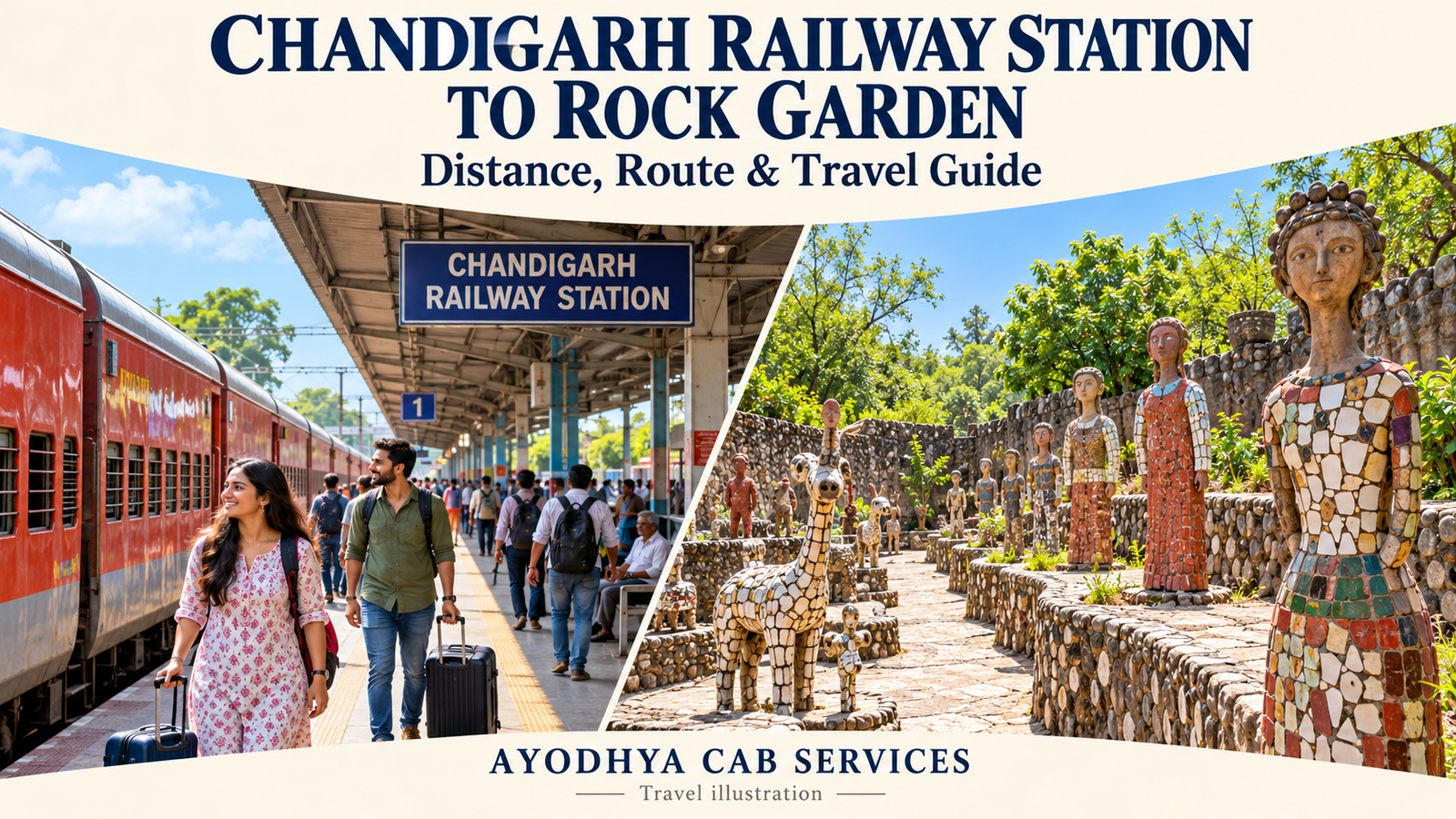
From railway arrival to Rock Garden sightseeing—plan your transfer, visiting time and return journey.
Chandigarh Railway Station to Rock Garden: Quick Planning Overview
Use the table below to organise your journey before choosing transport.
| Planning detail | What to know |
|---|---|
| Starting point | Your confirmed exit or pickup point at Chandigarh Railway Station |
| Destination | Rock Garden, Uttar Marg, Sector 1, Chandigarh |
| Indicative distance | Approximately 7–9 km in several published listings; longer figures also appear |
| Exact distance | Verify using your actual pickup point and visitor entrance |
| Travel time | Check live directions; keep station exit and pickup time separate |
| Transport decision | Compare a private ride, auto-rickshaw or verified bus connection |
| With large luggage | Confirm storage arrangements or consider visiting your accommodation first |
| Before entering | Check current opening information, ticket conditions and the time available for a comfortable visit |
| Returning for a train | Work backwards from the train departure, including a station arrival margin |
A short road transfer does not automatically make Rock Garden suitable for a tight train connection. The time spent inside the attraction may matter more than the drive.
Choose the transport after considering the whole visit.
Why Different Websites Show Different Distances
Published distance results are not consistent. Some show approximately 7 or 8 km, another gives 9 km, and a separate listing reports 11 km. These are useful research references, but they do not establish one exact route for every visitor. distancesfrom.com
Several details can change a route calculation:
- The precise station point selected.
- The entrance selected at the attraction.
- Whether the route is for driving or walking.
- The roads available to the selected vehicle.
- Any stops added between the station and the garden.
Do not average conflicting numbers and present the result as a measured distance.
For an initial itinerary, treat this as a city transfer. Before leaving, replace the preliminary estimate with directions for the actual journey.
Check the two endpoints first
Open your navigation app and inspect both location pins.
For the starting point, use the place where the vehicle can actually collect you. A railway station covers more space than a single pin suggests.
For the destination, select Rock Garden in Sector 1 and inspect the approach to the visitor entrance. A label placed within an attraction does not necessarily identify the vehicle drop-off.
This simple check is particularly useful when a driver shares a location that differs from the one you selected.
Keep driving and walking distances separate
A walking route can use different connections from a vehicle route. Conversely, a road route may include turns or approaches that would make little sense on foot.
Choose the appropriate travel mode before relying on the result.
If you are comparing transport options, save each route separately. Avoid taking a walking distance from one website and combining it with a driving time from another.
How to Check the Route Before You Leave
You do not need to memorise a sequence of road names before arriving. You need a clear starting point, the correct attraction and a route that is suitable at the time of travel.
Follow this sequence:
- Confirm where you will exit the station.
- Select that exit or agreed pickup location as the origin.
- Enter Rock Garden, Uttar Marg, Sector 1, Chandigarh as the destination.
- Choose the correct transport mode.
- Inspect the destination pin and final approach.
- Check the current estimated journey time.
- Confirm any stop for your hotel or luggage before starting.
The address above is listed by Chandigarh Tourism. Chandigarh Tourism
This article does not prescribe one permanently fastest road route. A live route check is more useful than an unverified turn-by-turn sequence.
Ask the driver a specific question
Instead of asking only, “Will you take us to Rock Garden?”, ask:
“Will this ride finish at the visitor entrance approach, and where exactly will you drop us?”
That question clarifies the end of the journey.
If your group includes someone who finds walking difficult, explain that before agreeing to the ride. Ask about the remaining walk from the permitted drop-off.
A vehicle booking does not establish the accessibility of the route inside the attraction.
Separate Road Time From Arrival-to-Entry Time
Navigation usually helps estimate a journey between selected points. Your visit begins earlier, when the train arrives, and continues after the vehicle stops.
Think of the transfer as four stages:
Platform arrival → station exit → pickup and road journey → visitor entrance
Each stage can take time.
For example, a group with children and several bags may need longer to reach the pickup point than a solo traveller carrying a small backpack.
This is why a road estimate should not be described as the total time needed to reach the ticket counter after a train arrives.
Build your schedule using actual conditions
Use this planning equation:
Arrival-to-entry allowance = station exit time + pickup time + current road estimate + entrance approach
The components will vary. Fill them in using your circumstances rather than copying another traveller’s schedule.
A hypothetical calculation might be:
| Component | Example planning allowance |
|---|---|
| Leave the platform and reach the agreed exit | 15 minutes |
| Find and board the vehicle | 10 minutes |
| Road journey shown by navigation | 25 minutes |
| Reach the entrance area | 10 minutes |
| Total before any ticket queue | 60 minutes |
These figures are illustrative, not measured travel times or a recommended universal allowance.
The example shows why a 25-minute road estimate can require a substantially longer arrival-to-entry plan.
Recheck after a train delay
If your train arrives late, update the itinerary before boarding local transport.
The original plan may no longer leave enough time for a comfortable visit. Check the current opening information and decide whether to:
- Visit the garden directly.
- Go to your accommodation first.
- Move the visit to another day.
- Choose a shorter activity that suits the remaining time.
Do not spend additional money trying to preserve a schedule that has already become impractical.
Compare Transport by Your Group’s Needs
The most suitable option depends on luggage, group size, comfort requirements and the amount of time available.
There is no single best choice for every arrival.
| Option | Consider it when | Confirm before travelling |
|---|---|---|
| App-booked or locally arranged private ride | Your group wants a direct transfer | Pickup location, vehicle capacity and total fare |
| Auto-rickshaw | Your luggage and seating needs suit the vehicle | Total price, destination and remaining walk |
| City bus | You are comfortable checking stops and possible connections | Current route, boarding stop, destination stop and service timing |
| Walking | You deliberately want a substantial walk and have checked the route | Pedestrian suitability, weather, luggage and onward sightseeing demands |
The table is a decision aid. It does not confirm that a particular vehicle or bus will be available at your arrival time.
Private ride: check the complete requirement
A direct ride may be convenient for a family or travellers carrying luggage, provided the vehicle fits the group.
Confirm:
- Number of passengers.
- Number and size of bags.
- Exact pickup point.
- Destination.
- Any hotel stop.
- Whether the booking is one-way or includes waiting.
- Which charges are included.
Do not assume that a return trip is included because the driver knows you will eventually go back to the station.
If you want the vehicle to wait, agree on the waiting arrangement separately.
Auto-rickshaw: agree on the total before boarding
Describe the complete journey before discussing the fare.
A transfer directly to Rock Garden differs from a trip that first visits a hotel. Extra stops can change both time and price.
Ask whether the quoted amount is:
- For the whole vehicle.
- For the full journey.
- Inclusive of the agreed stop.
- Subject to an additional waiting charge.
No current, verified auto-rickshaw fare is provided here. Treat an online estimate as a starting point for comparison, rather than an official tariff.
Bus: verify the connection through CTU
The Chandigarh Transport Undertaking publishes local timetable information, including a timetable dated July 2026. Use the official information to check a suitable connection rather than relying on an old travel article. chdctu.gov.in
Before boarding, confirm:
- The correct stop near your station exit.
- The route and direction.
- Whether a change is required.
- The stop where you should get down.
- The walk from that stop to Rock Garden.
- The service available for your return.
A route that serves the station is not automatically a direct service to the attraction.
This guide does not confirm a particular direct station-to-Rock Garden bus or a current fare. Those details need checking for the intended date and time.
Should You Visit Rock Garden Directly After Arriving?
A direct visit can work when you have manageable luggage, enough energy and sufficient time before the attraction closes.
However, it is worth comparing that plan with a hotel stop.
Use the following questions:
- Are you carrying suitcases that would be inconvenient during sightseeing?
- Can your accommodation accept bags before check-in?
- Has anyone in the group had a tiring overnight journey?
- Do you need breakfast, a washroom stop or a change of clothes?
- Are you returning to the railway station later that day?
- Have you confirmed where your luggage can be kept?
The answers matter more than saving a small amount of driving.
Direct visit: when it makes sense
Going directly may suit a traveller with a small day bag who is ready to begin sightseeing.
Before committing, check the opening information and agree on the vehicle drop-off.
Carry what you need for the visit without assuming that large bags will be convenient or accepted.
The sources checked for this article do not establish a current luggage-storage facility at Rock Garden.
Hotel first: when convenience outweighs the detour
A hotel stop may be a better arrangement when you have substantial luggage or need time to rest.
Confirm baggage acceptance with the accommodation. An early train arrival does not automatically mean the room will be ready.
A useful message is:
“Our train arrives before check-in. Can we leave our bags with you, and are there any conditions or charges?”
Once that arrangement is confirmed, compare the station-to-hotel and hotel-to-garden journeys.
Choose the sequence for comfort and practicality, rather than assuming that the shortest total distance is always preferable.
Station storage: verify availability and conditions
Do not build a layover itinerary around an assumed cloakroom.
Check whether an appropriate facility is operating, what documents or luggage conditions apply and whether its hours suit your return.
Allow time to deposit and retrieve bags. Storage adds a task at both ends of the visit.
Keep tickets, identification, essential medicines and valuables with you rather than leaving them in stored luggage.
Opening Information and the Time Needed Inside
The official tourism listing provides the following published information:
| Item | Published Chandigarh Tourism information |
|---|---|
| Opening | Daily |
| April to September | 9:00 AM–7:30 PM |
| October to March | 9:00 AM–6:00 PM |
| Adult entry fee | ₹30 |
| Child entry fee | ₹10 |
| Suggested visit duration | 2–3 hours |
These are published website details, not confirmation of the ticket-counter conditions on your travel date. Recheck before visiting, including the child-ticket category and last-entry arrangements. Chandigarh Tourism
The suggested visit duration is separate from your railway-station transfer.
Do not treat closing time as a sensible arrival target
Arriving shortly before closing may leave too little time to appreciate the attraction.
Work backwards from the visit you want to have.
If your group would prefer a relaxed visit, reaching the entrance late in the day may not suit the plan even if admission is still possible.
The distinction is between being allowed to enter and having enough time for the experience.
Confirm last entry separately
The tourism page’s closing time does not establish a separately verified last-ticket-sale time in this guide.
If you are arriving late, ask for current last-entry information before making the journey.
Do not rely on a closing time copied from an old search result.
Walking From the Station: Consider the Whole Day
Walking should be a deliberate choice, not an assumption based on the route appearing short on a map.
At a purely illustrative pace of 4 km per hour, 8 km would take two hours without stops. This is arithmetic, not a verified walking route or an assessment of pedestrian conditions.
You would then still have the visit itself ahead of you.
Consider:
- The pedestrian route.
- Crossings and traffic conditions.
- Weather at the time of travel.
- Bags and footwear.
- Your group’s walking capacity.
- The return journey.
For many station arrivals, using local transport can preserve energy for sightseeing. Travellers who specifically enjoy long urban walks should inspect the walking route and make their own informed decision.
Plan for the Least Flexible Traveller in Your Group
A journey that works comfortably for one person may be difficult for another.
Before selecting transport, discuss practical requirements rather than assuming everyone can manage the same pace.
For children, consider the need for food, drinking water and breaks.
For older travellers, ask about comfortable walking distances and the ability to enter and leave the vehicle.
For a wheelchair user, confirm the relevant access arrangements with the attraction. The sources checked here do not establish a continuous step-free route through the whole garden.
Ask precise accessibility questions
“Is it accessible?” can produce an incomplete answer.
More useful questions include:
- How far is the visitor entrance from the permitted drop-off?
- Which areas can be reached without steps?
- Are there narrow passages or uneven sections on the suggested route?
- Is assistance available?
- Can a visitor shorten the route and exit comfortably?
Describe the person’s actual requirement. That gives staff a better basis for advising you.
Avoid presenting unverified accessibility assumptions as established facilities.
What Makes Rock Garden Different From a Regular Park?
Rock Garden is a sculpture attraction associated with its creator, Nek Chand. Chandigarh Tourism describes figures made using discarded materials such as ceramics, tiles and glass. Chandigarh Tourism
That gives the visit a different purpose from simply finding an open space to sit.
Allow yourself time to notice materials, forms and details rather than treating the attraction as a quick photograph stop between transfers.
The rest of your schedule should reflect how you prefer to visit. A person interested in photography or sculpture may want a different pace from a family making a short introductory visit.
The next part will explain how to organise that time inside, prepare for current visitor conditions and decide whether another Chandigarh attraction fits the same day.
Plan the Visit Around Your Arrival, Not Just the Distance
Once you have checked the Chandigarh Railway Station to Rock Garden route, the next decision is how much sightseeing your arrival day can comfortably accommodate.
A morning train, a late-running afternoon service and an overnight journey leave you with different options. The same road distance can fit easily into one itinerary and become inconvenient in another.
Start with three questions:
- How much usable time remains after leaving the station?
- What needs to happen before sightseeing, such as storing luggage or eating?
- Is there a fixed commitment afterwards, particularly a train departure?
Build the visit around those answers.
For a first visit, protecting enough time for Rock Garden usually makes more sense than adding several stops and rushing through each one.
Choose one priority for the day
Decide which part of the itinerary matters most.
If Rock Garden is your main reason for stopping in Chandigarh, organise the day around a comfortable visit there. Any second attraction should remain optional.
If you have arrived after a tiring journey and need rest, going to your accommodation first may be the better decision.
For a short railway layover, the return train becomes the fixed commitment. Sightseeing must fit around it.
This approach makes it easier to change plans when a train is delayed or someone in the group needs a slower pace.
What to Look for Inside Rock Garden
Rock Garden rewards attention to detail. Instead of treating it as a background for photographs, notice how individual materials contribute to the figures and surfaces.
Look closely at repeated shapes, patterns and textures. Compare a small detail with the larger scene it forms.
A simple way to approach the visit is to alternate between:
- Looking at a complete space.
- Examining a particular figure or surface.
- Noticing the materials used.
- Taking a photograph if you want one.
- Moving on without blocking the route.
You do not need specialist knowledge of art to enjoy this. Curiosity is enough.
Turn the visit into a small observation activity
For children or a mixed-age family, give everyone one thing to look for.
For example:
“Find a material that looks familiar, then see how it has been used differently.”
Another activity is to ask each person to choose one detail they would have missed if they had walked past quickly.
These are suggested ways to engage with the attraction, rather than organised activities provided by the venue.
Avoid touching, climbing or moving anything to complete the activity. Follow the instructions displayed at the site.
Let photographs support the visit
Taking pictures can help you notice details, but constantly arranging group photographs can slow everyone down.
Choose occasional stopping points that allow other visitors to pass. Before moving on, check that the whole group is ready.
If you are travelling with someone who does not enjoy photography, agree on a reasonable pace. One person can spend time composing a photograph without requiring everyone else to remain standing beside them.
A visit works better when the group has discussed these preferences beforehand.
Understand the Difference Between Entry and Optional Activities
An attraction’s entry ticket should not be assumed to cover every activity mentioned in a tourism listing.
If a ride, performance, additional display or other activity is operating, check whether it has a separate charge or condition.
Ask a specific question:
“Does this ticket include the activity we want to do, or is another ticket required?”
The same principle applies when combining Rock Garden with another attraction. Nearby places do not automatically share admission arrangements.
Keep confirmation details accessible
If you purchase a ticket through an official online channel, save the confirmation before reaching the entrance.
Check:
- The attraction name.
- The intended date.
- The number of visitors.
- The ticket categories.
- Any instructions about entry.
- Whether identification is requested.
A screenshot can be useful if mobile connectivity is unreliable, but follow the ticket provider’s actual validation instructions.
Do not assume that a payment receipt alone is the required entry document.
Clarify the child-ticket category
Age-based ticket categories need to be checked carefully, particularly near the stated cutoff.
Chandigarh Tourism’s ticket dashboard publishes Rock Garden prices of ₹30 for adults and ₹10 for children. However, its labels describe adults as “12+” and children as “12 years or under”, creating ambiguity for a child aged exactly 12. Confirm the correct category at purchase rather than interpreting the overlapping wording yourself. Chandigarh Tourism
This is a small detail, but resolving it before buying several tickets can prevent unnecessary confusion.
Pack a Day Bag That Suits the Visit
The most useful bag is one you can carry comfortably while keeping your hands available.
Bring essentials according to your needs:
- Your phone and necessary travel documents.
- A practical way to keep the phone charged.
- Essential personal medicines.
- Suitable sun or rain protection for the forecast.
- Drinking water where current entry rules permit it.
- Small personal items you genuinely expect to use.
Check venue rules before carrying food, large bags or specialist equipment.
There is no need to bring all your railway luggage into the sightseeing plan if you can arrange appropriate storage elsewhere.
Keep railway essentials separate
If you will board a train later that day, keep the ticket details and identification accessible.
Avoid placing them at the bottom of a large bag that needs to be unpacked at the station.
A simple arrangement is to separate:
- Items needed during sightseeing.
- Items needed for the train.
- Luggage that can remain securely stored.
The purpose is to reduce repeated handling rather than to carry more.
Choose footwear for the whole itinerary
Consider the walking involved inside attractions as well as the transfer from the vehicle.
Footwear that is comfortable for a short station exit may feel different after an extended sightseeing day.
Wear something familiar and suitable for the conditions. A travel day is generally an inconvenient time to discover that new footwear is uncomfortable.
If rain is expected, consider both grip and how you will manage wet belongings afterwards.
Confirm Facilities That Matter to Your Group
Do not assume a facility is available simply because a destination is popular.
If the visit depends on a particular arrangement, confirm it before leaving the station or accommodation.
Examples include:
| Requirement | What to ask |
|---|---|
| Large-bag storage | Is storage available, and what conditions apply? |
| Wheelchair access | Which specific route or areas can be reached? |
| Seating | Where can someone pause during the visit? |
| Washroom access | Where are the facilities relative to the entrance and route? |
| Food requirements | What is permitted, and what options are currently operating? |
| Shortened visit | Can a visitor leave comfortably without completing every section? |
These questions identify practical needs. They do not establish that the facilities exist.
Explain the requirement clearly
Staff can give more useful guidance when they understand the actual situation.
Instead of asking only whether the place is suitable for older people, explain:
“One member of our group can walk short distances but needs regular seated breaks. Which route would you suggest?”
Similarly, a wheelchair user may need to know about steps, passage width and the distance from the drop-off.
A broad reassurance cannot replace those details.
Make a Family Visit Easier to Manage
Families often lose time through small coordination problems rather than the main journey.
Someone needs the washroom just as the vehicle arrives. A child becomes hungry while tickets are being arranged. Bags are divided between people who then move in different directions.
A short discussion before leaving the station can prevent much of this.
Agree on:
- Who keeps the tickets.
- Who carries the shared essentials.
- Who stays with younger children.
- Where the group will regroup if separated.
- How to contact the person arranging the return transport.
Keep the arrangements simple enough for everyone to remember.
Build in a pause before adding another stop
At the end of Rock Garden, check how the group feels.
Ask whether people want food, rest or more sightseeing. A second attraction that looked appealing before the train journey may no longer suit everyone.
Changing the itinerary at this point is sensible. It does not make the day unsuccessful.
A comfortable visit to one place can be more satisfying than a checklist completed under pressure.
Adding Sukhna Lake After Rock Garden
Sukhna Lake is one possible addition to a Chandigarh sightseeing day. Its official tourism listing places it in Sector 1 and describes lakeside walking and boating among the visitor activities. Chandigarh Tourism
Whether to include it depends on the time remaining, your group’s energy and the next commitment.
Check the route between the actual exit and the part of the lake you want to visit. Two attractions being in the same sector does not establish the most suitable walking or vehicle connection.
Choose the lake experience you actually want
A short lakeside pause and a boating visit require different plans.
For a simple visit, you might want to sit, walk a manageable section and enjoy the setting.
Boating introduces additional considerations:
- Whether the activity is operating.
- Ticket availability.
- Waiting time.
- Suitability for the group.
- Current safety instructions.
- The time needed to return afterwards.
Do not make a train connection depend on an optional activity starting immediately.
Keep entry and boating costs separate
The official Sukhna Lake listing describes entry as free, while boating has separate charges. Check current activity prices and operating conditions before purchasing. Chandigarh Tourism
A free-entry attraction can still involve spending on transport, refreshments and optional activities.
For budgeting, identify which parts are essential and which you would happily skip.
Considering Chandigarh Bird Park
Bird Park may appeal to travellers who want another nature-focused stop. Chandigarh Tourism identifies its location as Nagar Van behind Sukhna Lake. Chandigarh Tourism
Treat it as a separate visit requiring its own time and current visitor information.
Before adding it, check:
- Whether it is open on the intended day.
- Current admission arrangements.
- The entrance you need.
- Travel time from your previous stop.
- How much walking the group wants to do.
- Your remaining margin before the next commitment.
The sources checked for this part do not establish a verified current opening schedule suitable for quoting here.
Avoid turning proximity into a fixed three-stop package
Rock Garden, Sukhna Lake and Bird Park may appear together in a suggested itinerary. That does not mean every visitor should attempt all three after arriving by train.
A family with luggage and a same-day return has different constraints from someone staying overnight.
Choose the places that match your interests. Leave room to enjoy them.
If Bird Park is especially important to the group, consider giving it priority rather than treating it as the final stop squeezed into the day.
Capitol Complex Requires Separate Planning
An interest in Chandigarh’s architecture may lead you to consider Capitol Complex.
Chandigarh Tourism provides a dedicated permission-to-visit page that asks for a date and visiting slot. That is a reason to check the current process before including the complex in an itinerary. Chandigarh Tourism
Do not assume you can leave Rock Garden, arrive without preparation and immediately join a visit.
Confirm the available arrangements, reporting instructions and any identification requirements through the official channel.
Keep a confirmed slot fixed
If you have secured a visit slot, build other activities around it.
Allow for:
- Leaving the previous attraction.
- Reaching the reporting point.
- Finding the correct entrance.
- Completing any required checks.
A location shown on a map may not be the reporting point specified in the permission.
Save the instructions and follow them.
If your train is delayed, check whether the booking can still be used before continuing with the original plan.
Choose One of Three Practical Itinerary Patterns
The following patterns organise the day without claiming fixed road or queue times.
They are examples to adapt after checking your arrival, current opening information and onward commitments.
Pattern 1: Direct arrival and one main attraction
Railway station → confirmed luggage arrangement if needed → Rock Garden → meal or accommodation
This pattern suits someone whose main priority is Rock Garden.
Its advantage is simplicity. You make fewer transfers and can adjust the visit to your energy level.
Before leaving the station, resolve the luggage question. During the visit, avoid committing to another paid activity until you know how much time remains.
This is also a useful option when the arrival day is part of a longer trip.
Pattern 2: A relaxed day with one optional addition
Railway station → accommodation or bag drop → Rock Garden → optional Sukhna Lake visit → accommodation
This pattern gives the group a chance to settle in before sightseeing.
Treat the lake as optional until you finish the garden. If people are tired, return to the accommodation without trying to recover the “unused” plan.
The accommodation stop may add travel, but it can make the sightseeing portion easier when several bags are involved.
Confirm bag acceptance separately from room availability.
Pattern 3: Same-day railway stopover
Railway station → verified luggage storage if required → Rock Garden → luggage collection → railway station
This is the least flexible pattern because the return train sets the deadline.
Check the full chain before starting:
- Actual arrival time.
- Storage arrangements.
- Outward transport.
- Time available inside.
- Return transport.
- Bag retrieval.
- Station entry and platform access.
Add a second attraction only if the completed plan leaves a comfortable margin. Do not calculate that margin using best-case assumptions for every stage.
Use a Backwards Plan for a Train Connection
Start with the train’s departure time and subtract the tasks required before boarding.
The sequence is:
Train departure → station arrival target → luggage collection → return journey → attraction exit
This helps you identify when sightseeing needs to end.
A hypothetical example
Suppose you have chosen:
- A train departing at 7:00 PM.
- A personal station arrival target of 6:00 PM.
- A luggage retrieval allowance of 20 minutes.
- A return-transfer allowance of 40 minutes.
- A contingency margin of 20 minutes.
Your planning calculation would place the attraction exit at 4:40 PM.
These are illustrative choices, not recommended universal allowances or measured local travel times.
The useful point is the method: decide the exit time before entering the attraction.
Give the return plan an owner
In a group, agree on who monitors time and arranges the ride.
That person should have:
- The train details.
- The luggage location.
- The agreed station destination.
- A way to contact the other travellers.
- A backup option if the first ride is unavailable.
Everyone should know the planned departure from the attraction. The arrangement works best when it is shared rather than held by one person.
Plan Food and Breaks Without Complicating the Route
A meal stop can become a larger detour than expected when it is chosen after everyone is already hungry.
Decide whether to eat before Rock Garden, after it or at a confirmed suitable option during the day.
For groups, consider:
- Dietary preferences.
- Whether seating is needed.
- Time available.
- The distance from the sightseeing route.
- The onward journey.
Do not assume that a particular outlet is operating or can meet a dietary requirement without checking.
Avoid combining a short break with an unnecessary transfer
If the group needs only a drink and a seated pause, travelling across the city for a meal may not serve the immediate need.
Choose the stop for its purpose.
A longer lunch can fit well into an overnight stay. A train layover may call for a simpler arrangement that preserves the return margin.
Keep enough flexibility to respond to how people feel after the visit.
Adjust the Plan to the Day’s Conditions
Use the current forecast and what you experience on arrival.
For a warm day, consider the amount of outdoor time and the group’s preference for breaks.
If rain is expected, think about footwear, carrying belongings and whether everyone still wants an outdoor-heavy itinerary.
During poor visibility or disrupted conditions, allow more room for transport uncertainty.
There is no need to promise that a particular season always provides comfortable weather. Choose the day’s plan using the actual conditions.
Keep one activity easy to remove
A flexible itinerary contains an optional element.
That might be an extra attraction, a shopping stop or a paid activity. Removing it should not affect the main purpose of the visit.
This is especially helpful after a delayed train. You can protect the Rock Garden visit and the return journey without renegotiating the entire day.
Photography: Know When a Different Permission May Be Needed
A personal sightseeing visit and a planned commercial shoot are different activities.
If you intend to bring substantial equipment, organise a professional shoot or use the location for a commercial production, check the current permission process before travelling.
The official tourism website includes a separate shooting-location booking link. Its existence should not be interpreted as permission to conduct any shoot without approval.
For ordinary visitor photography, follow the instructions currently displayed at the venue.
Avoid presenting illustrative images as travel evidence
When choosing photographs for your own travel notes or article, distinguish actual location photographs from AI-generated illustrations.
An illustration can introduce the journey visually. It should not be used to prove the exact appearance of an entrance, the layout of a route or the availability of a facility.
For a practical route guide, a verified map or correctly identified location photograph serves a different purpose from a decorative featured image.
Get Help With the Question You Actually Need Answered
If a detail remains uncertain, ask the appropriate official source a specific question.
Chandigarh Tourism’s Travel Desk describes assistance with local transport, railway connectivity and visitor activities. Its Tourist Information Centres page lists centres including those at Sector 17, Capitol Complex and Sukhna Lake. Chandigarh Tourism
Prepare the essentials before contacting a desk:
- Travel date.
- Expected arrival time.
- Group size.
- Relevant mobility or luggage requirement.
- The exact information needed.
For example:
“We arrive at Chandigarh Railway Station in the afternoon and want to visit Rock Garden. Could you confirm today’s last-entry arrangement and where we should check the current bus connection?”
A precise question is easier to answer than a request to organise an entire day without context.
Decide the Return Arrangement Before Moving On
Before leaving Rock Garden for another stop, confirm where the day will end.
If you are staying overnight, that may be your accommodation.
If you have a train, keep the railway station and luggage collection in the calculation.
For a pre-arranged vehicle, agree on the pickup location and contact method. For an on-demand ride, leave enough time to request and reach it.
The return journey should not depend on finding the same driver or vehicle unless that arrangement has been explicitly agreed.
Returning From Rock Garden to Chandigarh Railway Station
The return journey deserves its own plan. Your outward ride may have been straightforward, but traffic, pickup availability and the group’s requirements can change later in the day.
Before arranging transport, check the departure station printed on your ticket.
Indian Railways lists Chandigarh as CDG. Compare that code with your booking rather than assuming that any train serving the wider area leaves from the same station. Old Station
Then identify everything that must happen before boarding:
- Leave the attraction.
- Reach the agreed pickup point.
- Collect stored luggage, if applicable.
- Travel to the correct station entrance.
- Complete station entry procedures.
- Locate the departure platform.
- Reach the correct boarding area.
The vehicle’s arrival at the railway station is only one stage of that process.
Share the complete return journey
A driver needs to know about a luggage stop before quoting or starting the trip.
For example:
“We need to collect two suitcases from our accommodation before going to Chandigarh Railway Station.”
Confirm whether the quoted price includes that stop and any waiting.
If the accommodation is not on the direct route, check the revised journey estimate. Do not continue using the Rock Garden-to-station estimate for a trip that now includes another destination.
Confirm the pickup point before separating
One person may leave the attraction earlier to find transport while others finish their visit. If you choose this arrangement, agree on a precise meeting point.
A useful pickup description includes:
- A location pin.
- A recognisable landmark.
- The vehicle’s registration details.
- The driver’s contact number.
- A clear instruction about where the group should wait.
Avoid asking children or someone unfamiliar with the area to find the vehicle independently.
Keep the group together unless there is a clear reason to separate.
Keep the Train Details Available Offline
A phone can lose connectivity or battery at an inconvenient moment. Save the information you need before beginning sightseeing.
Keep an accessible record of:
| Detail | Why it matters |
|---|---|
| Train number | Helps distinguish services with similar names |
| Departure date | Particularly important around midnight |
| Boarding station | Prevents confusion about the correct departure point |
| Scheduled departure | Provides the basis for your return plan |
| Coach and seat information | Helps organise boarding |
| Booking reference | Useful when checking the reservation |
| Accepted identification | Needed for the railway journey under the applicable rules |
Use current official railway information for running status and station displays for platform information.
Do not rely entirely on an earlier screenshot for a detail that can change.
Carry an accepted identity document
IRCTC’s e-ticket guidance lists accepted identity documents and explains its conditions for certain documents accessed through DigiLocker. Check the current guidance for your journey rather than assuming that any photograph or uploaded file will qualify. contents.irctc.co.in
Keep the relevant identification accessible.
There is no benefit in storing it with luggage that you cannot retrieve until shortly before boarding.
Build a Budget From Confirmed Components
A practical budget separates admission, transport, food and optional activities.
This is more reliable than copying a “complete trip cost” that may assume a different group size or journey.
Use a simple worksheet:
| Expense | How to calculate it |
|---|---|
| Outward transport | Confirmed fare for your actual pickup and destination |
| Rock Garden tickets | Applicable ticket category × number of visitors |
| Food and refreshments | Your chosen spending allowance |
| Optional attraction | Current admission or activity price |
| Additional transfers | Confirmed fares for extra stops |
| Luggage arrangement | Any verified storage charge |
| Return transport | Fare for the complete return route |
| Contingency | A separate amount for reasonable changes |
Check which costs apply to the whole group and which apply to each person.
A vehicle quote and an admission price cannot be multiplied in the same way.
Calculate admission separately from the total trip
Using the published Rock Garden prices discussed earlier, two adult tickets at ₹30 each would total ₹60.
That is an admission calculation only. It excludes transport, refreshments, storage and optional activities.
If children are travelling, confirm the applicable category before calculating the final amount. The published age labels noted in Part 2 overlap at age 12.
Keep the ticket receipt or confirmation until the visit is complete.
Compare the whole transport quote
A low initial quote can be difficult to compare if its inclusions are unclear.
Ask whether the price covers:
- The full group.
- The complete agreed route.
- Any luggage stop.
- Waiting.
- Parking or other applicable charges.
- The return journey, if requested.
Avoid assuming that “round trip” includes unlimited waiting or additional sightseeing.
Get the terms clear before deciding which option offers better value for your particular day.
Choose Transport Differently for a Solo Traveller and a Family
The cheapest option per person may change with the group size.
A solo traveller carrying a small bag might be comfortable checking a bus connection. A family carrying several suitcases may place greater value on a direct transfer.
Compare the actual alternatives:
For a solo traveller: Consider the fare, boarding-stop location, waiting time and remaining walk.
For a family: Check seating, luggage capacity, the number of transfers and whether everyone can board comfortably.
For a group with mobility requirements: Confirm the vehicle arrangement and the destination approach before booking.
The correct comparison includes effort as well as money.
Do not compromise on vehicle capacity
Passenger seating and luggage space are separate requirements.
Tell the transport provider how many people and bags are travelling. A vehicle that seats the group may still lack suitable space for the luggage.
Do not make the decision from a vehicle category name alone.
If the arrangement does not fit, choose another option before setting off.
If the Day Runs Late, Remove Activities in a Sensible Order
When time becomes limited, protect the fixed commitment and the main purpose of the visit.
For a same-day railway trip, the train remains the fixed commitment. Rock Garden may be the main sightseeing priority.
Remove optional elements first:
- An additional attraction.
- A lengthy shopping stop.
- A discretionary paid activity.
- A meal detour that can be replaced with a simpler arrangement.
Do not recover time by removing every allowance from the return journey.
A plan that works only if a vehicle arrives immediately and every road is clear is too fragile.
Reassess before entering another attraction
Once another ticket has been purchased, people can feel obliged to use it even when the schedule no longer works.
Pause before committing.
Check the current time, the next journey and the latest sensible departure for the station.
A decision to skip a second attraction is easier before payment and entry.
Manage a Late Arrival Without Rushing the Visit
An afternoon train delay may leave you close to the published closing period.
Check the current entry arrangements before leaving the station. If a comfortable visit is no longer possible, consider going to your accommodation and visiting another day.
If you cannot return, decide whether a shorter visit still suits your interests. That choice should be based on confirmed admission information, rather than a driver’s optimistic estimate.
Avoid treating the ticket price as the only cost
Even if admission is modest, reaching the attraction still uses time and transport.
Travelling there without checking whether entry remains possible can result in an unnecessary return journey.
A brief verification before departure may be more valuable than immediately finding a ride.
Arriving Early: Decide Where to Wait
If your train reaches Chandigarh before the attraction’s published opening time, plan the interval.
Depending on your arrangements, that might mean:
- Going to your accommodation.
- Having breakfast at a suitable operating venue.
- Completing a confirmed luggage deposit.
- Waiting in an appropriate public area.
Do not assume that the attraction’s visitor entrance offers the facilities your group needs before opening.
Confirm early bag acceptance with your accommodation if you intend to stop there.
Keep early arrival and early check-in separate
Permission to leave luggage is different from access to a room.
Ask the accommodation about both, particularly if the group needs a washroom, rest or a change of clothes.
Where early room access has a charge, confirm the terms before arrival.
This avoids building the morning around an arrangement that has not been agreed.
Travelling With Older Family Members
Ask what would make the day comfortable rather than making assumptions from age alone.
One person may enjoy an extended visit. Another may prefer shorter walking sections with opportunities to pause.
Discuss:
- Comfortable walking distance.
- Vehicle entry and exit.
- The need for seating.
- Meal timing.
- Whether a second attraction is desirable.
- How to shorten the visit if needed.
Keep essential personal medicines and necessary contact details accessible.
This is ordinary travel preparation; individual health questions should be discussed with the person’s clinician where relevant.
Give people a choice about the second stop
After Rock Garden, ask whether the group wants to continue.
A plan made before an overnight journey may feel different after arrival and sightseeing.
If some people want to rest while others continue, consider whether splitting the group is practical. Everyone should have a confirmed destination and a reliable way to communicate.
Avoid making someone wait uncomfortably simply to preserve the original itinerary.
Organising a School or Larger Group Visit
A larger group needs more coordination than an individual traveller.
Before departure, confirm current ticket arrangements, any required permissions and whether the vehicle can use the intended arrival and pickup locations.
Assign responsibilities for:
- Attendance.
- Tickets.
- Group movement.
- Emergency contacts.
- Transport coordination.
- Headcounts before each departure.
Use the venue’s current rules rather than assuming that a general visitor ticket covers an organised activity.
Keep group instructions short
Choose a meeting point, explain it clearly and make sure accompanying adults understand the plan.
At every major transfer, count the group before moving.
A shared itinerary should include the return departure time and the person authorised to change the plan.
For a school visit, follow the institution’s own supervision and consent procedures.
Common Planning Mistakes and Better Alternatives
The most avoidable problems usually come from combining several assumptions.
| Mistake | Better approach |
|---|---|
| Treating one online distance as exact | Check the actual pickup and visitor entrance |
| Using driving time as total arrival time | Include station exit, pickup and entrance approach |
| Assuming luggage storage exists | Confirm the facility before depending on it |
| Planning to arrive just before closing | Check last entry and leave enough visiting time |
| Assuming all attractions share tickets | Verify each attraction separately |
| Leaving the return ride until the last moment | Set a departure time and a transport plan |
| Adding every nearby attraction | Keep one main visit and optional additions |
| Relying on an old fare screenshot | Confirm current charges |
| Assuming the same vehicle will remain available | Agree on waiting or return arrangements |
| Forgetting a hotel or storage stop | Include it in both the route and the budget |
The goal is a plan that can absorb ordinary changes without becoming stressful.
A Practical Departure Check
Before leaving for Rock Garden, check these five items:
Destination: The correct attraction and visitor approach.
Belongings: Luggage arrangements and the day bag.
Entry: Current opening information and applicable tickets.
Return: The next destination and any fixed deadline.
Contact: A charged phone and accessible travel details.
This short check is useful whether you are travelling independently or with family.
It should take less effort than resolving a preventable misunderstanding after the journey starts.
Frequently Asked Questions
Can I use Chandigarh Airport as the starting point for this route?
No. An airport arrival is a different journey with a different pickup point. Use airport-to-Rock Garden directions rather than applying the railway-station estimate.
Likewise, a bus-terminal arrival requires its own route check.
Is a return journey automatically included in a one-way ride?
No. Agree on a return booking or waiting arrangement explicitly.
If you have booked only a transfer to Rock Garden, plan how you will arrange the next ride.
Can I leave and re-enter Rock Garden using the same ticket?
A current re-entry rule has not been verified for this guide. Ask before exiting if you intend to return.
Do not assume a ticket remains valid for repeated entry throughout the day.
Does arriving at the railway station mean I have enough time to board?
You still need to reach the correct platform and coach, with any required entry procedures and luggage handling completed.
Choose a station arrival margin that reflects your group’s needs and the journey conditions.
Can I leave luggage inside a hired vehicle while sightseeing?
Do not assume this is a luggage-storage service.
Clarify the arrangement, who retains access to the vehicle and whether the vehicle will remain available. Keep identification, valuables and essential medicines with you.
If the arrangement is unsuitable, use a separately verified storage option.
Is there one fixed fare from the station to Rock Garden?
No current universal fare has been established in this guide. Prices depend on the transport selected and the agreed journey.
Confirm the total before boarding or accepting a booking.
Should I book several attractions before knowing my train’s arrival time?
Avoid making a tightly connected set of commitments without understanding the cancellation conditions and arrival uncertainty.
Where possible, keep optional activities flexible until you know how the day is progressing.
Planning Your Next Journey From Ayodhya or Lucknow?
Your Chandigarh Railway Station to Rock Garden visit needs local transport planning. For a separate journey in Ayodhya, Lucknow or Varanasi, you can contact Ayodhya Cab Services to discuss your requirements and confirm availability.
When comparing the best cab service in Ayodhya or choosing a Lucknow airport pickup and drop service, check the details that matter to your journey:
- A vehicle suited to your passengers and luggage.
- A clearly agreed pickup point and schedule.
- The complete fare, including applicable additional charges.
- Waiting, cancellation and return-trip arrangements.
For an outstation cab from Ayodhya, share your destination, travel dates, passenger count and luggage requirements. Confirm that the requested route is available before booking; nationwide service should not be assumed.
Whether you need an Ayodhya sightseeing cab, a Lucknow railway station transfer or Varanasi local travel, ask for a quotation based on your actual itinerary.
Ayodhya Cab Services — Driven by Trust, Powered by Comfort.
Conclusion
The journey from Chandigarh Railway Station to Rock Garden is best planned using your actual station exit, the correct Sector 1 destination and live directions. Several published listings suggest approximately 7–9 km, but conflicting figures make a route-specific check important.
Give equal attention to luggage, visitor arrangements and the return journey. A short drive is only one part of the day.
Choose a comfortable Rock Garden visit first. Add another attraction when the group’s energy and the remaining time genuinely allow it.

