
Varanasi Junction to Sankat Mochan Temple: Distance, Route & Travel Guide
The journey from Varanasi Junction to Sankat Mochan Temple is a city road transfer. Use around 8 km as a preliminary planning distance, then check the route from your actual station pickup point to the temple’s permitted drop-off. A published travel guide places the temple approximately 8 km from Varanasi Junction, while other distance listings give shorter figures. These are not live measurements of your selected journey. trawell.in
For an initial itinerary, you can provisionally reserve 30–45 minutes for the road transfer, allowing more when current conditions require it. This is an editorial planning allowance, not a measured or guaranteed travel time. Station exit, luggage arrangements, the final approach and darshan need separate time.
Before arranging transport, confirm that your train arrives at Varanasi Junction, station code BSB. Banaras and Varanasi City are different stations; the route in this guide should not be applied to them without checking again.
The most useful plan connects four stages: leaving the correct station, reaching the agreed pickup point, completing the road journey and arriving ready for the temple visit.
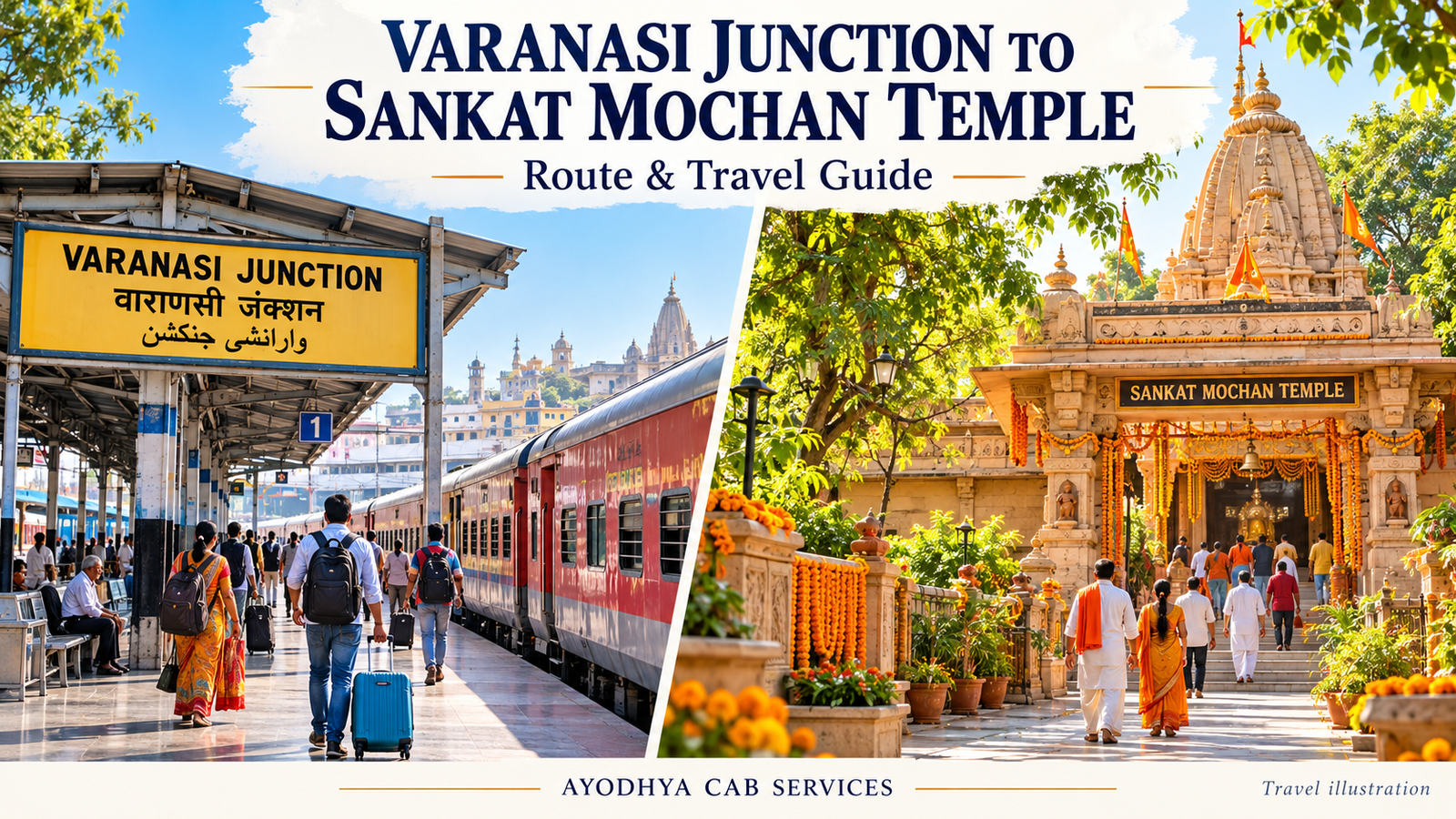
Plan your station-to-temple journey with clear pickup arrangements, luggage guidance and a confirmed temple approach.
Varanasi Junction to Sankat Mochan Temple: quick overview
| Planning detail | What to know |
|---|---|
| Starting station | Varanasi Junction |
| Station code | BSB |
| Destination | Sankat Mochan Hanuman Temple, Varanasi |
| Preliminary road-distance figure | Around 8 km; verify the selected endpoints |
| Initial road-transfer allowance | Provisionally 30–45 minutes; check current navigation |
| Temple locality | Sankat Mochan area, towards the Durga Kund–BHU side of the city |
| Transport to investigate | Auto-rickshaw, suitable private vehicle or app-based ride where available |
| With large luggage | Confirm storage before travelling directly to the temple |
| Darshan time | Separate from the road journey |
| Return journey | Confirm the station, pickup point and departure requirement separately |
The Varanasi district administration places Sankat Mochan Temple on the way between the Durga Temple area and the Banaras Hindu University side. It identifies the shrine as a temple dedicated to Lord Hanuman. India
Use that locality information to check the destination. Do not accept a similarly named temple elsewhere as the correct map result.
Confirm that your ticket says Varanasi Junction
Varanasi has several railway stations, and their names can cause confusion when arranging a pickup.
The Indian Railways station list identifies Varanasi Junction as BSB. A separate North Eastern Railway list identifies Banaras as BSBS. Old Station
These codes are a simple way to avoid beginning with the wrong starting point.
Check the station name before sending pickup details
| Ticket or booking detail | What to do |
|---|---|
| Varanasi Junction / BSB | Use this guide’s starting station |
| Banaras / BSBS | Check a separate route from Banaras station |
| Another Varanasi-area station | Use the exact station named on the ticket |
| Only a city name in a message | Ask the traveller to confirm the station and code |
When arranging transport, send the station name, code and arrival details together.
For example:
We arrive at Varanasi Junction, BSB. Please confirm the permitted pickup point after we exit the station.
Avoid saying only “Varanasi station pickup”.
That description may seem sufficient during booking but become unclear when the driver and traveller are standing at different locations.
Do not confuse a platform with a road pickup point
The platform where the train arrives and the place where a vehicle can collect you are different parts of the journey.
After arrival, follow the station’s current signs and staff instructions. Confirm the pickup point once you know which public exit you will use.
Do not rely on an old photograph of a station entrance as proof that the same arrangement applies today.
If the group needs assistance with luggage or movement, organise that before asking everyone to hurry towards an uncertain exit.
How far is Sankat Mochan Temple from Varanasi Junction?
A sensible starting figure is approximately 8 km by road, subject to the route and endpoints.
The variation in published figures is a reason to check the actual journey, not to claim that one precise number applies to every passenger.
A map may begin at a general station pin. Your vehicle may start from a particular approach road or pickup area. At the other end, a temple pin may not represent the location where a vehicle can stop.
Measure the journey you intend to make
Use the following endpoints:
Confirmed pickup point at Varanasi Junction → permitted drop-off for Sankat Mochan Hanuman Temple.
Then establish the remaining walk.
If you stop at a hotel first, that becomes a different itinerary. Do not describe the hotel detour as part of the direct station-to-temple distance.
Likewise, a route through another attraction needs its own measurement.
Why a shorter distance may take longer
Distance alone does not describe road movement.
A shorter option may involve slower junctions or a less convenient approach. A slightly longer option may suit the conditions better at the time of travel.
Ask the driver to explain a substantial change from the proposed route. There may be a practical reason, but it should still be clear what journey you are paying for.
Do not insist on a route solely because it was the shortest on a screenshot saved before your train journey.
Keep the distance estimate transparent
For publication and personal planning, distinguish:
- A figure quoted by a travel source.
- A route measured between defined points.
- A live navigation estimate.
- The distance actually travelled.
This guide’s preliminary figure belongs to the first category.
Before publishing a more exact answer, check a current route and record which station pickup point and temple endpoint were used.
How much time should you allow?
Begin with the current road estimate after arrival, then add the stages it does not include.
For a provisional plan, reserving 30–45 minutes for the road section can provide a starting allowance. Conditions may require longer, and this guide does not establish that range as a typical measured duration.
The more important calculation is:
Station exit + pickup coordination + road journey + final approach + temple visit.
Separate the stages
| Stage | What can affect it |
|---|---|
| Leaving the platform | Group size, luggage and assistance needs |
| Reaching the pickup | Exit choice and the agreed meeting point |
| Waiting for transport | Actual vehicle availability |
| Road movement | Current route and traffic |
| Final approach | Permitted drop-off and walking requirements |
| Darshan | Current access, worship arrangements and waiting |
A train arrival time is not the same as a vehicle departure time.
For a family with several bags, the difference may be significant enough to affect a planned temple arrival.
Use the train’s actual arrival
If the train is delayed, reassess the plan.
Confirm that darshan will be available when you expect to reach the temple. If you are tired or carrying luggage, a hotel stop may become more useful than continuing directly.
Do not ask a driver to recover a rail delay through faster road travel.
For a fixed onward departure, reduce optional activities rather than removing the time needed to reach the station safely and board.
Understand the route before selecting transport
The broad journey runs from the Varanasi Junction area towards Sankat Mochan Temple on the Durga Kund–BHU side of the city.
A route to compare in current navigation is:
Varanasi Junction → Sigra/Rath Yatra area → Bhelupur/Durga Kund side → Sankat Mochan Temple approach.
This is an indicative orientation, not a verified fastest route or a turn-by-turn instruction. Navigation may suggest another approach depending on the pickup point and current conditions.
Compare transport around your group’s needs
Choose transport based on passengers, luggage, comfort and the actual route.
| Option | When to consider it | What to confirm |
|---|---|---|
| Auto-rickshaw | A direct local transfer with suitable passenger and luggage space | Total fare, seating and drop-off |
| Private vehicle | A group needing more space or an intermediate stop | Vehicle size, luggage capacity and fare inclusions |
| App-based ride | Travellers comfortable arranging pickup through an app | Actual availability, meeting point and booking details |
| Shared local connection | Flexible travellers willing to investigate connections | Route, interchange, fare and final approach |
| Bus connection | Travellers who can verify a useful current service | Boarding point, destination stop and onward walk |
This comparison does not confirm that every option will be available when you arrive.
A low fare is useful only when the arrangement suits the group.
Auto-rickshaw: clarify whether the fare is private or shared
Ask whether the quote covers the whole vehicle or one passenger.
Also confirm that your bags fit without obstructing seating or movement. Do not assume that several large suitcases can be accommodated merely because enough passenger seats appear available.
If you need a hotel stop, mention it before agreeing on the fare.
A direct transfer and a journey with waiting or another destination are different requests.
Private vehicle: define the complete booking
A useful quotation should identify:
- The pickup location.
- Passenger count.
- Luggage requirements.
- Destination and permitted endpoint.
- Any intermediate stop.
- Waiting arrangements.
- Charges included and excluded.
A message saying “station pickup confirmed” leaves too much unresolved.
Keep the confirmation available before boarding and check the assigned vehicle through the appropriate booking process.
App-based ride: wait for an actual match
An app showing a category or estimated fare does not guarantee a vehicle.
Confirm that the ride has been accepted and communicate the pickup point through the available process. Follow station instructions about where vehicles may stop.
If the pickup becomes confusing, pause at an identifiable public location rather than repeatedly walking between entrances with the whole group.
Is there a direct bus or shared service?
A verified direct public-transport service from the selected station boarding point to the temple was not established in this research.
That does not mean no useful local connection exists. It means a route number, frequency or fare should not be invented.
Before choosing a public or shared connection, establish:
| Question | Why it matters |
|---|---|
| Where do we board? | A general station reference may be insufficient |
| Where does the service go? | The destination may be a locality rather than the temple |
| Is a change required? | Connections add time and luggage handling |
| What is the final walk? | Important for comfort and mobility |
| Is the service operating now? | Published information may be outdated |
| What is the current fare? | Avoid assumptions from old posts |
If these details cannot be confirmed and you have a tight schedule, compare a clearer direct arrangement.
What should you pay for the journey?
No verified current fare is quoted here.
The total can depend on the vehicle, the way the ride is arranged, waiting, additional stops and the agreed service scope.
Ask for the amount before departure.
Copy-ready fare enquiry
Please quote the total amount for a one-way journey from Varanasi Junction, BSB, to the permitted Sankat Mochan Temple drop-off. We are [number] passengers with [luggage details]. Please mention any parking, waiting or other additional charges.
For a return, add:
Please also confirm the pickup point after darshan, the included waiting period and how extra waiting is charged.
This gives the provider a clearer request than asking only for the “temple rate”.
Keep transport and worship expenses separate
A vehicle payment should not be assumed to include offerings, a requested puja or any other temple-related arrangement.
If someone offers a combined package, ask for its components.
Paying for transport does not establish priority temple access.
The visit should remain understandable even when several people are arranging different parts of it.
Should you visit directly from the station?
The answer depends largely on luggage and how you feel after the train journey.
Direct travel may suit you when
- The group is ready to continue.
- Belongings are limited and manageable.
- The intended temple access has been confirmed.
- The return or next journey is clear.
These are planning considerations, not confirmation that every bag or item will be accepted inside.
Consider accommodation first when
- You have large suitcases.
- Someone needs to rest or freshen up.
- The group needs to reorganise belongings.
- You cannot confirm a suitable storage arrangement.
- Arrival timing does not fit the intended visit.
Ask your accommodation about luggage storage if your room is not yet available. Confirm the arrangement rather than assuming it is included.
Do not rely on unverified temple storage
This guide has not established a current luggage-storage service at Sankat Mochan Temple.
Before arriving with bags, confirm the temple’s permitted-item rules and your storage plan.
Similarly, do not assume that leaving luggage inside a parked vehicle is a secure storage service. Discuss the arrangement explicitly and avoid leaving valuables unattended.
What about walking from Varanasi Junction?
Using the preliminary 8 km figure only as an illustration, walking at an assumed 4 km/h would take about two hours of movement.
That calculation excludes stops, navigation, crossings and the difference between road and pedestrian routes. It does not establish that the actual walking route is safe, comfortable or 8 km long.
After a train journey, walking should be a deliberate choice by someone comfortable with the verified route—not an assumption based on the phrase “within the city”.
For most first-time visitors carrying luggage, investigating road transport is the more practical starting point.
Check temple access before leaving the station
The official Kashi portal currently lists these published windows for Shri Sankat Mochan Temple:
| Published period | Listed time |
|---|---|
| Morning | 5:00 AM–11:30 AM |
| Afternoon and evening | 3:00 PM–11:00 PM |
Treat them as a reference and confirm the current arrangements for your visit. The same listing identifies Tuesdays and Saturdays as important worship days, so avoid assuming an identical experience across all dates. Kashi Official Web Portal
Do not confuse opening hours with a guaranteed queue length or access to a specific ritual.
If your train’s arrival leaves you close to a listed break, confirm before making the transfer solely for immediate darshan.
Plan Sankat Mochan darshan around your actual arrival
After completing the journey from Varanasi Junction to Sankat Mochan Temple, allow time for the final approach and the temple’s current entry process.
Do not plan darshan from the train’s scheduled arrival alone. Your train may arrive late, the group may need a break, or luggage arrangements may take longer than expected.
The practical question is:
When can we realistically reach the entrance, ready to visit?
Check that against the current opening arrangements before leaving the station or your accommodation.
Published opening windows
The official Kashi portal lists the following windows for Shri Sankat Mochan Temple:
| Period | Published timing |
|---|---|
| Morning | 5:00 AM–11:30 AM |
| Afternoon and evening | 3:00 PM–11:00 PM |
These are published reference times, not a guarantee of uninterrupted darshan or availability of a particular ritual. Reconfirm arrangements for your visit, especially if arriving close to a listed closing time. Kashi Official Web Portal
A road estimate that ends at 11:20 AM, for example, should not be treated as proof that you can complete a morning visit. It may exclude the walk from the drop-off, security procedures and waiting.
If the timing is uncertain, ask locally before committing to the journey.
Opening hours and aarti schedules are different
An opening window does not establish when every ceremony takes place.
If attending a particular aarti is important, confirm:
- Its current schedule.
- Whether visitors can attend.
- Any reporting or entry instructions.
- Whether arrangements change on your travel date.
Do not use an aarti time from an undated social media post as the only basis for planning a station transfer.
The same applies to special puja requests. Confirm the service with an appropriate temple representative rather than assuming it is available whenever the temple is open.
Understand the temple’s significance without confusing tradition and history
Sankat Mochan Temple is dedicated to Lord Hanuman. The Varanasi district administration associates its founding with Goswami Tulsidas, while the official Kashi description recounts the tradition of Tulsidas receiving a vision of Hanuman at the site. India
That devotional context helps explain why visitors may wish to spend time here rather than treat it as a quick stop between attractions.
Where an account concerns a vision, blessing or spiritual outcome, describe it as a belief or tradition. It should not be presented as a verifiable travel fact.
Keep the visit focused on your purpose
Some visitors come for darshan, others to recite prayers or spend time at a place important to their family.
Decide what matters to your group before adding more destinations.
If Sankat Mochan is the main reason for the outing, complete that visit before deciding whether to continue elsewhere. This prevents an optional sightseeing list from taking over the purpose of the day.
A shorter itinerary can still be a complete and satisfying visit.
Tuesdays, Saturdays and special occasions
The official Kashi listing identifies Tuesdays and Saturdays as particularly significant worship days and also describes Hanuman Jayanti as an important occasion at the temple. Kashi Official Web Portal
If you choose one of these days, ask about current access and allow flexibility.
Do not promise a short queue simply because you arrive early. Equally, do not assume that every visitor must avoid these days. Some devotees deliberately choose them for religious reasons.
The right advice depends on your purpose and tolerance for waiting.
Separate religious preference from convenience
Use this distinction when deciding:
| Your priority | What to establish |
|---|---|
| Worship on a particular day | Current access and practical waiting arrangements |
| A quieter visit | Ask about conditions rather than relying on a guaranteed “best hour” |
| A specific ceremony | Confirm the ceremony’s own instructions |
| A short stop before a train | Keep the visit flexible and protect the return journey |
| Travel with someone who finds standing difficult | Confirm assistance and the likely entry process |
A date can be meaningful while requiring more careful planning.
If the group includes someone who needs frequent rest, discuss that before choosing a visit mainly around someone else’s preferred schedule.
What to confirm about phones, bags and photography
A current, authoritative item-by-item entry policy was not established in the sources checked for this draft.
Do not assume that rules from Kashi Vishwanath Temple apply here. Each temple can have its own arrangements.
Before travelling directly from the railway station, confirm what can be carried and where any restricted belongings will remain.
Belongings checklist
| Item or requirement | What to confirm |
|---|---|
| Mobile phone | Whether it may be carried and used |
| Camera | Photography rules for the relevant area |
| Backpack or handbag | Whether it is accepted |
| Large suitcase | A separate storage arrangement before arrival |
| Offerings | What is permitted |
| Essential personal items | How they can be carried appropriately |
| Deposited belongings | Location, acknowledgement and collection process |
Do not describe a locker, cloakroom or storage counter as available unless it has been confirmed.
An online photograph of a counter does not establish its present operation, accepted items or terms.
Avoid arriving with an unresolved luggage problem
If you have large bags, a hotel stop can make the temple visit simpler.
Ask the accommodation:
- Can luggage be stored before check-in?
- Who receives and records the bags?
- Will you get an acknowledgement?
- When can they be collected?
- Are there any restrictions or charges?
Those answers are more useful than assuming that storage is automatically included.
If you have no accommodation booking, investigate a suitable authorised arrangement before leaving the station. Do not travel to the temple expecting someone there to solve it.
Dress, offerings and conduct
Wear clothing suitable for a religious visit and follow instructions at the entrance.
This draft does not establish a detailed official dress code for Sankat Mochan Temple. Avoid inventing mandatory colours or garments.
Choose practical clothing and footwear for the journey, then follow the temple’s current footwear arrangements.
Purchase offerings after checking what is permitted
Before buying a large package, ask what is accepted for your intended worship.
If requesting a puja, clarify the arrangement with the appropriate representative:
| Detail | Question |
|---|---|
| Service | What will be performed? |
| Availability | Can it be arranged at the intended time? |
| Amount | What payment or donation arrangement applies? |
| Materials | What is included, and what must be provided separately? |
| Participation | What does the visitor need to do? |
No verified puja tariff is quoted here.
Keep transport payments, optional purchases and religious offerings separate so that the group understands each expense.
Photography should follow the local instructions
Ask before taking photographs inside or near worship areas.
Even where photography is permitted, avoid blocking entrances or interrupting people who are praying. Do not assume that a photograph posted by another visitor establishes permission.
If the aim is a family picture, take it in a permitted location without holding up the movement of others.
Visiting with parents or someone who needs assistance
Plan around the person who needs the most support.
Ask about walking, standing, changes in level and the need for breaks. Age alone does not tell you what someone can comfortably manage.
A person may walk well but struggle with prolonged standing. Another may need a shorter approach but be comfortable once inside.
Ask about the complete approach
This guide has not verified a continuous wheelchair-accessible route or an assistance service at the temple.
Explain the requirement precisely:
One traveller uses a wheelchair. Can you confirm whether the entire approach and entrance are suitable?
Or, in Hindi:
हमारे साथ एक व्यक्ति हैं जिन्हें सीढ़ियाँ चढ़ने में परेशानी होती है। उतरने की जगह से मंदिर के प्रवेश तक रास्ता कैसा है?
A reply saying “the vehicle comes nearby” does not answer the accessibility question.
Confirm the remaining distance, surface and any steps before choosing the drop-off.
Agree on an alternative plan
Before leaving the station or hotel, decide what you will do if the approach is unsuitable.
Options might include waiting while someone checks ahead, taking a break or changing the visit’s timing. The appropriate choice depends on the people involved and the current conditions.
Do not leave a traveller waiting alone at an unfamiliar roadside location while everyone else continues.
A family plan should include the return arrangement as well as the outward ride.
Visiting with children
Keep the outing understandable.
Tell children the main destination, who they will remain with and where the group will meet after the visit. Younger children should stay with a responsible adult.
If several adults are travelling, assign responsibilities instead of assuming someone else is watching.
Keep the first outing manageable after a train journey
A tired child may find a long sequence of temples, shopping and waiting difficult.
Consider completing Sankat Mochan darshan and then returning for food or rest. Decide on additional places afterwards.
Carry the personal essentials the child normally needs, subject to confirmed entry rules. Do not depend on finding every required item at the destination.
Prepare for separation without alarming the group
Choose a recognisable, permitted meeting location.
“Outside the temple” may be unclear if people emerge at different points or move away from the entrance.
Give another responsible adult the hotel address and contact details. Avoid making one phone the only source of information for the whole family.
Plan for monkeys without turning the visit into a spectacle
The district administration notes the presence of monkeys at the temple. India
Keep belongings secured, follow staff instructions and avoid encouraging animals to approach for photographs.
Do not allow children to chase, tease or attempt to handle them. If staff give instructions about food or offerings, follow those instructions.
This is a practical consideration, not a reason to exaggerate the setting or promise that a particular encounter will occur.
Choose one nearby addition before planning a full circuit
Sankat Mochan can be part of a wider Varanasi visit, but each extra destination adds its own approach, waiting and return decisions.
Start with one optional addition.
The district tourism information identifies Tulsi Manas Temple near the Durga Temple area and places Sankat Mochan on the Durga–BHU side. This supports considering the area together, but it does not supply a verified connecting distance for every route. India
Nearby-stop comparison
| Place | Why you might consider it | What to check separately |
|---|---|---|
| Tulsi Manas Temple | Interest in Rama devotion and Ramcharitmanas inscriptions | Current opening arrangements and connecting route |
| Durga Kund Temple | A separate temple visit in the same broader area | Access, timing and actual transfer |
| Assi Ghat | A riverfront visit | Route, steps and current conditions |
| New Vishwanath Temple at BHU | A different temple and campus destination | Correct pin, campus approach and timing |
Do not present these as four stops that every traveller should complete.
Choose according to your interests and the group’s available time.
Adding Tulsi Manas Temple
The official Kashi portal describes Tulsi Manas Temple as a Rama temple near Durga Kund, known for Ramcharitmanas verses inscribed on its walls. Kashi Official Web Portal
That gives the visit a distinct purpose: it is not simply another temple name to tick off.
If you are interested in the inscriptions, allow time to look at them rather than arriving only for a photograph.
Check its opening arrangements independently
Do not assume that Tulsi Manas follows Sankat Mochan’s schedule.
The official listing publishes its own hours, which should be reconfirmed before the visit. A morning arrival suitable for one temple may not fit another. Kashi Official Web Portal
Check the current connecting route from the point where you finish, especially if you are deciding whether to walk.
This article does not establish a measured Sankat Mochan–Tulsi Manas walking distance.
Adding Durga Kund Temple
Durga Kund is another possible addition if it matches your interests.
Keep it as a separate visit with its own destination, entrance and worship arrangements.
If your later plan involves Durga Kund Temple to Kashi Vishwanath Temple, use a separate route assessment for that connection. Do not extend the station-to-Sankat-Mochan distance to cover the rest of the day.
Confirm the fare scope before extending a ride
If you ask a vehicle to continue to another temple or wait, clarify the revised arrangement first.
The original one-way fare may not include:
- Another destination.
- Waiting during darshan.
- Returning to the station.
- A hotel stop.
A short discussion before continuing is easier than a disagreement at the end.
Adding Assi Ghat
A ghat visit is a different activity from temple darshan.
It may involve steps, walking and time beside the river. Choose it only if the group wants that experience and the current approach is suitable.
Do not assume that a boat service will be available or that boarding will suit every traveller.
If a river journey interests you, confirm its operation and practical arrangements separately.
Keep an evening plan flexible
An evening riverfront programme can become a fixed commitment if you organise transport or seating around it.
Before adding one, establish the exact ghat, current timing and the return journey.
After a train arrival and temple visit, the group may prefer a shorter outing. Leave room to make that decision.
Distinguish the two Vishwanath temples
The New Vishwanath Temple at BHU is a different destination from the old-city Kashi Vishwanath Temple.
The district administration lists them separately and identifies the newer temple within Banaras Hindu University. India
When asking for directions, specify which one you mean.
“Vishwanath Temple” alone may not be a sufficiently clear instruction for the rest of your itinerary.
If visiting the old-city temple, plan its access, belongings and onward journey independently.
Three itinerary patterns after arriving at Varanasi Junction
These are planning examples, not fixed-duration packages.
Pattern 1: Temple visit followed by rest
Sequence: Station → confirmed luggage arrangement if needed → Sankat Mochan → accommodation.
Choose this when the main objective is darshan and the group has arrived after a tiring journey.
Complete the visit without adding another fixed appointment. You can decide later whether to go out again.
Pattern 2: Temple visit with one nearby addition
Sequence: Station → luggage arrangement → Sankat Mochan → one confirmed nearby destination → accommodation or onward journey.
Choose the extra place before negotiating a multi-stop fare. Confirm that its access fits the likely arrival time.
If the first visit takes longer, remove the optional stop.
Pattern 3: Temple visit before an onward train
Sequence: Station → confirmed belongings arrangement → Sankat Mochan → collect belongings → correct departure station.
This requires the clearest time plan.
Establish the onward station from the ticket. Do not assume that arrival at BSB means the return train also departs from BSB.
The time available for worship begins only after protecting the full return and boarding requirement.
A hypothetical family example
Consider a family arriving at Varanasi Junction with two suitcases and a parent who prefers shorter walks.
They first confirm luggage storage at their accommodation. After resting, they check temple access and arrange a vehicle with an agreed drop-off and return meeting point.
At the temple, they follow current belongings and entrance instructions. After darshan, they decide whether everyone wants another stop.
Their plan works because the main decisions were made in the right order:
Luggage and comfort → current access → transport → darshan → optional activity.
This is an illustrative example. It does not represent a client itinerary, a measured journey or a guaranteed facility.
Reassess the plan when the day changes
A train delay, an access change or a tired traveller can make the original itinerary unsuitable.
Use the main objective to decide what stays.
| Change | Practical adjustment |
|---|---|
| Train arrives later than expected | Recheck the temple window before leaving |
| Luggage storage is unavailable | Resolve storage before attempting direct darshan |
| Final approach is unsuitable | Ask about another permitted option |
| First visit takes longer | Remove the optional destination |
| Onward departure becomes tight | Begin the return rather than adding another activity |
The goal is a manageable visit, not completing a list at any cost.
Plan the return from Sankat Mochan Temple separately
The outward journey does not establish the time, fare or pickup arrangement for your return.
You may leave the temple at a different time of day, continue to your accommodation or need to reach another railway station. Confirm that journey before the group begins its next activity.
The most useful return instruction is specific:
Please collect us at the agreed permitted pickup point and take us to [station name and code].
“Back to the station” can be unclear, particularly if your arrival and departure bookings use different stations.
Check the departure station on your ticket
Varanasi Junction is BSB, while Banaras is BSBS. Use the name and code on the onward booking rather than assuming both journeys use the same station.
Before confirming the return, check:
| Detail | What to establish |
|---|---|
| Departure station | Exact name and code on the ticket |
| Train | Correct train number and travel date |
| Departure time | Current information from an official railway source |
| Pickup point | A location the vehicle can reach |
| Belongings | Whether luggage must be collected elsewhere |
| Assistance | Any help needed to enter the station and reach the platform |
Do not decide the return route using only the station name remembered from the morning.
A few seconds checking the ticket can prevent an unnecessary station-to-station transfer.
Work backwards from the train departure
A road estimate is only one part of reaching a train.
Your plan must also account for collecting belongings, reaching the vehicle, entering the correct station and finding the platform.
Use this structure:
Train departure − station and boarding allowance − road journey − luggage collection − temple exit and pickup approach
The amounts depend on the actual journey. A traveller with one small bag and someone needing assistance should not use identical assumptions.
Protect the return allowance
If the plan becomes tight, remove optional activities first.
Do not spend the time reserved for the station transfer on shopping or another temple visit simply because the map suggests a short drive.
Also avoid treating a delayed train as permission to stay out indefinitely. Continue checking official information and consider whether you can reliably reach the station if the situation changes.
The objective is to arrive ready to board, rather than reach a station entrance at the last possible moment.
Keep travel documents accessible
Keep the ticket information and applicable identification available during the return.
IRCTC’s e-ticket guidance explains the identification requirements for passengers travelling on an e-ticket. Check the current instructions relevant to your booking. contents.irctc.co.in
Avoid packing essential documents into a bag that is difficult to retrieve. If belongings were deposited elsewhere, include collection in the return plan.
You do not need to carry every document the family owns. Carry what is applicable and protect it appropriately.
Agree on a usable pickup point
The place where you were dropped may not be suitable for waiting.
Before entering the temple, confirm where you should return and how to contact the driver or transport provider.
Use a recognisable public landmark and clarify which side or approach is intended.
Copy-ready return confirmation
We will return to [agreed location]. Please confirm that pickup is permitted there. Our next destination is [station or accommodation]. Please explain whether waiting is included and how we should contact you when we are ready.
If phones must be deposited under the current entry arrangements, make the meeting plan before putting them away.
Do not depend on a call that you may be unable to make until after collecting your belongings.
If the pickup location changes
Ask for a clear explanation of the replacement point and the walk needed to reach it.
If someone in the group has difficulty walking, explain that immediately. A change that is simple for the driver may be inconvenient for the passengers.
Keep everyone together while confirming the new arrangement. Avoid sending different family members towards different descriptions of “the main road”.
Keep the budget clear through the final journey
Transport misunderstandings often arise when the itinerary changes.
A one-way station transfer, a vehicle waiting during darshan and a multi-stop outing are different services.
Before extending the plan, confirm the revised amount and what it covers.
Journey-cost record
| Item | Agreed detail |
|---|---|
| Outward journey | Pickup and drop-off |
| Intermediate stop | Hotel, luggage collection or another destination |
| Waiting | Included period and extra-charge basis |
| Return | Final destination and pickup |
| Other charges | Items specifically confirmed |
| Total | Amount applicable to the agreed itinerary |
No fixed fare is supplied here because a current tariff for your selected arrangement has not been verified.
Where possible, retain the written confirmation. A clear itinerary makes a quotation easier to understand and compare.
Adjust the plan to the time of arrival
Train passengers reach Varanasi at different hours. A single itinerary cannot suit every arrival.
Use the temple’s current opening arrangements, your accommodation plan and the group’s condition to choose the next step.
Early arrival
If the train arrives early, first establish that the group is ready to continue.
Someone who has slept poorly may prefer a break. Large bags may still require storage even when the temple is open.
Confirm access before travelling directly. Early arrival does not guarantee a shorter queue.
Arrival near a published break
Check whether the visit remains practical before leaving the station.
A road journey that reaches the locality shortly before a closing window may leave insufficient time for the entrance process.
If necessary, use the interval for accommodation, food or rest, then confirm the later visit.
Do not assume that the published window can be extended for an individual traveller.
Evening arrival
Check the complete journey rather than only the road distance.
You still need a suitable pickup, confirmed temple access and a clear destination afterwards. If continuing to accommodation, establish its arrival arrangements.
A shorter visit can be more manageable than adding several places after a late train arrival.
Do not let the weather decide the itinerary too late
Review the conditions before setting out from the station or hotel.
Rain can make boarding, luggage handling and the final walk less convenient. Heat can make a long outing tiring. These considerations are particularly relevant when someone needs frequent breaks.
Choose transport and optional activities accordingly.
Keep the final approach practical
Ask about the condition of the route from the drop-off to the entrance.
If it is unsuitable for someone in the group, investigate another permitted approach or reconsider the timing. Do not assume that a vehicle can move closer simply because the passengers would prefer it.
Take particular care when getting in and out with luggage. Find a permitted place to stop rather than rushing the group into moving traffic.
Keep wider Varanasi journeys separate
A useful travel guide should answer the journey in its title clearly.
The Varanasi Junction to Sankat Mochan Temple route does not provide the distance for every later part of the itinerary.
If you add another temple, a ghat or the airport, check that connection independently.
Continuing to Kashi Vishwanath
Kashi Vishwanath is a separate destination with its own approach and belongings arrangements.
If your wider plan includes Durga Kund Temple to Kashi Vishwanath Temple, use the dedicated guide for that connection. Do not add its distance to this article’s station-transfer figure without explaining the separate stages.
Similarly, Kashi Vishwanath Temple to Gauri Kedareshwar Temple is an old-city temple connection requiring its own route assessment.
Arriving or departing by air
The Varanasi Airport to Kashi Vishwanath Temple journey begins at a different location and should be planned separately.
If your trip combines rail arrival with air departure, confirm the actual airport pickup point and allow for your airline’s reporting requirements.
A temple visit should not become dependent on every earlier activity finishing at the most optimistic time.
Common questions about the journey
Is Varanasi Junction the same as Banaras railway station?
No. Varanasi Junction uses BSB, while Banaras uses BSBS. Check the station on your ticket before arranging the journey.
Can I walk from Varanasi Junction to Sankat Mochan Temple?
Investigate the actual pedestrian route before deciding. This is a city transfer, and the preliminary road-distance figure does not establish the length or suitability of a walking route.
For someone arriving with luggage or feeling tired after the train, road transport is the more practical option to investigate first.
Can I use an e-rickshaw for the entire journey?
Confirm the permitted route, passenger capacity, luggage suitability and actual availability locally. This research did not verify a specific through-service that can be promised to every traveller.
Does a transport booking include temple entry?
Do not assume that it does. The vehicle arrangement and temple-access process are separate unless a specific, authorised arrangement has been clearly established.
Is there verified luggage storage at the temple?
This guide has not verified a current storage facility suitable for railway luggage. Resolve your belongings plan before travelling directly with large bags.
Is the temple visit suitable for wheelchair users?
A complete accessible approach has not been verified here. Ask about the drop-off, surface, steps, entrance and any available assistance before making the plan.
Can I finish darshan and catch a train during a short layover?
That depends on the actual arrival, luggage arrangements, current access, waiting and return journey. There is no reliable universal minimum layover for this visit.
If the available time cannot comfortably cover every stage, leave the temple visit for another occasion.
Is the preliminary distance a live map result?
No. Around 8 km is a published planning figure. Check the selected station pickup point and temple endpoint in current navigation before departure.
Final station-to-temple checklist
Before the train arrives
- Confirm Varanasi Junction, BSB.
- Keep the temple’s full name available.
- Check current temple-access arrangements.
- Decide whether luggage requires an accommodation stop.
- Confirm any booked pickup.
Before boarding local transport
- Agree on the permitted destination endpoint.
- Check that passengers and bags fit appropriately.
- Confirm the fare and additional charges.
- Explain mobility requirements.
- Clarify any waiting or return arrangement.
After darshan
- Regroup and collect deposited belongings.
- Check the next destination.
- Confirm the pickup point.
- Review the time remaining before an onward departure.
- Remove optional stops if the return allowance is becoming tight.
Looking for the Best Cab Service in Ayodhya, Lucknow or Varanasi?
A comfortable temple visit starts with clear travel arrangements. When comparing the best cab service in Ayodhya, check passenger space, luggage requirements, pickup coordination and fare inclusions before booking.
Ayodhya Cab Services provides cab services in Ayodhya, Lucknow and Varanasi. Share your itinerary when enquiring about an Ayodhya sightseeing cab, a Lucknow airport transfer or a Varanasi temple visit, so availability and journey details can be confirmed.
For travellers seeking a Varanasi Junction to Sankat Mochan Temple cab, explain your train arrival, passenger count and luggage requirements. Confirm the station pickup point, permitted temple drop-off, any hotel stop and whether you need a return journey. Temple timings and darshan arrangements remain separate from the vehicle booking.
Planning an outstation journey from Ayodhya? Send the destination and dates first. Availability for routes beyond the confirmed service cities must be checked individually.
Contact Ayodhya Cab Services for a quotation based on your confirmed itinerary.
Conclusion: Plan the complete transfer
For Varanasi Junction to Sankat Mochan Temple, use around 8 km as a preliminary road-planning figure, then verify your actual route and permitted drop-off.
Treat the road journey, station exit, belongings arrangements, final approach and darshan as separate stages. Choose transport around the group’s needs and agree on the service before boarding.
A clear return plan is just as important as the outward ride. Confirm the station on your next ticket, protect the boarding allowance and keep additional sightseeing flexible.

