
Ayodhya to Gangasagar Distance: Route, Train, Nearest Railway Station & Travel Guide 2026
Ayodhya to Gangasagar Distance is an important search for travellers planning a journey from Uttar Pradesh to Sagar Island in West Bengal. The trip is different from a normal city-to-city road journey because Gangasagar lies on an island. Therefore, travellers need to understand the road route, railway connection, ferry crossing, Kachuberia transfer, and the final journey to Gangasagar before leaving Ayodhya.
Gangasagar, also known as Sagar Island or Sagardwip, lies in South 24 Parganas. It is known for the meeting point of the Ganga and the Bay of Bengal, Kapil Muni Ashram, its beach, and the annual Gangasagar Mela. The island is roughly 100 km south of Kolkata according to West Bengal Tourism.
However, reaching Gangasagar is not as simple as following one highway until the destination. Road travellers generally need to reach the mainland ferry side, cross the Muriganga, arrive at Kachuberia on Sagar Island, and then continue towards Gangasagar. Rail travellers also need a combination of train and local transport. Therefore, planning each stage in advance makes the journey much easier.
This 2026 travel guide explains the practical routes from Ayodhya, train planning, the nearest useful railway station, ferry connectivity, road travel, suitable seasons, accommodation planning, and common mistakes. It is written for travellers who want one clear resource before planning the trip.
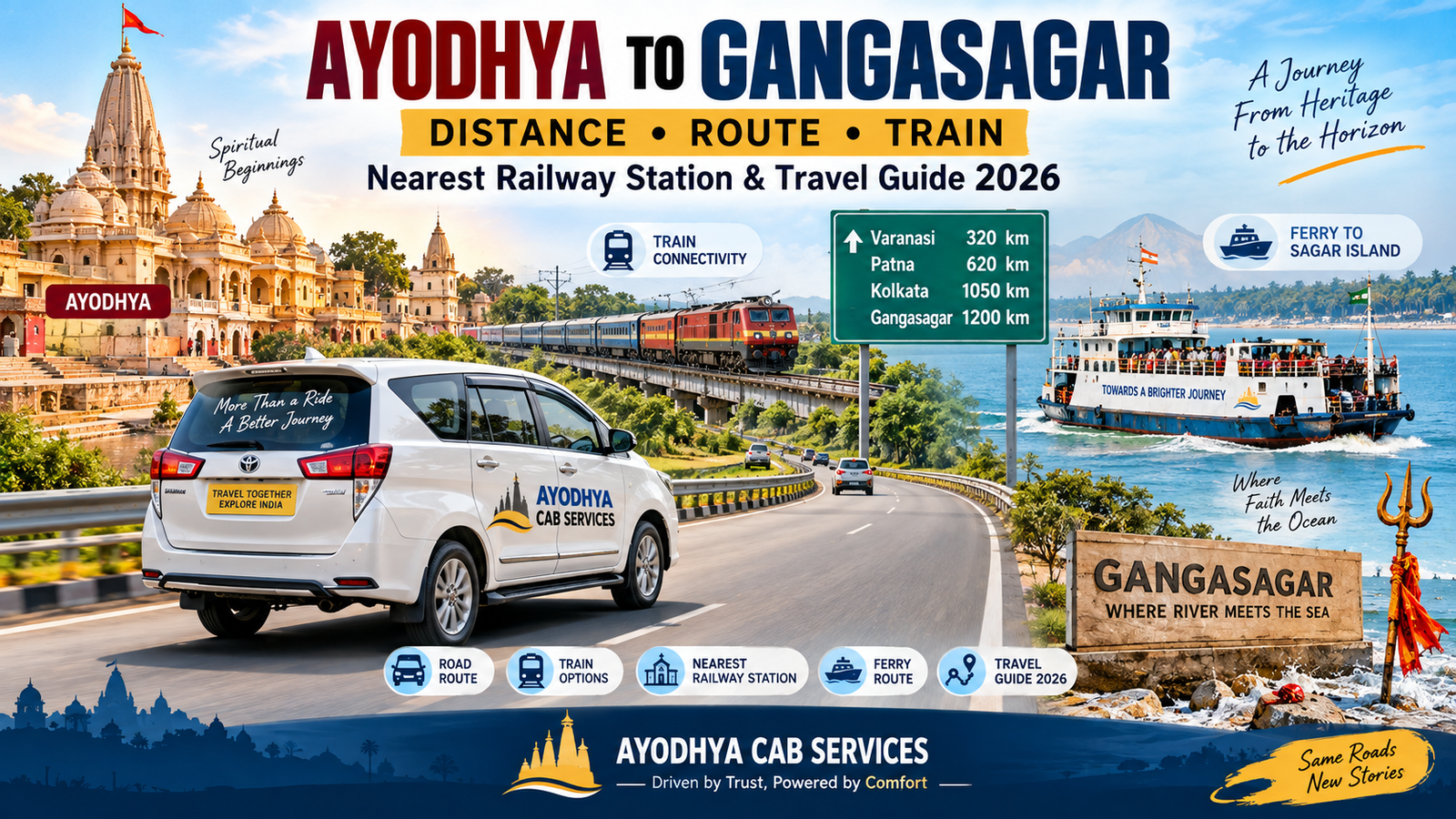
Plan your Ayodhya to Gangasagar journey with road route, train connectivity, nearest railway station, ferry crossing and essential travel information for 2026.
Ayodhya to Gangasagar Distance by Road
The road journey from Ayodhya to Gangasagar is a long interstate trip from Uttar Pradesh towards southern West Bengal. However, the most important thing to understand is that a simple road-distance number does not explain the complete journey.
Gangasagar is located on Sagar Island. Therefore, the trip includes a mainland road section, a water crossing, and another road section after reaching the island. West Bengal Tourism describes the road approach from Kolkata through Harwood Point. Travellers cross the Muriganga and reach Kachuberia, from where local road transport continues towards Gangasagar.
For this reason, travellers should treat online distance figures as planning estimates rather than the complete door-to-door experience. The actual time can change because of the chosen highway, Kolkata traffic, rest breaks, weather, ferry waiting time, and local movement after the crossing.
A sensible journey should therefore be divided into stages. First, plan the long road section from Ayodhya towards West Bengal. Next, decide where you want to stop for rest. Finally, keep enough time for the ferry and island transfer.
This approach is much more useful than planning the journey around kilometres alone.
Best Ayodhya to Gangasagar Route by Road in 2026
Travellers searching for the best road route from Ayodhya to Gangasagar should plan around major highways and practical stopping points rather than selecting the shortest-looking line on a map.
A typical long-distance journey heads east from Uttar Pradesh towards Bihar and then enters West Bengal before continuing towards the Kolkata region. From there, the route turns south towards the Gangasagar mainland access side.
However, road conditions can change. Construction, diversions, congestion, weather, and local restrictions may affect the route on the actual travel date. Therefore, travellers should check live navigation before departure rather than depending entirely on a fixed route published months earlier.
The Kolkata portion deserves additional time. Traffic around a large metropolitan area can significantly change arrival estimates. Moreover, reaching the ferry side late can make the remaining journey less convenient.
For families, the fastest theoretical route is not always the most comfortable option. A slightly longer highway with better road conditions, fuel stations, restaurants, and rest facilities may make more sense.
Most importantly, remember that reaching the mainland side does not complete the Gangasagar journey. The ferry crossing and Kachuberia transfer still need to be considered.
Ayodhya to Gangasagar Travel Time by Car
Travellers often calculate road time by dividing total kilometres by average speed. That method is unreliable for this journey.
The route involves long highway driving, city traffic, meal stops, fuel breaks, and a ferry connection. Therefore, the actual journey can take considerably longer than a map’s pure driving estimate.
Families travelling with children or elderly passengers should keep a comfortable buffer. Driving continuously for many hours can make the trip unnecessarily tiring. A planned overnight halt can turn a difficult journey into a much more manageable one.
Arrival timing near the ferry side matters as well. Even after reaching the mainland access point, travellers may need to wait before crossing. Ferry movement can be influenced by local operating conditions and tides. West Bengal Tourism specifically advises travellers to check ferry schedules in advance because tidal conditions can matter.
Therefore, do not plan an important Gangasagar activity immediately after the expected road arrival. Keep the first day flexible.
A realistic schedule should include highway time, breaks, traffic delays, ferry waiting, the crossing, and the final island transfer.
How to Reach Gangasagar from Ayodhya
The question how to reach Gangasagar from Ayodhya has more than one practical answer. Travellers can combine road, rail, and local transport depending on their budget and preferred comfort level.
A road-based journey provides flexibility during the long mainland section. However, the island geography means travellers still need to plan the crossing carefully.
Train travellers can first move towards Kolkata or another suitable rail connection and then continue towards the Gangasagar access area. West Bengal Tourism states that trains on the Sealdah South line run through Kakdwip towards Namkhana.
Another option is to combine a long-distance train with local rail and ferry transport. This can reduce the amount of continuous road travel.
The right choice depends on the traveller. Families carrying more luggage may value flexibility. Solo travellers may prefer rail. Senior citizens may benefit from fewer complicated transfers.
Whichever mode you choose, understand the final stages before starting. Reaching Kolkata, Kakdwip, or the mainland ferry point is not the same as reaching Gangasagar itself.
That small distinction prevents a lot of confusion during trip planning.
Ayodhya to Gangasagar Train Options in 2026
Searching for an Ayodhya to Gangasagar train can be confusing because Gangasagar itself is not a normal mainland railway destination.
Instead of looking only for one direct train, plan the journey in sections. First, check current long-distance trains from the Ayodhya region towards Kolkata or another practical connecting station. Then plan the onward movement towards the southern rail corridor.
West Bengal Tourism states that the Sealdah South railway network runs through Kakdwip towards Namkhana. Its Gangasagar tourism material also identifies Kakdwip Railway Station as the nearest railway station for its suggested Gangasagar itinerary.
However, train schedules can change. A service operating on one date may not match another date. Therefore, travellers should check current railway availability for their exact departure day rather than relying on an old blog timetable.
Connections matter as much as train duration. A cheap ticket with a very inconvenient interchange can make the journey harder.
Before booking, compare arrival time, waiting period, onward local transport, ferry access, luggage, and the needs of everyone travelling with you.
Gangasagar Nearest Railway Station for Tourists
The phrase Gangasagar nearest railway station creates confusion because travellers may encounter both Kakdwip and Namkhana while researching the trip.
For a practical Gangasagar itinerary, West Bengal Tourism’s published package information identifies Kakdwip Railway Station as the nearest railway station and directs travellers onward towards Lot No. 8 for the ferry crossing.
West Bengal Tourism’s broader destination information also explains that trains on the Sealdah South line travel through Kakdwip towards Namkhana.
Therefore, do not select a railway station simply because its name appears closest on a map. The important question is how easily that station connects with your intended ferry point.
For travellers arriving from Ayodhya, the complete rail plan can involve a long-distance connection towards Kolkata followed by an appropriate local or regional connection.
Always check the latest timetable before booking. Also, leave enough time between train arrival and onward transport.
Understanding the railway-to-ferry connection before departure makes the final part of the journey far less confusing.
Kakdwip Railway Station to Gangasagar Travel Guide
Travellers searching for Kakdwip Railway Station to Gangasagar should think of the journey as several connected stages.
According to West Bengal Tourism’s Gangasagar itinerary, travellers arriving at Kakdwip Railway Station proceed towards the ferry point at Lot No. 8. From there, a vessel crosses to Kachuberia on Sagar Island. After reaching Kachuberia, Gangasagar is roughly 30 km away by road transport.
This is why Kakdwip appears frequently in Gangasagar travel searches. It works as a useful mainland transport point rather than the final destination.
Keep luggage manageable if you are using several forms of public transport. Moving between a train, local vehicle, ferry, and another vehicle becomes more difficult with heavy bags.
Families should also avoid planning extremely tight connections. Even a small delay at one stage can affect the next stage.
During busy periods, additional waiting should be expected. Therefore, a relaxed schedule is usually better than trying to complete every transfer at the minimum possible time.
Lot No. 8 to Kachuberia Ferry Route
The Lot No. 8 to Kachuberia ferry route is one of the most important parts of the Gangasagar journey.
West Bengal Tourism’s suggested itinerary directs travellers from Kakdwip towards Lot No. 8 and then across by vessel to Kachuberia on Sagar Island. It also advises checking the ferry schedule because tidal conditions can affect movement.
This water crossing makes Gangasagar different from many other long-distance destinations. Therefore, travellers should not plan the entire trip as if it were only a road journey.
During busy periods, queues can increase. Weather may also affect how smoothly the crossing operates. Consequently, keeping additional time in the schedule is sensible.
After arriving at Kachuberia, the journey continues by road. So, ferry arrival should not be treated as the final destination.
First-time visitors often underestimate this last stage. However, understanding it beforehand makes the route straightforward.
Check current local arrangements close to your travel date, especially during large events or periods of unusually heavy visitor movement.
Kachuberia to Gangasagar Distance and Local Travel
After crossing the Muriganga and arriving at Kachuberia, travellers still need to continue across Sagar Island.
West Bengal Tourism’s itinerary describes Gangasagar as approximately 30 km from Kachuberia and notes onward travel by bus or taxi.
This final road section should be included when estimating your arrival time. Many first-time visitors calculate only the journey to the ferry point and forget the remaining island transfer.
During normal periods, the onward journey may be relatively straightforward. However, traffic can become much heavier during major gatherings.
Families should keep essential items easily accessible during this stage. After a long interstate journey and ferry crossing, repeatedly opening large bags can be inconvenient.
If you are arriving late, confirm your accommodation arrangements before completing the final transfer. That becomes especially important when travelling with children or senior citizens.
The main lesson is simple: Kachuberia is an arrival point on Sagar Island, not the end of the Gangasagar trip.
Ayodhya to Sagar Island Travel Guide
The Ayodhya to Sagar Island travel route combines the landscapes of Uttar Pradesh, eastern India, the Kolkata region, and the coastal environment of southern West Bengal.
Gangasagar and Sagar Island are often used interchangeably in travel searches. West Bengal Tourism describes Gangasagar as an island in the Ganges delta on the continental shelf of the Bay of Bengal.
This geography explains why the final journey includes a water crossing.
Travellers should therefore plan differently from a normal interstate city trip. Booking accommodation is only one part of the preparation. Ferry timing, onward island transport, weather, and luggage also matter.
If you are travelling by road, keep the final mainland arrival time flexible. Train travellers should do the same with their local connections.
Sagar Island can also be enjoyed beyond a quick arrival and departure. The coastal environment, beach, Kapil Muni area, and sunrise or sunset can make a relaxed stay worthwhile.
A little extra time often produces a much better experience than rushing through every stage.
Ayodhya to Kapil Muni Temple Gangasagar Travel Guide
Kapil Muni Ashram is one of the best-known attractions associated with Gangasagar. West Bengal Tourism identifies it as a major reason visitors travel to the island.
Travellers coming from Ayodhya should avoid treating the temple visit as an isolated stop. It is better to plan it as part of the complete Sagar Island itinerary.
After the long interstate journey, ferry crossing, and island transfer, some travellers may prefer to rest before visiting the main area. Others may plan an early visit the following morning.
Timing becomes especially important around Makar Sankranti and Gangasagar Mela. Visitor numbers can rise sharply, which affects transport and movement across the island.
For elderly travellers, avoid an overly tight itinerary. The combination of long-distance travel and multiple transfers can be tiring.
Comfortable footwear, light luggage, drinking water, and weather-appropriate clothing can make the day easier.
Most importantly, verify local access arrangements before travelling during major events because temporary crowd-management systems can change normal movement patterns.
Why Is Gangasagar Famous?
Gangasagar is known for its geographical setting, pilgrimage importance, beach environment, Kapil Muni Ashram, and the annual Gangasagar Mela.
West Bengal Tourism describes Sagar Island as lying in the Ganges delta near the Bay of Bengal. It also highlights the island as a destination for both pilgrims and other visitors.
The largest seasonal attraction is Gangasagar Mela, held around Makar Sankranti. During this period, visitors arrive from many parts of India.
However, the destination is not limited to the festival period. Travellers can also experience the coastal landscape during quieter months.
The island’s location creates a journey that feels different from an ordinary road trip. Visitors travel across highways, urban areas, river channels, and island roads before reaching the final destination.
For first-time visitors, this variety is part of the experience. Yet it also makes advance planning important.
Knowing the transport sequence before leaving Ayodhya can prevent confusion after reaching southern West Bengal.
Best Time to Visit Gangasagar from Ayodhya
The best time to visit Gangasagar from Ayodhya depends on whether you want comfortable weather, lower crowds, or the experience of Gangasagar Mela.
Winter is generally easier for a long journey because temperatures are more comfortable for outdoor movement. January, however, can become extremely busy around Makar Sankranti.
Travellers specifically planning for the Mela should expect a very different experience from an ordinary visit. Transport systems may operate under special arrangements, while crowd management becomes a major consideration.
The South 24 Parganas district administration issued dedicated arrangements for Gangasagar Mela 2026 covering locations including Sagar Island, Kachuberia, Lot No. 8, and Namkhana. This illustrates how significantly travel patterns can change during the event.
Outside peak festival dates, the journey can feel more relaxed.
Monsoon travel requires additional flexibility because coastal and river conditions can influence movement. Summer, meanwhile, can be hot and humid.
Choose dates according to the type of experience you want rather than simply selecting the first available weekend.
Ayodhya to Gangasagar Trip During Gangasagar Mela
A Gangasagar Mela trip from Ayodhya needs more preparation than an ordinary visit.
Accommodation can become harder to arrange. Roads and ferry points can experience much heavier demand. Additionally, crowd-control measures may change how visitors move through key locations.
Therefore, early planning is essential.
Do not rely on an itinerary created for a normal week. Check the current year’s official arrangements before departure.
Keep luggage compact. Carry essential documents, medicines, power banks, and basic travel necessities in a smaller bag that stays with you.
Families should establish a meeting point in case members become separated in crowded areas. Phone networks can also become heavily used during major gatherings, so relying entirely on calls may not always be convenient.
Elderly travellers need additional rest time. Avoid scheduling several difficult transfers without breaks.
The Mela can be a memorable experience, but the scale of the gathering changes the practical side of the journey considerably.
Ayodhya to Gangasagar Family Trip Planning
A long family journey requires a different plan from solo travel. Children, senior citizens, luggage, meal timings, and rest stops all influence the schedule.
Start by deciding whether the family is comfortable with one very long road journey. If not, include an overnight stop.
Train travel can reduce continuous driving, but it introduces additional transfers. Therefore, compare convenience rather than only cost.
Keep one small bag for the final journey. Medicines, water, identification, chargers, snacks, and essential clothing should remain easy to reach.
Accommodation should be confirmed before reaching the island, particularly during weekends or busy travel periods.
Avoid planning a return journey immediately after completing a tiring arrival. Giving the family time to rest can improve the entire trip.
Senior citizens may need more time at railway stations, ferry points, and local transfers. Children may also become tired during long waiting periods.
A family-friendly itinerary is not necessarily the fastest itinerary. It is the one that leaves enough room for delays without turning every stage into a rush.
Ayodhya to Gangasagar Road Trip With Senior Citizens
Travelling with senior citizens requires careful pacing because this journey contains several transport stages.
The long road or rail section is only the beginning. Travellers then need to manage local transport, a ferry crossing, and another road transfer on Sagar Island.
Therefore, avoid unnecessary luggage. Choose accommodation that does not create difficult additional travel after arrival.
Medicines should remain in hand baggage. Carry enough for unexpected delays rather than packing only the exact amount needed for the planned number of days.
Rest breaks matter on road journeys. Continuous driving may save time on paper but can make the trip exhausting.
Train travellers should choose connections with reasonable transfer windows. A very short interchange can become stressful when platforms are crowded.
The final island journey should also be planned during comfortable hours where possible.
Most importantly, build flexibility into the schedule. Senior-friendly travel is easier when a delay does not cause the entire itinerary to fail.
Ayodhya to Gangasagar Train or Road: Which Is Better?
Choosing between Ayodhya to Gangasagar by train or road depends on your group, budget, luggage, and preferred style of travel.
Road travel provides more flexibility during the mainland journey. Families can choose their own meal stops and take breaks when needed. However, the overall drive is long.
Train travel reduces continuous driving. It can also be more relaxing for travellers comfortable with railway journeys. Yet multiple transfers may be required before reaching the ferry side.
The ferry portion remains relevant either way because Gangasagar lies on Sagar Island.
Therefore, compare the complete journey rather than only the first stage.
A family with substantial luggage might prefer road travel for much of the route. A solo traveller may find rail connections easier. Senior citizens might prefer whichever option reduces complicated transfers.
There is no universal winner.
The best mode is the one that fits your group while leaving enough time for the final ferry and island journey.
Gangasagar Ferry Timing and Travel Planning
Ferry timing is one of the most important details to check before the final stage of the trip.
West Bengal Tourism specifically advises checking ferry schedules in advance because tidal conditions can influence operations.
Therefore, avoid publishing or relying on one permanent ferry timetable for every travel date. Current local information is more useful.
Travellers arriving from Ayodhya should keep a buffer between their expected mainland arrival and any important activity on Sagar Island.
Weather can add another variable. Coastal conditions are not always predictable far in advance.
During large gatherings, passenger volume can increase dramatically. Waiting times may therefore be longer even when services are operating.
Keep essential items accessible while waiting. Water, basic snacks, identification, medicines, and phone charging support can be useful.
Once the crossing is complete, remember that Kachuberia is followed by an additional road journey.
Planning all three stages—mainland arrival, ferry crossing, and island transfer—provides a much more realistic estimate of when you will actually reach Gangasagar.
Where to Stay in Gangasagar for a Family Trip
Accommodation planning becomes especially important after such a long journey.
West Bengal Tourism lists tourism accommodation associated with Gangasagar and the South 24 Parganas region. However, availability can vary significantly by date.
Families should prioritize practical location, cleanliness, accessibility, and confirmed booking status rather than choosing accommodation only by the lowest price.
If travelling with senior citizens, check stairs, walking distance, and basic facilities before booking.
During Makar Sankranti, advance planning becomes far more important because visitor demand increases sharply.
Outside peak dates, travellers may have greater flexibility. Still, arriving on the island without a confirmed stay after a long interstate journey can be unnecessarily stressful.
Read recent guest feedback where available. Also, reconfirm directly before departure if your booking was made far in advance.
A comfortable stay gives travellers time to recover from the road, rail, and ferry journey before exploring the destination.
How Many Days Are Enough for an Ayodhya to Gangasagar Trip?
The number of days required depends heavily on your travel mode.
A rushed itinerary may technically be possible, but it can turn most of the trip into transportation. Since Ayodhya and Gangasagar are far apart, allowing additional time generally creates a more comfortable experience.
Road travellers may want to divide the long mainland journey. Train travellers need to account for schedules and connections.
At Gangasagar itself, at least one overnight stay can make the visit less rushed. Travellers who want a slower experience can stay longer.
Families should avoid planning the return journey immediately after arrival. Senior citizens may particularly appreciate a rest period.
Festival travel requires even more flexibility because transport and crowds can affect schedules.
Therefore, count travel days separately from destination time when creating the itinerary.
A good trip should provide enough time to experience Gangasagar rather than spending almost every waking hour trying to reach or leave it.
Common Problems on the Ayodhya to Gangasagar Journey
One common mistake is treating Gangasagar like a mainland city. Travellers may plan the road or train journey carefully but overlook the ferry and final island transfer.
Another problem is creating extremely tight connections. A late train, highway delay, or longer ferry queue can then disrupt the entire schedule.
Heavy luggage creates additional difficulty. Multiple transport changes are much easier with manageable bags.
Festival crowds can also surprise first-time visitors. Gangasagar during Makar Sankranti requires different expectations from an ordinary weekday visit.
Weather deserves attention as well. Conditions can influence both road comfort and the water-crossing stage.
Outdated online information is another risk. Old train numbers, ferry timings, fares, or route details may no longer apply.
Therefore, verify time-sensitive information shortly before departure.
Most journey problems are manageable when travellers understand that Gangasagar is a multi-stage destination. Planning each stage separately makes the complete trip much easier.
Ayodhya to Gangasagar Travel Budget Planning for 2026
The cost of the trip depends on transport mode, number of travellers, accommodation category, food preferences, and travel dates.
Train travellers need to consider long-distance tickets, connecting transport, ferry charges, and island transfers.
Road travellers should budget for fuel, tolls, meals, parking where applicable, overnight stops, and the final transport stages.
Accommodation prices can change significantly during busy periods. Therefore, a festival trip should not be budgeted using rates seen during quieter months.
Families can reduce unexpected expenses by booking major components early while keeping some money aside for local transport and delays.
Avoid estimating the complete trip from one ticket price. A cheap train fare does not represent the final cost after local connections and accommodation are included.
Similarly, road travel should not be calculated using fuel alone.
A realistic budget includes the entire journey from the starting point in Ayodhya until the traveller returns home.
Places to Visit in Gangasagar During Your Trip
Gangasagar is primarily associated with Kapil Muni Ashram and the confluence area, but travellers can also spend time experiencing the island’s coastal setting.
West Bengal Tourism highlights the beach and views around Gangasagar as part of the destination experience.
A relaxed itinerary can include time around the coast rather than limiting the trip to a quick arrival and departure.
Sunrise and sunset can be particularly appealing for travellers interested in photography. However, weather conditions will influence visibility.
Families should keep the itinerary simple after such a long journey. Trying to fit too many activities into one day can make the trip tiring.
The surrounding region also offers other travel possibilities, although combining several destinations requires additional days.
For a first visit, focus on Gangasagar itself. Understanding the island and spending some unhurried time there can provide a better experience than rushing through a long list of places.
Ayodhya to Gangasagar Two-Day Local Travel Plan
A two-day stay at Gangasagar can work well after the long journey from Ayodhya.
On arrival, keep the first part of the day relatively light. Complete the ferry crossing, reach Kachuberia, travel towards your accommodation, and rest.
If time and energy permit, explore the nearby coastal area later. However, avoid forcing a full sightseeing schedule after a tiring journey.
The following morning can be used for the main Gangasagar experience. An earlier start may provide more comfortable conditions depending on the season.
Afterwards, spend some time around the beach or local area before preparing for the return journey.
The exact schedule should remain flexible. Ferry movement, weather, crowds, and personal energy levels can all affect the plan.
During the Mela period, this itinerary needs considerably more buffer time.
A two-day local stay works best when the long interstate travel days are counted separately rather than being squeezed into the same schedule.
Ayodhya to Gangasagar Travel Guide for First-Time Visitors
First-time visitors should remember one simple idea: plan the trip in stages.
The first stage takes you from Ayodhya towards West Bengal. The next brings you towards the southern mainland access point. After that comes the ferry crossing to Sagar Island. Finally, local road transport completes the journey towards Gangasagar.
Once this sequence is understood, the route becomes much easier to plan.
Do not depend entirely on old train schedules or ferry timings. Both should be checked close to your actual travel date.
Pack lightly where possible. Keep essential medicines and documents easy to reach.
Families should also book accommodation before arrival, especially during busy periods.
Most importantly, avoid rushing. Gangasagar is a destination where the journey itself contains several distinct stages.
Understanding them before departure can save time, reduce confusion, and make the overall experience far more comfortable.
Ayodhya to Gangasagar Distance: Final Travel Advice for 2026
Ayodhya to Gangasagar Distance should be understood as more than a kilometre figure because the complete journey includes highways, railway options, a ferry crossing, and local transport on Sagar Island. First-time travellers should therefore plan around the route sequence rather than relying only on a navigation estimate.
Kakdwip is a useful railway point for the commonly described Lot No. 8 approach. From the mainland, travellers cross towards Kachuberia and then continue roughly 30 km by road towards Gangasagar.
Before leaving Ayodhya, verify current train availability, road conditions, ferry operations, weather, and accommodation. This becomes even more important during Makar Sankranti and Gangasagar Mela.
Keep the itinerary comfortable if children or senior citizens are travelling. Moreover, allow enough time for unexpected waiting between different modes of transport.
With sensible planning, the long journey becomes much easier to understand. The key is to prepare separately for the mainland journey, ferry connection, and final Sagar Island transfer rather than treating the entire trip as one continuous road route.
Ayodhya to Gangasagar Road Distance for First-Time Travellers
A first-time journey from Ayodhya to Gangasagar needs more planning than an ordinary interstate road trip. The reason is simple. Gangasagar lies on Sagar Island, so the journey does not end when the mainland road ends. Travellers also need to account for the ferry crossing and the road journey after reaching Kachuberia.
Therefore, avoid calculating the trip only from a map’s kilometre figure. A navigation app can estimate driving time, but it cannot always predict ferry waiting, heavy traffic, meal breaks, or delays around Kolkata. These factors become especially important when a family is travelling together.
Before departure, divide the journey into manageable stages. Plan the long highway section first. Then consider where you will rest before moving towards the ferry side. Finally, allow enough time for the crossing and onward island transfer.
This method also helps when choosing an overnight halt. Instead of pushing through a very long day, travellers can stop at a practical location and resume with enough energy the next morning.
For first-time visitors, a flexible schedule is usually better than the shortest possible itinerary. It gives room for unexpected delays without disturbing the complete trip.
Best Highway Route from Ayodhya to Gangasagar
The best highway route from Ayodhya to Gangasagar should be selected according to current road conditions rather than only the shortest distance shown online. Since this is a long interstate journey, highway quality can make a major difference to comfort and travel time.
Travellers generally need to move east from Uttar Pradesh, continue towards Bihar and West Bengal, and eventually approach the Kolkata region before travelling south towards the Gangasagar ferry corridor. However, the exact highway combination can change according to construction, diversions, traffic, and the starting point within Ayodhya.
Therefore, check live navigation on the morning of departure. If two routes show similar travel times, consider fuel stations, restaurants, rest facilities, and road quality before making the final choice.
Kolkata traffic also deserves attention. Entering or crossing busy areas during peak hours can add substantial time. Consequently, your expected arrival near the ferry point should include a buffer.
A highway route should make the journey comfortable, not merely shorter on paper. For a long trip like this, good roads and sensible breaks can matter more than saving a small number of kilometres.
Ayodhya to Gangasagar via Varanasi and Eastern India
Some travellers may consider a route through the Varanasi side before continuing east towards Bihar and West Bengal. This can be relevant for people beginning from the broader Ayodhya region or combining Varanasi with their travel plan.
However, a route should not be selected simply because a familiar city appears on the map. The complete journey needs to be compared using current highway conditions and estimated driving time.
If Varanasi is included as a planned stop, the route becomes more meaningful. Travellers can divide the journey and continue east after resting. On the other hand, deliberately adding a large detour only to pass through a particular city may increase both time and fuel expenses.
The eastern portion of the journey also requires careful planning. Long highway stretches can become tiring, so drivers should rotate where possible and take proper breaks.
Moreover, reaching West Bengal does not mean the journey is almost finished. Travellers still need to approach southern West Bengal, reach the appropriate ferry corridor, cross to Sagar Island, and continue from Kachuberia.
That complete sequence should guide route selection.
Ayodhya to Gangasagar by Car for a Comfortable Family Journey
Travelling Ayodhya to Gangasagar by car can be convenient for families because it provides greater control over breaks, luggage, food stops, and departure time. However, comfort depends heavily on how the journey is planned.
Avoid starting with the assumption that the entire mainland section must be completed without an overnight stop. A very long driving day can exhaust both the driver and passengers. Instead, consider the age of travellers and how comfortable everyone is with extended road journeys.
Children may need frequent breaks. Similarly, senior citizens may require comfortable meal stops and additional rest.
Keep a smaller travel bag inside the vehicle. Medicines, water, snacks, chargers, identification, and basic clothing should remain easily accessible.
Road travellers should also understand the ferry arrangement before departure. The final part of the journey involves an island crossing, so the car journey cannot be treated like a normal door-to-door highway trip without checking current local vehicle and ferry arrangements.
A well-paced journey may take longer, but it usually provides a better family experience.
Ayodhya to Gangasagar Road Trip Stopover Planning
A sensible stopover can make a long road trip significantly easier. Instead of selecting a halt only after becoming tired, decide beforehand where you are likely to stop.
The ideal location depends on departure time and daily driving preference. Some travellers prefer covering a large distance on the first day. Others prefer two more balanced driving days.
Whichever approach you choose, avoid planning the stop too close to the final ferry connection. Reaching the mainland side exhausted and then immediately managing another transport stage can be uncomfortable.
Accommodation near a major city or highway corridor may provide more choices for food, fuel, parking, and basic facilities. Therefore, compare these practical factors rather than booking purely by price.
Morning departure after proper rest can also help travellers handle the final approach more comfortably.
During winter, daylight hours should be considered. In monsoon conditions, additional buffer time may be useful because heavy rain can slow highway travel.
A stopover is not wasted time. On a long interstate trip, it can improve safety, comfort, and the overall quality of the journey.
Ayodhya to Gangasagar Train Journey for First-Time Travellers
The Ayodhya to Gangasagar train journey should be planned as a combination rather than a single railway trip. Gangasagar itself does not have a railway station where a long-distance train from Uttar Pradesh can simply terminate.
First, travellers need a suitable rail connection from the Ayodhya region towards West Bengal. Kolkata can act as a major interchange for onward travel.
From the Kolkata side, local railway connectivity can help travellers move towards the southern mainland corridor. Kakdwip is particularly important for the commonly used Lot No. 8 ferry approach. West Bengal Tourism also uses Kakdwip Railway Station in its Gangasagar travel itinerary.
After reaching the appropriate mainland point, travellers continue towards the ferry. The crossing leads to Kachuberia on Sagar Island. Another road journey then completes the final section.
This means train passengers should calculate transfer time carefully. A late arrival can affect the next stage.
For first-time travellers, fewer and more comfortable connections are usually preferable to a complicated itinerary created only to save a small amount on the fare.
Ayodhya to Kolkata Train for Gangasagar Trip
Searching for an Ayodhya to Kolkata train for Gangasagar can be a practical starting point because Kolkata is the major transport gateway for the onward journey.
However, train availability varies by date. Therefore, avoid depending on a train number found in an old travel article. Instead, check current railway schedules for your exact journey date before booking.
Arrival time in Kolkata matters as much as journey duration. An early arrival can make onward travel easier, while a late-night arrival may require an overnight stay before continuing.
Families should also consider the station at which their long-distance train terminates. Kolkata has multiple important railway terminals, and onward travel arrangements can differ depending on where you arrive.
If the connection towards Kakdwip is planned for the same day, keep a generous buffer. Moving between stations or transport systems with luggage can take longer than expected.
A Kolkata halt can also make the journey less tiring. After a long train ride from Uttar Pradesh, resting before starting the local rail, road, and ferry stages may be worthwhile.
Kolkata to Gangasagar Distance and Route
The Kolkata to Gangasagar route forms the final major section for many travellers arriving from northern and central India.
West Bengal Tourism describes Gangasagar as roughly 100 km south of Kolkata and explains the onward approach through the mainland ferry corridor and Sagar Island.
However, that approximate figure should not be treated like a normal 100 km city-to-city drive. The route includes a ferry crossing. Therefore, total journey time can be longer than expected from distance alone.
Travellers can move south from Kolkata using road transport or combine local rail with onward transport towards the ferry side.
Those choosing rail can consider the Kakdwip corridor. Road travellers can proceed towards the relevant mainland ferry access according to current local arrangements.
After crossing to Kachuberia, another road section remains before reaching Gangasagar.
Therefore, Kolkata should be treated as the gateway rather than the final nearby stop. Understanding the remaining road-water-road sequence helps travellers create a much more realistic itinerary.
Sealdah to Kakdwip Train for Gangasagar
The Sealdah to Kakdwip train is useful to research when planning the local railway portion of a Gangasagar trip.
West Bengal Tourism notes that the Sealdah South railway network runs through Kakdwip towards Namkhana. This makes Kakdwip an important point for travellers moving towards the commonly used Gangasagar ferry corridor.
However, local train schedules can change. Services can also become crowded, particularly during busy periods.
Travellers carrying heavy luggage should take this into account. A journey that looks simple on a route map can feel very different when a family is managing several bags during peak hours.
After reaching Kakdwip, the trip is not complete. Travellers still need onward local transport towards the ferry side. They then cross to Kachuberia and continue by road on Sagar Island.
Therefore, allow enough time between each stage. Avoid creating an itinerary where one small train delay makes the entire ferry plan difficult.
Current railway information should always be checked close to the travel date.
Kakdwip to Lot No. 8 Distance and Travel Route
Travellers reaching Kakdwip by rail need to continue towards the mainland ferry point commonly associated with the Gangasagar route.
West Bengal Tourism’s Gangasagar itinerary describes the transfer from Kakdwip Railway Station towards Lot No. 8, followed by the vessel crossing to Kachuberia.
The exact local journey time can vary because of traffic and visitor volume. Therefore, avoid scheduling the train and ferry connection too tightly.
Local transport arrangements may also differ during Gangasagar Mela. Temporary traffic systems and larger crowds can affect normal travel patterns.
Families should keep essential luggage together during this stage. Moving from train to local transport and then towards the ferry becomes easier when bags are manageable.
First-time travellers should also confirm the correct boarding area after arriving. Following current local signs and official instructions is more reliable than depending entirely on an old travel blog.
Think of Kakdwip as a connecting point. The railway journey ends there, but the Gangasagar journey continues.
Harwood Point to Gangasagar Ferry Journey
Harwood Point to Gangasagar is another phrase travellers may encounter while researching the route. West Bengal Tourism describes the road approach through Harwood Point before the Muriganga crossing towards Kachuberia.
This is why travel guides sometimes use Harwood Point and Lot No. 8 while explaining the mainland side of the Gangasagar journey.
The important thing for a visitor is not getting confused by multiple place names. Instead, understand the sequence. You approach the mainland ferry area, cross the river towards Kachuberia, and then continue across Sagar Island.
Current local signage and transport instructions should guide the final approach.
Ferry schedules should also be checked close to departure. Tidal conditions can affect operations, so fixed timings copied from an older article may not remain reliable.
During peak visitor periods, allow additional waiting time.
Once the crossing is complete, keep enough energy and time for the remaining road journey. Kachuberia is the island gateway, not the final Gangasagar destination.
Kachuberia to Gangasagar by Bus or Local Transport
After arriving at Kachuberia, travellers need local road transport for the remaining island journey.
West Bengal Tourism’s Gangasagar itinerary places the onward distance at roughly 30 km and describes bus or taxi transport towards Gangasagar.
For most travellers, this is the last major transfer of the journey.
However, visitor volume can influence travel time. During Gangasagar Mela, roads can become much busier than on ordinary days.
Families should therefore avoid calculating arrival time too precisely. Keep enough flexibility for queues and local traffic.
If you are staying overnight, save the accommodation details offline or take a screenshot. Mobile connectivity can sometimes become less dependable in crowded areas.
Travellers should also keep a small amount of easily accessible cash alongside digital payment options for local travel needs.
After a long journey from Ayodhya, this final section can feel tiring. A relaxed schedule helps.
Once accommodation is reached, rest before beginning a packed sightseeing plan. The journey itself has already involved several distinct transport stages.
Gangasagar Nearest Railway Station From the Ferry Point
Travellers often search for the nearest railway station to Gangasagar hoping to find a station directly beside the final destination. However, the island geography makes the answer more complicated.
Kakdwip is a practical rail connection for the Lot No. 8 approach and is identified as the nearest railway station in West Bengal Tourism’s published Gangasagar package itinerary.
Yet reaching Kakdwip still leaves several stages. Travellers continue towards the ferry point, cross to Kachuberia, and then travel by road towards Gangasagar.
This distinction matters when comparing hotel listings, train schedules, or map distances.
A station may appear relatively close geographically, but actual travel depends on water crossings and local transport.
Therefore, railway planning should focus on connectivity rather than straight-line distance.
For visitors arriving from Ayodhya, this makes Kolkata and Kakdwip useful names to understand during planning. One provides major long-distance railway connectivity, while the other helps with the final mainland approach.
Namkhana to Gangasagar Route Explained
Namkhana often appears in searches related to Gangasagar because it lies on the southern rail corridor and is associated with transport in this coastal region.
West Bengal Tourism notes that the Sealdah South railway line continues through Kakdwip towards Namkhana.
However, travellers should not automatically assume that the last station on a rail line must be the best station for Gangasagar.
The practical route depends on the ferry connection you intend to use. For the commonly described Lot No. 8 approach, Kakdwip is particularly relevant.
Therefore, first decide your ferry route. Then select the railway connection that fits that plan.
This prevents a common travel mistake: booking a train simply because a station appears geographically close, only to discover that onward transport is less convenient.
During major events, local arrangements can also change. Check current information before travel rather than relying on a route used several years earlier.
A little research at this stage can save significant time after reaching southern West Bengal.
Gangasagar Ferry Route for First-Time Visitors
The Gangasagar ferry route is the part of the journey that first-time visitors should understand most clearly.
On the commonly used approach, travellers reach the mainland ferry side and cross the Muriganga towards Kachuberia. From Kachuberia, the trip continues by road towards Gangasagar.
West Bengal Tourism advises travellers to check vessel schedules because tidal conditions influence ferry movement.
Therefore, avoid building the entire itinerary around an old fixed departure time.
Arrive with a reasonable buffer. This becomes especially important if you have a hotel check-in, planned activity, or return connection later that day.
Keep tickets, identification, medicines, and essential items in a smaller bag. Large luggage can make repeated transfers more tiring.
Parents should keep children close during busy boarding periods. Similarly, senior citizens may need extra time while moving through crowded areas.
Once travellers understand this crossing, the complete Gangasagar route becomes much easier to visualize.
Gangasagar Mela 2026 Travel Planning From Ayodhya
A Gangasagar Mela 2026 trip from Ayodhya should be planned differently from an ordinary Gangasagar visit.
The South 24 Parganas administration issued special arrangements for the 2026 Mela across locations including Sagar Island, Kachuberia, Lot No. 8 and Namkhana. This reflects the scale of transport and crowd management required during the event.
Therefore, travellers should not assume that normal local routes, waiting times, or traffic conditions will remain unchanged.
Accommodation should be arranged early. Transport connections should also have more buffer than usual.
Carry only necessary luggage during the final stages. Moving through crowded ferry and transport areas becomes much easier with fewer bags.
Families should decide in advance what to do if members become separated. A clear meeting location can be useful.
Moreover, elderly travellers may need additional rest. Do not schedule every stage back-to-back.
The Mela experience can be very different from a quieter Gangasagar visit. Preparation therefore becomes just as important as the route itself.
Gangasagar Mela Travel Problems and How to Avoid Them
Crowding is one of the biggest challenges during Gangasagar Mela. Railway stations, roads, ferry points, and island transport can all experience substantially higher passenger volume.
Therefore, travellers should avoid extremely tight schedules.
Accommodation availability can create another problem. Waiting until arrival may leave families with fewer suitable choices.
Heavy luggage also becomes inconvenient. Keep bags compact and separate essential items from larger luggage.
Phone batteries can drain quickly because travellers rely heavily on maps, calls, tickets, and digital payments. Carrying a charged power bank can therefore be useful.
Senior citizens and children require additional attention in crowded areas. Agree on simple meeting instructions before entering high-traffic zones.
Weather can create another variable. Pack according to current forecasts rather than assuming January conditions will be identical every year.
Most importantly, follow current local administration and transport guidance. Event arrangements can change from year to year.
A well-prepared traveller can handle crowds much more comfortably than someone relying on a normal-season itinerary.
Best Time to Leave Ayodhya for Gangasagar by Road
The best departure time depends on how far you plan to drive on the first day. An early start can help travellers cover a substantial portion of the route before evening.
However, the driver should be properly rested. Starting at an extremely early hour after inadequate sleep defeats the purpose.
Families should prepare luggage, fuel, documents, and basic supplies the previous evening. This prevents unnecessary delays after departure.
The expected Kolkata approach also deserves consideration. If your schedule would place you in heavy urban traffic at an inconvenient time, an earlier stop or adjusted departure may make sense.
Similarly, do not aim to reach the ferry side at the very end of a long driving day unless current arrangements support that plan.
An overnight halt before the final section can make the following morning much easier.
Road trips work best when departure time is connected to a realistic daily driving target rather than an ambitious final arrival time.
Ayodhya to Gangasagar Winter Travel Guide
Winter is one of the more comfortable seasons for this long journey because road travel and outdoor movement are generally easier than during peak summer heat.
However, winter also includes the Gangasagar Mela period. Therefore, weather comfort can come with much larger crowds around Makar Sankranti.
Travellers visiting outside the busiest dates may find the overall journey more relaxed.
Morning and evening temperatures can feel cooler, so carry appropriate layers. At the same time, remember that Gangasagar has a coastal environment. Conditions may feel different from Ayodhya.
Road travellers should also be aware of winter visibility issues in northern India. Fog can affect highway travel, particularly during early morning hours.
Therefore, avoid creating an itinerary that depends on maintaining a fixed high average speed.
Train passengers should similarly keep connection buffers because seasonal conditions can affect schedules.
Winter can provide a comfortable Gangasagar experience, but flexible planning remains essential.
Ayodhya to Gangasagar Summer Travel Guide
Summer changes the character of the journey. Long road travel becomes more tiring, especially during the hottest part of the day.
Carry sufficient drinking water and plan regular rest stops. However, avoid leaving perishable food inside a hot vehicle for long periods.
Light clothing can make travel more comfortable. Sun protection is also useful once travellers reach the coastal area.
Families with young children or elderly members should avoid unnecessarily long periods outdoors during strong afternoon heat.
Road travellers need to monitor the vehicle as well. Tyres, coolant, air conditioning, and basic maintenance should be checked before a long interstate trip.
Train travel can reduce continuous road exposure, but the local transfers and ferry section still require outdoor movement.
Therefore, summer itineraries should allow additional rest.
A slower schedule may be more comfortable than trying to complete every part of the journey as quickly as possible.
Ayodhya to Gangasagar Monsoon Travel Guide
Monsoon travel requires the greatest flexibility because rain can influence highways, local roads, ferry conditions, and outdoor plans.
Check weather forecasts before leaving Ayodhya and again before beginning the final mainland-to-island section.
Road travellers should reduce speed during heavy rain. Waterlogging, reduced visibility, and unexpected road conditions can increase journey time.
Keep luggage protected. Electronics, documents, medicines, and clothing should be stored where they will remain dry during transfers.
Footwear also matters because ferry areas and local roads can become slippery.
Most importantly, do not rely on a rigid ferry schedule during uncertain weather. Current local operational information should guide the crossing.
If conditions are unsuitable, waiting is better than forcing the itinerary.
Monsoon landscapes can be attractive, but the season requires patience. Add extra time to the trip and avoid booking tightly connected return travel.
What to Carry for an Ayodhya to Gangasagar Trip
Packing for Gangasagar should reflect the multiple transport stages involved in reaching the destination.
Keep identification, medicines, chargers, tickets, and essential personal items together. A small day bag is particularly useful during train, ferry, and local transport transfers.
Clothing should match the season. Winter visitors may need layers, while summer travellers should prioritize breathable clothing.
Comfortable footwear matters because visitors may walk more than expected around transport points and the destination.
A power bank can be useful during a long journey. Likewise, keeping some offline screenshots of hotel details and important travel information can help if connectivity becomes inconsistent.
Avoid carrying unnecessary luggage. Every extra heavy bag becomes more inconvenient when moving between railway platforms, local vehicles, ferry points, and island transport.
Families should keep children’s essentials easily accessible.
Good packing will not shorten the journey, but it can make every transfer significantly easier.
Gangasagar Travel Safety Tips for Families
Family travel becomes easier when everyone understands the journey before departure.
Share the route with adult members of the group. Children should know whom to stay with during crowded transfers.
Keep identification and essential medicines secure. Important phone numbers can also be written down rather than stored only on one device.
During ferry boarding, avoid rushing. Follow local instructions and keep children and elderly family members together.
Road travellers should take proper breaks. Driver fatigue is a much bigger concern on a long interstate journey than saving a small amount of time.
At the destination, check weather and local conditions before going near the coast.
During Mela periods, establish a meeting point in case anyone becomes separated.
Most safety measures are simple. However, they become more important when a journey involves highways, trains, crowds, water crossings, and unfamiliar local transport.
Gangasagar Travel Guide for Senior Citizens From Ayodhya
Senior citizens can complete the journey comfortably when enough rest is built into the itinerary.
Avoid unnecessary transport changes. If two routes are available, the one with fewer difficult transfers may be better even if it takes slightly longer.
Medicines should remain accessible at all times. Carry prescriptions where necessary and keep additional doses for unexpected delays.
An overnight halt can also be useful. Long road journeys followed immediately by a ferry and another local transfer may be exhausting.
Accommodation should be selected with accessibility in mind. Ask about stairs and walking requirements before booking if mobility is limited.
During busy periods, additional waiting should be expected. Therefore, carry water and basic snacks where appropriate.
Most importantly, do not plan the trip according to what younger travellers can comfortably manage.
A slower itinerary can make Gangasagar much more enjoyable for the entire family.
Ayodhya to Gangasagar Travel Guide With Children
Travelling with children requires more breaks and fewer rushed connections.
Pack snacks, water, a change of clothes, basic medicines, and simple entertainment for the long journey.
If travelling by road, schedule breaks before children become uncomfortable. Train travellers should keep essential items in a smaller bag rather than inside large luggage.
The ferry stage can be exciting for children, but parents should remain attentive during crowded boarding and disembarking.
After reaching Kachuberia, remember that another road transfer remains. Therefore, avoid telling children that the journey is finished immediately after the ferry.
A comfortable first evening can help everyone recover from the trip.
During peak Mela dates, families with very young children should carefully consider the higher crowd levels when planning their visit.
Children usually handle long trips better when the day includes food, rest, and predictable breaks. A realistic itinerary therefore matters more than a fast one.
How to Plan the Return Journey From Gangasagar to Ayodhya
The return trip needs as much planning as the outward journey.
Start with the ferry. Allow enough time to travel from Gangasagar towards Kachuberia and complete the crossing before connecting with onward mainland transport.
Train passengers should avoid choosing a long-distance departure with an extremely narrow connection after the ferry.
Road travellers should consider whether they want to begin a long interstate drive immediately after leaving the island. An overnight halt can make the return journey more comfortable.
Weather should be checked again. Conditions may have changed since arrival.
During busy periods, assume that local transport could take longer than expected.
Keep essential items available until the complete journey is over. Travellers sometimes pack chargers or medicines deep inside luggage before beginning the return transfers.
A relaxed return schedule prevents the final day from becoming the most stressful part of the trip.
Ayodhya to Gangasagar Travel Cost for Family Trips
The overall travel cost depends on the number of passengers, transport mode, accommodation, food, local transfers, and season.
Train travel may reduce the long-distance transportation cost for some families. However, local railway connections, road transfers, ferry tickets, accommodation, and meals still need to be included.
Road travel has different expenses. Fuel, tolls, food stops, accommodation, parking, and local arrangements can contribute to the final budget.
Festival dates may increase accommodation demand. Therefore, ordinary-season hotel prices should not be used to estimate a Mela trip.
Families should keep a contingency amount for delays or unexpected transport changes.
Instead of asking only, “What is the fare from Ayodhya to Gangasagar?” calculate the complete trip from home to destination and back.
That provides a far more realistic budget.
Is Gangasagar Worth Visiting From Ayodhya?
For travellers interested in Sagar Island, its coastal environment, Kapil Muni area, or Gangasagar Mela, the journey offers an experience very different from destinations closer to Ayodhya.
However, it is a long trip. Therefore, visitors should allocate enough days to make the journey worthwhile.
A rushed schedule can leave travellers spending most of their time on highways, trains, ferries, and local transfers.
Adding a comfortable stay changes the experience. Visitors can rest after arrival and explore without constantly watching the clock.
The journey itself also has variety. It moves from Uttar Pradesh through eastern India before finishing with a ferry and island road trip.
For first-time visitors, understanding this complexity beforehand is important.
Gangasagar is better approached as a planned long-distance journey rather than a quick weekend drive.
Long-Tail Search Guide for Ayodhya to Gangasagar Travel
Travellers researching this journey often ask several related questions rather than searching for one distance figure. They want to know how to reach Gangasagar from Ayodhya by train, nearest railway station for Gangasagar, Kakdwip to Gangasagar ferry route, Kolkata to Gangasagar travel time, and how to reach Sagar Island from Kakdwip.
Others search for Ayodhya to Gangasagar by road, Ayodhya to Gangasagar by car, Gangasagar ferry timing, Kachuberia to Gangasagar distance, or Gangasagar Mela travel guide 2026.
These searches all relate to one underlying problem: Gangasagar cannot be understood through a single city-to-city distance.
A useful travel guide should therefore answer the complete journey.
Road, rail, ferry, island transport, accommodation, season, crowds, and return planning all belong to the same travel decision.
That is why this article focuses on practical connections instead of repeating one keyword or one kilometre figure throughout every section.
Planning the Complete Ayodhya to Gangasagar Journey in 2026
A successful Gangasagar trip begins by understanding the order of travel. First comes the long journey from Ayodhya towards West Bengal. Next comes the southern mainland approach. After that, travellers cross towards Sagar Island and continue from Kachuberia to Gangasagar.
Train travellers should pay particular attention to connections. Road travellers need to account for rest and the final ferry stage.
Families should plan around comfort. Meanwhile, visitors travelling during Gangasagar Mela need significantly more buffer time.
Current train schedules, ferry operations, weather, and local arrangements should always be verified close to departure because these details can change.
Ayodhya to Gangasagar Journey Planning for a Comfortable 2026 Trip
A comfortable Gangasagar journey starts with realistic planning. The route is long, and the final section involves more than ordinary highway travel. Therefore, travellers should avoid building a schedule where every connection depends on arriving exactly on time.
Start with the number of days available. Then decide whether road or rail travel suits your family. After that, plan the mainland approach, ferry crossing, and final transfer on Sagar Island separately. This makes the journey easier to understand.
Rest is equally important. A family travelling from Ayodhya may prefer an overnight break rather than completing the entire mainland journey in one stretch. Train passengers should also avoid difficult connections after a long overnight journey.
Keep the final day flexible as well. Weather, local traffic, ferry operations, and visitor volume can affect travel time.
A good itinerary should feel comfortable even when one stage takes longer than expected. That flexibility is particularly valuable for families, children, and senior citizens.
The objective is not to complete the route in the minimum possible time. Instead, plan each stage so that the journey remains manageable from Ayodhya until the final arrival at Gangasagar.
Ayodhya to Gangasagar Distance by Road Versus Railway Journey
Comparing Ayodhya to Gangasagar Distance by road with a railway journey requires more than looking at kilometres. Road travellers and train passengers complete the final part of the journey differently, yet both eventually need to account for the island connection.
A road trip provides flexibility. Travellers can stop for meals, choose an overnight halt, and carry more luggage comfortably. However, a long drive requires proper rest, particularly when only one person is driving.
Rail travel can reduce continuous road fatigue. Still, it introduces transfers. A traveller may first reach the Kolkata region, continue towards the southern railway corridor, move towards the ferry point, cross to Sagar Island, and then use local transport.
Therefore, neither option should be compared only through distance.
Families should consider the number of travellers, age of passengers, luggage, available days, and preferred level of flexibility.
Rail may suit travellers comfortable with several transport stages. Meanwhile, a road-based itinerary can work better for groups wanting more control over the mainland journey.
The better option is ultimately the one that makes the complete trip comfortable.
How to Reach Gangasagar from Ayodhya by Train and Ferry
Travellers researching how to reach Gangasagar from Ayodhya by train and ferry should divide the journey into clear sections.
First, search for a suitable train from the Ayodhya region towards Kolkata. The exact service should be checked for the actual travel date because railway schedules and availability can change.
After reaching Kolkata, travellers can continue towards the southern rail corridor. West Bengal Tourism identifies Kakdwip Railway Station as a useful railway point for its Gangasagar itinerary. The onward journey then continues towards the mainland ferry side.
The ferry takes travellers across towards Kachuberia on Sagar Island. From there, road transport completes the journey towards Gangasagar.
This route contains several transfers. Therefore, avoid booking connections with extremely short gaps.
A delayed long-distance train should not automatically mean missing every onward connection.
Families can also consider spending a night in Kolkata before continuing. This adds time but can make the overall journey much more relaxed.
How to Reach Gangasagar from Ayodhya Without a Direct Train
A direct railway station at Gangasagar does not exist in the same way it would for a mainland city. Therefore, searching endlessly for one train that completes the entire journey can create unnecessary confusion.
Instead, identify the most convenient long-distance railway connection from Ayodhya towards West Bengal. Kolkata is a practical major gateway because it provides onward connectivity towards southern West Bengal.
After reaching the Kolkata region, travellers can continue towards Kakdwip and the ferry corridor.
This combination may initially look complicated. However, it becomes straightforward once each stage is considered separately.
The first stage is the long-distance train. The second is movement towards the southern mainland area. The third is the ferry crossing. Finally, local road transport completes the island journey.
Check the latest train schedules rather than relying on old timetable information. Moreover, leave enough time for transfers.
Once travellers stop looking for a single direct train and begin planning the route in stages, the journey becomes much easier to organize.
Ayodhya to Gangasagar Train Ticket Booking Guide 2026
Train ticket planning should begin as soon as travel dates become reasonably certain, particularly if the journey falls near a major holiday or Gangasagar Mela period.
First, identify practical long-distance connections from the Ayodhya region towards Kolkata. Compare departure and arrival times rather than selecting only by fare.
An arrival during convenient daytime hours can simplify the next stage. Conversely, reaching Kolkata late at night may make an overnight halt more practical.
Families should also think carefully about travel class. A long railway journey can become tiring when comfort is sacrificed purely to reduce cost.
When booking connecting travel, leave a sensible gap. Delays are possible, so a very tight connection creates unnecessary pressure.
Current schedules and seat availability should be checked through official railway booking channels before payment.
Avoid depending on train numbers mentioned in older blogs. Timetables can change between seasons.
Finally, remember that the long-distance ticket covers only one part of the complete journey. Local rail, road transport, ferry movement, and the Sagar Island transfer still need to be planned.
Kolkata to Gangasagar by Train and Ferry
Travellers who reach Kolkata can continue towards Gangasagar using a combination of railway and local transport.
The southern rail network provides connectivity towards Kakdwip. From there, travellers move towards the relevant ferry point before crossing towards Kachuberia.
This combination can be useful for budget-conscious travellers. However, luggage should remain manageable because several transfers are involved.
Morning travel can be convenient when travellers want enough daylight for the remaining stages. Still, actual schedules should always be checked before departure.
Once the ferry reaches Sagar Island, another road journey remains. Therefore, do not estimate arrival at Gangasagar based only on the railway journey.
Families arriving in Kolkata after a long overnight train may prefer to rest before continuing. Trying to complete every stage immediately can make the day exhausting.
The Kolkata connection is useful because it breaks a complex interstate journey into smaller, easier sections. As a result, first-time visitors can understand exactly where the railway portion ends and the island journey begins.
How to Reach Sagar Island from Kolkata
The search how to reach Sagar Island from Kolkata is useful even for travellers beginning in Ayodhya because Kolkata works as a major gateway for the final section.
West Bengal Tourism places Gangasagar roughly 100 km south of Kolkata and describes the onward journey through the mainland ferry corridor towards Kachuberia.
Travellers can use road transport for much of the mainland section. Alternatively, railway travel towards Kakdwip can be combined with local transport.
After reaching the ferry side, passengers cross the Muriganga towards Sagar Island.
The journey then continues by road from Kachuberia.
This explains why simple Kolkata-to-Gangasagar distance figures can be misleading. The route includes different forms of transport, so travel time is not determined by road distance alone.
Travellers should also check current ferry arrangements before leaving Kolkata. During major events, local movement can differ from ordinary days.
Understanding this sequence makes the final part of an Ayodhya journey much easier to organize.
Kakdwip Railway Station to Lot No. 8 Ferry Point
Kakdwip is important because it connects railway travellers with the commonly described Gangasagar ferry approach.
After reaching Kakdwip Railway Station, passengers need local transport towards Lot No. 8. West Bengal Tourism uses this sequence in its Gangasagar itinerary before the crossing towards Kachuberia.
Do not create an extremely tight railway-to-ferry schedule. Local traffic, crowds, and transport availability can influence how quickly travellers reach the boarding area.
During peak periods, the route may become much busier. Therefore, extra time is useful.
Families should keep luggage compact. Moving repeatedly between different transport modes becomes harder when every passenger has several heavy bags.
It is also sensible to keep identification, medicines, phone chargers, and accommodation details in a smaller bag.
First-time visitors should follow current local instructions after reaching Kakdwip. This is more reliable than expecting every detail from an older itinerary to remain unchanged.
Once the ferry point is reached, the mainland railway portion of the journey is essentially complete.
Lot No. 8 to Kachuberia Ferry Travel Tips
The ferry crossing is a key part of the Gangasagar journey. Therefore, it deserves the same attention as railway or highway planning.
West Bengal Tourism advises travellers to check vessel schedules because tidal conditions can influence ferry operations.
Arrive with sufficient time. During busy periods, passenger queues may become longer.
Keep important belongings secure and easily accessible. Moreover, families should stay together while boarding and leaving the vessel.
Travellers with elderly relatives should avoid rushing. Allow them enough time to move comfortably through crowded areas.
Weather also matters. Therefore, check current conditions before beginning the final mainland approach.
Once the vessel reaches Kachuberia, travellers have arrived on Sagar Island. However, Gangasagar itself is still some distance away.
That final point is important. The ferry crossing is not the end of the trip. Another local road section remains before the main Gangasagar area is reached.
Kachuberia to Gangasagar Road Journey After the Ferry
Kachuberia acts as a major gateway for travellers arriving on Sagar Island through the commonly used ferry route.
West Bengal Tourism’s published itinerary describes Gangasagar as roughly 30 km from Kachuberia. The onward journey is completed by local road transport.
Travel time can vary. Ordinary days may be easier, while Mela periods can create much heavier traffic.
Therefore, avoid booking a hotel or activity based on an exact arrival minute.
After a long journey from Ayodhya, passengers may already be tired by this stage. Keep water and essential items nearby.
Families travelling with children should consider food and rest before beginning the final road section if necessary.
Once accommodation is reached, avoid immediately packing the rest of the day with activities. Rest can make the following morning much more enjoyable.
The Kachuberia section is short compared with the interstate journey, but it remains an essential part of the complete route.
Gangasagar Nearest Airport for Travellers from Ayodhya
Some travellers may consider flying for part of the journey instead of using road or rail for the entire distance.
For Gangasagar, Kolkata provides the major practical air gateway for travellers arriving from other parts of India. From the Kolkata region, passengers still need to travel south towards the Gangasagar access corridor.
Therefore, air travel does not remove the ferry and island transfer.
A flight can reduce the long interstate travel time. However, airport transfers, luggage, onward road travel, ferry timing, and local transport still need to be considered.
This option may suit travellers with limited days. On the other hand, families with several passengers should compare the total cost with rail or road travel.
Flight schedules can also affect the itinerary. Arriving late in Kolkata may make an overnight stay preferable before continuing south.
The fastest first leg does not always create the fastest complete journey.
Compare the door-to-door experience before deciding whether air travel provides enough benefit for your trip.
Ayodhya to Gangasagar Three-Day Local Travel Plan
A three-day stay around Gangasagar provides more breathing room than a quick overnight visit.
After arriving on Sagar Island, use the first day primarily for settling in. Complete the final road transfer, check into accommodation, and rest.
If everyone still has energy, the evening can be used for a relaxed visit around the coastal area.
The second day can focus on the main Gangasagar experience. Travellers can visit the Kapil Muni area and spend time near the coast without constantly worrying about the return journey.
The third day can begin slowly. After breakfast and any remaining local activity, travellers can start moving towards Kachuberia for the return ferry.
This itinerary is especially useful for families that have already completed a long interstate journey.
However, the three local days should be counted separately from travel time between Ayodhya and West Bengal.
During Gangasagar Mela, even more flexibility may be useful because crowds can significantly influence local movement.
One-Day Gangasagar Trip: Is It Possible?
A one-day visit may be possible for travellers already staying relatively close to the Gangasagar access corridor. However, it is not a sensible description of the complete journey from Ayodhya.
The interstate distance is too substantial to treat the destination as a quick day trip from Uttar Pradesh.
Instead, travellers from Ayodhya should separate their travel days from the actual destination visit.
Once near Kolkata or southern West Bengal, a tightly planned Gangasagar day can sometimes be considered. Yet ferry timings, traffic, weather, and crowd levels still affect the schedule.
A rushed visit can also leave very little time at the destination after several transfers.
Families and senior citizens should generally avoid designing the trip around the minimum possible time.
Gangasagar is better experienced with enough room for delays and rest.
Therefore, when someone asks whether Gangasagar can be visited in one day, the answer depends heavily on where that day begins. From Ayodhya, the complete trip clearly requires a broader itinerary.
Gangasagar Two-Night Stay Itinerary for Families
A two-night stay can create a comfortable balance between travel and destination time.
After arriving on the island, check into your accommodation and keep the first evening relaxed. Families may simply explore the nearby area and recover from the journey.
The next morning can be used for the main visit. Starting earlier can help travellers avoid unnecessary heat during warmer months.
Later, spend time around the coastal area or return to the accommodation for rest.
The second night removes the pressure of immediately catching a return ferry after completing local activities.
On the final morning, pack calmly and begin travelling towards Kachuberia with enough buffer for the ferry.
This approach works particularly well for families with children or elderly passengers.
During peak festival dates, transport conditions can be much busier. Therefore, additional time may still be required.
The value of a two-night stay is simple: it allows the destination to feel like a visit rather than merely another connection in a long transport schedule.
Gangasagar Hotel Booking Tips for 2026
Accommodation should be booked according to travel dates, group size, and the level of comfort required.
During ordinary periods, travellers may find more flexibility. However, demand can increase sharply around Makar Sankranti and Gangasagar Mela.
Therefore, festival travellers should begin researching accommodation much earlier.
Do not select a property using photographs alone. Check recent reviews, location, basic facilities, accessibility, and cancellation conditions.
Families with senior citizens should ask about stairs and walking requirements. Similarly, parents travelling with children may prefer accommodation with easier access to food and basic necessities.
Reconfirm the reservation before beginning the long journey from Ayodhya.
Save the address and contact details offline. This can be useful after arriving on Sagar Island.
Finally, avoid assuming that the cheapest accommodation will produce the lowest total trip cost. A poorly located stay can require additional local travel and create unnecessary inconvenience.
Gangasagar Food Guide for First-Time Travellers
Food planning becomes important during a journey that involves several long travel stages.
On the highway, choose clean and busy establishments rather than waiting until everyone becomes extremely hungry.
Train travellers can carry light snacks for connections. However, avoid packing more food than necessary for the complete trip.
After reaching Gangasagar, local food availability can vary by area and season. During major visitor periods, more temporary food options may appear.
Families should keep children’s dietary requirements in mind. Senior citizens may also prefer simpler meals after a long journey.
Carry drinking water during transfers, especially when waiting around ferry points.
However, avoid overloading bags with unnecessary supplies. Basic items can generally be purchased during the journey.
A good approach is to carry enough for unexpected waiting while relying on regular meal stops for the majority of the trip.
Food may seem like a small detail, but poorly planned meal timings can make an already long journey considerably more tiring.
Gangasagar Weather Guide for Travellers from Uttar Pradesh
The weather at Gangasagar can feel different from Ayodhya because of its coastal location.
Winter is generally comfortable for outdoor travel. However, January also includes the busiest festival period.
Summer can be hot and humid. Therefore, travellers should plan outdoor activities around more comfortable parts of the day.
Monsoon brings additional uncertainty. Rain can affect local movement and the overall ferry experience.
Check the forecast shortly before departure rather than packing entirely according to the season.
Road travellers should consider weather along the entire route as well. Conditions in Uttar Pradesh, Bihar, Kolkata, and Sagar Island may differ on the same day.
Carry clothing that can adapt to those changes.
Weather also influences how much buffer should be built into the schedule.
A good travel plan does not assume ideal conditions. Instead, it leaves enough flexibility to adjust when heat, rain, fog, or coastal weather changes the expected pace.
Best Month to Visit Gangasagar for Lower Crowds
Travellers who want a quieter experience should avoid choosing dates solely because they are the most famous period for visiting Gangasagar.
Makar Sankranti attracts the largest seasonal attention because of Gangasagar Mela. Consequently, visitors seeking lower crowds may prefer dates outside the peak festival window.
Winter outside the busiest days can offer a useful balance between comfortable weather and easier movement.
However, crowd levels can still rise on weekends and holidays.
Before booking, check whether your chosen dates overlap with a major local event.
A quieter visit can make ferry movement, accommodation, local transport, and sightseeing easier.
Families with small children or senior citizens may particularly appreciate lower visitor density.
Travellers interested specifically in the Mela will naturally choose a different strategy. In that case, crowds are part of the experience and should be planned for rather than avoided.
The best month therefore depends on whether your priority is festival atmosphere or a more relaxed island visit.
Gangasagar Mela vs Normal Days: Which Trip Is Better?
Gangasagar during Mela and Gangasagar during an ordinary period can feel like two very different trips.
The Mela brings enormous visitor interest, special transport arrangements, additional facilities, and much heavier movement.
For travellers who specifically want that experience, the busy atmosphere may be the main reason for visiting.
However, families seeking a quieter coastal trip may prefer another period.
Normal days can make accommodation, local transport, and ferry movement easier to manage. Travellers also have more freedom to explore without navigating very large crowds.
Senior citizens and families with young children should consider these differences carefully.
Neither option is universally better. They serve different travel preferences.
If the objective is Gangasagar Mela itself, prepare early and expect crowds. If the objective is a relaxed Gangasagar visit, choose dates away from the busiest festival period.
Understanding this distinction before booking can prevent expectations from clashing with the actual experience.
Gangasagar Travel Mistakes First-Time Visitors Should Avoid
One of the biggest mistakes is assuming that reaching the mainland ferry point means the journey is almost finished.
Travellers still need to cross to Kachuberia and complete the island road section.
Another mistake is relying on old ferry timings. Because local conditions can affect operations, current information is more useful.
Heavy luggage creates another unnecessary problem. Multiple transfers become harder when travellers carry too many bags.
Some visitors also underestimate crowd levels during Gangasagar Mela. A normal-day itinerary should not simply be reused during the festival period.
Poor connection planning can cause stress as well. Avoid booking a long-distance return train shortly after the expected ferry arrival.
Finally, do not forget rest. Travelling from Ayodhya is already a substantial journey.
Most problems can be prevented through realistic scheduling. Understand every stage, keep time buffers, and verify changing information shortly before departure.
How to Avoid Missing the Gangasagar Ferry
Missing a planned ferry can disrupt later travel, especially when a return train or hotel check-in depends on the connection.
Therefore, avoid arriving at the ferry point at the last possible moment.
Start from your previous location with enough buffer for local traffic. During busy periods, add even more time.
Rail travellers should not assume that a train will always arrive exactly as scheduled.
Keep luggage organized before reaching the boarding area. Searching through several bags can create unnecessary delays.
Current ferry information should be checked locally. This matters because operations can be influenced by tidal and weather conditions.
If travelling during Gangasagar Mela, follow the current crowd-management instructions rather than expecting the normal boarding process.
Most importantly, do not build a return itinerary where missing one ferry automatically means missing a long-distance train.
A flexible connection window makes the journey far less stressful.
How to Avoid Train Connection Problems on a Gangasagar Trip
Train connection problems usually become serious when travellers leave almost no buffer between services.
A long-distance train can be delayed. Local transport between stations can also take longer than expected.
Therefore, avoid booking the next critical connection immediately after the scheduled arrival.
Families carrying luggage should allow additional time for platform changes and local transfers.
If the onward journey involves a ferry on the same day, the buffer becomes even more important.
Travellers can also consider an overnight stay in Kolkata when the long-distance arrival time is inconvenient.
This may increase accommodation cost, but it can remove considerable pressure from the itinerary.
Before departure, save current ticket details and relevant station information offline.
A good connection plan assumes that small delays are possible.
When the schedule still works despite those delays, the complete journey becomes much more comfortable.
Gangasagar Travel Problems During Monsoon and Bad Weather
Bad weather can affect several parts of the trip at once.
Heavy rain may slow highway travel. Local roads can also become more difficult, while ferry operations may require additional caution.
Therefore, weather forecasts should be checked for both the route and destination.
Keep important belongings waterproof. Documents, medicines, chargers, and electronics should not be left exposed during transfers.
Footwear with reasonable grip can help around wet transport areas.
Road travellers should reduce speed during poor visibility. Reaching the destination slightly later is better than trying to maintain an unrealistic timetable.
If ferry operations are affected, follow local instructions and wait when necessary.
Return travel should also include a buffer during uncertain weather.
Monsoon travel can still be enjoyable. However, the itinerary must remain flexible enough to handle changing conditions without creating unnecessary pressure.
Planning Gangasagar With Kolkata in One Trip
Combining Kolkata and Gangasagar can make sense for travellers coming such a long distance from Ayodhya.
Kolkata is already a major gateway for the journey. Therefore, spending additional time there can turn a transport stop into part of the holiday.
Travellers can explore Kolkata before continuing south or after returning from Sagar Island.
However, avoid squeezing both destinations into too few days.
Gangasagar itself requires several transport stages. Meanwhile, Kolkata has enough attractions to justify separate time.
A balanced itinerary might include rest after arriving in Kolkata, followed by the Gangasagar journey on the next day.
On the return, travellers can spend another night in the city before beginning the long journey towards Ayodhya.
This structure can be especially useful for families.
Instead of treating every stop as a connection, the trip becomes a broader West Bengal travel experience with enough time to enjoy both destinations.
Gangasagar and Kolkata Family Itinerary from Ayodhya
A family itinerary can begin with the long journey from Ayodhya towards Kolkata.
After arrival, use the first day for rest and light local activity rather than immediately starting another long transfer.
The following morning can begin the journey towards Gangasagar. After completing the ferry and island transfer, spend at least one night at the destination.
A second day at Gangasagar can provide a more relaxed experience. Families can then return towards Kolkata without rushing for a same-day long-distance departure.
Another night in Kolkata creates a useful buffer before the final journey home.
The exact number of days depends on available leave and budget. However, this structure prevents the trip from becoming a continuous sequence of trains, roads, and ferries.
Children and elderly travellers usually benefit from the additional rest.
A longer itinerary costs more, but it can significantly improve the quality of a long family journey.
Ayodhya to Gangasagar Budget Trip Planning
Budget travel does not mean choosing the cheapest option at every stage. A very cheap connection can become expensive if it causes an overnight delay or requires several additional transfers.
Start with long-distance transportation. Compare rail and road costs according to the number of travellers.
Then add local transport, ferry expenses, food, accommodation, and return travel.
Choose accommodation according to location as well as price. Saving a small amount on a distant stay may create additional local transport costs.
Food expenses can be controlled by planning regular meals rather than relying entirely on tourist-area purchases.
Travelling outside peak festival dates may also make budgeting easier.
Keep a contingency amount available for delays or changes.
Most importantly, calculate the round trip rather than only the outward journey.
A realistic budget provides more value than an artificially low estimate that ignores several necessary stages.
Gangasagar Trip Planning for Solo Travellers
Solo travellers have more flexibility because they do not need to coordinate a large group. However, that flexibility should not lead to careless planning.
Share your itinerary with someone before departure. Keep identification and important documents secure.
Rail travel can be convenient for solo visitors, especially when luggage is light.
During the ferry and local transport stages, follow official instructions and avoid relying on unknown individuals offering confusing alternatives.
Book accommodation before arriving if travelling during a busy period.
Keep your phone charged and save important details offline.
Solo travellers may also find it easier to use public transport because there is no need to manage a family’s luggage.
Nevertheless, avoid unnecessary late-night transfers in unfamiliar locations.
A simple, well-planned route is usually better than experimenting with multiple complicated connections simply to save a small amount of time.
Gangasagar Photography and Coastal Travel Tips
Gangasagar’s coastal environment gives travellers opportunities for landscape photography, particularly around sunrise and sunset.
However, weather conditions can change visibility. Therefore, avoid planning an entire trip around one expected photograph.
Protect cameras and phones from sand, moisture, and rain.
If using a larger camera, carry only the equipment you genuinely need. Remember that the journey includes several transfers.
Crowded festival periods require extra care with expensive equipment.
Travellers should also respect local restrictions and avoid blocking movement while taking photographs.
Early morning can provide softer light and, outside major events, a calmer atmosphere.
A phone camera may be more practical than heavy professional equipment for families completing a long interstate journey.
Photography should enhance the trip rather than make every transfer harder.
Long-Distance Travel Planning from Ayodhya to West Bengal
A long journey from Ayodhya to West Bengal becomes easier when travellers stop thinking only about the final destination.
Break the route into manageable sections. Decide where to rest, when to eat, and how much travel each day should contain.
Road travellers should check the vehicle before departure. Train passengers should confirm tickets and connections.
Weather can differ considerably across the route. Therefore, check conditions in more than one city.
Keep documents and essential medicines accessible throughout the journey.
Families should also share the itinerary so that more than one person understands the next stage.
Once West Bengal is reached, the Gangasagar section still requires careful planning because the route continues towards the southern coastal area and Sagar Island.
A structured approach makes a long interstate journey feel much more manageable.
Final Planning Guide for the Complete Gangasagar Journey
The easiest way to understand this trip is to divide it into four parts: the journey from Ayodhya towards West Bengal, the southern mainland approach, the ferry crossing to Sagar Island, and the final road transfer from Kachuberia.
Each stage has different planning requirements.
Highway travellers need rest and route checks. Train travellers need sensible connections. Ferry passengers need current operational information. Finally, island travellers need enough time for the last road section.
Weather, festival crowds, and family requirements can change the itinerary further.
Therefore, avoid treating any online travel time as a guarantee.
Plan accommodation before departure, particularly during busy periods. Keep luggage manageable and leave room for delays.
This approach answers far more than a simple distance query. It gives travellers a realistic picture of what the journey actually involves.
Why Ayodhya Cab Services Is a Top Cab Service in Ayodhya for Long-Distance Travel
When travellers search for the best cab service in Ayodhya or a reliable option for a long road journey, they usually need more than a vehicle. Long-distance travel requires comfortable seating, suitable luggage space, sensible route planning, planned breaks, and clear coordination before departure. Ayodhya Cab Services positions itself around these needs for travellers beginning their journey from Ayodhya.
This becomes especially relevant for long routes such as Ayodhya to Gangasagar. The journey crosses several regions and eventually requires planning for the final Sagar Island connection. Therefore, travellers should consider the complete journey rather than only the road distance.
Ayodhya Cab Services can be presented as a top cab service in Ayodhya for outstation travel, with the emphasis remaining on trips that originate from Ayodhya. This distinction is important. A journey from Ayodhya towards West Bengal does not mean the company operates local taxis inside Gangasagar, Kakdwip, Kolkata, or other West Bengal cities.
This clear positioning helps the brand build authority around long-distance cab from Ayodhya, private cab from Ayodhya, family outstation cab from Ayodhya, and similar travel searches without creating confusion about local service availability in destination states. Your existing route content uses the same distinction.
Best Cab Service in Ayodhya for Outstation Trips Across India
Ayodhya Cab Services can position itself as one of the best cab services in Ayodhya for outstation trips by focusing on journeys that start from Ayodhya and continue towards destinations across India.
A traveller may want to travel from Ayodhya towards West Bengal, Madhya Pradesh, Rajasthan, Uttarakhand, Bihar, Gujarat, Delhi, or another destination. In each case, the important point is that the outstation journey begins from Ayodhya.
Private road travel can be useful for families who want flexibility with luggage, meal breaks, rest stops, and departure timing. Moreover, passengers do not need to manage several railway or bus transfers during the main road journey.
However, destination availability and route feasibility should always be confirmed before booking a very long interstate journey. This keeps the service description accurate.
For SEO, this section naturally supports searches such as best outstation cab service in Ayodhya, Ayodhya outstation taxi booking, long-distance taxi from Ayodhya, private car for outstation from Ayodhya, and Ayodhya to anywhere in India cab travel.
Ayodhya to Anywhere in India Cab Service for Long-Distance Road Trips
The phrase Ayodhya to anywhere in India cab service should mean exactly what it says: the road journey starts from Ayodhya and continues towards another destination in India.
For example, someone may plan a road trip from Ayodhya towards Ujjain, Jaipur, Haridwar, Delhi, Gangasagar, Deoghar, Dwarka, or another long-distance destination. Ayodhya Cab Services can remain connected with these searches because Ayodhya is the origin of the journey.
This does not mean the company provides local taxi services in every city or state mentioned in its travel guides. That clarification is particularly important for SEO traffic because readers from across India can discover destination articles through Google.
The travel guides can therefore remain informational for everyone. Meanwhile, customers actually starting from Ayodhya can identify the relevant outstation travel option.
This positioning gives you useful long-tail phrases such as cab from Ayodhya to anywhere in India, interstate cab service from Ayodhya, long-distance road trip cab from Ayodhya, outstation car booking from Ayodhya, and private taxi from Ayodhya for interstate travel. Your existing site content already uses this origin-based distinction.
Ayodhya to Gangasagar Cab for a Long-Distance Road Journey
Travellers researching an Ayodhya to Gangasagar cab should understand that this is not a normal city-to-city drive. The journey starts in Ayodhya and covers a long interstate road section before reaching the Gangasagar access corridor.
Therefore, passengers need to think about departure time, luggage, meal stops, driver rest, overnight halts where necessary, and the final island connection.
For families, a private road journey can provide flexibility during the mainland portion. Children and senior citizens can take breaks according to their needs. Luggage also remains together instead of being moved repeatedly between trains and buses.
However, Gangasagar lies on Sagar Island. The final travel arrangements should therefore be planned according to current ferry and local transport conditions.
This section can naturally target Ayodhya to Gangasagar cab service, Ayodhya to Gangasagar taxi, Ayodhya to Gangasagar by car, private cab from Ayodhya to Gangasagar, and Ayodhya to Gangasagar family road trip without implying local taxi service in West Bengal.
Best Cab Service in Lucknow and Ayodhya for Outstation Travel
Travellers also search for the best cab service in Lucknow and Ayodhya, particularly when their journey involves airport, railway, family, or outstation travel between the two cities. The Ayodhya–Lucknow corridor itself has substantial intercity cab competition and is widely served by major booking platforms.
Ayodhya Cab Services can build its brand around clear travel planning and its actual operating locations rather than making broad local-service claims for distant cities.
For someone starting in Ayodhya, the brand can remain focused on outstation cab booking from Ayodhya. For supported Lucknow travel requirements, content can naturally target cab service in Lucknow, Lucknow to Ayodhya cab, and Lucknow Ayodhya outstation cab where applicable.
This creates a stronger local identity while still allowing the website to publish useful route guides covering destinations throughout India.
The advantage from an SEO perspective is clarity. Readers understand where the business is based, while search engines receive consistent geographic context around Ayodhya and supported locations.
Top Outstation Cab Service in Ayodhya for Family Road Trips
Family road trips have different requirements from short city rides. Passengers may carry more luggage, children need breaks, and elderly family members may prefer a slower schedule.
For this reason, Ayodhya Cab Services can position itself around searches for a top outstation cab service in Ayodhya for families.
Vehicle selection should depend on passenger count and luggage. Similarly, a long interstate itinerary should include realistic rest periods rather than focusing only on reaching the destination quickly.
This becomes especially important on routes such as Gangasagar. A long road journey followed by ferry and island travel can become tiring when the itinerary has no flexibility.
Useful long-tail search phrases for this section include family cab booking in Ayodhya, comfortable outstation cab from Ayodhya, SUV for outstation trip from Ayodhya, private family taxi from Ayodhya, and long-distance family cab from Ayodhya.
The branding remains strong, but the article still solves the reader’s travel problem first.
Why Choose Ayodhya Cab Services for Outstation Travel From Ayodhya?
Ayodhya Cab Services is building its brand around travel planning from Ayodhya, supported local markets, and outstation journeys originating from those locations. Its official website currently highlights round trips, one-way drops, local rentals and airport transfers, alongside its broader cab offering.
For long journeys, travellers commonly value comfort, luggage capacity, route understanding, convenient pickup, and flexibility for necessary stops. These requirements become more important as the journey gets longer.
Therefore, the brand can naturally position itself as a top cab service in Ayodhya, best outstation cab in Ayodhya, reliable taxi service in Ayodhya, and long-distance cab service from Ayodhya.
Most importantly, the geographic message should remain consistent: travel guides on your website may cover destinations anywhere in India, but that does not mean Ayodhya Cab Services operates a local taxi fleet in every destination mentioned.
For someone beginning an outstation journey from Ayodhya, however, the brand can be presented as a strong starting point for planning a comfortable road trip.
Ayodhya Cab Services – Driven by Trust, Powered by Comfort
Driven by Trust, Powered by Comfort reflects the positioning you want travellers to associate with Ayodhya Cab Services.
A long road journey requires trust before the vehicle even leaves Ayodhya. Travellers want clear communication about the trip, an appropriate vehicle, practical route planning, and enough flexibility for necessary breaks.

