
Ayodhya to Nandigram Bharat Kund: Distance, Route & Half-Day Trip Guide
Ayodhya to Nandigram Bharat Kund is roughly 15–20 km one way as a planning reference. The Ayodhya Development Authority lists 15 km from Sahadatganj Hanumangadi Chauraha, while IRCTC describes Nandigram as about 20 km from Ayodhya. Those figures use different starting references, so check the distance from your hotel, temple-side pickup point or railway station before leaving. tenderfile.ayodhyada.in
For a first visit, set Bharat Kund Sarovar, Nandigram, Ayodhya district as your destination and keep the pond and the nearby Bharat–Hanuman Milap Mandir as your main stops. That gives you a manageable half-day plan if the outward drive, time on site and return all fit. If you are going specifically for aarti or a family ritual, confirm those arrangements first and build the journey around them. nandigramaarti.org.in
| What you need to know | Practical answer |
|---|---|
| Where to go | Bharat Kund Sarovar in Nandigram, Ayodhya district |
| Approximate distance | Use 15–20 km as a broad reference; check the road distance from your own pickup pin |
| Road corridor | The local trust identifies the Faizabad–Sultanpur road, NH 330, as a nearby approach |
| What to save on your phone | The sarovar pin, the temple pin and the exact place you need to return to |
| Can it fit in half a day? | Often a reasonable plan for a short visit, provided you account for both road legs and confirm any time-specific activity |
| What to confirm before leaving | Return transport, aarti or ritual arrangements if relevant, and how far you may need to walk from your drop-off |
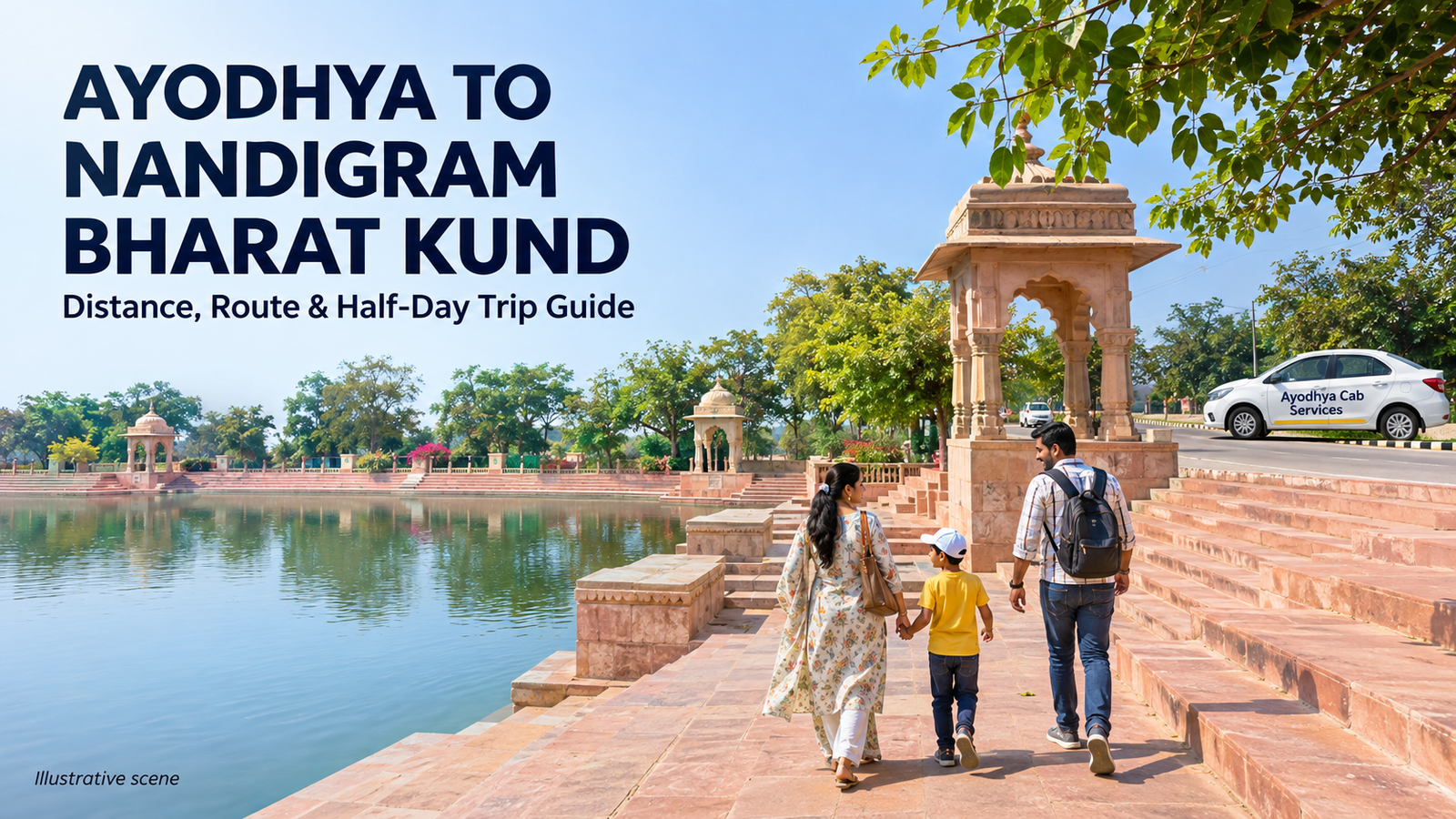
An illustrated look at a half-day trip from Ayodhya to Bharat Kund Sarovar in Nandigram.
Ayodhya to Nandigram Bharat Kund distance: Which starting point should you use?
The phrase “from Ayodhya” is useful when comparing destinations. It is less useful when deciding what time to leave. A visitor staying near Ram Mandir, a passenger arriving at Ayodhya Cantt and a family starting in Sahadatganj are all leaving from Ayodhya, but they may have different routes to the same pond.
The 15 km figure is useful because the development authority gives a specific starting landmark: Sahadatganj Hanumangadi Chauraha. It should not be reused as the exact distance from Ram Mandir or Ayodhya Dham Junction. Likewise, IRCTC’s about 20 km is a general description of Nandigram’s location, not a door-to-door measurement for every visitor. tenderfile.ayodhyada.in
Use the starting point that matches your journey:
| If you are starting from… | Use this as your map origin |
|---|---|
| Ram Mandir area | The point where you can actually meet your vehicle after leaving the temple area |
| A hotel or guesthouse | The property’s vehicle entrance, or the nearby landmark where you have agreed to meet |
| Ayodhya Cantt (AYC) | Ayodhya Cantt Railway Station, then refine the origin to your actual exit or pickup point |
| Ayodhya Dham Junction (AY) | Ayodhya Dham Junction Railway Station, not Ayodhya Cantt |
| Sahadatganj | Your own pickup pin, using the authority’s 15 km figure only as a reference |
Ayodhya Cantt and Ayodhya Dham are separate stations. If you are arriving at one and leaving from the other, check both tickets before saving the route. You may need directions from the arrival station to Bharat Kund and from Bharat Kund to a different departure station. India
The return leg may be a different journey
A family staying near Ram Mandir might start the day from its hotel, visit Bharat Kund and finish at Ayodhya Cantt for an evening train. In that case, doubling the outward driving estimate will give the wrong answer. Look up each leg on its own.
The same applies if your luggage is still at the hotel. Your real return route is Bharat Kund → hotel to collect bags → departure station. Put the luggage stop on the map before deciding how long you can spend at the kund. If you overlook it, a comfortable outing on paper can turn into a rushed departure.
How to reach Bharat Kund from Ayodhya by road
The Nandigram Bharat Kund Aarti Seva Trust identifies the Faizabad–Sultanpur stretch of NH 330 as a nearby road corridor. Think of that as a useful orientation point. Your navigation app may suggest a different city approach depending on your pickup point and road conditions. nandigramaarti.org.in
For the final approach, search for “Bharat Kund Sarovar, Nandigram, Ayodhya” rather than only “Nandigram.” Open the result and check that it points to the sarovar, or pond, if that is where you want to begin. A search for “Bharat Kund” can also lead you to Bharat Kund Railway Station, which the local trust lists separately from the pilgrimage stops. A pin for the station does not take you to the pond entrance. nandigramaarti.org.in
You can start with this Google Maps search for Bharat Kund Sarovar, Nandigram. Check the result before sharing it, then add your own starting point for directions.
Agree on a drop-off and a return meeting point
Ask where the vehicle can leave you for the sarovar, and save that spot before you walk away. The return meeting point can be the same place if stopping there is practical. If it needs to be somewhere else, agree on a landmark that someone seeing it for the first time can recognise.
For example, “meet at the pond” leaves room for confusion if the driver is waiting on one side and your group walks out on another. A shared map pin and the name of a visible shop, gate or other landmark are more useful together than either one alone.
If someone in the group has difficulty with steps or uneven ground, ask specifically about the walk from the drop-off to the pond and the temple. A road pin tells you where the drive ends; it does not confirm the condition of the pedestrian approach.
What is the difference between Nandigram and Bharat Kund?
Nandigram is the place; Bharat Kund is the sacred pond associated with it. You may also see the pond referred to as Bharat Sarovar. The local trust lists the Bharat–Hanuman Milap Mandir as another stop in Nandigram. This matters when making your plan: the pin you use for the pond is not automatically the best pin for a temple-first visit. A pilgrimage to Ayodhya
Nandigram is associated with Bharat in the Ramayana tradition. According to the account outlined by IRCTC, Bharat stayed there during Shri Ram’s exile and governed in his brother’s name, with Ram’s padukas, or sandals, representing him. The local trust associates the Milap Mandir with the meeting between Bharat and Hanuman. These traditions explain why visitors often plan time for both the pond and the temple. irctctourism.com
A first visit need not include every site in the surrounding area. Start with what brought you there. If you want to see the kund and understand its association with Bharat, give those two stops your time. If your family has arranged a ritual, make that the priority and treat the temple visit as an addition only if the schedule allows.
A practical half-day plan for Nandigram Bharat Kund
Start by setting one return deadline. It might be hotel checkout, a train, a meal with family or the next fixed stop. Then subtract the time you need to get there from Nandigram. This tells you when you should leave the kund area and how much time you have for the visit itself.
| Stage | What to plan |
|---|---|
| Leave Ayodhya | Check the road estimate from your confirmed pickup point before you start |
| Arrive at Nandigram | Find the sarovar approach and agree where you will meet for the return |
| Visit the main stops | Plan the pond and Bharat–Hanuman Milap Mandir; change the order if your reason for visiting calls for it |
| Leave Nandigram | Depart by the time you worked out, especially if there is a train or flight later |
| Complete the return | Allow for luggage collection, check-in or the walk from the station entrance to your platform, as applicable |
Example: Fitting the trip into a four-hour window
Suppose you have four hours free between leaving your hotel and needing to be back. If your map estimates 45 minutes each way, set aside 90 minutes for the two drives. Suppose you allow another 30 minutes for pickup, short waits and walking to and from the vehicle. That leaves two hours for the visit and any spare time you want to keep.
Those are illustrative figures, not verified driving times. The point is to check the arithmetic before adding a third stop. If the return drive gets longer, the sensible adjustment may be to skip the extra stop rather than spend the time reserved for getting back.
If you are combining Bharat Kund with Ram Mandir
Pick which visit will determine the schedule. If Ram Mandir darshan is your priority, wait until that part of the day is complete before deciding whether the remaining time is enough for Nandigram. If Bharat Kund is the main reason for the outing, reserve its travel window first and place city sightseeing around it.
A useful decision rule is to check the round-trip route when you are ready to leave, rather than using the estimate you looked up earlier in the day. If you have been delayed, recalculate with the time you actually have. An itinerary that worked before lunch may no longer work by late afternoon.
If aarti is the main reason you are going
Confirm the time for your date with the Nandigram Bharat Kund Aarti Seva Trust. The trust’s site refers to a daily aarti but shows inconsistent time information. A visitor planning around that event should verify it directly rather than relying on a fixed time copied into an itinerary. Also decide how you will return afterward, especially if you have another commitment that evening
How to travel from Ayodhya to Nandigram Bharat Kund and back
Choose your transport by working out how you will return from Nandigram. Getting a ride from Ayodhya is only half the decision. If you want to stay for aarti, have a family ritual planned or need to reach a railway station afterward, decide whether your vehicle will wait, return at an agreed time or be replaced by another ride you have already arranged.
For a half-day visit, compare the full journey, including waiting, any walk from the drop-off and the trip to wherever you need to be next.
| Transport option | When it may suit you | What to confirm |
|---|---|---|
| Private car or taxi | Your group wants to travel together, has several bags or needs a defined return time | Whether the quote covers both legs, how much waiting is included and where the return ends |
| Direct auto | You are travelling light and can confirm a ride for the required legs | Whether the ride is private or shared, where it drops you and whether the driver will wait or return |
| Shared transport | Your schedule is flexible and you have confirmed the route and return option | Boarding point, where to get off, the final walk and how to get back |
| Train with a local connection | You have found a suitable service for your date and confirmed how to get from the station to the sarovar | The specific train’s stop, the last leg to the site and the return plan |
The local trust lists Bharat Kund Railway Station near Nandigram. That identifies a railway station to look up; it does not establish that a suitable train stops there when you need it. If you are starting in Ayodhya and have only half a day, compare the entire rail option—including both station waits and the local connection—with a direct road journey. nandigramaarti.org.in
When to choose a round trip with waiting
A round trip with waiting is useful when the end of your visit is difficult to predict. You might spend longer than expected at the sarovar, take more time walking with family, or need to wait for a planned activity. Keeping the same vehicle means you can agree on the departure when you are ready, within the waiting terms you booked.
Ask when the waiting period starts. Does it begin at drop-off? Does it cover the temple visit as well as time at the pond? If the driver needs to park elsewhere, how much notice should you give before you want to leave?
You may not need a waiting vehicle if your group has a predictable schedule and a confirmed return pickup. In that case, choose a meeting time and a landmark before you leave the first vehicle. Make sure at least two people in the group have those details.
When a one-way ride is enough
A one-way arrangement can make sense if a relative is meeting you in Nandigram or you already have a confirmed onward vehicle. It is a weaker plan when the entire return depends on finding transport after you finish, especially if you are working around an evening departure or a train.
Think through this before accepting a one-way ride: If the next vehicle does not arrive when expected, where will we wait, who will we contact and how late can we afford to leave? A workable answer matters more than a low outward fare.
What to ask before agreeing to a fare
Ask for a quote for your actual itinerary. “Ayodhya to Bharat Kund” could mean a drop at the sarovar, a return to the original pickup point or a trip that ends at Ayodhya Cantt after a hotel stop. Those are different jobs.
Use a message like this:
Pickup: [hotel entrance or landmark in Ayodhya].
Destination: Bharat Kund Sarovar, Nandigram.
Passengers: [number]. Bags or mobility equipment: [details].
Plan: Visit the sarovar and Bharat–Hanuman Milap Mandir, then return to [exact address or station].
Please confirm the total fare, included waiting time, any extra charges and where we can meet for the return.
If you are comparing two quotes, first check that both include the same pickup, stops, waiting and final drop-off. A lower quote for an outward drop is not directly comparable with a quote that covers both directions. Ask how extra waiting is charged and whether any parking charge is included or paid separately, if applicable.
If your return is to a railway station
Give the full station name and code when requesting the quote. Ayodhya Cantt (AYC) and Ayodhya Dham Junction (AY) are separate stations. “Drop us at Ayodhya station” leaves an important part of your itinerary open to interpretation. ayodhya.nic.in
If you also need to collect bags at a hotel, put that stop in the quote. More importantly, put it in your return deadline. You need time to reach the hotel, collect the bags and continue to the station—not just time to drive from Bharat Kund to Ayodhya.
What to do at Nandigram Bharat Kund
For a first visit, start with the sarovar and the Bharat–Hanuman Milap Mandir. The local trust lists both as places to visit in Nandigram. Its account associates the mandir with Hanuman bringing Bharat news of Shri Ram’s return. If you are travelling with children, that gives them a simple way to understand why the temple belongs in the same visit as the pond. nandigramaarti.org.in
If the sarovar is your main stop
Set the sarovar as your first drop-off. Once there, take a moment to identify the pedestrian approach and a clear place for the group to meet afterward. If you plan to visit the temple next, check how to reach it from where you are standing. Do not assume the vehicle needs to move just because the map shows two separate pins.
Some visitors may want to spend time by the water while others prefer to go straight to the temple. If the group splits briefly, agree on a meeting time and place on land where everyone can find it. That is especially helpful if the person coordinating the return ride goes ahead.
If temple darshan is your main stop
Check the Bharat–Hanuman Milap Mandir pin separately and ask whether the approach works for everyone in your group. Plan the sarovar as a second stop if you have time and the walking route is suitable.
Use the full temple name when asking for directions. IRCTC’s Ramayana itinerary also mentions a Ram Bharat Milap temple, while the local trust identifies the Bharat–Hanuman Milap Mandir. If one specific temple matters to your visit, confirm the name or show the pin rather than asking only for “Milap Mandir.” www.irctctourism.com
Planning a family ritual at Bharat Kund
Bharat Kund is associated with pind daan in local tradition, and the Ayodhya Dham pilgrimage portal notes that devotees visit for it during Pitru Paksha. If a family ritual is your reason for going, give it a separate plan from an ordinary sightseeing visit. The family’s arrangements determine when you should arrive, what you should bring and how long you may need to stay. ayodhya-dham.in
Before leaving Ayodhya, confirm the following with the person guiding your family’s arrangements:
- Where to meet: Ask for a specific place at or near the sarovar rather than a general instruction to reach Nandigram.
- When to arrive: Check whether you need to reach before an agreed time and whom to contact if you are delayed.
- What to bring: Ask which items you are expected to carry and what has already been arranged.
- Who needs to be present: Confirm this so everyone who needs to attend travels together.
- How much time to set aside: Use the estimate for your own arrangements, especially before committing to a fixed pickup or onward train.
Different families may follow different arrangements. If you are unsure what applies to yours, ask the person guiding the ritual. A travel itinerary can help with the journey, but it cannot tell you which steps your family should follow.
If only some family members are taking part
Agree in advance on where the others will wait and when the group will regroup. Someone travelling with a small child or a relative who tires easily may prefer a shorter walk while the rest of the family stays at the site. Confirm where they can comfortably wait rather than assuming seating or shelter will be available at a particular spot.
Set the return meeting time after allowing for the ritual and the walk back. If the visit takes longer than expected, drop an optional sightseeing stop before cutting into the time needed to get back to Ayodhya.
How to plan around Bharat Sarovar aarti
If Bharat Sarovar aarti is the reason for your trip, build the outing around the confirmed time for your date. The trust’s website refers to daily aarti but gives inconsistent time information, so check directly with the Nandigram Bharat Kund Aarti Seva Trust before fixing your departure from Ayodhya. nandigramaarti.org.in
Plan backwards from when you want to be at the sarovar, allowing for the drive and the walk after drop-off. For the return, decide whether your ride will wait until you are ready or meet you at a fixed time. If aarti is optional and you have a train to catch, agree on the latest time you can leave Nandigram before deciding whether to stay.
For example, a couple spending the night in Ayodhya may be able to allow extra time after aarti. A family with a station departure has a firmer deadline. Both can use the same outward route, but they should not use the same return plan.
Visiting with children, older relatives or someone who needs a shorter walk
Ask about the distance from the drop-off to the part of the site you want to visit. “Near Bharat Kund” does not tell you whether there are steps, how long the walk is or whether someone using a wheelchair can reach the intended spot. Confirm the route locally if that detail affects whether a family member can participate.
- For children: Keep the visit simple. Choose the pond or the temple as the first stop, then decide whether there is enough energy and time for the second. Keep children close near the water and follow any instructions on site.
- For anyone who cannot manage steps: Ask whether there is a suitable approach or viewing spot. Decide before the visit whether reaching the water’s edge is necessary for your plans.
- For a group with different walking speeds: Agree on a meeting landmark and a latest return time. Let the slower group choose its own pace rather than asking everyone to keep up with the fastest person.
- For visitors carrying ritual items: Confirm what needs to come out of the vehicle at the first stop. Keep those items separate from bags that can remain with you in the vehicle, if the arrangement allows it.
A manageable visit might mean one short walk, time at the sarovar and a direct return. There is no need to add a stop just because it appears close on a map.
A practical plan for three kinds of visitors
| Your reason for going | Make this the priority | Keep this flexible |
|---|---|---|
| A first look at Nandigram | A visit to the sarovar and, if practical, the Bharat–Hanuman Milap Mandir | Which stop you see first and whether you add anything else |
| A family ritual | The confirmed meeting place, timing and arrangements | Temple visits, meal stops and other sightseeing afterward |
| Bharat Sarovar aarti | The confirmed aarti time and your ride back | How early you arrive and whether you visit the temple beforehand |
What can you visit on the same day as Nandigram Bharat Kund?
If you are making a half-day trip from Ayodhya to Nandigram Bharat Kund, start with the sarovar and Bharat–Hanuman Milap Mandir. Add one stop in Ayodhya only if it fits the rest of your day. The most useful extra stop is the one that works with where you need to finish, whether that is your hotel, a railway station or another place you have arranged to visit. nandigramaarti.org.in
| What you want from the day | A practical combination | What to check |
|---|---|---|
| A short outing with family | Bharat Kund Sarovar and Bharat–Hanuman Milap Mandir | Whether the walk between your drop-off and the two stops suits everyone |
| A temple-focused day | Ram Mandir or Kanak Bhawan in Ayodhya, plus Nandigram in a separate time block | The time you actually have after darshan, the walk to your pickup and the return journey |
| A visit followed by time by the Saryu | Nandigram first, then Ram Ki Paidi or Guptar Ghat if time allows | Which ghat fits your onward route and where you can be picked up afterward |
| A family ritual or aarti | Keep Bharat Kund as the main visit | The confirmed time, meeting point and transport after the visit |
| An onward train later that day | Nandigram, followed by the correct departure station | Whether you must collect luggage first and what time you need to leave Nandigram |
Kanak Bhawan is near Ram Janmabhoomi in Ramkot. The district administration describes Ram Ki Paidi as a series of ghats on the Saryu and lists Guptar Ghat as a separate place to visit. Save the individual destination pins. An instruction such as “drop us at Saryu Ghat” may be too broad if you have a particular location in mind. India
If you want to visit Ram Mandir and Bharat Kund on the same day
Give each visit its own time block. A plan such as “Ram Mandir first, Bharat Kund once we are back at the pickup point” works better than setting the second departure based on when you hope darshan will end. The time between leaving the temple and reaching your vehicle belongs in the plan.
If you are arriving by train and want to start with darshan, use the railway station to Ram Mandir guide to orient yourself. Check that the guide’s starting station matches your ticket before using its route. For the Nandigram leg, use the point where you can actually meet your vehicle. ayodhyacabservice.in
If both places are important to your group, keep the evening open where possible. If you have a fixed departure, choose which visit you would keep if the day starts late. Make that decision before travelling; it is harder to agree on what to drop when everyone is already in the vehicle.
If you want to add a ghat after Nandigram
Choose the ghat based on what you want to do there and where you are going afterward. If your next stop is a hotel or railway station, compare Bharat Kund → ghat → final destination against the direct route. A stop that adds little driving can still take a while if you need to walk from the drop-off and arrange another pickup.
An Ayodhya sightseeing plan can help you choose other places for your stay. Keep Nandigram separate when estimating local sightseeing time. A list of places near the city’s temples does not tell you whether the drive out to Bharat Kund and back fits the same outing. ayodhyacabservice.in
If you are landing in Ayodhya that day
Decide whether you can go straight to Nandigram with your luggage or whether it makes more sense to check in first. If you are also visiting Ram Mandir, the Ayodhya Airport to Ram Mandir guide covers that separate leg. Use live directions from your actual pickup point for the Bharat Kund trip; a route to Ram Mandir does not estimate the journey to Nandigram. Best Taxi from Lucknow to Ayodhya
For an arrival-day visit, use the time you leave the airport, rather than the scheduled landing time, to decide what fits. A delayed arrival or a long hotel stop can change the day enough that Nandigram makes more sense the following morning.
How to fit Bharat Kund around an onward train
If you have a train after the visit, start with the time you want to be on the platform. Work backwards from there. First allow for getting through the station, then the drive from Nandigram, any luggage collection and time for the unexpected. The result is your latest practical departure from Bharat Kund.
A worked example: Evening train from Ayodhya Cantt
Suppose your train is at 7:00 pm and you want to be on the platform by 6:30 pm. For this example, assume:
- 15 minutes from the station drop-off to the platform.
- 50 minutes of driving in total, including both legs if you must go via the hotel.
- 20 minutes to collect your bags and load the vehicle.
- 20 minutes of extra margin for pickup delays or slower traffic.
Those allowances total 1 hour 45 minutes, so you would plan to leave Nandigram by 4:45 pm. If you want to spend 75 minutes at the sarovar and temple, aim to reach your first stop by 3:30 pm. Then check the outward driving estimate and decide when to leave Ayodhya.
The figures are illustrative, not standard driving or station times. The calculation makes it easy to see what happens if your hotel is out of the way or if you have to leave the pond earlier than expected. If aarti is your priority and its confirmed time conflicts with your departure deadline, choose another day for the visit or revisit your onward plans.
When to cut an optional stop
If you leave Ayodhya later than planned, check the updated arrival time at Nandigram before adding anything back into the itinerary. Keep the stop that matters most to your group. For a family visiting for a ritual, that may mean skipping the temple afterward. For a first-time visitor interested in Nandigram itself, it may mean visiting the sarovar and leaving the city ghat for another day.
Avoid borrowing time from the platform walk to squeeze in one more stop. The walk is still there when you reach the station, and you may have less information about it than you do about the drive.
What to do when the route or visit changes
The map takes you to the wrong Bharat Kund pin
Stop and check whether the selected place is Bharat Kund Railway Station, Bharat Kund Sarovar or a temple. These names describe different destinations. If you want to begin at the pond, switch to the sarovar pin and ask for the approach to the pond rather than directions to “Bharat Kund” alone. If you are meeting someone for a ritual, use the pin they confirm. nandigramaarti.org.in
The group wants different things from the visit
Agree on a common return time. If some people want a longer temple visit and others prefer a shorter walk, choose a shared meeting point that both groups can reach. Let the person who has the driver’s number handle changes to the pickup. Multiple people sending different locations can turn a simple return into a search for the right vehicle.
Your return pickup changes after you arrive
Ask for the replacement landmark and confirm that everyone can reach it. If you are travelling with someone who needs a shorter walk, discuss that before agreeing to a pickup farther away. A slightly later vehicle at an accessible meeting point may work better for the group than one that arrives sooner but requires a difficult walk.
Frequently asked questions
Can I use 15 km as the distance from Ram Mandir to Bharat Kund?
Use it only as a general reference. The Ayodhya Development Authority’s 15 km figure starts at Sahadatganj Hanumangadi Chauraha, not Ram Mandir. For a temple-side departure, enter the actual place where you will get into the vehicle and choose Bharat Kund Sarovar as the destination. tenderfile.ayodhyada.in
Should I visit the sarovar first or the Bharat–Hanuman Milap Mandir?
Start at the sarovar if seeing Bharat Kund is your main reason for going. Start at the mandir if darshan is the priority or you have agreed to meet someone there. The local trust lists both places; it is worth confirming the approach to the one you want rather than assuming both map pins use the same entrance. nandigramaarti.org.in
Do I need to go to Ayodhya Dham Junction before leaving for Bharat Kund?
No. If your train arrives at Ayodhya Cantt and you are continuing by road, check the direct route from that station to Nandigram. There is no reason to transfer to Ayodhya Dham Junction unless your itinerary has a separate purpose for going there. The district administration lists the two as separate stations. ayodhya.nic.in
Can I plan the return from Nandigram to a different station than the one I arrived at?
Yes. Set your return destination to the station on your onward ticket, even if you started from another station or a hotel. Confirm the station name and code when arranging transport. If you are collecting bags on the way, add that stop separately when checking the route. nr.indianrailways.gov.in
Before you leave Ayodhya
For the Ayodhya to Nandigram Bharat Kund trip, use 15–20 km as a broad one-way reference and check the road distance from your real pickup point. Save the sarovar and temple pins separately. Then decide where you need to finish the outing and when you must leave Nandigram to get there. If your visit centres on aarti or a family ritual, confirm those arrangements first. A half-day plan is most useful when it includes the return and leaves room for the reason you came.
Why Choose Ayodhya Cab Services for Your Bharat Kund Trip?
Looking for the best cab service in Ayodhya for a Bharat Kund trip? Before booking, ask whether the fare covers the return journey, how much waiting time is included, and where you’ll meet your driver after visiting the sarovar. Those details matter if you’re travelling with family, attending aarti or catching a train later that day.
With Ayodhya Cab Services, you can request a round-trip taxi from Ayodhya to Bharat Kund or ask about a Lucknow to Nandigram Bharat Kund cab. Tell us whether you want to visit Bharat Kund Sarovar, stop at Bharat–Hanuman Milap Mandir or finish at Ayodhya Cantt. We can confirm vehicle availability, the fare and waiting terms for your itinerary before you book.
For a longer journey, our pickup locations are Ayodhya, Lucknow and Varanasi. If you need an outstation cab from Ayodhya to another city in India, share your destination and travel date so we can confirm whether we cover that route.
Request a quote from Ayodhya Cab Services — include your pickup point, travel date, passenger count and preferred return drop-off.https://ayodhyacabservice.in/

