
Prayagraj Junction to Triveni Sangam: Distance, Route & Travel Guide
The journey from Prayagraj Junction to Triveni Sangam is a local transfer within Prayagraj. One published local guide gives approximately 7–9 km, depending on the riverfront entry selected. Treat that as a preliminary estimate: the distance to your permitted vehicle drop-off can differ from the distance to a map pin labelled “Triveni Sangam”. Check the actual route before travelling. Prayagraj Portal
The most important distinction is between reaching the riverbank and visiting the confluence. A road journey brings you to an accessible shore-side approach; any boat trip is a separate arrangement.
Prayagraj’s district administration describes Sangam as the meeting of the Ganga and Yamuna, with the unseen Saraswati forming part of the religious tradition. prayagraj.nic.in
For a first visit, confirm three things before leaving the station: where you will be collected, where the vehicle will stop and what you want to do after reaching the riverfront.
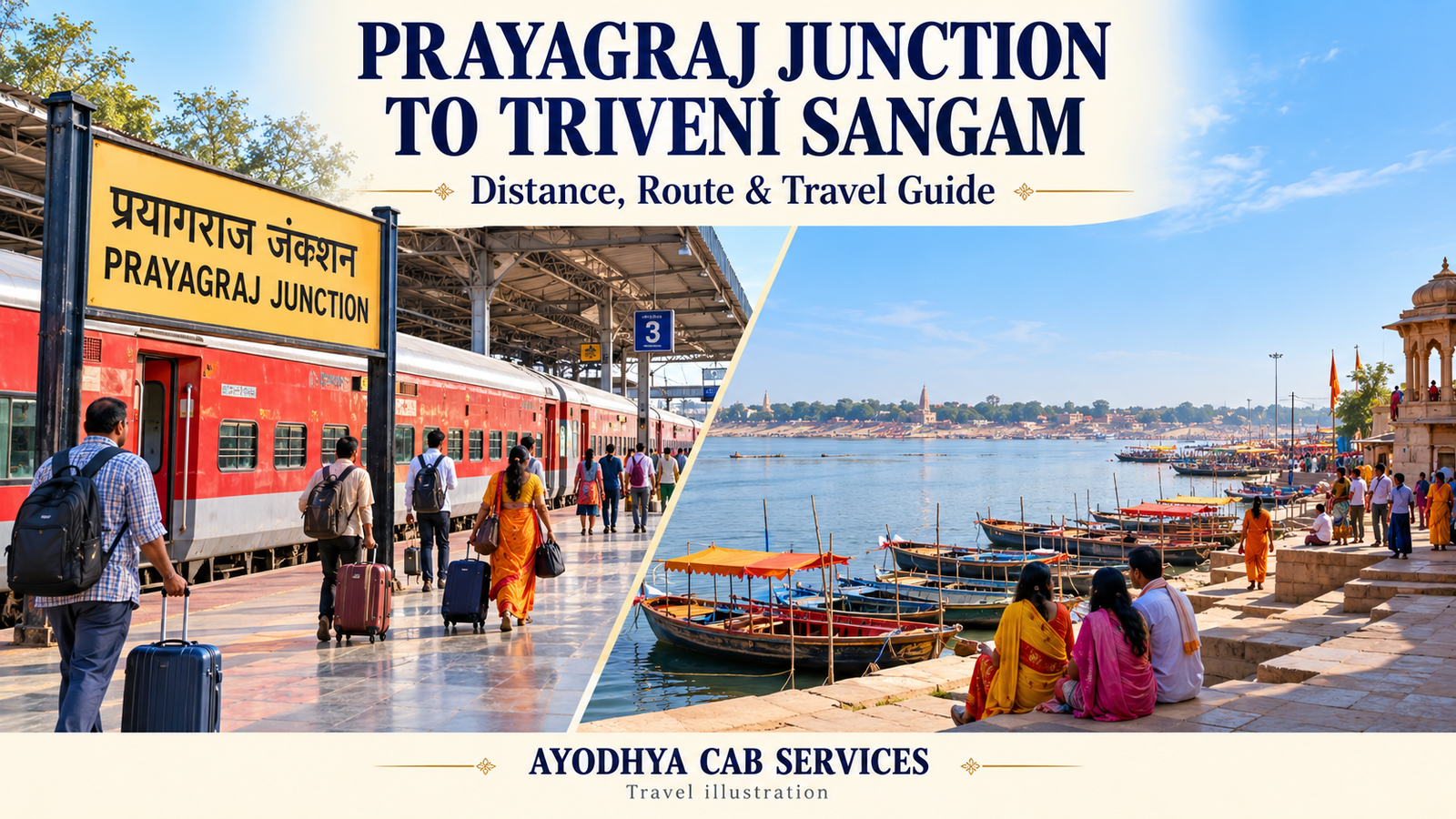
From railway arrival to the Sangam riverfront—plan your transfer, visit and return journey.
Prayagraj Junction to Triveni Sangam: Quick Planning Overview
| Planning question | Practical answer |
|---|---|
| Which station does this guide cover? | Prayagraj Junction, station code PRYJ |
| What distance should I use initially? | Approximately 7–9 km from a published local guide; verify your selected approach |
| Is that an exact live road measurement? | No |
| Can a vehicle reach the confluence itself? | A road vehicle takes you to a shore-side approach, not the meeting point in the river |
| Is a boat included in a station transfer? | Do not assume so; it is a separate arrangement |
| What determines the route? | Station exit, selected riverfront approach and current access conditions |
| What should I do with suitcases? | Confirm storage or accommodation arrangements before sightseeing |
| How should I estimate time? | Separate station exit, pickup, road travel, walking and any river activity |
| What if I have a return train? | Plan backwards from the required station arrival time |
Indian Railways identifies Prayagraj Junction as PRYJ. Check that code against your ticket before applying this guide to your journey. indianrailways.gov.in
The table gives a planning framework. It does not confirm a current traffic route, transport fare or boat service.
First Confirm That Your Train Arrives at Prayagraj Junction
A city name in a travel plan is not always enough to identify the station.
Read the arrival station on your ticket and check the code. If it says something other than PRYJ, use directions from that actual station.
Do the same for your onward journey. The arrival and departure stations should not be assumed identical.
Share the station name before arranging pickup
Send the person collecting you:
- The full station name.
- Station code.
- Train number.
- Expected arrival time.
- Passenger count.
- Number of bags.
Once you know your exit, share the pickup point.
Avoid sending only “Prayagraj station”. A precise message reduces the risk of someone waiting at a different location.
Agree on the exit before leaving the platform area
Station buildings and approaches can cover a substantial area. A driver’s pickup location may not match the exit closest to your coach.
Ask:
“Which exit should we use, and what landmark should we look for?”
Follow station signs and staff instructions. If you have heavy bags or a mobility requirement, mention that before agreeing to a distant meeting point.
There is no need to walk between unfamiliar exits simply because a ride has been booked.
Check the Destination Pin Carefully
“Triveni Sangam” is not a sufficiently precise destination unless you also inspect its location.
During research for this guide, a major journey planner returned a route to a place called Triveni Sangam in Maharashtra, producing a journey of hundreds of kilometres. That result does not describe the local Prayagraj trip. 9 ways to travel via train
This is a useful reminder: a familiar destination name can still lead to the wrong pin.
Verify the city and the final approach
Before starting navigation:
- Enter the full destination, including Prayagraj, Uttar Pradesh.
- Check that the map remains within the intended city.
- Inspect whether the pin lies on the riverbank or in the water.
- Ask which shore-side approach the vehicle can use.
- Confirm the remaining walk.
- Recheck the route for your actual station pickup point.
If a result sends you to another state, discard it rather than trying to interpret it as a local detour.
Choose the endpoint according to your visit
Your preferred destination depends on what you intend to do.
A traveller wanting a shore-side view needs a different arrangement from someone planning a boat visit. A person attending a religious ceremony may have a meeting point provided by the organiser.
Use that requirement to select the endpoint.
A general attraction pin should not override a specific, confirmed meeting location.
Why the Distance Changes Between Listings
A riverfront destination does not behave like a building with one permanent entrance.
Published figures can differ because they use different:
- Station points.
- Riverbank approaches.
- Vehicle drop-offs.
- Travel modes.
- Route assumptions.
Some listings also contain location-matching errors, as the Maharashtra example demonstrates.
For this reason, the preliminary 7–9 km figure should help you recognise the scale of the local journey. It should not be presented as an exact distance to every Sangam activity.
Ask what the quoted distance measures
When someone gives you a distance, ask:
“Is that to the vehicle drop-off, the walking approach or a map point at the confluence?”
That question helps resolve apparent contradictions.
For instance, a longer road journey might reach a suitable drop-off, while a shorter line on the map points somewhere a vehicle cannot go.
The useful figure is the one connected to your actual journey.
Do not combine unrelated estimates
Avoid taking a distance from one route and a travel time from another.
Similarly, do not combine a direct-driving estimate with an itinerary that includes a hotel stop.
Use one confirmed set of endpoints for each journey you are comparing.
If the plan changes, update the estimate.
Reaching the Riverbank Is Different From Reaching the Confluence
The road transfer and the river visit should be planned separately.
A practical sequence is:
Railway station → vehicle drop-off → riverfront approach → chosen activity → return meeting point
The activity could be observing the riverfront, meeting someone for a ceremony or considering a boat trip under the arrangements operating that day.
Each option affects the time and preparation needed.
Explain your intention before discussing transport
Tell the person arranging the journey whether you want:
- A riverfront visit.
- A boat boarding approach.
- A meeting point for a pre-arranged ceremony.
- A short visit before an onward train.
- A relaxed visit with family.
This makes the drop-off discussion more useful.
“Take us to Sangam” leaves several practical details unresolved.
Keep the return meeting point specific
After walking towards the riverfront, it can become harder to describe where you started.
Save the drop-off location and agree on a return point before the vehicle leaves.
If the return pickup will be elsewhere, confirm that location separately. Do not assume you will naturally emerge at the same place.
How to Plan the Road Route
This guide does not prescribe one permanently fastest street-by-street route.
Your driver or navigation service should check the journey from the agreed station exit to the confirmed riverfront approach. Current restrictions and permitted access matter more than a copied sequence of road names.
Before departure, confirm:
- The actual origin.
- The intended shore-side destination.
- Whether any intermediate stop is included.
- The permitted drop-off.
- The expected remaining walk.
- How the return will be arranged.
Ask about access when the visit coincides with an organised event
Do not assume that an ordinary-day route remains available during a major gathering.
Look for date-specific instructions from the administration or police, and ask whether the drop-off has changed.
An old festival map is not current access information.
If a person recommends a diversion, clarify where it ends and what the group must do next.
Avoid promising doorstep access
At a riverfront attraction, the final walking section can be more important to some travellers than the road distance.
If a family member cannot comfortably walk far, ask for details before choosing the approach.
A general assurance such as “the vehicle goes very close” is difficult to use. Ask for an approximate walking distance and the nature of the route, while recognising that conditions may change.
Estimate Arrival-to-Riverfront Time in Stages
A navigation estimate is only part of the schedule.
Separate:
- Leaving the train.
- Reaching the correct exit.
- Finding the vehicle.
- Travelling by road.
- Walking from the drop-off.
- Arranging any activity.
This makes it easier to see where a tight plan could fail.
Use a worksheet rather than a fixed promise
Fill in the following after checking your circumstances:
| Stage | Your allowance |
|---|---|
| Platform to agreed exit | ___ minutes |
| Pickup and boarding | ___ minutes |
| Current road estimate | ___ minutes |
| Drop-off to intended riverfront point | ___ minutes |
| Additional margin | ___ minutes |
| Total before the activity begins | ___ minutes |
No universal total is given here because the relevant endpoints and access conditions have not been live-verified.
For a family carrying luggage, a short pickup delay can matter as much as the drive.
Recalculate after a delayed arrival
If the train arrives late, review the whole visit.
A plan that initially included a riverfront stop, a boat trip and a meal may need to become a shorter shore-side visit.
Decide before making new commitments.
Protect an onward train or another fixed booking rather than attempting to preserve every optional activity.
Compare Local Transport Options
Choose transport according to the group’s needs and the actual destination.
| Option | What to assess |
|---|---|
| Auto-rickshaw | Seating, bags, total fare and final drop-off |
| E-rickshaw | Availability, agreed route, capacity and any required change |
| App-booked or locally arranged car | Pickup point, luggage space and complete fare |
| City bus | Current route, boarding stop, destination stop and final walk |
| Walking | Verified pedestrian route, conditions, luggage and energy required for the visit |
This comparison does not confirm that every option is available from your exit at your arrival time.
Auto-rickshaw: agree on the full journey
Explain any intermediate stop before asking for a price.
A direct transfer and a journey via a hotel are different requests.
Confirm whether the quote is:
- For the whole vehicle.
- For all passengers.
- For the complete route.
- Inclusive of waiting, if requested.
- One-way or return.
No verified current local fare is quoted in this guide.
E-rickshaw: confirm where the ride ends
An affordable ride can become inconvenient if its endpoint differs from the one you expected.
Ask whether the driver will reach the agreed approach or whether another vehicle is required.
Mention suitcases and group size before boarding.
Do not assume that every vehicle can carry the same passengers and luggage comfortably.
Car: check capacity and pickup instructions
A car may suit a group with luggage, but confirm the actual seating and bag requirement.
Share the number of large and small bags.
If you need a return journey, agree on whether the vehicle waits or whether a separate booking is required. Clarify the waiting terms rather than assuming they are included.
Bus: verify the current connection
A bus option needs a confirmed boarding stop, direction and destination stop.
Ask about the walk after getting down. A service that passes somewhere near the wider riverfront area may still leave a substantial final approach.
A current direct station-to-Sangam bus, timetable and fare have not been verified for this article.
Do not turn an old route mention into a present-day service promise.
Decide What to Do With Luggage Before Leaving the Station
Large luggage can complicate a riverfront visit.
Before starting, choose between:
- A confirmed accommodation bag drop.
- A verified storage arrangement.
- Carrying only manageable belongings.
- Postponing sightseeing until after check-in.
The sources checked for this part do not establish a current Sangam luggage-storage facility.
Accommodation first can be the simpler choice
A hotel stop adds a journey, but it may reduce the effort of carrying bags throughout the visit.
Ask whether the accommodation accepts luggage before room check-in.
If you need a room immediately, confirm that separately. Bag acceptance does not establish early room availability.
Do not treat a vehicle as automatic storage
If you intend to leave bags in a vehicle, discuss the arrangement explicitly.
Confirm whether the vehicle remains with the booking and who retains access. Keep essential documents, valuables and medicines with you.
If the arrangement is unclear, resolve it before leaving the bags.
Walking From the Station Requires Its Own Assessment
At an illustrative pace of 4 km per hour, an 8 km walk takes two hours without stops.
That is arithmetic, not a verified pedestrian route or a recommendation.
You would still have the riverfront visit and return journey ahead of you.
Consider:
- Suitable crossings and walking connections.
- Weather.
- Bags.
- Footwear.
- The group’s walking capacity.
- Any final approach at the riverfront.
For many railway arrivals, local transport can preserve energy for the main visit.
A traveller who deliberately wants to walk should inspect a pedestrian route rather than following driving directions on foot.
Make the First Decision Before Reaching Sangam
Before leaving the station, everyone in the group should understand the basic plan.
Agree on:
- The destination approach.
- The luggage arrangement.
- Whether a boat trip is being considered.
- The time available.
- The next fixed commitment.
- Who will coordinate the return.
This short conversation prevents a road transfer from turning into an unplanned series of decisions at the riverbank.
Plan What You Want to Do After Reaching Sangam
Your Prayagraj Junction to Triveni Sangam journey becomes easier to organise when you decide what the visit should include.
A shore-side visit, a boat journey and a pre-arranged religious ceremony involve different amounts of time, movement and preparation.
Choose your main purpose before adding other activities.
| Your priority | What to arrange first |
|---|---|
| See the riverfront | A suitable approach and return meeting point |
| Consider a boat visit | Current operating conditions, boarding arrangements and complete price |
| Attend a ceremony | A verified meeting point, service details and expected duration |
| Travel with family | Luggage, mobility requirements, breaks and group coordination |
| Return for a train | A latest departure time from the riverfront |
There is no need to include every possible activity in one visit.
If the train journey has been tiring, a shorter riverfront visit may suit the group better than a tightly packed itinerary.
Understand Sangam’s Religious Significance
The Prayagraj district administration’s Sangam information describes the confluence of the Ganga and Yamuna, with Saraswati understood within religious tradition as an unseen river. Its description also explains Sangam’s importance as a pilgrimage destination. India
Keep that distinction clear when discussing what visitors will see.
The religious meaning of Triveni Sangam is not a promise that three separately visible rivers can be photographed from a particular spot.
For more background, a guide to Triveni Sangam Prayagraj rivers can explain the subject separately from the station-transfer instructions.
Let the purpose determine the pace
A person visiting for prayer may want quiet time. Someone interested in the landscape may prefer observing the riverfront. Another traveller may have a specific ceremony to attend.
Discuss these expectations within the group.
A disagreement about how long to stay is easier to resolve before reaching the riverbank than after some people have committed to an activity.
Keep historical descriptions separate from current arrangements
A tourism page can explain the importance of a destination without confirming what is operating on your travel date.
Check current access, boating and event information independently.
Do not use an old Kumbh or mela description as evidence of today’s parking, boarding points or visitor facilities.
Is a Boat Trip Necessary?
That depends on what you want from the visit.
You can choose to spend time at an accessible riverfront point without committing to a boat journey. If your intention is to visit the confluence by boat, the road transfer is only the first stage.
The district’s tourism information describes boat visits from the ghat near the fort. It does not establish a current fare, fixed boarding point or guaranteed operating service for your arrival. India
Treat the boat decision as a separate arrangement.
Ask what the trip actually includes
Before paying, clarify:
- Where the boat departs.
- Where it will go.
- Whether it returns to the same boarding point.
- Whether the quote is per person or for the whole boat.
- Whether other passengers will share the trip.
- Whether waiting is involved.
- What happens if conditions prevent departure.
- Whether any religious service is separate.
A brief conversation can prevent different expectations about the destination or duration.
Confirm the return as well as the outward journey
Ask:
“Does this price include taking us out and bringing us back to this boarding point?”
If the return location differs, decide how you will reach your vehicle, belongings or next destination.
Do not assume that a person arranging road transport has also arranged the boat return.
These are separate parts of the itinerary unless explicitly agreed otherwise.
Assess the Boarding Arrangement Before Committing
Look at how your group would board and leave the boat.
Someone who can walk comfortably on a road may still find a moving boarding surface difficult. Children, older travellers and people with limited balance may need different arrangements.
Explain the actual requirement before paying.
Useful questions include:
- Is boarding currently permitted from this point?
- What assistance is available?
- Are suitable life jackets available for everyone?
- Is the boat suitable for the intended passenger group?
- What instructions should passengers follow?
Follow directions from the authorities and the operator responsible for the trip.
If an arrangement feels unsuitable, decline it. A boat journey is optional.
Do not let a train deadline pressure the decision
A tight connection can encourage people to accept an arrangement without checking it properly.
Set the latest sensible departure from the riverfront before considering a boat trip.
If there is insufficient time for boarding, the journey, return and onward travel, choose a shore-side visit instead.
A verbal assurance that “everything will be quick” is not a substitute for a workable schedule.
Keep your hands available while boarding
Carry only what you need.
Secure your phone and avoid managing several loose bags while stepping between surfaces. Ask for assistance where required and follow the boarding instructions.
Take photographs after you are settled, rather than during a movement that needs attention.
How to Compare Boat Quotes Without Inventing a Standard Fare
A current official boat tariff has not been verified for this guide.
Avoid treating a price copied from a blog as a guaranteed rate.
Instead, compare quotations using the same requirements.
| Detail | What to clarify |
|---|---|
| Group size | Adults and children travelling |
| Pricing basis | Per person or entire boat |
| Sharing | Private arrangement or shared departure |
| Route | Intended destination and return |
| Timing | Departure, expected duration and waiting |
| Inclusions | What the payment covers |
| Exclusions | Any separately charged service |
| Cancellation | What happens if the trip cannot operate |
The cheapest number is not necessarily the same product.
A shared trip with a waiting period differs from an agreed private departure.
Record what was agreed
Keep the operator’s contact details and payment confirmation where available.
For a group, let one person coordinate the discussion so that conflicting instructions are not given.
If the arrangement changes, clarify the revised terms before proceeding.
This is useful for any paid activity, particularly when road transport and river activities are handled separately.
Bathing Is a Separate Decision From Sightseeing
A person can visit Sangam for its religious significance without entering the water.
If you intend to bathe, check whether bathing is permitted at the selected location and follow the instructions operating that day.
Do not assume that a place used by other people is suitable for your group.
Choose an authorised arrangement and stay within the permitted area. Avoid entering the water if you are uncertain about the conditions or your ability to manage them.
Plan belongings and changing arrangements
Before beginning, decide:
- Who will look after bags.
- Where dry clothing will remain.
- How wet belongings will be carried.
- Where the group will reunite.
- How much time is needed afterwards.
Current changing-room, locker and washroom facilities have not been verified in this guide.
Do not build the plan around their assumed availability.
Consider individual requirements
Someone’s religious intention and physical comfort can require different choices.
Discuss those needs respectfully.
A person who prefers to remain on shore should have a comfortable plan rather than feeling obliged to join an activity.
For individual health questions about bathing or river travel, seek appropriate advice before the trip.
Arrange Religious Services Clearly and Voluntarily
If you wish to engage a priest or arrange a ceremony, establish what you want before agreeing to a service.
Ask:
- What does the ceremony involve?
- How long is it expected to take?
- What items are included?
- Which payments are fixed?
- Which contributions are voluntary?
- Where will the group meet?
Keep the discussion clear without treating every visitor as someone who wants a paid ceremony.
You can visit the riverfront without accepting an unsolicited service.
Separate donations from service charges
If a payment is requested, ask what it covers.
Avoid accepting a vague combined amount when the group has not agreed to the activities involved.
For a pre-arranged ceremony, keep the organiser’s name and contact details accessible. Confirm the meeting point directly rather than relying on an intermediary’s description.
Avoid adding a ceremony to a rushed layover
A ceremony may involve preparation and waiting beyond the activity itself.
If your return train leaves limited flexibility, explain the deadline before booking.
When the available time does not suit the service, arrange another visit rather than expecting the ceremony to fit an unrealistic schedule.
Choose a Riverfront Visit That Everyone Can Manage
The final approach deserves as much attention as the road journey.
Ask about the route from the permitted drop-off to the intended activity. Consider the surface, distance and any assistance required.
The sources checked for this article do not establish a continuous step-free route from every drop-off to every activity.
Use specific mobility questions
Instead of asking only whether the area is accessible, explain the requirement:
“One person in our group can walk short distances but needs a stable surface and regular breaks. Which approach is suitable today?”
For a wheelchair user, ask about the exact journey from vehicle to destination, not simply whether a wheelchair can be brought.
A broad reassurance can leave important details unanswered.
Allow someone to shorten the visit
Before separating, agree on where a person can wait or how they can return with a companion.
Avoid leaving someone alone at an unfamiliar location because the rest of the group wants to continue.
The most practical itinerary gives everyone a clear option.
What to Carry for the Riverfront Visit
Pack according to your intended activity.
Useful items may include:
- Necessary travel documents.
- Essential personal medicines.
- A charged phone.
- A secure bag for small belongings.
- Weather-appropriate protection.
- Suitable footwear.
- Dry clothing if bathing is planned.
- A way to carry wet items separately.
Carry drinking water and food according to the current rules and your requirements.
Do not assume that a particular shop or facility will be operating where you need it.
Keep railway documents apart from wet belongings
If you are returning for a train, protect the items needed for boarding.
Keep identification, tickets and essential electronics separate from clothing that may become wet.
Check that the person carrying the documents remains reachable by the rest of the group.
A simple bag arrangement can prevent an avoidable problem during the return journey.
Adding Bade Hanuman Temple to the Visit
Shri Lete Hue Hanumanji Temple, also commonly referred to as Bade Hanuman Temple, is listed on the district administration’s tourism website. India
If it is important to your group, treat it as a separate visit with its own approach and current entry arrangements.
Do not assume that the time spent at Sangam includes the temple visit.
Before proceeding, check:
- Current access.
- Whether the temple is open for the intended visit.
- The queue.
- Belongings arrangements.
- The return route.
- Whether everyone still wants to continue.
A current, verified daily opening schedule is not quoted here.
Choose which visit comes first
Your sequence should reflect confirmed arrangements.
A pre-booked ceremony may fix the riverfront timing. A temple visit may be more flexible, or the opposite may apply on your date.
If neither has a fixed commitment, decide based on the group’s preferences and current access information.
Do not copy a sequence solely because it appears in another traveller’s itinerary.
Considering Akshayvat, Patalpuri or the Fort Area
These names can appear in broader Prayagraj sightseeing plans, but their current access conditions should be verified separately.
Viewing a structure from outside is different from entering a particular visitor area.
Before adding any of these stops, establish:
- What is currently open to visitors.
- Where entry takes place.
- Whether identification or permission is required.
- What belongings are permitted.
- How much time to allow.
- Whether the intended visit suits your group’s mobility.
This guide does not confirm current entry rights or a fixed visiting schedule for those locations.
Avoid treating “near Sangam” as automatic inclusion
Nearby attractions can still require a different approach, a queue or another transfer.
If the main purpose of the day is Sangam, keep additional visits optional.
A full itinerary should not depend on every entry point being immediately available.
Choose Between Three Practical Itinerary Patterns
The following are planning examples, not timed tour packages.
Use your actual arrival, current access information and onward commitments to choose one.
Pattern 1: A simple riverfront visit
Prayagraj Junction → confirmed riverfront approach → shore-side visit → meal or accommodation
This suits travellers who want an introduction to Sangam without committing to several activities.
It can also work for a group that has not decided whether a boat trip will suit everyone.
Resolve the luggage arrangement first. Keep the visit flexible once you arrive.
Pattern 2: Sangam with a boat trip under suitable conditions
Station or accommodation → confirmed boarding approach → agreed boat visit → return to shore → next destination
This requires more coordination.
Before beginning, confirm the return point and allow for boarding and waiting. The boat journey should remain conditional on the arrangements and conditions being suitable.
Do not pre-fill the schedule with an unverified duration.
Pattern 3: Sangam and one additional religious visit
Station → luggage arrangement → Sangam visit → Bade Hanuman Temple, if feasible → accommodation or station
This pattern suits a group with sufficient flexibility.
Reassess after Sangam. If someone is tired or the river visit takes longer, remove the additional stop.
Keep the railway return as the fixed commitment when travelling onward that day.
Build a Layover Plan Backwards
A same-day rail stopover needs a different approach from an overnight stay.
Start with the departure train, then work backwards:
Train departure → station arrival target → luggage collection → return transfer → riverfront exit
Only the time remaining before that exit is available for sightseeing.
Use a hypothetical calculation carefully
Suppose you choose the following allowances:
| Item | Illustrative allowance |
|---|---|
| Departure train | 6:30 PM |
| Personal station arrival target | 5:30 PM |
| Luggage retrieval | 20 minutes |
| Planned return transfer | 45 minutes |
| Additional contingency | 25 minutes |
That calculation places the riverfront departure at 4:00 PM.
These are invented planning inputs for arithmetic, not measured local travel times or recommended universal margins.
The value is the method: set the exit time before agreeing to another activity.
Protect the margin when the day changes
If an activity begins late, do not automatically subtract the delay from the station allowance.
Consider shortening or removing the optional activity.
A useful schedule contains something you can skip without affecting the main purpose of the visit.
Plan Meals and Rest Around the Actual Journey
After a train arrival, a meal or seated break may be more useful than immediately adding another attraction.
Discuss dietary needs and the preferred pace before the group becomes tired or hungry.
If you intend to visit a specific place to eat, check that it is operating and that the detour fits the route.
Avoid presenting an unverified restaurant recommendation as a guaranteed convenient stop.
Keep the next transfer visible
A meal stop changes the return plan if it is away from the direct route.
Update the journey estimate and tell the person arranging transport.
For a short layover, choose a practical stop rather than crossing the city for an optional experience.
Photography and Respectful Visiting
Ask before photographing people closely, particularly during a religious ceremony or a private family moment.
Follow any local restrictions and staff instructions.
At the riverfront, do not step into an unsuitable area or change your position in a moving boat merely to improve a photograph.
Keep your phone secure and avoid blocking others while arranging group pictures.
Label illustrative images accurately
An AI-generated featured image can introduce this travel guide, but it should not be used as proof of:
- The current road approach.
- The exact boarding point.
- Water conditions.
- A particular temple entrance.
- The availability of facilities.
Use a verified map for precise directions and correctly identified photographs for documentary details.
Check Current Conditions Before Leaving the Station
The final decision should use information for your travel date.
Check for relevant administration or police instructions, riverfront restrictions and the current weather.
If you are visiting during a major organised gathering, verify the specific arrangements rather than relying on an ordinary-day route.
Avoid assuming that every day has the same permitted vehicle approach or boarding point.
Ask questions that can be answered clearly
A useful enquiry might be:
“We are arriving at Prayagraj Junction this afternoon with an older family member. Which riverfront approach is currently permitted, and what walking is required after the vehicle drop-off?”
For a boat visit, add:
“Where should we confirm today’s authorised operating arrangements?”
Specific questions are easier to act on than a general request for the “best Sangam tour”.
Confirm the Plan Before Starting an Activity
Before paying for or beginning an activity, the group should know:
- What is included.
- What it costs.
- Where it starts.
- Where it ends.
- Who is coordinating it.
- When the group needs to leave.
- What happens if the plan cannot proceed.
This applies to boats, ceremonies and additional sightseeing.
A few clear decisions at the riverbank can make the visit more comfortable without turning it into a rigid timetable.
Returning From Triveni Sangam to Prayagraj Junction
The return journey begins before you leave the riverfront. You need to reach the agreed pickup point, collect any stored belongings and travel to the correct railway station.
Start by checking the departure station on your ticket.
This guide covers Prayagraj Junction, PRYJ. Your onward train may use a different station, so compare the full name and code with the booking before arranging transport. Indian Railways identifies Prayagraj Junction as PRYJ. indianrailways.gov.in
Tell the person arranging the ride about every required stop. A journey directly to the station is different from one that first visits your accommodation to collect suitcases.
Confirm the pickup point while you still recognise it
Before moving towards the riverfront, save the location where you will meet your return vehicle.
Use a clear landmark and a location pin where possible. If the driver cannot collect you from the original drop-off, agree on the alternative.
A message such as “we are near Sangam” leaves too much uncertainty.
A better message identifies:
- The agreed meeting point.
- A visible landmark.
- The number of travellers.
- Whether anyone needs help with the final approach.
- The time the group expects to be ready.
Do not request the vehicle while some members are still boarding a boat or attending a ceremony unless the waiting arrangement has been agreed.
Allow time to leave the activity
Finishing a boat trip or ceremony is not the same as being ready to board a vehicle.
You may still need to:
- Return to shore.
- Gather the group.
- Manage wet belongings.
- Retrieve footwear or bags.
- Walk to the pickup point.
- Find the correct vehicle.
Include those tasks when deciding when the visit must end.
A schedule built only around the road estimate overlooks the most variable part of the return.
Protect the Railway Connection
For a same-day visit, your train is the fixed commitment. Optional sightseeing should fit around it.
Use the backwards-planning method introduced in Part 2, but update the inputs using the actual conditions.
Confirm:
- Your train’s scheduled departure.
- Your chosen station arrival target.
- Whether luggage collection is required.
- The current return-route estimate.
- The time needed to reach the vehicle.
- A reasonable allowance for uncertainty.
The station arrival target should reflect your circumstances. A person travelling alone with a small bag and a family managing several suitcases have different needs.
Do not spend the entire margin on one more activity
If the visit runs late, remove an optional stop before reducing every return allowance.
For example, it may be sensible to skip a shopping detour or additional temple visit. It is less sensible to assume that a vehicle will appear immediately because you have already used the available time.
Discuss this with the group before the day begins.
Agreeing on priorities early makes a later change less frustrating.
Keep one person responsible for coordination
A group works better when someone knows:
- The departure details.
- The location of stored luggage.
- The agreed pickup.
- The contact number for the ride.
- The latest time to leave.
- Which activities remain optional.
Share the essential information with another adult as a backup.
Responsibility should make coordination easier, rather than leaving the rest of the group unaware of the plan.
Keep Travel Documents Accessible
Save your booking details before leaving for the riverfront.
Keep an accessible record of the train number, boarding station, departure date and reservation details. Pay particular attention to journeys around midnight, when the calendar date can cause confusion.
Use current official railway information for running status and station displays for platform information.
A screenshot is useful for reference, but it does not establish that a changeable detail remains current.
Separate identification from stored luggage
Keep the identification required for your railway journey with you.
Refer to IRCTC’s e-ticket guidance for accepted documents and the conditions that apply to digital identification. Do not assume that every photograph or uploaded file is accepted in the same way as an approved document.
If your visit involves bathing, protect the documents from wet clothing and other belongings.
The person carrying the tickets and identification should remain reachable by the group.
Build the Budget Around Your Actual Visit
A useful budget separates essential transfers from optional activities.
Do not copy a complete trip price that may assume a different station, group size or riverfront arrangement.
Use this worksheet:
| Expense | What to confirm |
|---|---|
| Station-to-riverfront transport | Total fare for the agreed pickup and drop-off |
| Intermediate stop | Whether a hotel or storage stop changes the quote |
| Boat visit, if chosen | Pricing basis, route, return and waiting |
| Religious service, if chosen | Agreed service charge, inclusions and voluntary contributions |
| Food and refreshments | Your group’s spending allowance |
| Luggage arrangement | Availability, conditions and any charge |
| Additional sightseeing | Separate transport and entry arrangements |
| Return journey | Complete route, including bag collection |
| Contingency | Money reserved for a reasonable change of plan |
No current universal local transport or boat fare has been verified for this guide.
The worksheet is intended to help you obtain comparable quotations.
Distinguish per-person and whole-group prices
Ask how a quotation is calculated.
A vehicle price may cover the whole group, while another activity may charge each visitor separately.
For example, if a hypothetical activity costs ₹100 per person, four people would pay ₹400. If the quote is ₹400 for the entire group, multiplying it again would be incorrect.
Those numbers are arithmetic examples, not Sangam tariffs.
A brief clarification before payment can prevent a larger disagreement afterwards.
Keep optional spending optional
Decide which activities matter before arriving.
If the main purpose is a riverfront visit, a boat trip or ceremony should not become an automatic expense simply because it is offered.
You can decline politely.
For a family, discussing the budget beforehand also avoids placing one person under pressure to approve an unexpected payment for everyone.
Compare the Complete Arrangement
The lowest initial figure may not describe the same journey as another quotation.
Before choosing, compare:
- Pickup location.
- Destination approach.
- Passenger capacity.
- Luggage capacity.
- Included stops.
- Waiting.
- Return arrangements.
- Payment and cancellation conditions.
A direct transfer with no waiting differs from a vehicle retained for a visit.
Likewise, a shared boat departure differs from a separately agreed trip.
Choose the arrangement that fits the plan rather than comparing numbers without their conditions.
Confirm changes before they happen
If you add a stop, ask about the revised terms before travelling there.
Do not assume that an extra destination is included because it lies “on the way”.
A clear agreement is easier to manage than negotiating after the journey is complete.
If Your Train Arrives Late
Recalculate the visit before leaving the station.
A delay can affect more than the road transfer. It may reduce the time available for a boat trip, ceremony, meal or return.
Choose between:
- Keeping a shorter riverfront visit.
- Going to accommodation first.
- Moving the visit to another day.
- Removing the optional activity.
- Cancelling sightseeing if the onward connection no longer allows it comfortably.
The correct decision depends on the remaining time and the group’s needs.
Avoid chasing the original plan
A plan made before departure is useful until the conditions change.
Once they do, assess the revised situation. Do not assume that spending more on transport will recover every lost minute.
The aim is a worthwhile visit that fits the day, not completing a checklist at any cost.
Early-Morning and Late-Evening Arrivals
A railway arrival outside ordinary daytime hours needs additional preparation.
Do not assume that the same transport, facilities, boarding arrangements or visitor conditions apply throughout the day and night.
Before travelling, confirm:
- Where you will go after leaving the station.
- Whether your accommodation can receive you.
- Whether the intended riverfront activity is operating.
- What access instructions apply.
- How the return journey will work.
A destination being an open riverfront does not establish that every activity is suitable or available at all hours.
Choose an appropriate waiting arrangement
If you arrive before your planned visit, decide where the group can wait comfortably.
That may be your accommodation or another suitable operating venue.
Confirm luggage acceptance separately from early room access.
Avoid taking the group to an unfamiliar approach simply to wait for an activity whose start time has not been established.
Travelling With Children
A riverfront visit requires close supervision and clear group arrangements.
Before leaving the station, decide who keeps the tickets and who stays with younger children during transfers.
Explain the meeting plan in simple language. Children should know which accompanying adult to approach if the group becomes separated.
Keep the day manageable.
A child who has completed an overnight journey may need food and rest before another activity.
Reassess before a boat visit
Consider the actual boarding arrangement and the child’s ability to follow instructions.
Ask about suitable life jackets and the operator’s passenger arrangements.
If the setup does not suit the family, choose a shore-side visit. There is no requirement to take a boat to make the day meaningful.
Travelling With Older Relatives or Mobility Requirements
Ask each person what would make the visit comfortable.
Useful details include:
- A manageable walking distance.
- Assistance with boarding or vehicle entry.
- Stable surfaces.
- Opportunities to pause.
- The ability to shorten the visit.
- A suitable return arrangement.
Do not treat age alone as a measure of capability.
One person may enjoy a longer visit; another may prefer a short riverfront stop.
Plan for the least flexible part of the journey
A comfortable vehicle does not resolve a difficult final approach.
Similarly, a manageable walk to the shore does not establish that boarding a boat will be suitable.
Discuss each stage separately.
Where access information remains unclear, choose the arrangement that avoids depending on an unverified facility.
Continuing Towards Varanasi or Vindhyachal
A local Sangam visit and an intercity journey should have separate plans.
If your trip continues towards Prayagraj, Varanasi and Vindhyachal, review the wider route after deciding how much of the day Sangam will occupy.
Check the onward journey using the actual destination, departure point and date.
Do not simply add an old highway estimate to a local sightseeing schedule.
Avoid attaching a long journey to an overfilled day
Consider:
- The group’s condition after the train arrival.
- Time spent at the riverfront.
- Meals and rest.
- Luggage collection.
- The onward route.
- Your expected arrival at the next accommodation.
If the combined day becomes tiring or uncertain, an overnight stay may be worth considering.
This is an itinerary decision, not a fixed recommendation for every traveller.
Common Mistakes That Make the Visit Harder
| Mistake | Better approach |
|---|---|
| Selecting a Sangam pin in another state | Confirm Prayagraj, Uttar Pradesh and inspect the map |
| Treating a water pin as the vehicle destination | Agree on a suitable shore-side drop-off |
| Assuming every Prayagraj station is interchangeable | Check the ticket’s full station name and code |
| Using road time as the complete visit duration | Include walking, waiting and the chosen activity |
| Carrying suitcases without a plan | Confirm storage or accommodation arrangements |
| Assuming a boat is included | Discuss it as a separate booking |
| Accepting a vague combined charge | Clarify inclusions and pricing basis |
| Adding several optional visits | Choose a main purpose and retain flexibility |
| Forgetting luggage collection on the return | Include it in the route and timing |
| Relying on an old festival map | Check date-specific instructions |
These checks do not remove every uncertainty. They prevent several avoidable misunderstandings.
A Short Plan to Save on Your Phone
Before leaving the station, fill in the following:
Arrival station:
Station exit and pickup:
Riverfront drop-off:
Main activity:
Luggage location:
Return meeting point:
Latest departure from the riverfront:
Onward station and train:
Contact person:
Share the plan with the other adults travelling.
A concise record is easier to use than searching through several unrelated booking messages.
Frequently Asked Questions
Can I use the same route if my train arrives at another Prayagraj station?
No. Start directions from the station printed on your ticket. This article specifically covers Prayagraj Junction, PRYJ.
The destination approach also needs to be confirmed.
Can I visit Sangam without bathing?
Yes, your visit can focus on the riverfront and its religious significance. Choose an accessible, permitted approach and follow current local instructions.
Bathing is a separate personal decision.
Is there one ticket that covers transport, boating and a ceremony?
Do not assume so. These are separate arrangements unless an identified provider has explicitly combined them and explained the terms.
Check what each payment covers.
Can I leave the boat trip until I arrive?
You can assess the arrangements on arrival, but do not assume immediate availability.
Keep sufficient time to decline or choose a different activity without affecting your onward journey.
Does this guide confirm a particular boat operator?
No operator has been verified or endorsed here. Confirm current authorised arrangements locally and assess the actual boarding and passenger conditions.
Can a map estimate tell me how long a ceremony will take?
No. A navigation estimate concerns the journey between selected points. Discuss the ceremony’s requirements and expected duration separately.
Is a short railway layover automatically enough?
No. Evaluate the entire chain: station exit, transport, riverfront approach, activity, return, luggage retrieval and boarding.
If the remaining time depends on best-case assumptions, shorten or postpone the visit.
Planning an Ayodhya or Lucknow Journey Alongside Your Sangam Visit?
Your Prayagraj Junction to Triveni Sangam visit needs its own local transport arrangements. For a separate journey beginning in Ayodhya, Lucknow or Varanasi, contact Ayodhya Cab Services to discuss your itinerary and confirm availability.
When searching for the best cab service in Ayodhya, compare the details that affect your trip: passenger seating, luggage space, pickup arrangements, the complete quotation and return conditions.
You can enquire about:
- Ayodhya local sightseeing cab requirements.
- Lucknow airport pickup and drop arrangements.
- Varanasi railway station transfers.
- An outstation cab from Ayodhya to Prayagraj, subject to route availability.
- A family pilgrimage journey from Ayodhya, based on your destinations and schedule.
For any longer journey from Ayodhya, share your travel dates, passenger count, luggage and planned stops. Confirm the requested destination before booking; availability across every city in India should not be assumed.
Ayodhya Cab Services — Driven by Trust, Powered by Comfort.
Conclusion
The journey from Prayagraj Junction to Triveni Sangam needs a clear station pickup and a suitable shore-side destination. The preliminary 7–9 km figure from a published local guide should be checked against your actual route rather than treated as an exact measurement.
Plan the river visit separately from the road transfer. Confirm luggage arrangements, assess any boat or ceremony booking carefully and protect the return journey.
A well-paced visit gives your group time for its main purpose while leaving room to adjust when conditions change.

