
Ayodhya to Jakhu Temple – Shimla Temple: Distance, Train Route & Nearest Railway Station 2026
Ayodhya to Jakhu Temple – Shimla Temple Distance is an important search for travellers planning a journey from Uttar Pradesh to one of Shimla’s best-known Hanuman temples. The trip combines a long journey from Ayodhya to Himachal Pradesh with a final uphill approach to Jakhu Hill. Travellers can plan the main journey by road or combine a broad-gauge train with the Kalka–Shimla mountain railway, depending on schedules and current operating conditions.
Jakhu Temple, also written as Jakhoo Temple, stands on Jakhu Hill, the highest point in Shimla city. The hill rises to roughly 2,445–2,455 metres, depending on the reference point used. The temple is dedicated to Lord Hanuman and is known for its enormous Hanuman statue. From central Shimla, the temple is close in kilometres. However, the steep hill makes the final approach quite different from an ordinary city journey.
This 2026 guide explains the practical route from Ayodhya, railway options, the nearest railway stations, Kalka connections, Shimla’s toy train, road planning, the final climb from The Ridge, weather considerations, and common travel problems. Because train operations and mountain-road conditions can change, travellers should always verify their exact travel date before departure.
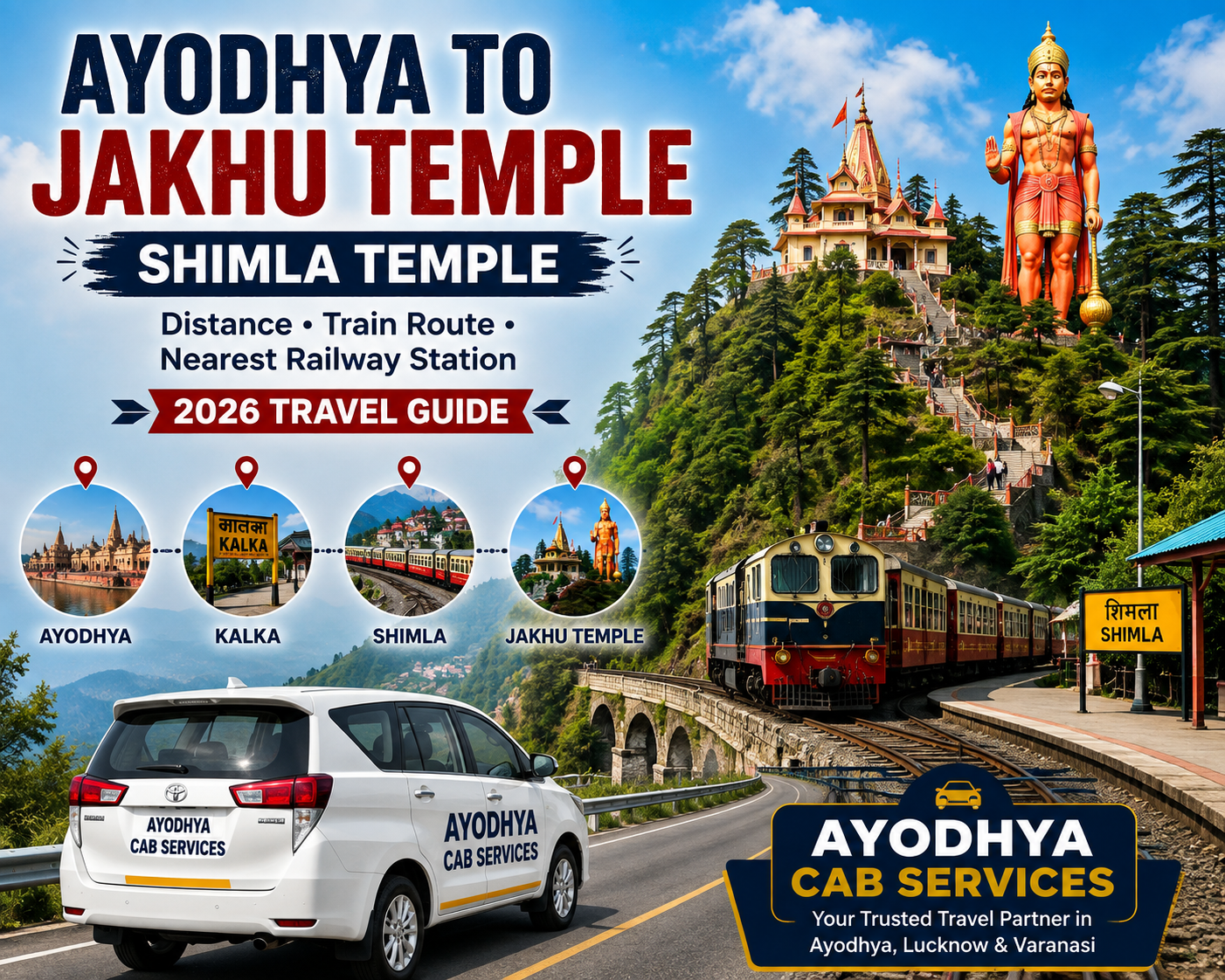
Plan your Ayodhya to Jakhu Temple journey with the Shimla distance, train route, nearest railway station and hill travel information for 2026.
Ayodhya to Jakhu Temple – Shimla Temple Distance
The complete journey should be understood in two stages. First, you need to travel from Ayodhya to Shimla. After reaching Shimla, the final section takes you uphill to Jakhu Temple.
The road distance can vary according to the chosen highway, current diversions, and starting point within Ayodhya. Therefore, it is better not to depend on one fixed kilometre figure while planning a long road journey. Navigation apps can provide the current distance for your exact date and route.
Once you arrive in Shimla, the remaining journey becomes much shorter. Himachal Tourism lists Jakhoo Temple at about 2.5 km from Shimla via The Ridge and about 6 km when approached through Circular Road. The difference exists because the direct route is an uphill approach, whereas the road route follows the mountain terrain.
Consequently, travellers should not judge the final journey by distance alone. A few kilometres in Shimla can take longer than expected because of slopes, traffic restrictions, parking, walking areas, and weather.
If you plan to travel by train, the journey also needs to be divided into the broad-gauge rail section and the final mountain section.
Ayodhya to Jakhu Temple Distance by Road
Travelling entirely by road provides flexibility, especially when several people are travelling together. However, this is a long inter-state journey and should be planned with sufficient rest.
The route generally moves northwest from Uttar Pradesh toward the Delhi–Chandigarh side before climbing into Himachal Pradesh toward Shimla. Your navigation system may suggest a different alignment according to traffic, roadwork, and the starting location.
The plains portion of the trip is usually easier than the final mountain section. Once the route begins climbing toward Shimla, average speed can fall considerably.
Sharp curves, changing gradients, local traffic, fog, rain, or winter conditions can affect travel time. Therefore, an estimated arrival time shown early in the journey should not be treated as fixed.
A daytime arrival in the hill section can be more comfortable for travellers who are unfamiliar with mountain roads. Moreover, adequate breaks are important on such a long trip.
After reaching Shimla, you still need to plan the final approach to Jakhu Hill. Depending on where you stay, you can walk, use available local transport, or consider the ropeway from near The Ridge.
Ayodhya to Shimla Road Route 2026
There are different ways to approach Shimla from Ayodhya, so a route should be selected according to current highway conditions rather than copied permanently from an old travel guide.
Broadly, the journey connects Ayodhya with the northern highway network and then continues toward the Chandigarh–Kalka–Shimla corridor.
Kalka is an important reference point because it sits near the foothills. From this region, the journey changes noticeably as the road begins climbing toward Shimla.
This last section deserves extra travel time.
Mountain-road distance can appear small compared with the journey across the plains, but the driving conditions are very different. Therefore, a traveller should avoid calculating the entire trip using one average highway speed.
Weather is another factor. Heavy monsoon rain can cause temporary disruptions in Himachal Pradesh. Winter can bring snow or icy stretches around higher areas.
Before departure, check the latest road and weather conditions. This becomes especially important during periods of intense rainfall or winter weather.
Ayodhya to Shimla Distance by Car
A private car gives travellers more control over breaks, luggage, and departure time. It can also make the journey convenient for families.
Still, a long drive from Ayodhya to Shimla requires realistic planning.
If only one person is driving, fatigue can become a serious concern. A stop during the journey may be preferable to pushing through a very long drive without adequate rest.
Fuel planning is easy across most of the plains because the route passes through developed highway corridors. Nevertheless, it is sensible to refuel before entering the mountain section.
Once you approach Shimla, parking also needs attention.
Central Shimla contains pedestrian-oriented areas and traffic restrictions. You may not be able to drive directly to every hotel or attraction.
Therefore, check your accommodation’s parking arrangement before arrival. A hotel that appears close to Mall Road on a map may still involve a climb, stairs, or walking from the nearest vehicle-accessible point.
That small detail can make a major difference when travelling with children, elderly family members, or heavy luggage.
Ayodhya to Jakhu Temple by Train
Train travel can make the long journey more comfortable, but passengers should understand that Jakhu Temple itself has no railway station.
The practical rail journey involves reaching a suitable gateway and then continuing toward Shimla.
Kalka is the major broad-gauge railway gateway for the famous Kalka–Shimla mountain railway. Travellers can therefore search for connections from Ayodhya or nearby major railheads toward the Chandigarh–Kalka region.
A direct connection may not always match your chosen date. In such cases, an interchange may be necessary.
Do not book separate trains with an extremely tight connection.
Long-distance services can be delayed, and missing the second train can disturb the entire plan.
Another option is to reach Chandigarh or Kalka and continue toward Shimla by road. This can be useful when the mountain train timing does not match the long-distance arrival.
For 2026 travel, always check the current railway timetable for the exact date because services, train numbers, operating days, and temporary disruptions can change.
Ayodhya to Jakhu Temple Train Route
A practical way to understand the rail route is:
Ayodhya → suitable major rail connection → Chandigarh/Kalka region → Shimla → Jakhu Temple
The exact interchange depends on the train available on your travel date.
Kalka has special importance because it connects the broad-gauge railway network with the mountain line to Shimla.
After reaching Shimla Railway Station, the journey continues by local road transport and walking toward the central area and Jakhu Hill.
Travellers who do not want to use the mountain railway can continue by road from Kalka or Chandigarh.
That option can sometimes save time because the toy train is primarily valued for its mountain-rail experience rather than speed.
Therefore, choose according to your trip style.
If scenery and the railway experience are important, the Kalka–Shimla journey can become part of the holiday. If reaching Shimla sooner matters more, compare current road and rail timings before booking.
Nearest Railway Station to Jakhu Temple Shimla
Shimla Railway Station (SML) is the nearest practical railway station for reaching Jakhu Temple by train.
However, there is an important distinction.
Shimla Railway Station is on the narrow-gauge Kalka–Shimla line. It is not a conventional broad-gauge long-distance terminal with direct trains from cities across India.
Therefore, travellers arriving from Ayodhya generally need to think about Kalka as the broad-gauge gateway and Shimla as the closest rail endpoint.
From Shimla Railway Station, Jakhu Temple lies within the city area. Indian Railways information about the Kalka–Shimla section places major attractions including Jakhu Temple within roughly 4 km of the station’s surrounding area. Actual road distance can be longer because of Shimla’s terrain and road alignment.
That is why two websites may show different kilometre figures.
One may calculate straight-line proximity, another may measure a walking path, while a third follows the vehicle route.
For practical travel, plan according to the route you will actually use.
Kalka Railway Station to Shimla
Kalka Railway Station is one of the most important transport points for travellers entering Shimla by rail.
Kalka connects with India’s broad-gauge railway network. From there, passengers can transfer to the narrow-gauge mountain line.
The Kalka–Shimla railway is famous for its scenic Himalayan journey. It climbs gradually from the foothills toward Shimla and passes through mountain scenery, stations, bridges, and tunnels.
However, this journey takes several hours.
Therefore, passengers arriving at Kalka should leave enough time between their long-distance train and the mountain service.
If the connection is inconvenient, continuing from Kalka toward Shimla by road is another practical option.
This flexibility is useful because mountain railway operations can occasionally be affected by weather or infrastructure issues.
In fact, travellers planning in early September 2026 need to be especially careful because recent heavy rain has temporarily disrupted Kalka–Shimla rail operations. Anyone travelling during or immediately after such disruptions should verify restoration before depending on the toy train.
Kalka to Shimla Toy Train 2026
The Kalka–Shimla railway is not simply a transport connection. For many tourists, it is one of the memorable experiences of visiting Shimla.
The narrow-gauge route connects Kalka with Shimla through mountain terrain. Several services normally operate on this section, although schedules can change.
The journey is slower than travelling the same corridor by road.
That is part of its appeal.
Instead of treating it as the fastest option, travellers often choose it for the scenery and historic railway experience.
Seats can become difficult to obtain during popular holiday periods. Therefore, advance planning is sensible.
At the same time, mountain railways are more vulnerable to weather-related interruptions than ordinary plains routes.
Heavy rainfall can damage tracks, slopes, bridges, or nearby infrastructure.
As of early September 2026, the Kalka–Shimla line has faced a temporary suspension following rain-related damage. This is exactly why a travel guide should not promise that a particular mountain train will operate on every future date.
Always check the live railway status shortly before travelling.
Is There a Direct Train from Ayodhya to Shimla?
Travellers should not plan this trip on the assumption that a regular direct long-distance train will take them from Ayodhya straight to Shimla.
Shimla is connected to Kalka by a narrow-gauge mountain railway.
Therefore, the rail journey normally involves a transfer.
The first objective is to reach the Kalka/Chandigarh side through the broad-gauge network. After that, travellers can choose the mountain train or road transport to Shimla.
This arrangement is common for hill stations connected by heritage mountain railways.
The transfer is not necessarily a disadvantage.
Travellers who enjoy train journeys can turn the Kalka–Shimla section into part of the experience.
However, families with substantial luggage may prefer a road transfer after the long-distance train.
Before booking, compare arrival and departure timings carefully. A connection that appears possible on paper may become stressful if the gap is too small.
Ayodhya Dham Junction or Ayodhya Cantt for Shimla Journey
Ayodhya has more than one railway station, and this can confuse travellers during booking.
Ayodhya Dham Junction and Ayodhya Cantt are different stations.
Therefore, always check the station code and boarding location before confirming a ticket.
Do not assume that a train shown as serving “Ayodhya” automatically leaves from the station closest to your hotel or home.
The best departure station depends on the connection available for your travel date.
Sometimes a suitable long-distance train may require boarding from another nearby major railhead. In that case, compare the total journey rather than only the first train.
A route with one convenient interchange can be easier than a journey containing several short connections.
Families should also consider luggage movement between platforms and stations.
The simplest itinerary is often better than the theoretically fastest one.
Ayodhya to Chandigarh Train Route for Shimla
Chandigarh can be a useful alternative gateway when travelling toward Shimla.
It has strong railway connectivity and road connections toward the hills.
If a suitable train reaches Chandigarh but not Kalka, passengers can continue toward Shimla by road. Another rail connection toward Kalka may also be possible depending on timings.
This route offers flexibility.
For travellers who prioritize convenience, Chandigarh can sometimes be easier because of its broader transport infrastructure.
However, those specifically wanting the Kalka–Shimla mountain railway should plan the additional connection to Kalka carefully.
The correct choice depends on arrival time.
A late-night arrival may make an immediate hill journey less appealing, especially for families. In such cases, staying overnight and beginning the mountain section after rest may provide a more comfortable trip.
Always compare the complete door-to-door journey instead of choosing a gateway solely because its railway fare is lower.
Chandigarh to Shimla Distance and Travel Route
Chandigarh is one of the most widely used gateways for Shimla.
From Chandigarh, the road climbs toward the Himachal hills through the Kalka–Solan corridor before reaching Shimla.
The journey is popular, so traffic can become heavy during weekends, holiday periods, and peak tourist seasons.
Roadwork can also influence journey time.
Therefore, avoid planning an important temple visit immediately after your expected arrival in Shimla.
A delayed hill transfer could leave very little time.
Instead, settle into your accommodation and plan the temple according to daylight, weather, and personal comfort.
Travellers who experience motion sickness should prepare before the mountain section because the road contains many curves.
Sitting where the road is visible and avoiding a heavy meal immediately before the climb can make the journey more comfortable for some people.
Kalka to Shimla Distance by Road
Kalka is much closer to Shimla than Ayodhya, but the remaining journey still takes time because it enters mountain terrain.
The road generally follows the corridor toward Solan and then continues upward to Shimla.
Travel time varies according to traffic, weather, road conditions, and stops.
Peak tourist periods can create congestion.
Monsoon rain can slow traffic considerably. Winter conditions may create different challenges.
Therefore, road distance alone should not determine your schedule.
If your long-distance train reaches Kalka after a tiring overnight journey, consider whether immediately continuing by mountain road is comfortable for everyone in the group.
Families with elderly travellers or young children may benefit from a more relaxed schedule.
The goal should be reaching Shimla safely and comfortably rather than saving every possible minute.
Shimla Railway Station to Jakhu Temple Distance
After reaching Shimla Railway Station, travellers are already within Shimla city. However, Jakhu Temple stands high above the central area.
That elevation is the main reason the final trip needs planning.
The temple is on Jakhu Hill, Shimla’s highest point.
Rather than focusing on one station-to-temple kilometre number, consider how you want to approach the hill.
One option is to reach The Ridge and continue on foot.
Another is to use available local transport for part of the journey.
The ropeway can also provide an alternative from near The Ridge when operating.
Because Shimla’s streets, pedestrian areas, and slopes create different route lengths, online distance estimates can vary significantly.
Travellers with mobility concerns should select the easiest practical approach rather than the shortest line on a map.
Shimla to Jakhu Temple Distance
From Shimla’s central tourist area, Jakhu Temple is very close geographically.
Official Himachal Tourism information lists it at about 2.5 km via The Ridge and around 6 km through Circular Road.
This difference illustrates how hill-station distances work.
The direct route may involve a steep climb. Meanwhile, a road suitable for vehicles needs to follow the contours of the hill.
Consequently, “2.5 km away” does not mean every visitor will reach the temple with an easy 2.5 km drive.
The exact experience depends on whether you walk, use local road transport, or take the ropeway.
Weather can also change the difficulty.
A pleasant uphill walk on a clear morning can feel very different during heavy rain or on a slippery winter day.
Therefore, choose the approach according to the conditions rather than following one fixed recommendation.
The Ridge to Jakhu Temple Distance
The Ridge is one of the most useful starting points for understanding the final journey.
From here, the direct uphill route to Jakhu Temple is approximately 2 km to 2.5 km depending on the point used for measurement.
The climb generally takes around 30–45 minutes for many travellers, although personal fitness and stops can make it longer.
This is not a flat city walk.
The route climbs toward the highest hill in Shimla and can feel demanding for people who are not accustomed to steep slopes.
However, the surrounding deodar trees and mountain setting make the walk enjoyable for many visitors.
Wear shoes with good grip.
Carry only what you need.
If the weather has been wet, take extra care on slippery sections.
Visitors should also remain alert around monkeys and avoid carrying food openly.
Jakhu Temple Ropeway from The Ridge
The ropeway offers an alternative for travellers who do not want to complete the full uphill walk.
Its lower access is near The Ridge area, while the upper side brings visitors close to the temple complex.
This can be particularly useful for families or travellers who want the aerial experience.
However, ropeway operation can depend on weather and other operational conditions.
Timings and fares can also change.
Therefore, verify them locally on the day of the visit rather than relying on an old blog price.
During busy tourist periods, queues may add waiting time.
Travellers should also remember that reaching the lower ropeway station can itself involve some walking depending on their starting point.
The ropeway reduces the steep climb, but it does not necessarily make the entire journey completely walking-free.
Walking to Jakhu Temple from The Ridge
Walking is one of the classic ways to reach the temple.
The uphill trail begins from the central Shimla side and climbs through a wooded setting.
The route is relatively short but steep.
Therefore, travellers should judge it according to fitness rather than kilometres.
A person who regularly walks on hills may find the climb manageable. Someone unused to steep gradients may need several breaks.
Morning can be a comfortable time because temperatures are often cooler and visitors can complete the climb before the busiest part of the day.
However, weather conditions should guide the decision.
During rain, surfaces can become slippery.
In winter, snow or ice can increase difficulty.
Take your time and avoid rushing simply because an online guide suggests a specific walking duration.
Jakhu Temple Height and Location
Jakhu Hill is the highest point within Shimla city.
Official tourism information places the temple area at roughly 2,445 metres above sea level, while other government material gives a figure around 2,455 metres. Small differences arise from the exact point being measured.
The elevated position gives the area wide views over Shimla and the surrounding Himalayan landscape when weather is clear.
It also explains why reaching the temple requires an uphill journey.
The temple is dedicated to Lord Hanuman and is one of Shimla’s best-known religious attractions.
A 108-foot Hanuman statue stands prominently at the site and can be seen from different parts of the city.
Because the temple is located within the Shimla urban area, visitors can combine it with other central attractions without planning another long inter-city journey.
Jakhu Temple Hanuman Statue Shimla
The giant Hanuman statue is one of the most recognizable features of Jakhu Hill.
At approximately 108 feet tall, it rises above the surrounding trees and has become a visual landmark of Shimla.
For many visitors, seeing the statue from lower parts of the city builds anticipation before reaching the hilltop.
Once at the temple area, the elevated setting also provides an opportunity to enjoy the surrounding landscape.
Photography may be attractive when the weather is clear. However, visitors should remain mindful of the religious setting and other people around them.
The local monkey population also deserves attention.
Loose objects, food packets, sunglasses, or other easily grabbed items should be handled carefully.
Keeping belongings secure can make the visit much more comfortable.
Jakhu Temple History and Hanuman Connection
Jakhu Temple is associated with the Ramayana tradition and Lord Hanuman’s journey in search of the Sanjeevani herb.
According to the traditional account, Hanuman stopped at Jakhu Hill while travelling toward the Himalayas.
This connection has made the temple an important place for Hanuman devotees.
The hilltop setting adds to the experience because visitors move away from Shimla’s busiest commercial streets into a wooded, elevated area.
The modern giant statue is now one of the site’s most recognizable features, yet the temple’s cultural importance goes much deeper than the statue itself.
Travellers interested in the story can read about the tradition before visiting. Doing so gives more context to what they see at the temple.
Jakhu Temple Timings 2026
Temple timings should always be checked close to the date of travel.
The Shimla district government’s current tourism page lists Jakhoo Temple as open every day from 7:00 AM to 8:00 PM and states that there is no entry fee.
However, online travel websites sometimes display different opening times.
This is why government or local confirmation is preferable before planning an early-morning or late-evening visit.
Festival days can also affect crowd levels and access patterns.
If you are travelling specifically for darshan, avoid building a tight itinerary around an unverified timing copied from an old article.
Ropeway timings are separate from temple timings.
Even when the temple is open, the ropeway may have different operating hours.
Therefore, check both if the ropeway is part of your plan.
Best Time to Visit Jakhu Temple
The ideal period depends on what kind of Shimla experience you prefer.
Spring and early summer generally attract travellers looking for comfortable hill weather.
Monsoon brings greener landscapes, but heavy rain can affect mountain roads, walking routes, and rail services.
Autumn often provides pleasant conditions and clearer views.
Winter offers a different Shimla experience, with the possibility of snow. However, snow and ice can also make the uphill approach more challenging.
Therefore, there is no single perfect month for everyone.
Families prioritizing easy movement may prefer stable weather.
Travellers hoping for winter scenery should accept the possibility of weather-related delays.
Regardless of season, checking the forecast before travelling is important because Himalayan conditions can change quickly.
Jakhu Temple in Winter 2026
Winter can transform Shimla into a very different destination.
Cold temperatures, frost, and occasional snowfall create attractive scenery. At the same time, they can make walking and driving more difficult.
The climb toward Jakhu Hill deserves particular care when surfaces are icy.
Wear suitable footwear with good grip.
Warm layers are essential because temperatures at the hilltop can feel colder than in lower areas.
Road traffic may also slow during snowfall.
If severe weather is forecast, allow flexibility in your itinerary rather than fixing every activity to an exact hour.
Train and road schedules should also be rechecked.
Mountain travel works best when the itinerary has room for weather-related changes.
Jakhu Temple During Monsoon
Monsoon brings beautiful greenery to Shimla, but it also creates practical travel concerns.
Heavy rainfall can affect roads, slopes, walking paths, and railway infrastructure.
The steep path toward Jakhu Temple may become slippery.
Therefore, proper footwear is important.
An umbrella can help during light rain, although a rain jacket may be easier to manage while climbing.
Visitors should also monitor local weather alerts.
Recent 2026 disruption on the Kalka–Shimla railway demonstrates why monsoon travellers need a backup plan.
If the mountain train is unavailable, road transport may be required. Yet road conditions should also be checked during intense rainfall.
Flexibility is one of the most important parts of monsoon hill travel.
Best Time of Day for Jakhu Temple Darshan
Morning is a popular choice because the weather can feel cooler and the city may be less crowded.
Clear mornings can also provide attractive views from the hill.
However, the best time depends on the season.
During winter, a slightly later visit may feel warmer. In summer, an earlier climb can help avoid stronger daytime sun.
Festival days and weekends may attract larger crowds.
If you are walking from The Ridge, allow more time than the minimum estimate.
Stopping along the route is completely reasonable.
Those using the ropeway should check operating hours before deciding on an early visit.
A relaxed schedule generally creates a better experience than trying to fit the temple between tightly timed sightseeing stops.
Jakhu Temple for Senior Citizens
Senior travellers should consider the steep terrain before choosing the walking route.
The distance from The Ridge may sound short, but the incline can make it tiring.
Local transport or the ropeway can reduce the physical effort when available.
However, some walking may still be required.
Therefore, families should check accessibility according to the individual’s mobility.
Avoid rushing elderly travellers because of a fixed sightseeing schedule.
Altitude can also make physical effort feel different for some visitors, although Shimla’s elevation is far below extreme high-altitude destinations.
Comfortable footwear, hydration, rest, and a flexible pace are useful.
If someone has medical limitations affecting walking or exertion, follow their doctor’s travel advice.
Jakhu Temple Trip with Family and Children
Families can enjoy the visit, but preparation helps.
Children may find the giant Hanuman statue and ropeway especially interesting.
However, the uphill walk can become tiring for younger children.
Parents should also be particularly careful around monkeys.
Avoid giving children open food packets while walking near the temple area.
Secure sunglasses, small bags, and loose belongings.
Weather-appropriate clothing is another priority.
Shimla temperatures can feel much cooler than Ayodhya, especially in winter or after sunset.
Families travelling by train should also keep connection times comfortable.
A relaxed journey usually works better than trying to cover the long-distance train, toy train, hotel check-in, and temple visit within one tightly scheduled day.
Monkeys at Jakhu Temple: What Travellers Should Know
Jakhu Hill is well known for its monkey population.
Visitors should remain calm and avoid teasing or approaching the animals.
Food is particularly important.
Do not carry snacks openly or attempt to attract monkeys for photographs.
Loose objects should remain secure.
Sunglasses, food bags, and small items can attract unwanted attention.
Families should keep children nearby.
The goal is not to be frightened of the monkeys, but to behave sensibly around them.
Local advice can also be useful because people working around the temple know current conditions.
A little preparation can prevent an avoidable problem from affecting an otherwise enjoyable visit.
Places to Visit Near Jakhu Temple
Jakhu Temple is conveniently located near several of central Shimla’s best-known attractions.
The Ridge is the most obvious place to combine with the visit.
Mall Road is also nearby and forms one of Shimla’s main pedestrian areas.
Christ Church stands prominently at The Ridge and is one of the city’s recognizable landmarks.
Travellers can therefore plan a central Shimla day rather than treating the temple as an isolated excursion.
After visiting Jakhu Hill, return toward The Ridge and explore the surrounding area at a comfortable pace.
However, avoid packing too many distant attractions into the same day.
Shimla’s slopes make walking more tiring than the map may suggest.
A smaller itinerary often creates a better experience.
Jakhu Temple and The Ridge Shimla One-Day Plan
A practical day can begin with Jakhu Temple when the weather is comfortable.
After darshan, return toward The Ridge.
Spend time enjoying the open views and central landmarks.
From there, continue toward Mall Road for shopping, food, and a relaxed walk.
This itinerary works because the locations are concentrated around central Shimla.
However, walking effort still adds up.
If you climbed Jakhu Hill on foot, leave time to rest before continuing.
Travellers staying near central Shimla can keep the evening flexible.
Those staying farther away should also account for local traffic and transport availability.
The best one-day plan is not necessarily the one containing the largest number of attractions. It is the one that allows you to enjoy each stop without constantly watching the clock.
Jakhu Temple and Mall Road Distance
Mall Road and The Ridge form the heart of Shimla’s tourist area, while Jakhu Hill rises above them.
The temple is therefore geographically close to Mall Road.
However, the final approach is uphill.
This distinction is important when choosing accommodation.
A hotel advertised as “near Mall Road” can be convenient for central sightseeing, but it does not necessarily eliminate the climb toward Jakhu Temple.
Similarly, a property shown as only a short distance away on a map may involve steep walking.
Before booking, check both vehicle access and walking gradients.
This is especially useful for families carrying luggage or travelling with older relatives.
Where to Stay in Shimla for Jakhu Temple Visit
Central Shimla can be convenient for travellers who want easy access to The Ridge, Mall Road, and the Jakhu Temple approach.
However, accommodation should be selected according to more than map distance.
Check parking if travelling by car.
Confirm whether the hotel can be reached directly by vehicle.
Some properties around pedestrian areas may require walking from a drop-off point.
Families should also ask about lifts if the property has several floors.
Hill hotels can involve more stairs than expected.
If you prefer a quieter stay, areas outside the busiest central zone may be attractive. However, local travel time will increase.
The right choice depends on whether your priority is walking access, parking, views, price, or a quieter environment.
Budget Planning for Ayodhya to Shimla Trip
The cost of the journey varies greatly according to transport style.
Train travel can reduce the main transportation cost, especially when booked in an appropriate class.
However, connecting transport, mountain rail tickets, local travel, accommodation, food, and sightseeing should also be included.
Road travellers need to account for fuel, tolls, parking, and possible overnight stops.
Hotel prices in Shimla can rise sharply during weekends, holidays, summer vacations, and popular winter periods.
Therefore, booking accommodation early can help during peak dates.
Keep some flexibility in the budget for unexpected transport changes.
For example, a cancelled mountain train could require a road transfer.
A realistic budget should include these possibilities rather than calculating only the cheapest theoretical itinerary.
Ayodhya to Jakhu Temple Travel Time
Total travel time depends heavily on the chosen mode.
A road journey requires many hours and can vary with traffic, breaks, and hill conditions.
Train travel can be more relaxing, but connections add time.
Using the Kalka–Shimla mountain railway makes the journey especially scenic, yet it is slower than a straightforward road transfer from the foothills.
Therefore, “fastest” and “best” are not always the same.
A couple travelling for leisure may enjoy the mountain railway.
A family with small children might prioritize fewer transfers.
Someone with only a short weekend may prefer a faster combination.
Compare the complete itinerary from departure in Ayodhya to hotel arrival in Shimla.
That gives a much more useful picture than comparing individual train durations.
Ayodhya to Jakhu Temple 3-Day Trip Plan
A three-day itinerary can work if travel connections are efficient, although additional time makes the journey more relaxed.
The first day can focus primarily on reaching Shimla.
Avoid planning major sightseeing immediately after a long overnight journey.
The second day can begin with Jakhu Temple and continue through The Ridge and Mall Road.
This keeps the central attractions together.
The third day can include another nearby Shimla attraction before beginning the return journey, depending on departure time.
However, remember that travel from Shimla back toward the plains also takes time.
If using the mountain train, its timetable will influence the entire day.
A longer four- or five-day plan provides more flexibility for travellers who want to explore beyond central Shimla.
Ayodhya to Shimla Family Trip Planning
Family trips benefit from fewer complicated transfers.
While a multi-train route might appear cheaper, repeatedly moving luggage can become tiring.
Therefore, compare convenience as well as fare.
If travelling with elderly relatives, prioritize accommodation with easier access.
For children, keep enough rest between the long journey and hill sightseeing.
Weather preparation is equally important.
Shimla can be considerably cooler than Ayodhya.
Check the forecast rather than packing solely according to the season name.
Finally, avoid overloading the itinerary.
Hill travel involves more physical effort, and traffic can be unpredictable.
A comfortable family trip usually leaves some time unplanned.
Common Mistakes When Planning Ayodhya to Jakhu Temple
One common mistake is assuming that Shimla has the same type of long-distance railway connectivity as major plains cities.
It does not.
Kalka is the key broad-gauge gateway, while Shimla sits at the end of the mountain railway.
Another mistake is underestimating hill distances.
Two kilometres uphill can require considerably more effort than two kilometres on a flat city road.
Travellers also sometimes ignore weather conditions.
Mountain trains and roads can be disrupted by heavy rain or winter conditions.
Booking extremely tight connections is another avoidable problem.
Finally, many visitors choose accommodation based only on straight-line distance from Mall Road.
Vehicle access, slopes, stairs, and parking can matter just as much.
Understanding these issues before departure makes the journey much smoother.
Is Jakhu Temple Worth Visiting from Ayodhya?
For travellers already planning a Shimla trip, Jakhu Temple can be one of the most memorable places in the city.
The temple combines religious importance, a prominent Hanuman statue, forested surroundings, elevated views, and an interesting uphill approach.
However, travelling all the way from Ayodhya requires significant time.
Therefore, it makes sense to combine the temple with a wider Shimla itinerary rather than planning such a long journey for a very short visit.
The Ridge, Mall Road, central Shimla, and other nearby attractions can easily become part of the same trip.
Those who enjoy rail travel can also include the Kalka–Shimla mountain railway when it is operating normally.
Together, these experiences make the journey much more complete.
Ayodhya to Jakhu Temple Travel Guide 2026
A successful trip starts with choosing the right gateway.
For rail travellers, compare connections toward Chandigarh and Kalka.
If the mountain train fits your schedule and is operating, it can provide a memorable final rail journey to Shimla.
Otherwise, continue by road.
Once in Shimla, decide whether to walk from The Ridge, use available local transport, or take the ropeway.
Then check the weather.
This simple step can influence everything from footwear to travel time.
Finally, keep the itinerary flexible.
Mountain destinations can be affected by conditions that are difficult to predict weeks in advance.
A flexible traveller can adjust without allowing one delayed train or rainy morning to spoil the entire trip.
Important 2026 Kalka–Shimla Train Update
Anyone travelling in September 2026 should pay particular attention to the current status of the Kalka–Shimla railway.
Heavy rainfall has recently damaged railway infrastructure, leading to a temporary suspension of services.
The situation may change after repairs.
Therefore, this information should not be interpreted as meaning that the route will remain closed throughout 2026.
Instead, it highlights an important travel-planning rule.
Check your train’s live status shortly before departure.
Do not rely solely on a booking made weeks earlier.
If the mountain service is unavailable, travellers can consider road transport between the Kalka/Chandigarh side and Shimla, subject to current road conditions.
This is particularly important during the monsoon because both rail and road networks can be affected by severe weather.
Frequently Asked Questions About Ayodhya to Jakhu Temple
Travellers commonly ask whether Jakhu Temple has a railway station. It does not. Shimla Railway Station is the nearest rail endpoint, while Kalka is the important broad-gauge gateway.
Another common question concerns the final climb. The direct route from The Ridge is roughly 2–2.5 km uphill. Travellers who prefer not to walk the entire route can explore local transport or the ropeway when available.
People also ask whether the toy train is compulsory. It is not. You can travel from the foothills toward Shimla by road instead.
Finally, many visitors wonder whether the trip can be completed year-round. Shimla remains a year-round destination, but weather can affect roads, walking conditions, ropeway operation, and mountain railway services.
Therefore, seasonal preparation is essential.
Best Train and Road Combination for Ayodhya to Jakhu Temple
There is no single combination that is best for every traveller.
Those who enjoy rail travel may prefer reaching Kalka and continuing by mountain train.
Travellers focused on convenience can consider a suitable train toward Chandigarh or Kalka followed by road transport.
Families may prefer fewer transfers.
Budget travellers can compare railway connections carefully, while travellers with limited time may prioritize the fastest practical combination.
The important point is to calculate the whole journey.
A train that saves money but requires a long overnight interchange may not actually be the most convenient.
Similarly, a mountain train may take longer but add a unique experience to the holiday.
Choose according to your priorities.
Final Travel Tips for Jakhu Temple Shimla
Keep your travel plan flexible, particularly during monsoon and winter.
Check train status close to departure.
Confirm mountain railway operations separately from the long-distance train.
Pack shoes suitable for steep walking.
Keep belongings secure around monkeys.
Check the weather before climbing Jakhu Hill.
Travellers with limited mobility should research the easiest available approach rather than relying on the direct walking route.
Also, avoid carrying excessive luggage during central Shimla sightseeing.
The city is much easier to enjoy when you can move comfortably through pedestrian areas and slopes.
Most importantly, allow enough time.
A relaxed itinerary makes both the long journey and the final temple visit more enjoyable.
Conclusion
Ayodhya to Jakhu Temple – Shimla Temple Distance should be planned as a long journey to Shimla followed by a short but steep final approach to Jakhu Hill. Travellers using rail can consider the broad-gauge network toward Kalka or Chandigarh, followed by either road transport or the famous Kalka–Shimla mountain railway when services are operating.
Shimla Railway Station is the closest railway endpoint, while Kalka remains the important broad-gauge rail gateway. After reaching central Shimla, Jakhu Temple is roughly 2.5 km via The Ridge, although the road approach can be longer because of the mountain terrain.
For 2026, weather checks are especially important. Heavy rainfall can temporarily affect the mountain railway and roads, while winter conditions can change walking and driving times. Verify current schedules before departure, keep enough connection time, and avoid depending on one fixed travel duration.
With sensible planning, the journey can combine train travel, Himalayan scenery, central Shimla sightseeing, the Kalka–Shimla railway experience, and a visit to one of the city’s most recognizable Hanuman temples.
Ayodhya to Shimla Train Journey Planning
Planning the rail journey from Ayodhya to Shimla requires more attention than booking a normal direct train between two major cities. Shimla is connected with Kalka through the narrow-gauge mountain railway. Therefore, travellers usually need at least one change before reaching the hill station.
The first step is to search for a convenient broad-gauge connection from Ayodhya toward Chandigarh, Ambala, Kalka, or another suitable junction. The best option can change according to the travel date. As a result, travellers should compare the total journey instead of selecting a train only because it appears faster for the first section.
Connection time is especially important. A delay of even one or two hours on a long-distance train can create problems if the next service leaves shortly after arrival. Therefore, keeping a reasonable buffer between trains is much safer.
Families should also consider platform changes and luggage movement. A journey containing several short connections may appear efficient online, but it can become tiring in practice.
When possible, choose a simple itinerary. One comfortable long-distance train followed by one road or rail transfer toward Shimla is usually easier than changing trains repeatedly.
Best Railway Route from Ayodhya to Shimla
There is no single railway route that remains the best throughout the year. Train availability, operating days, reservation status, and seasonal disruptions can change.
For many travellers, reaching Chandigarh or Kalka is the most practical objective.
Kalka is particularly useful because it connects directly with the famous mountain railway to Shimla. However, Chandigarh has broader transport options and can sometimes provide a more convenient long-distance connection.
If you reach Chandigarh, you can continue toward Shimla by road. Alternatively, you can travel toward Kalka if you specifically want to experience the toy train.
Another possibility is reaching Ambala and connecting onward. Yet every additional transfer increases the risk of delays.
Therefore, compare departure time, arrival time, connection duration, and total travel effort.
For families, an overnight train that reaches the gateway city in the morning can be particularly convenient. It allows the hill journey to begin in daylight.
Before final booking, verify the exact station name and code. Ayodhya Dham Junction and Ayodhya Cantt are different stations, so confusion at the booking stage can create unnecessary travel problems.
Ayodhya to Kalka Train Route
Kalka is one of the most logical rail gateways for reaching Shimla.
The town sits near the foothills and marks the starting point of the Kalka–Shimla narrow-gauge railway. Therefore, travellers searching for a train-based journey should check whether a suitable route reaches Kalka directly or requires an interchange.
Depending on the date, a connection through another major junction may be necessary.
When planning separate tickets, leave enough time between trains. Railway delays are always possible, and mountain services usually have fixed departures.
If your first train reaches Kalka after the mountain train has left, you can still continue toward Shimla by road. That flexibility makes Kalka a useful gateway even when the toy train does not fit the schedule.
Travellers arriving late at night should think carefully before immediately starting the mountain drive. Resting and continuing after daylight may be more comfortable.
The route is especially attractive for visitors who enjoy railway travel because the final section transforms the journey from an ordinary long-distance train trip into a scenic mountain experience.
Ayodhya to Chandigarh Train for Shimla Trip
Chandigarh can be one of the easiest gateway cities for travellers heading toward Shimla.
It has a major railway station and stronger transport connectivity than many smaller foothill towns. Therefore, if a convenient train from the Ayodhya side reaches Chandigarh, continuing by road may simplify the journey.
The road from Chandigarh toward Shimla gradually enters the hills. Depending on traffic and weather, the journey can take several hours.
Travellers who want to use the mountain railway can continue toward Kalka first. However, this adds another transfer.
Therefore, the best choice depends on priorities.
If reaching Shimla efficiently is most important, a road transfer from Chandigarh can make sense. If the railway experience is part of the holiday, travelling onward to Kalka may be worthwhile.
Hotel check-in time should also be considered. Reaching Chandigarh in the afternoon and then starting the hill journey may result in a late arrival in Shimla.
For families, reaching the hill station before evening can make hotel access and luggage management much easier.
Ambala to Shimla Route as an Alternative
Ambala is another railway junction that can become useful when no convenient connection is available directly toward Chandigarh or Kalka.
Many long-distance trains pass through Ambala Cantt. From there, travellers can continue toward Chandigarh, Kalka, or the hill route according to the available connection.
However, an additional interchange should only be added when it genuinely improves the journey.
A route containing Ayodhya, Ambala, Chandigarh, Kalka, and Shimla may look interesting on a map, but several transfers can make the trip tiring.
Therefore, calculate the complete travel time.
A slightly longer direct train to Chandigarh can sometimes be easier than a faster train to Ambala followed by waiting and another connection.
This becomes even more important when travelling with children or elderly family members.
Keep flexibility in the plan because railway schedules may not align perfectly.
The objective should be to reach Shimla comfortably, not to create the mathematically shortest route with the highest number of changes.
Kalka to Shimla Toy Train Travel Experience
The Kalka–Shimla railway is one of the most famous mountain railway journeys in India.
The train climbs gradually through the hills and offers a very different experience from a normal express train. Instead of covering distance quickly, the journey focuses on mountain scenery, small stations, tunnels, bridges, and changing landscapes.
For travellers who enjoy slow travel, this section can become one of the highlights of the trip.
However, it requires patience.
The journey generally takes much longer than travelling from Kalka to Shimla by road. Therefore, it may not suit a very short itinerary.
Families with children may enjoy the experience, but several hours on a mountain train can also become tiring.
Seat availability is another consideration during busy tourist periods.
If the toy train is important to your trip, book early and continue checking the operating status before departure.
Weather can affect mountain railway operations. Consequently, always keep a road-transfer backup plan when visiting during heavy monsoon periods or other difficult conditions.
Kalka Shimla Railway Route for Tourists
The mountain railway route begins at Kalka and climbs toward Shimla through the lower Himalayan landscape.
This gradual ascent is part of what makes the journey attractive.
Unlike a direct road transfer, the railway allows travellers to experience the changing elevation more slowly.
The train passes through several stations along the route. Some services stop more frequently than others, so total travel time can vary.
Before booking, compare the type of service rather than selecting solely according to departure time.
The mountain railway is most suitable for travellers who value the journey itself.
If you are reaching Shimla for a short weekend and have limited sightseeing time, the slower journey may reduce the hours available in the city.
On the other hand, if your itinerary is relaxed, the railway can add a distinctive experience without requiring another separate excursion.
Always remember that seasonal weather can influence operations, so current status matters more than an old timetable found online.
Kalka to Shimla by Road vs Toy Train
Both options have advantages.
The road is usually faster and more flexible. You can depart according to your arrival time rather than waiting for a fixed train.
The mountain railway, however, offers a unique travel experience.
Therefore, the decision depends on whether your priority is time or scenery.
Families with large luggage may find a direct road transfer easier. Travellers who enjoy photography and railway journeys may prefer the toy train.
Weather is another deciding factor.
During difficult conditions, one mode may face disruption while the other remains available. Therefore, checking the latest situation before travel is important.
A useful compromise is to use the mountain train in one direction and travel by road in the other.
This allows travellers to experience the railway without depending on it for the entire trip.
However, this should only be planned after checking current availability and ticket timings.
Shimla Railway Station to Mall Road
Shimla Railway Station is relatively close to the central tourist area, but the city’s steep terrain changes how distance feels.
Mall Road is situated higher than several road-access points.
Therefore, travellers carrying heavy luggage should not assume they can comfortably walk from the station to every central hotel.
Local transport can help for accessible sections. However, some hotels around pedestrian areas may still require walking after the nearest drop-off point.
Before booking accommodation, ask the hotel about the easiest route from the railway station.
This simple question can save considerable effort.
A hotel described as “near Mall Road” may be close in distance but located above or below a steep slope.
Families with children, elderly travellers, and guests carrying several bags should pay particular attention to this issue.
After checking in, central Shimla becomes much easier to explore without luggage.
Therefore, avoid planning a Jakhu Temple visit immediately after arriving at the station unless everyone has had enough rest.
Mall Road to Jakhu Temple Distance
Jakhu Hill rises above Shimla’s central tourist area, which makes the temple appear very close on a map.
However, reaching it involves climbing.
From the Mall Road and Ridge area, travellers generally move toward the uphill route leading to Jakhu Hill.
The walking distance is manageable for many visitors, but the gradient can make it tiring.
Therefore, people should not compare it with a flat walk of the same length.
A slow pace works better.
Stop when necessary and enjoy the surrounding hill environment.
Those who prefer to avoid the full climb can consider the ropeway or available local transport.
During rain, the path may become slippery. In winter, cold weather and possible ice can make the route more challenging.
As a result, footwear and weather preparation matter more than the kilometre figure.
The journey is short compared with the trip from Ayodhya to Shimla, but it deserves proper planning because it is the most physically demanding section for many visitors.
Jakhu Temple Trek from Mall Road
The walk toward Jakhu Hill is sometimes described as a short trek because of its steep uphill character.
It is not a remote Himalayan trek requiring specialized equipment. However, the slope can still test travellers who are not accustomed to hill walking.
Start slowly.
Trying to climb quickly at the beginning can cause unnecessary fatigue.
Comfortable shoes are more useful than fashionable footwear on this route.
Carry a small bottle of water if needed, but avoid carrying visible food because of monkeys.
During warmer months, morning can be pleasant for the climb. In winter, a slightly later start may provide more comfortable temperatures.
Families should allow children to walk at their natural pace.
Older travellers may prefer the ropeway or local transport.
The main point is to choose the approach according to physical comfort rather than feeling that walking is compulsory.
Jakhu Ropeway Shimla Travel Guide
The Jakhu ropeway provides a convenient way to reduce the steep uphill effort.
For many travellers, it also adds an enjoyable aerial view of central Shimla and the surrounding hills.
The lower access is near the Ridge side, so visitors already exploring central Shimla can combine the ropeway with their sightseeing plan.
However, operational timings can change.
Weather may also affect service.
Therefore, check the current status on the same day.
During peak tourist periods, waiting time can increase considerably.
As a result, someone expecting an immediate ride may need to adjust their schedule.
Travellers should also remember that some walking is still involved around the lower and upper access points.
The ropeway is best viewed as a way to reduce the climb rather than eliminate all walking.
For senior citizens or travellers with limited stamina, it can be particularly helpful when operating normally.
Jakhu Temple Entry Fee and Visiting Cost
Government tourism information currently lists no entry fee for the temple itself.
However, visiting expenses can still include local transport, ropeway tickets, parking, food, and other sightseeing costs.
Therefore, budget planning should consider the whole experience rather than only temple entry.
Travellers using the ropeway should verify the current fare locally because prices can change.
Likewise, parking charges around central Shimla vary according to location and duration.
If staying near The Ridge or Mall Road, hotel parking arrangements may influence the total cost significantly.
For budget travellers, walking from the central area can reduce local transport expenses.
However, convenience should also be considered.
A family with elderly members may find the additional cost of easier transport worthwhile.
The best plan balances price, comfort, and time.
Jakhu Temple Opening Time and Closing Time
Current government tourism information lists Jakhoo Temple as open daily from morning until evening, but travellers should still verify timings near their visit.
Festival days can bring changes in crowd management.
Weather can also affect access to the hill.
Therefore, planning a visit too close to closing time can create unnecessary stress.
Morning usually provides more flexibility.
If you reach later than expected, you still have time to adjust.
Travellers using the ropeway should remember that ropeway operating hours may differ from temple hours.
Therefore, checking only the temple closing time is not enough.
If you plan to return by ropeway, verify the last ride before beginning the visit.
Those walking down have more flexibility but should still avoid unfamiliar steep paths after dark.
Jakhu Temple Morning Darshan
Morning is often one of the most comfortable periods for visiting Jakhu Hill.
The city can feel quieter, and temperatures are generally pleasant during much of the year.
For travellers staying near central Shimla, an early visit also leaves the rest of the day free for The Ridge, Mall Road, and other attractions.
However, season matters.
Winter mornings can be extremely cold.
Therefore, visitors should not force a very early start simply because a travel guide recommends it.
Check the forecast.
If frost or snow is present, waiting until conditions improve may make walking safer.
During summer, an earlier climb can feel more comfortable than walking during stronger midday sun.
Visitors using the ropeway should confirm that operations have begun before reaching the station.
A well-timed morning visit can make the entire sightseeing day more relaxed.
Jakhu Temple Evening Darshan
Evening can provide a beautiful atmosphere around Shimla, especially when the weather is clear.
However, travellers should plan more carefully than they would for a daytime visit.
The steep walking path becomes less convenient after dark.
Temperatures can also drop quickly in the hills.
Therefore, anyone visiting later should keep enough time to return to the central area comfortably.
Ropeway closing time becomes particularly important.
If the final service finishes before you return, you may need another way down.
Winter evenings can become very cold, while monsoon evenings may bring fog or rain.
For first-time visitors, daytime is usually easier.
Those who prefer an evening visit should choose a clear-weather day and avoid beginning the climb too close to closing time.
Jakhu Temple Weather Throughout the Year
Shimla weather changes considerably between seasons.
Summer usually offers milder temperatures compared with the plains.
This makes the city popular during school holidays.
Monsoon brings heavy rain and lush greenery, but it also increases the possibility of road and rail disruption.
Autumn can provide clearer weather and pleasant sightseeing conditions.
Winter is cold and may bring snowfall.
Therefore, packing should be based on the latest forecast rather than only the month.
Even during warmer periods, evenings can feel cooler than Ayodhya.
A light layer can be useful.
During winter, proper warm clothing is essential.
For the Jakhu Hill climb, shoes with good grip remain important throughout the year.
Weather can change quickly in mountain areas, so keeping some flexibility in the daily itinerary is sensible.
Shimla Snowfall and Jakhu Temple Trip
Travellers hoping to experience snowfall should understand that snow cannot be guaranteed for a specific date.
Winter conditions vary from year to year.
When snowfall does occur, Jakhu Hill can look particularly attractive because of its elevation and forested setting.
However, snow also creates practical challenges.
Roads may slow down.
Walking surfaces can become slippery.
Ropeway operations may be affected by severe weather.
Therefore, winter visitors should prioritize safety over completing every planned activity.
If the climb appears icy, use the easiest available alternative.
Carry suitable footwear and warm layers.
Families with young children should also avoid keeping them outdoors for long periods during very cold conditions.
A flexible itinerary is essential because snowfall can change travel times across Shimla.
Shimla Monsoon Travel Safety
Monsoon deserves special attention because heavy rainfall can affect the Himalayan road network.
Landslides, slope instability, waterlogging, and temporary closures can occur in hill areas.
Therefore, check official weather and transport updates before beginning the mountain section.
Avoid unnecessary travel during severe-weather warnings.
If rain becomes intense after reaching Shimla, shifting sightseeing to another day may be wiser than forcing the original plan.
Jakhu Hill itself can become slippery.
Good footwear and careful walking are essential.
The mountain railway may also face temporary disruptions after heavy rain.
Therefore, do not build a return itinerary with no backup option.
A road transfer toward the plains can serve as an alternative when rail services are interrupted, subject to road conditions.
Monsoon travel can still be enjoyable, but flexibility is more important than during stable-weather periods.
Best Season for Ayodhya to Shimla Temple Trip
Different travellers prefer different seasons.
Those seeking comfortable sightseeing weather often choose spring or early summer.
Families travelling during school holidays may find May and June convenient, although Shimla can become crowded.
Autumn can offer pleasant temperatures and clearer views.
Winter attracts visitors hoping for snow and a traditional cold-weather hill-station experience.
Monsoon has fewer tourists at times, but weather-related uncertainty is higher.
Therefore, the best season depends on what matters most.
If easy walking and predictable road conditions are priorities, avoid periods of extreme weather.
If snowfall is the main attraction, winter can be appealing, but delays should be expected.
Regardless of season, book popular dates early.
Hotel prices and availability can change significantly during peak travel periods.
How Many Days Are Enough for Shimla and Jakhu Temple?
A temple visit itself does not require several days.
However, the long journey from Ayodhya means travellers should allow enough time to make the trip worthwhile.
Three nights or more in the broader travel plan can create a more relaxed experience.
One day can focus on central Shimla and Jakhu Hill.
Another can be used for nearby attractions or a slower exploration of the town.
Additional time is useful if travellers want to visit Kufri, Mashobra, Naldehra, or other destinations around Shimla.
However, each extra location increases road travel.
Therefore, avoid turning a short holiday into a race between attractions.
For a first visit, enjoying central Shimla properly can be more satisfying than covering many distant places quickly.
Two-Day Shimla Itinerary with Jakhu Temple
A short two-day stay can still cover the main central attractions.
The first day can focus on arrival, hotel check-in, Mall Road, and The Ridge.
This keeps the schedule relaxed after the long journey.
The second morning can be used for Jakhu Temple.
After returning, travellers can spend additional time around central Shimla before beginning the onward or return journey.
However, this plan leaves little room for weather delays.
If the hill road or train is disrupted, the itinerary can become tight.
Therefore, travellers with enough leave should consider an additional day.
A short trip works best when transportation connections are reliable and accommodation is conveniently located.
Four-Day Shimla Trip from Ayodhya
A four-day plan provides much more breathing room.
The first day can focus entirely on reaching Shimla.
The second can cover Jakhu Temple, The Ridge, Mall Road, and nearby central attractions.
The third day can be reserved for another local or nearby destination depending on weather and personal interest.
The fourth day can be used for the return journey.
This structure reduces the pressure to start sightseeing immediately after arrival.
It also provides some flexibility if rain or another disruption affects one day.
Families generally benefit from this slower pace.
Long-distance travel already consumes significant energy, so adding a tightly packed sightseeing schedule can make the holiday exhausting.
A little unplanned time can improve the overall experience.
Jakhu Temple with Kufri Trip
Jakhu Temple and Kufri can both be included in a Shimla itinerary, but they should not be treated as the same location.
Jakhu Hill is within Shimla city.
Kufri lies outside central Shimla and requires additional road travel.
Therefore, covering both on the same day is possible for some travellers but can feel rushed.
A better approach may be to visit Jakhu Temple and central Shimla on one day.
Kufri can then receive a separate half-day or full-day slot.
Traffic toward Kufri can become heavy during peak tourism periods.
Winter conditions can also affect travel time.
Therefore, leave enough flexibility.
Families should particularly avoid scheduling several hill drives after already completing the steep Jakhu visit.
Jakhu Temple with Mall Road and Ridge Itinerary
These locations fit naturally together because they are all connected with central Shimla.
A practical plan can begin with Jakhu Temple.
After returning, spend time at The Ridge.
Mall Road can then be explored at a relaxed pace.
This arrangement reduces unnecessary vehicle travel.
It also allows travellers to experience the contrast between the wooded hilltop temple and Shimla’s busiest pedestrian areas.
Food and shopping options are easy to find around Mall Road.
Therefore, there is no need to carry much during the temple climb.
This is especially useful because open food can attract monkeys around Jakhu Hill.
Keeping the sightseeing plan compact makes the day easier and leaves more time to enjoy the city rather than sitting in traffic.
Shimla Mall Road Travel Tips
Mall Road is primarily a pedestrian area, so vehicle access is restricted.
This is one of the reasons hotel location needs careful attention.
Visitors arriving with luggage should check the nearest drop-off point before reaching Shimla.
Once settled in the hotel, walking around Mall Road is enjoyable because there is no normal through traffic in the main section.
Shops, restaurants, cafes, viewpoints, and historic buildings make it one of the most popular parts of Shimla.
However, walking distances can accumulate because the surrounding city contains slopes.
Comfortable footwear remains useful even when you are no longer climbing Jakhu Hill.
Evening can become crowded during peak season.
Therefore, families with young children should keep everyone together.
Parking in Shimla Near Mall Road
Parking is an important issue for travellers arriving by private car.
Central Shimla has limited direct vehicle access, particularly around Mall Road and The Ridge.
Therefore, do not assume your hotel has dedicated parking.
Confirm before booking.
A property may advertise parking nearby rather than within the hotel itself.
This can mean carrying luggage from a parking structure or using local transport.
During peak periods, popular parking facilities can become busy.
Therefore, reaching the city earlier in the day may help.
Travellers planning only a central sightseeing day may prefer leaving the vehicle parked and exploring on foot.
Repeatedly moving the car through Shimla traffic can waste time.
For Jakhu Temple, check the practical local access route instead of assuming you can drive directly to every point around the hill.
Hotels Near Jakhu Temple Shimla
Travellers searching for accommodation near Jakhu Temple should compare location carefully.
Being geographically close to the hill does not always mean easy road access.
A hotel may sit on a steep lane or require significant walking.
Therefore, check the route before booking.
Properties near The Ridge or central Shimla can be convenient for both Jakhu Temple and Mall Road.
However, they may also be more expensive during peak periods.
If budget matters more than immediate walking access, accommodation slightly outside the centre can offer better value.
The trade-off is additional local travel.
Families with elderly members should prioritize lifts, easier vehicle access, and manageable walking conditions.
A room with a beautiful view is attractive, but accessibility can matter more after a long journey.
Budget Hotels Near Mall Road Shimla
Budget accommodation around Shimla should be evaluated using more than price.
Check reviews about cleanliness, heating during winter, hot water, road access, and staff assistance.
Location descriptions can sometimes be misleading because “near Mall Road” does not describe the slope.
A hotel 500 metres away may involve a steep climb.
Therefore, use maps and recent guest feedback to understand the practical route.
During peak seasons, inexpensive rooms can sell out quickly.
Booking early provides more options.
However, check cancellation conditions before paying because hill travel can be affected by weather.
A slightly higher room price with better access may ultimately save local transport costs and physical effort.
Family Hotels in Shimla Near Central Attractions
Families often benefit from staying close to central attractions.
Less daily transport means more time for sightseeing.
However, convenience should include vehicle access, room size, lifts, and nearby food options.
Parents travelling with small children may also prefer quieter rooms away from the busiest pedestrian streets.
Winter visitors should confirm heating arrangements.
Not every hill hotel provides the same level of room heating.
Families with elderly travellers should ask specifically about stairs.
A building may have a lift but still require climbing steps before reaching the entrance.
These practical details can influence the trip more than the hotel’s star category.
Food Options Near Jakhu Temple and Mall Road
Central Shimla offers many food options, particularly around Mall Road and adjoining areas.
Therefore, travellers do not need to carry heavy snacks during the temple climb.
In fact, avoiding visible food around Jakhu Hill is sensible because of monkeys.
Eat before beginning the climb if necessary.
After returning to central Shimla, travellers can choose from cafes, restaurants, local snacks, and familiar North Indian meals.
During busy periods, popular restaurants may have waiting times.
Families can avoid delays by eating slightly earlier than the main lunch or dinner rush.
Those with dietary requirements should check menus in advance.
Keeping meals light before a steep uphill walk can also make the climb more comfortable.
What to Carry for Jakhu Temple Visit
Carry only the essentials.
Comfortable footwear is one of the most important items.
Weather-appropriate clothing is also necessary.
During winter, warm layers are essential. During monsoon, a light rain jacket can be useful.
Keep a small water bottle if needed.
However, avoid carrying open food.
Phones, sunglasses, and small loose objects should remain secure around monkeys.
A heavy backpack can make the uphill route more tiring.
Therefore, leave unnecessary luggage at the hotel.
If travelling with children, keep their belongings organized rather than allowing them to carry snacks openly.
The simpler the day bag, the easier the climb becomes.
What Not to Do at Jakhu Temple
Avoid feeding or teasing monkeys.
Do not display food openly.
Running toward animals for photographs can create unnecessary problems.
Visitors should also avoid rushing on steep or slippery sections.
The hill route deserves patience, especially after rain.
Do not assume that every person in the group can walk at the same speed.
Allow elderly visitors and children enough time.
Another common mistake is carrying excessive luggage from the railway station directly into sightseeing.
Check into the hotel first whenever practical.
Finally, avoid relying on outdated transport timings.
Temple access, ropeway operation, mountain train schedules, and road conditions can all change.
Photography at Jakhu Hill
Jakhu Hill can offer attractive views of Shimla when the weather is clear.
The giant Hanuman statue also provides a distinctive visual landmark.
Visitors interested in photography may prefer morning light or clear late-afternoon conditions.
However, fog can sometimes reduce visibility.
That is part of mountain travel.
Do not take unnecessary risks near slopes while trying to capture photographs.
Keep devices secure around monkeys.
If using a phone, avoid holding several loose accessories at the same time.
Photography should not interfere with other visitors or temple activities.
A few carefully chosen photographs are usually better than spending the entire visit looking through a screen.
Is Jakhu Temple Difficult to Reach?
The temple is not remote.
It is located within Shimla.
However, the steep hill can make the final approach physically demanding.
This is why travellers receive very different impressions.
Someone using the ropeway may find the visit easy.
A fit traveller walking from The Ridge may enjoy the climb.
An elderly visitor attempting the same route could find it exhausting.
Therefore, “difficult” depends on the chosen approach.
The practical solution is to match the route with your mobility.
Do not feel that walking the entire hill is necessary.
Local transport and ropeway options can reduce effort when available.
The journey from Ayodhya is much longer than the final temple approach, but physical difficulty is concentrated in those last few kilometres.
Is Jakhu Temple Accessible by Car?
Road access exists toward the Jakhu area, but central Shimla traffic rules and local restrictions can influence how close a private vehicle can practically reach.
Therefore, travellers should verify current access rather than assuming they can drive directly to the temple entrance.
Local taxis may know the permitted routes better than visitors unfamiliar with the city.
Parking availability can also be limited.
This is why many tourists use The Ridge and ropeway route or walk the final section.
For elderly travellers, checking local vehicle access at the hotel before leaving can help.
The most convenient route can change according to traffic management and current conditions.
Is Jakhu Temple Safe for Children?
The temple can be visited with children, but parents should remain attentive.
The main concern is usually the monkeys.
Children should not hold food packets openly.
Loose items should remain secured.
The steep route is another consideration.
Young children may tire quickly, so choose the ropeway or other easier transport when necessary.
During winter, slippery surfaces need extra caution.
Monsoon rain can create similar problems.
With basic preparation, families can enjoy the visit comfortably.
Avoid rushing and keep children nearby throughout the hilltop area.
Ayodhya to Shimla Solo Travel Guide
Solo travellers have more flexibility with train connections because managing luggage and transfers is easier than for a large family.
However, safety and timing still matter.
Avoid arriving at unfamiliar hill locations very late at night if another option exists.
Keep confirmed hotel details available before reaching Shimla.
If taking the mountain railway, verify the current operating status.
Solo travellers can also choose the Jakhu walking route more easily according to personal fitness.
However, remain cautious around monkeys and avoid isolated shortcuts.
Central Shimla is generally busy with tourists, but normal travel awareness remains important.
A solo journey can be particularly enjoyable when the itinerary leaves enough time to explore rather than rushing through fixed attractions.
Ayodhya to Shimla Couple Trip Plan
Couples planning Shimla can combine the temple visit with a relaxed central-city itinerary.
Instead of trying to cover many locations in one day, spend time around Jakhu Hill, The Ridge, and Mall Road.
The Kalka–Shimla railway can also add a memorable travel experience when it fits the schedule.
Accommodation with good central access can reduce daily transport.
However, parking is important if travelling by car.
Winter can create a romantic hill-station atmosphere, but weather delays should be expected.
Summer offers easier movement, although tourist crowds are larger.
Choose the season according to the experience you prefer.
Ayodhya to Shimla Senior Citizen Travel Guide
Senior citizens can complete the journey comfortably with good planning.
Rail travel may reduce the fatigue of a long road journey.
However, multiple train changes should be minimized.
A convenient gateway connection followed by one road transfer can be simpler.
In Shimla, accommodation accessibility becomes especially important.
Check lifts, stairs, slopes, and vehicle access.
For Jakhu Temple, the steep walking route may not suit everyone.
Use available alternatives according to mobility.
Keep medication and necessary medical documents easily accessible during the journey.
The itinerary should also include enough rest.
Hill sightseeing can require more physical effort than travelling in a flat city.
Travel Problems You May Face on the Ayodhya Shimla Route
Long-distance travel always involves possible delays.
Railway connections can be missed.
Road traffic near Delhi, Chandigarh, or the hill section can increase travel time.
Weather can affect Shimla access.
Hotels may also have difficult vehicle access.
Therefore, the best protection is flexibility.
Avoid non-refundable bookings with extremely tight timings where possible.
Keep alternative transport options in mind.
If the mountain train is unavailable, road travel may work.
If road conditions become unsafe, delaying the trip can be better than taking unnecessary risk.
A realistic itinerary accepts that not every element will operate exactly according to the original plan.
Why Online Distances to Jakhu Temple Are Different
Travellers often notice different distance figures across travel websites.
This happens because different starting points and route types are used.
One website may calculate from central Shimla.
Another may begin from the railway station.
A third may measure from Mall Road.
Walking routes, vehicle roads, and straight-line distances can also produce different figures.
Mountain geography increases these differences.
A temple may be physically close but require a longer road because vehicles must follow the hillside.
Therefore, always check what two locations the distance actually connects.
For practical travel, use the route you intend to follow rather than one number copied from a search result.
Understanding Shimla Mountain Distances
Hill-station travel teaches an important lesson: kilometres do not equal time in the same way they do on flat highways.
A 5 km road in the plains may take only a few minutes.
The same distance in Shimla can involve curves, gradients, traffic restrictions, or narrow roads.
Walking is also different.
A 2 km uphill route can feel much longer than a 2 km flat walk.
Therefore, travellers should plan Shimla using both distance and terrain.
This becomes especially important when creating a full-day itinerary.
Three attractions that appear close on the map can still require substantial physical effort.
Leaving extra time creates a much more enjoyable trip.
Ayodhya to Jakhu Temple – Shimla Temple Distance Planning Tips
When planning the Ayodhya to Jakhu Temple – Shimla Temple Distance, avoid relying on one fixed kilometre or travel-time number. The route can change with the chosen highway, gateway railway station, mountain transport, and final approach to Jakhu Hill.
Rail travellers should first focus on reaching Chandigarh or Kalka conveniently. Road travellers need to account for a long plains journey followed by slower mountain driving.
After reaching Shimla, the remaining distance is short but steep.
Therefore, the final approach should be selected according to fitness, weather, and mobility.
Keep current train status, road conditions, and ropeway operation in mind.
A well-planned journey is not necessarily the fastest one. It is the route that gives travellers enough rest, comfortable connections, and flexibility when mountain conditions change.
The journey from Ayodhya toward Jakhu Temple becomes much easier to understand when it is divided into clear stages. First comes the long-distance journey toward Chandigarh or Kalka. Next comes the climb into Shimla by road or mountain railway. Finally, travellers need to reach Jakhu Hill from the central city.
Kalka remains an important railway gateway, while Shimla Railway Station is the closest rail endpoint to the temple area. The Ridge and Mall Road provide convenient reference points for the final approach.
Travellers should pay particular attention to weather, train connections, hotel access, parking, and the steep nature of the hill.
Most importantly, do not build the itinerary around only one transport option. A flexible combination of rail and road makes the trip much easier to manage when conditions change.
Why Ayodhya Cab Services Is a Trusted Cab Service in Ayodhya
Ayodhya Cab Services focuses on making travel from Ayodhya simple, comfortable, and well planned. Whether a traveller is arriving for tourism, visiting family, planning an outstation journey, or travelling onward to another destination, choosing a reliable local cab provider can make the first and last part of the journey easier.
Our local service presence is focused on Ayodhya, Lucknow, and Varanasi. This helps travellers arrange airport transfers, railway station pickups, local journeys, and relevant intercity travel within our service network. For journeys beginning from Ayodhya, travellers can also enquire about suitable long-distance outstation travel according to route and availability.
With a focus on transparent communication, suitable vehicle selection, route planning, and customer convenience, Ayodhya Cab Services aims to be a trusted choice for travellers searching for the best cab service in Ayodhya.
Best Cab Service in Ayodhya for Local and Outstation Travel
Finding the Best Cab Service in Ayodhya for Local and Outstation Travel is about more than booking a vehicle. Travellers also need clear communication, proper trip planning, and a cab suited to the number of passengers and amount of luggage.
Ayodhya Cab Services supports different travel requirements originating from Ayodhya. A short local journey requires a different approach from a long outstation trip. Therefore, travel requirements should be discussed before the journey so the route and vehicle can be planned properly.
For longer journeys, comfort becomes especially important. Adequate luggage space, planned breaks, and a practical route can make a significant difference.
This becomes relevant for a long hill journey such as Ayodhya toward Shimla. Travellers should understand the total road journey, mountain conditions, overnight-rest requirements, and seasonal weather before deciding whether a complete road trip is suitable.
Top Cab Service in Ayodhya for Outstation Trips
Ayodhya is connected by road with destinations across Uttar Pradesh and the wider Indian highway network. Therefore, travellers often search for a Top Cab Service in Ayodhya for Outstation Trips when they want to begin a long road journey directly from the city.
Ayodhya Cab Services can be considered for suitable outstation journeys starting from Ayodhya, subject to route and availability. However, this should not be confused with providing local taxi operations in every destination across India.
For example, a traveller may enquire about an outstation journey beginning in Ayodhya and ending in another city. That does not mean Ayodhya Cab Services operates a local cab network within that destination.
This distinction keeps service information clear while still helping travellers who genuinely need a long-distance cab starting from Ayodhya.
Ayodhya to Anywhere in India Outstation Cab
Travellers searching for an Ayodhya to Anywhere in India Outstation Cab are usually looking for a vehicle that begins the journey in Ayodhya and travels to their required destination.
That is different from booking a local taxi after arriving in another state.
Depending on destination, road conditions, trip duration, driver planning, and availability, long-distance journeys originating from Ayodhya can be discussed with Ayodhya Cab Services.
However, extremely long routes should be compared with train and flight alternatives before booking.
For a destination such as Shimla, for example, a complete road journey offers flexibility but requires substantial driving time. Some travellers may prefer a train or flight for the major section and then use local transportation after reaching the destination.
The right option depends on budget, passengers, luggage, available time, and comfort.
Ayodhya to Shimla Outstation Cab Travel Planning
An Ayodhya to Shimla Outstation Cab search usually comes from travellers considering a complete road journey from Ayodhya into Himachal Pradesh.
This is a long route.
Therefore, travellers should not select a cab only by comparing the lowest quoted fare. Driving time, mountain-road conditions, rest requirements, luggage, weather, and passenger comfort are equally important.
Shimla’s final road section includes mountain driving. During monsoon, heavy rainfall can affect travel conditions. Winter creates different challenges, particularly when snow or ice affects higher areas.
Anyone considering this route should therefore check current conditions before departure.
After reaching Shimla, local sightseeing and transport should be arranged according to locally available services. Ayodhya Cab Services should not be interpreted as operating a local Shimla taxi network.
Ayodhya to Himachal Pradesh Cab from Ayodhya
The long-tail search Ayodhya to Himachal Pradesh Cab from Ayodhya can be useful for travellers planning a road journey that originates in Ayodhya.
Himachal Pradesh contains many destinations, so an enquiry should always include the exact drop location.
A journey to Shimla is very different from travelling farther into another mountain region. Distance, road conditions, driving time, and seasonal accessibility can all change.
Therefore, proper route planning is essential.
Travellers should also decide whether a complete road journey is actually the most comfortable option. For some families, travelling together in one vehicle can be convenient. Others may prefer reaching Chandigarh or another gateway by train or flight.
Ayodhya Cab Services can be associated with the originating journey from Ayodhya rather than implying local taxi availability throughout Himachal Pradesh.
Ayodhya to Jakhu Temple Road Trip by Cab
An Ayodhya to Jakhu Temple Road Trip by Cab involves reaching Shimla first and then planning the final approach to Jakhu Hill.
The long inter-state road journey ends in a very different driving environment from where it begins. Plains highways eventually give way to mountain roads as travellers approach Shimla.
Therefore, travel time should include sufficient breaks.
After reaching Shimla, Jakhu Temple lies within the city on Jakhu Hill. The final visit can involve local transport, walking, or the ropeway when available.
Travellers should not expect a long-distance vehicle to operate like a local Shimla sightseeing cab automatically. Local restrictions, parking rules, pedestrian areas, and vehicle-access conditions need to be considered separately.
This distinction is particularly important around central Shimla.
Ayodhya Cab Booking for Long Distance Travel
An Ayodhya Cab Booking for Long Distance Travel should begin with complete trip information.
Travellers should provide the pickup location, destination, travel date, passenger count, luggage requirements, and whether the journey is one-way or includes a return.
These details help determine whether the requested journey is practical.
For long routes, travellers should also ask what is included in the quoted amount and what may be charged separately.
Clear communication before departure reduces misunderstandings later.
Ayodhya Cab Services aims to keep the booking process focused on the actual journey rather than attracting enquiries for unrelated local taxi requirements in cities where the company does not operate.
Lucknow to Ayodhya Cab Service
Ayodhya Cab Services also focuses on relevant travel requirements connected with Lucknow.
A Lucknow to Ayodhya Cab Service can be useful for travellers arriving in Lucknow and continuing toward Ayodhya by road.
Likewise, travellers may need transportation connected with railway stations, airports, hotels, or planned trips between the service cities.
Because Lucknow is a major transport gateway for Uttar Pradesh, it frequently becomes part of Ayodhya travel itineraries.
This is different from claiming local cab availability throughout every destination covered in the travel blog.
The core service presence should remain clear: Ayodhya, Lucknow, and Varanasi, along with suitable outstation journeys originating from the supported locations according to availability.
Ayodhya to Lucknow Cab Booking
The Ayodhya to Lucknow Cab Booking route is useful for business travellers, families, tourists, and passengers connecting with flights or trains.
Timing becomes particularly important when a passenger has an onward flight.
Road travel should include a sufficient buffer for traffic rather than planning arrival immediately before airport reporting time.
The same principle applies when travelling for a railway connection.
For return journeys, travellers can discuss their complete requirement before booking.
This allows the trip to be planned according to pickup time, passengers, luggage, and onward schedule.
For travellers searching specifically within the company’s operational region, this type of route represents a much clearer service query than broad searches for local taxis in unsupported cities.
Ayodhya to Varanasi Cab Service
An Ayodhya to Varanasi Cab Service connects two major destinations within the company’s stated service network.
This route can be relevant for tourists combining Ayodhya and Varanasi within one Uttar Pradesh travel itinerary.
Road travel offers flexibility because passengers do not need to coordinate their schedule with a particular train departure.
However, actual journey time can vary with traffic and road conditions.
Travellers should therefore avoid planning tightly timed activities immediately after expected arrival.
For multi-city journeys involving Ayodhya, Lucknow, and Varanasi, route planning can also reduce unnecessary backtracking.
That makes advance itinerary discussion useful for families and groups.
Airport Transfer Service in Ayodhya
Travellers arriving by air may search for an Airport Transfer Service in Ayodhya to reach hotels, railway stations, family addresses, or other locations.
Airport pickups work best when flight information is communicated correctly.
Passengers should provide the arrival date, expected landing time, and required destination.
Luggage quantity also matters when choosing a vehicle.
Families carrying several suitcases may need more luggage capacity than passengers travelling light.
Similarly, passengers departing from Ayodhya should keep enough time for airport reporting and possible road delays.
Reliable transfer planning is therefore about timing and vehicle suitability, not simply covering the distance between two locations.
Railway Station Cab Service in Ayodhya
A Railway Station Cab Service in Ayodhya can help travellers arriving at or departing from the city’s railway stations.
Station names need careful attention because Ayodhya Dham Junction and Ayodhya Cantt are different locations.
Travellers should confirm the exact station shown on the railway ticket before arranging pickup.
This small step prevents confusion on the travel day.
For visitors arriving for tourism, the railway pickup may also become the first stage of a broader Ayodhya itinerary.
Meanwhile, passengers beginning an outstation journey can discuss their destination and travel requirements separately.
Accurate station, train, and arrival information makes coordination much easier.
Best Outstation Cab Service from Ayodhya
Ayodhya Cab Services aims to build recognition as a Best Outstation Cab Service from Ayodhya by focusing on journeys that genuinely begin within its service region.
This wording is important.
It communicates long-distance capability without suggesting that local taxis are available in every Indian city.
A traveller beginning in Ayodhya may enquire about a suitable outstation drop elsewhere in India. However, someone already located in Shimla, Jaipur, Mumbai, or another unsupported city should not interpret the website as advertising local taxi service there.
Clear service boundaries help customers find the right information and reduce irrelevant enquiries.
For genuine Ayodhya-origin journeys, route, distance, vehicle type, trip duration, and current conditions should be discussed before confirmation.
Why Choose Ayodhya Cab Services?
Ayodhya Cab Services combines local familiarity with travel planning for relevant intercity and outstation requirements.
The brand focuses primarily on Ayodhya, Lucknow, and Varanasi, which keeps its core service area clear.
For suitable journeys beginning from Ayodhya, longer outstation travel can also be considered according to route and availability.
This makes the service useful for travellers who want one clear starting point for their road journey without falsely presenting the company as a local taxi operator across India.
From railway station and airport transfers to relevant city-to-city travel and longer road journeys, the focus remains on practical trip planning and clear communication.
For these reasons, Ayodhya Cab Services aims to be recognized among the top cab services in Ayodhya and a dependable choice for travellers beginning their journey from the city.
Ayodhya Cab Services — Best Cab Service in Ayodhya
For travellers searching for the best cab service in Ayodhya, top taxi service in Ayodhya, Ayodhya outstation cab booking, long-distance cab from Ayodhya, Ayodhya to Lucknow cab, Lucknow to Ayodhya taxi, Ayodhya to Varanasi cab, Varanasi to Ayodhya cab, Ayodhya airport cab service, Ayodhya railway station taxi, or an outstation taxi from Ayodhya, Ayodhya Cab Services can be considered according to the required route and availability.
For this Shimla travel topic, the most important distinction is simple: Ayodhya Cab Services does not claim to provide local cab services in Shimla or throughout India. Long-distance wording refers to suitable journeys originating from Ayodhya/service locations, while the company’s regular service focus remains Ayodhya, Lucknow, and Varanasi.

