
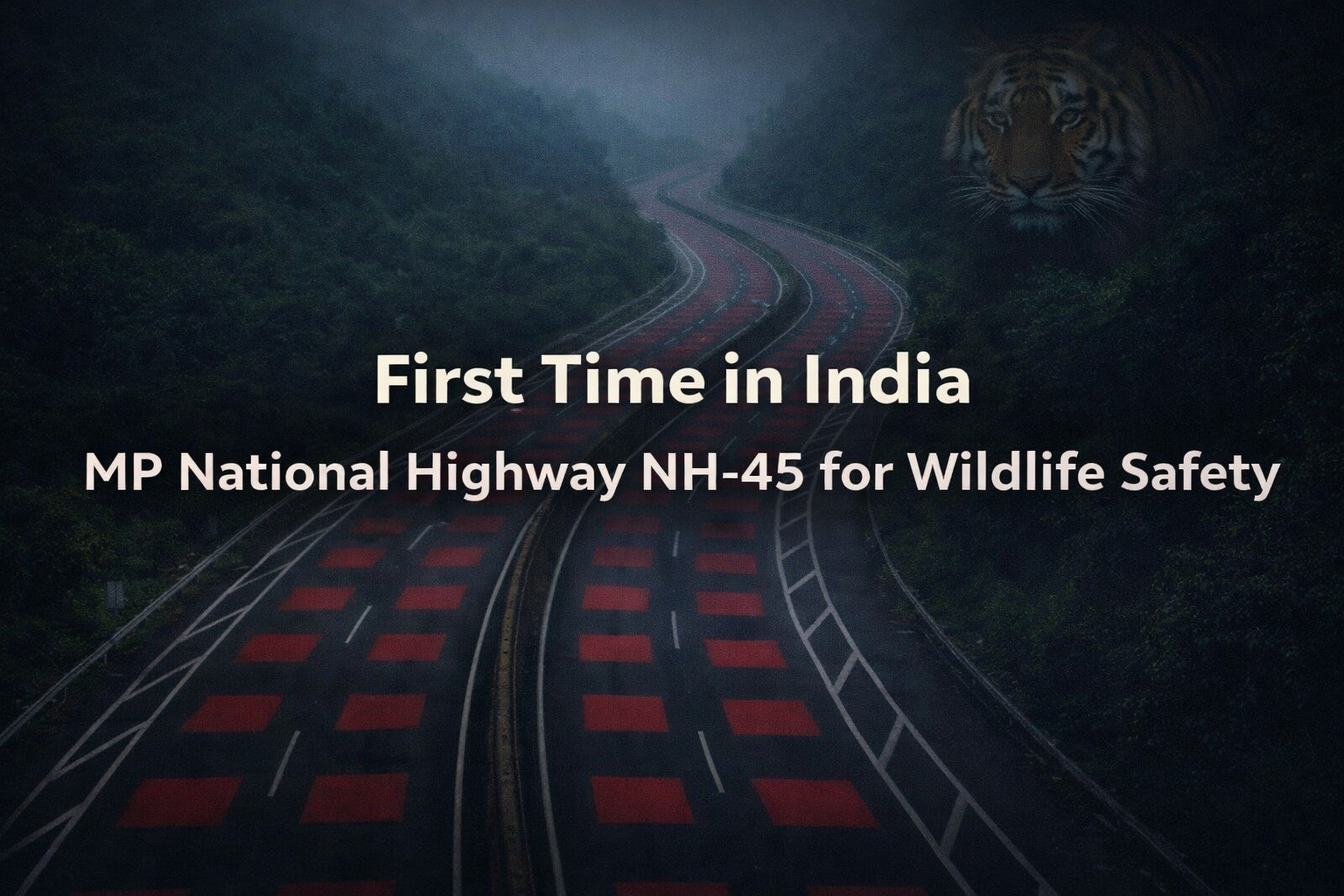
First Time in India: MP National Highway NH-45 Built for Wildlife Safety with 5mm Red Carpet Markings Across 11.96 KM Near Veerangana Durgavati Tiger Reserve
Introduction
The Veerangana Durgavati TigerReserve highway has become a national talking point after Madhya Pradesh introduced India’s first wildlife-focused national highway design on NH-45. For the first time in India, a 5mm red carpet marking has been laid across 11.96 kilometres to protect animals near a sensitive forest zone. This stretch of the MP National Highway runs close to the Veerangana Durgavati Tiger Reserve, making wildlife safety a top priority from the planning stage itself.
Unlike conventional road projects, this highway was designed after studying animal movement patterns. As a result, it balances infrastructure growth with environmental responsibility. Projects like this are not only engineering achievements but also symbols of India’s evolving approach to sustainable development.

India’s first MP National Highway NH-45 designed with red carpet markings for wildlife safety near Veerangana Durgavati Tiger Reserve
Why MP National Highway NH-45 Is Being Called India’s First Wildlife-Safe Highway
MP National Highway NH-45 is being described as India’s first wildlife-safe highway because its design goes beyond speed and traffic flow. Instead, it prioritizes animal safety from the ground up. Engineers and forest experts worked together to observe wildlife movement before finalising the road plan. Consequently, the highway includes visual cues, surface markings, and speed-calming indicators that alert drivers in advance.
Moreover, the red carpet marking is not cosmetic. It functions as a high-visibility warning system. Drivers subconsciously slow down when road colour changes. This simple yet powerful psychology reduces animal-vehicle collisions significantly. Therefore, this highway is not just a road but a safety corridor.
Such initiatives show how Indian highways can coexist with forests. Over time, this model could influence future road projects across wildlife zones nationwide.
How the 5mm Red Carpet Marking Improves Animal Safety on Highways
The 5mm red carpet marking used on NH-45 is a carefully tested safety feature. Unlike standard white or yellow lines, red markings create immediate visual contrast. Because of this, drivers instinctively reduce speed. Additionally, red is globally associated with caution and alertness.
This marking extends across 11.96 km, which ensures continuity. Animals crossing the road are less likely to encounter speeding vehicles. Furthermore, the marking works day and night due to its reflective properties. Even in low visibility, drivers remain alert.
Importantly, this solution does not require advanced technology. It relies on behavioural science. As a result, maintenance costs remain low while effectiveness stays high. This makes the method scalable for other highways passing through forest regions.
Veerangana Durgavati Tiger Reserve Area and Highway Planning Challenges
Building a highway near the Veerangana Durgavati Tiger Reserve was not simple. The region supports diverse wildlife, including tigers, deer, and smaller mammals. Any infrastructure activity risked disturbing this delicate ecosystem. Therefore, planners adopted a wildlife-first approach.
Before construction, teams conducted movement studies. These studies helped identify crossing zones and peak animal activity hours. Consequently, safety markings and road features were aligned with real wildlife behaviour.
Additionally, forest officials monitored construction closely. Noise levels, lighting, and material use were controlled. This careful coordination ensured minimal ecological disruption. Hence, the project became a benchmark for infrastructure development near protected areas.
MP Wildlife-Focused Infrastructure and Its National Importance
Madhya Pradesh has long been known for its forest cover and tiger reserves. However, this highway project elevates the state’s reputation further. By integrating wildlife safety into road design, MP has set a national precedent.
This initiative proves that development and conservation can progress together. Other states now have a working example to study. If replicated, such designs could reduce wildlife fatalities across India.
From a policy perspective, this project strengthens India’s commitment to sustainable infrastructure. It aligns with global conservation goals while supporting economic connectivity. Therefore, the impact of this highway extends far beyond state borders.
Travel, Awareness, and Responsible Tourism Around the Highway Corridor
Highways near forest reserves attract travellers and nature enthusiasts. Safe roads encourage responsible tourism. Visitors can explore nearby regions without disturbing wildlife. This balance benefits both local economies and conservation efforts.
Travel services like Ayodhya Cab Services play a role here. By promoting responsible travel practices, such services help spread awareness. Tourists using trained drivers are less likely to overspeed in sensitive zones.
Moreover, educational signage along the highway informs travellers about wildlife presence. This awareness changes driving behaviour. Over time, informed travellers become conservation supporters rather than threats.
The NH-45 wildlife safety initiative near the Veerangana Durgavati Tiger Reserve marks a turning point in Indian highway planning. It demonstrates that thoughtful design can save lives without slowing development. As this model gains attention, it could redefine how India builds roads through nature.
Wildlife movement study behind MP National Highway NH-45 design
Before construction began, wildlife experts conducted detailed movement studies near the Veerangana Durgavati Tiger Reserve. These studies tracked animal paths, seasonal migration, and crossing frequency. Instead of forcing animals to adapt to roads, planners adapted the road to animals. This shift changed the entire project approach.
Because the highway intersects forest influence zones, planners avoided straight, high-speed stretches. Instead, visual alerts and surface markings guide driver behaviour. Consequently, animals crossing the road face reduced risk. This planning method highlights how infrastructure can respond intelligently to ecological data rather than ignoring it.
Why 11.96 km stretch was selected for animal safety markings
The 11.96 km stretch was not chosen randomly. Forest data showed this section experienced the highest wildlife crossings. Additionally, animal movement peaked during early morning and late evening hours. Therefore, this zone demanded special attention.
Rather than applying safety measures inconsistently, authorities marked the entire vulnerable stretch. This continuous marking prevents sudden speed changes. As a result, drivers remain cautious throughout the zone. Such consistency increases effectiveness and reduces confusion. Over time, this approach may become standard practice for forest-adjacent highways.
How red carpet road markings influence driver psychology
Road colour has a strong psychological impact on drivers. The red carpet marking on NH-45 was selected after behavioural research. Red signals caution and urgency. Therefore, drivers instinctively reduce speed without conscious effort.
Unlike speed breakers or barricades, colour-based cues do not interrupt traffic flow. Instead, they influence behaviour smoothly. Additionally, these markings remain effective during rain, fog, and low light. Because of this, the solution works round the clock. This makes it both practical and scalable for other wildlife corridors.
Environmental balance between development and conservation in MP
Madhya Pradesh faces a unique challenge. It must balance infrastructure growth with forest conservation. This highway project proves that balance is achievable. By prioritizing wildlife safety, MP has shown leadership in sustainable planning.
Moreover, the project reflects a mindset shift. Development is no longer viewed as separate from conservation. Instead, both goals are addressed together. This philosophy strengthens public trust and international perception. As environmental concerns grow globally, such projects improve India’s ecological credibility.
Role of forest department and highway authorities coordination
Coordination played a key role in the project’s success. Highway engineers worked closely with forest officials at every stage. Decisions were reviewed jointly. As a result, ecological concerns were addressed early.
Construction schedules were adjusted to reduce disturbance. Lighting was controlled. Noise was minimized. These small decisions had a large cumulative impact. Consequently, the project avoided major wildlife disruption. This coordination model can guide future infrastructure projects near protected areas.
Long-distance travel awareness near tiger reserve highways
Travellers using forest highways often underestimate wildlife risk. However, awareness changes behaviour. Informational boards along NH-45 educate drivers about animal presence. This prepares them mentally before entering the zone.
Cab operators like Ayodhya Cab Services contribute by training drivers for forest routes. Responsible driving protects passengers and wildlife alike. Additionally, informed drivers become ambassadors for conservation. Over time, awareness-based travel reduces accident rates naturally.
MP wildlife safe highway model and future replication
The success of this project positions MP as a model state for wildlife-safe infrastructure. Other states with forest highways are observing closely. Replication could significantly reduce animal fatalities nationwide.
Because the solution is cost-effective, adoption barriers remain low. Red carpet markings, signage, and planning discipline can be implemented widely. If scaled properly, this model may influence national highway guidelines. Therefore, the long-term impact could be transformational.
The NH-45 project near the Veerangana Durgavati Tiger Reserve shows how thoughtful design saves lives. It proves that safety does not always require expensive technology. Sometimes, understanding nature is enough. As attention grows, this highway may become India’s reference point for wildlife-sensitive development.
Comparison with other wildlife corridors on Indian highways
Across India, several highways pass through forest areas. However, most rely on signboards alone. In contrast, the NH-45 project introduces active behavioural control. This difference matters. Signboards are often ignored. Visual road cues, however, demand attention.
In states like Rajasthan and Maharashtra, wildlife crossings exist. Yet, few highways use surface-based warning systems. Therefore, the MP model stands apart. It combines planning, psychology, and visibility. Because of this, experts view it as a next-generation safety solution rather than a temporary fix.
Animal accident reduction potential on forest highways
Animal-vehicle collisions cause severe ecological damage. They also endanger human lives. Studies show that visual speed-reduction cues lower accident probability significantly. The red carpet marking on NH-45 targets this exact issue.
Instead of reacting after accidents occur, this approach prevents them. Drivers slow down naturally. Animals cross safely. Over time, this reduces mortality rates. If implemented nationwide, such measures could save thousands of animals annually. This proactive mindset marks a shift in India’s road safety philosophy.
Impact on tiger conservation and habitat connectivity
Tiger reserves depend on connected habitats. Roads often fragment these connections. However, wildlife-sensitive highways reduce this fragmentation effect. By allowing safer crossings, animals continue natural movement patterns.
Near the Veerangana Durgavati Tiger Reserve, this highway design supports ecological flow. Tigers, prey species, and smaller animals move with reduced stress. Consequently, habitat health improves. Conservation efforts benefit indirectly from safer infrastructure.
Role of public awareness in wildlife highway success
Infrastructure alone cannot ensure safety. Public awareness completes the system. Drivers must understand why slowing down matters. Educational boards along NH-45 explain wildlife presence clearly.
Additionally, trained drivers make a difference. Cab providers like Ayodhya Cab Services follow route discipline near forest zones. Responsible driving becomes a shared responsibility. Over time, awareness-driven behaviour creates safer travel culture.
Tourism growth with responsible travel practices
Wildlife-friendly highways encourage eco-tourism. Tourists feel safer traveling through forest regions. At the same time, animals face lower disturbance. This balance benefits local economies.
Travel services supporting responsible tourism help sustain this ecosystem. Visitors learn to respect forest zones. Reduced accidents improve public perception. As a result, tourism grows without harming nature.
Infrastructure lessons for future highway projects
The NH-45 initiative offers valuable lessons. First, planning must include ecological data. Second, simple solutions can outperform complex ones. Third, coordination across departments is essential.
Future highways can adopt similar designs. Forest-adjacent roads should include visual cues, controlled lighting, and awareness elements. This integrated approach ensures long-term safety rather than short-term fixes.
National policy influence and long-term vision
Projects like this influence policy thinking. As success data emerges, authorities may update highway guidelines. Wildlife safety could become mandatory near reserves.
This would mark a historic shift. Infrastructure would evolve with conservation priorities. MP’s initiative could trigger national transformation. Therefore, its importance extends beyond one highway.
Responsible driving culture near protected areas
A responsible driving culture saves lives. Near forest zones, speed discipline matters more than convenience. Highways like NH-45 encourage this mindset subtly.
Drivers adapt without enforcement pressure. Visual cues guide behaviour. Over time, safe driving becomes habit. This cultural change ensures lasting impact beyond physical infrastructure.
The MP National Highway NH-45 project near the Veerangana Durgavati Tiger Reserve represents a milestone in Indian infrastructure. It blends innovation with empathy. It proves that roads can protect life instead of threatening it.
With continued awareness, replication, and policy support, this model can reshape how India builds highways through nature.
Comparison with other wildlife corridors on Indian highways
Across India, several highways pass through forest areas. However, most rely on signboards alone. In contrast, the NH-45 project introduces active behavioural control. This difference matters. Signboards are often ignored. Visual road cues, however, demand attention.
In states like Rajasthan and Maharashtra, wildlife crossings exist. Yet, few highways use surface-based warning systems. Therefore, the MP model stands apart. It combines planning, psychology, and visibility. Because of this, experts view it as a next-generation safety solution rather than a temporary fix.
Animal accident reduction potential on forest highways
Animal-vehicle collisions cause severe ecological damage. They also endanger human lives. Studies show that visual speed-reduction cues lower accident probability significantly. The red carpet marking on NH-45 targets this exact issue.
Instead of reacting after accidents occur, this approach prevents them. Drivers slow down naturally. Animals cross safely. Over time, this reduces mortality rates. If implemented nationwide, such measures could save thousands of animals annually. This proactive mindset marks a shift in India’s road safety philosophy.
Impact on tiger conservation and habitat connectivity
Tiger reserves depend on connected habitats. Roads often fragment these connections. However, wildlife-sensitive highways reduce this fragmentation effect. By allowing safer crossings, animals continue natural movement patterns.
Near the Veerangana Durgavati Tiger Reserve, this highway design supports ecological flow. Tigers, prey species, and smaller animals move with reduced stress. Consequently, habitat health improves. Conservation efforts benefit indirectly from safer infrastructure.
Role of public awareness in wildlife highway success
Infrastructure alone cannot ensure safety. Public awareness completes the system. Drivers must understand why slowing down matters. Educational boards along NH-45 explain wildlife presence clearly.
Additionally, trained drivers make a difference. Cab providers like Ayodhya Cab Services follow route discipline near forest zones. Responsible driving becomes a shared responsibility. Over time, awareness-driven behaviour creates safer travel culture.
Tourism growth with responsible travel practices
Wildlife-friendly highways encourage eco-tourism. Tourists feel safer traveling through forest regions. At the same time, animals face lower disturbance. This balance benefits local economies.
Travel services supporting responsible tourism help sustain this ecosystem. Visitors learn to respect forest zones. Reduced accidents improve public perception. As a result, tourism grows without harming nature.
Infrastructure lessons for future highway projects
The NH-45 initiative offers valuable lessons. First, planning must include ecological data. Second, simple solutions can outperform complex ones. Third, coordination across departments is essential.
Future highways can adopt similar designs. Forest-adjacent roads should include visual cues, controlled lighting, and awareness elements. This integrated approach ensures long-term safety rather than short-term fixes.
National policy influence and long-term vision
Projects like this influence policy thinking. As success data emerges, authorities may update highway guidelines. Wildlife safety could become mandatory near reserves.
This would mark a historic shift. Infrastructure would evolve with conservation priorities. MP’s initiative could trigger national transformation. Therefore, its importance extends beyond one highway.
Responsible driving culture near protected areas
A responsible driving culture saves lives. Near forest zones, speed discipline matters more than convenience. Highways like NH-45 encourage this mindset subtly.
Drivers adapt without enforcement pressure. Visual cues guide behaviour. Over time, safe driving becomes habit. This cultural change ensures lasting impact beyond physical infrastructure.
The MP National Highway NH-45 project near the Veerangana Durgavati Tiger Reserve represents a milestone in Indian infrastructure. It blends innovation with empathy. It proves that roads can protect life instead of threatening it.
With continued awareness, replication, and policy support, this model can reshape how India builds highways through nature.
How this project reshapes public thinking about animal safety
Public perception plays a powerful role in conservation. Earlier, wildlife accidents on highways were often seen as unavoidable. However, the NH-45 initiative changes that belief. It shows that accidents are not destiny. They are design failures that can be corrected.
As people learn about the red carpet markings and planning behind the project, attitudes shift. Citizens begin questioning older road designs. This awareness slowly creates demand for safer infrastructure. In the long run, informed public opinion becomes a driver of policy reform.
Ethical responsibility of infrastructure in wildlife regions
Infrastructure carries ethical responsibility when built near forests. Roads cut through animal habitats. Ignoring this reality leads to silent loss. The NH-45 project acknowledges this responsibility openly.
By modifying design instead of blaming animals, authorities accept accountability. This ethical stance matters. It builds moral legitimacy for development projects. When ethics guide planning, resistance decreases and cooperation increases.
Scientific reasoning behind visual road safety interventions
Scientific studies confirm that visual stimuli influence human behaviour faster than instructions. The red colour activates caution instinctively. This scientific principle guided the marking choice.
Unlike written warnings, visual cues require no interpretation. Drivers respond instantly. This immediacy explains why the system works effectively. Applying science to design elevates infrastructure quality significantly.
Night-time driving risks and mitigation near forest highways
Night-time increases wildlife accident risk. Visibility drops. Reaction time shortens. The NH-45 markings address this challenge directly.
Reflective properties ensure visibility under headlights. Drivers receive early warnings even at night. This reduces panic braking and sudden swerves. Consequently, both driver and animal safety improve. This night-focused design element makes the highway safer round the clock.
Influence on driver behaviour beyond the marked zone
Behavioural changes often extend beyond designated areas. Drivers who slow down in one forest zone tend to remain cautious later. This spillover effect multiplies safety benefits.
Regular travellers internalize safe driving habits. Over time, these habits spread to other forest roads. Thus, one project indirectly improves safety elsewhere. Behavioural influence becomes a hidden strength of the initiative.
Long-distance logistics and wildlife safety coexistence
Freight movement depends on highways. Slowing traffic may raise concerns. However, the NH-45 design proves otherwise. Controlled speed zones do not disrupt logistics significantly.
Instead, predictability improves. Fewer accidents mean fewer delays. Logistics operators benefit from safer, more reliable routes. This alignment ensures that economic activity and conservation do not conflict.
Role of driver training programs in wildlife corridors
Infrastructure works best when paired with training. Driver education enhances effectiveness. Professional drivers play a key role on such highways.
Travel providers like Ayodhya Cab Services emphasize training for forest routes. Drivers learn alertness techniques and speed discipline. This human factor strengthens infrastructure impact. When training and design work together, results improve.
Long-term cost savings through accident prevention
Accidents carry hidden costs. Medical expenses, vehicle damage, legal issues, and ecological loss add up. Preventing accidents saves money long-term.
The NH-45 project reduces these hidden costs. Although initial planning required effort, long-term savings outweigh it. This economic logic strengthens the case for replication nationwide.
Why wildlife-sensitive highways improve global image
Global attention increasingly focuses on sustainability. Countries demonstrating innovation gain respect. India’s wildlife-safe highway strengthens its environmental image.
This positive perception supports tourism, investment, and diplomacy. Infrastructure becomes a soft-power tool. The NH-45 initiative contributes quietly but meaningfully to this image.
Cultural shift from domination to coexistence
Historically, development symbolized domination over nature. Modern thinking challenges that view. Coexistence now defines progress.
The NH-45 project embodies this shift. It respects wildlife presence. It adjusts human behaviour. This cultural evolution reflects maturity in development philosophy.
Educational value for general public and youth
Such projects educate citizens. Students, researchers, and young professionals learn through real examples. Abstract conservation ideas become tangible.
As awareness spreads, future generations expect better infrastructure. Expectations shape demand. Demand shapes policy. Education thus becomes a long-term impact channel.
Closing reflection on human–wildlife coexistence
Highways once divided humans and animals. Thoughtful design now reconnects responsibility. The NH-45 initiative demonstrates this transformation clearly.
When roads respect life, they become symbols of progress. This philosophy defines sustainable development.
Why this highway project will be remembered as a turning point
Some infrastructure projects gain attention because of scale. Others become famous due to speed or cost. However, a few rare initiatives stand out for their values. The MP National Highway NH-45 wildlife safety project clearly belongs to this category.
By prioritizing animal life, the project redefined development thinking. Instead of treating wildlife as an obstacle, planners treated animals as stakeholders. Over time, this approach will influence how future highways are designed across India.
Human safety and animal safety progressing together
Wildlife protection does not reduce human safety. In reality, both goals strengthen each other. When vehicles slow down near forest zones, accident risks decline for everyone involved.
On NH-45, this connection becomes visible. Fewer collisions mean fewer injuries and delays. As a result, the road benefits drivers, passengers, and animals at the same time. This shared advantage explains why public acceptance has grown steadily.
Infrastructure that quietly shapes driver behaviour
Effective systems often work without noise. Instead of forcing compliance, they guide behaviour naturally. The red carpet marking on this highway follows that principle.
Rather than relying on enforcement, the design influences instinctive caution. Drivers slow down without conscious effort. Over time, this quiet behavioural change creates lasting safety benefits without resistance.
Contribution to India’s sustainability commitments
India’s sustainability goals require practical implementation. Policy statements alone are not enough. The NH-45 initiative provides a working example of how conservation and connectivity can coexist.
Through thoughtful planning, ecological harm is reduced. At the same time, economic movement continues uninterrupted. Consequently, the project strengthens India’s credibility in sustainable infrastructure discussions.
Replication potential across forest highways nationwide
Many highways across India pass close to forest regions. Similar challenges exist everywhere. Wildlife movement intersects with traffic daily.
Fortunately, the NH-45 model offers a realistic solution. Because the approach is cost-effective and simple, adoption barriers remain low. If replicated wisely, this design could improve wildlife safety across multiple states within years.
Conservation benefits without development conflict
Conservation initiatives often face resistance when they restrict access. This project avoided that outcome. Roads remained functional. Connectivity stayed intact.
Instead of limiting movement, the design improved coexistence. Reduced animal fatalities supported conservation goals quietly. At the same time, uninterrupted transport preserved economic efficiency. This balance ensures long-term acceptance.
Importance of responsible travel practices
Infrastructure creates opportunity, but behaviour completes the system. Responsible driving plays a critical role near forest zones. Awareness changes outcomes.
Service providers such as Ayodhya Cab Services contribute by promoting disciplined driving. Trained drivers reduce risk and set examples. Over time, these habits influence broader travel culture.
Public awareness as a factor of long-term success
Projects survive longer when communities understand their purpose. Awareness builds respect. Signage, media coverage, and discussion keep the initiative visible.
As understanding grows, public ownership develops. People protect what they value. This collective responsibility ensures the durability of wildlife safety measures beyond official oversight.
Lessons for planners and policymakers
Every infrastructure decision shapes the future. Roads influence landscapes and behaviour alike. This project demonstrates the power of empathy-led planning.
Future policymakers can learn from this example. When science guides design and coordination replaces isolation, outcomes improve significantly. Such lessons deserve national attention.
Symbolism behind the red carpet for wildlife
Beyond engineering, symbolism matters. The red carpet signals respect. It communicates that animals have a rightful presence.
This shift changes narratives. Roads no longer dominate nature. Instead, they adapt to it. That cultural change reflects maturity in development philosophy.
Relevance beyond Madhya Pradesh
Although located in MP, the project carries national relevance. Wildlife-road conflict exists globally. Few solutions balance cost and effectiveness so well.
India’s approach demonstrates leadership. By focusing on behaviour and design, the solution remains accessible to many regions. Global relevance emerges naturally.
Final reflection on progress and responsibility
Progress without responsibility creates loss. Responsibility without progress creates stagnation. The NH-45 wildlife safety initiative proves both can advance together.
Highways can connect cities while respecting ecosystems. Development can move forward without erasing life. This project illustrates that possibility clearly.
FINAL CONCLUSION
The MP National Highway NH-45 wildlife safety initiative near the Veerangana Durgavati Tiger Reserve stands as a landmark in Indian infrastructure. Through 5mm red carpet markings across 11.96 kilometres, the project protects wildlife while maintaining connectivity.
By combining ethical responsibility, scientific insight, and thoughtful design, the initiative sets a new standard. With responsible travel practices supported by Ayodhya Cab Services, this model can guide future highways across India.
This road is not just a route.
It is a direction toward balanced progress.

